Introduction
The eukaryotic genome is extensively transcribed into RNA. However, approximately 98% of the transcribed RNAs do not produce any functional proteins, and these RNAs are called non-coding RNAs (ncRNAs) (Wang et al. 2017). Housekeeping RNAs such as ribosomal RNAs, transfer RNAs, small nuclear RNAs, and small nucleolar RNAs are ncRNAs that have been comprehensively studied as they are fundamentally expressed and play a vital role in cell viability (Morey & Avner 2004). However, other ncRNAs are synthesized in response to external stimuli or during specific developmental stages (Fig. 1) (Szymański 2003).

Fig. 1 Classification of ncRNAs. Housekeeping RNAs have been extensively studied because of the fundamental nature of their expression. Other ncRNAs can be synthesized because of external stimuli and may be classified according to length into small RNAs (20-24 nucleotides) and long non-coding RNAs (≥200 nucleotides) |
The ncRNAs can be categorized according to their length. Small RNAs (sRNAs) comprising 20-24 nucleotides include small interfering RNAs (siRNAs) and microRNAs (miRNAs) (Axtell 2013). Long non-coding RNAs (lncRNAs) are typically described as having a length greater than 200 nucleotides. However, this value is arbitrary. A better way to describe lncRNAs is as RNAs that have functions distinct from protein-coding potential and have biogenesis mechanisms other than molecular scale-based cleaving or trimming, which are similar to mechanisms in sRNAs (Wierzbicki et al. 2021). LncRNAs may be classified in numerous ways according to their lengths, locations of protein-coding genes, biogenesis pathways, subcellular locations, functions, and so forth. One of the most common systems of classification is based on genomic origins (Fig. 2) (Wang & Chekanova 2017).
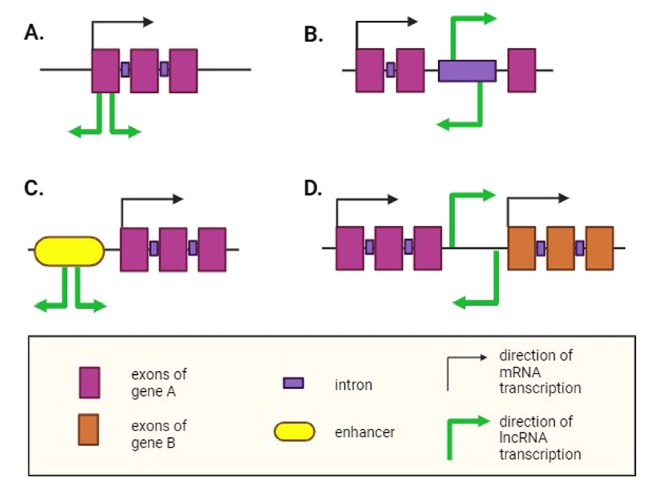
Fig. 2 Classification of lncRNAs. Based on the genomic locations from which RNAs are transcribed relative to protein-coding regions, long non-coding RNAs (lncRNAs) can be classified into five distinct groups. A Exonic lncRNAs can partially or completely overlap with the exons of genes that code for proteins. They are transcribed in either the same direction (sense lncRNA) or the opposite direction (antisense lncRNA) as the mRNA. B Intronic lncRNAs originate from long introns of protein-coding genes and may be transcribed in either the same or the opposite direction as the mRNA. C Enhancer lncRNAs are transcribed from short enhancer regions of DNA. They may be bidirectional (as shown in the figure) or unidirectional, depending on their transcription direction. D Long intergenic non-coding RNAs (lincRNAs) arise from the intergenic region between two protein-coding genes and may be transcribed in either the same or the opposite direction of the nearest genes |
Despite being classified as “non-coding”, lncRNAs may have regions of under 100 codons known as small open reading frames that can be translated into biologically useful microproteins or peptides (Fesenko et al. 2021). One study found that these lncRNA-encoded peptides helped control the growth and differentiation of moss (Physcomitrella patens) (Fesenko et al. 2019). LncRNAs may consequently perform both protein-coding and non-protein-coding functions (Li & Liu 2019). The presence of lncRNAs is not proof of their functionality, and early research hypothesized that lncRNAs were simply byproducts of RNA processing or “transcriptional noise”. However, recent studies have revealed their roles in diverse biological processes in both plants and animals (Chekanova 2015). For example, dysregulation of these RNAs in mammals can impair normal cellular function, resulting in growth abnormalities and various diseases such as cancer (Weng et al. 2020). The functions of mammalian lncRNAs in immune responses, homeostasis, growth hormone production, organ development, and synaptic function have also been comprehensively studied (Dhanoa et al. 2018; Mattick et al. 2023; Wang & Chang 2011). In plants, lncRNAs play a role in controlling epigenetics, flowering time, organogenesis, and photomorphogenesis, and they also control gene expression to help plants deal with stress (Bardou et al. 2014; Berry & Dean 2015; Matzke & Mosher 2014; Wang et al. 2014).
Two categories of external conditions that disrupt plant growth, development, and productivity are biotic and abiotic stresses (Gull and Ahmad Lone 2019). Living organisms such as bacteria and fungi are the root causes of biotic stress, while environmental factors such as heat, drought, salinity, etc. cause abiotic stress (Rodríguez et al. 2005). Horticultural crops, including fruits, vegetables, and medicinal plants, are vital to human health and the global economy. As plants are immobile, they need to acclimatize to adverse conditions in order to survive (Patra et al. 2016). LncRNAs may play a role in plant defense mechanisms against abiotic stress.
As abiotic stress severely restricts crop yield and productivity, several strategies to enhance plant stress tolerance have been explored. The exogenous application of compounds such as methyl jasmonate and salicylic acid (SA) is one of the most efficient of these strategies (Hosseinifard et al. 2022). This review summarizes the research status of the effects of several abiotic stresses on lncRNA expression in different horticultural plant species. It also examines the small body of literature regarding the possible link between lncRNAs and exogenous chemical treatments in plant defense against abiotic stress.
Functional mechanisms of lncRNAs
A growing number of lncRNAs have been reported in plant transcriptomes during the last few decades, although only a small percentage of these have been functionally characterized. Gene expression is controlled at the epigenetic, transcriptional, post-transcriptional, translational, and post-translational levels in eukaryotic cells. LncRNAs play a major role in the regulation of gene expression on many of these levels (Statello et al. 2021). They can perform their regulatory roles in various ways by acting as scaffolds, guides, signals, or decoys (Fig. 3) (Chowdhary et al. 2021). Certain lncRNAs can perform more than one of these roles; therefore, it is difficult to categorize them into a single group (Wang & Chang 2011).
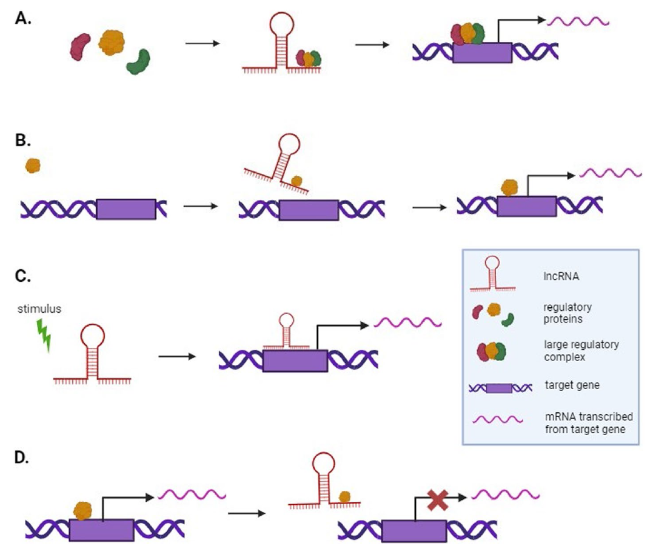
Fig. 3 Mechanisms of action of lncRNAs. LncRNAs may regulate gene expression by acting as scaffolds, guides, signals, or decoys. A Scaffolds bind to multiple small molecular components simultaneously and act as a platform for assembling these components into large regulatory complexes that activate or inhibit gene expression. B Guides bind to specific regulatory proteins and direct their localization to specific target genomic loci where gene expression is regulated. C Signals function as molecular cues because they precisely start transcription at certain times and places, letting cells respond to different stimuli. They function in various ways, such as by directly binding to the target site to perform a regulatory role. D Decoys act by binding to RNA-binding proteins, such as transcription factors or chromatin modifiers, and sequester them away from their intended targets, thus inhibiting these proteins from performing their roles. Note: The regulatory proteins are shown as positively regulating gene expression, but they may also inhibit gene expression |
Scaffolds
LncRNAs interact with proteins by complementary sequence motifs or secondary or tertiary structures. They help assemble and connect small protein complexes to form large functional units (Blythe et al. 2016; Ma et al. 2022). For example, the responsive lncRNAs TCONS_00202587 and TCONS_00260893 controlled their targets by acting as RNA scaffolds. This helped protect and recover photosynthetic processes, stopped membrane peroxidation, and lowered DNA damage in poplar (Populus simonii) under heat stress (Song et al. 2020).
Guides
Guide lncRNAs attach to molecules such as transcriptional co-regulators or chromatin regulatory protein complexes and move them to specific parts of the genome where target gene expression is controlled (Lv et al. 2023; Ma et al. 2022). In the first intronic region of FLOWERING LOCUS C (FLC), COLD-ASSISTED INTRONIC NON-CODING RNA (COLDAIR) recruits polycomb repressive complex 2, which results in the H3K27me3 alteration of histones during the early vernalization of plants (Heo & Sung 2011).
Signals
LncRNAs can connect to DNA-binding proteins such as transcription factors (TFs) and histone-modifying complexes. This can change the levels of transcription, splicing, and translation to control gene expression. Thus, they act as indicators of transcriptional activity at a particular time and space (Wang & Chang 2011).
TFs contain DNA-binding domains that bind to specific regions of genes and control the rate of transcription, regulating the rate and timing of gene expression. In plants, lncRNAs may directly interact with TFs or indirectly interact with the multiprotein complex “mediator”, which in turn interacts with TFs (Yang et al. 2023; Yin & Wang 2014). An example of the first type is how the lncRNA AUXIN-REGULATED PROMOTER LOOP (APOLO) and the TF WRKY42 work together in Arabidopsis thaliana under cold stress. A complex called WRKY42-APOLO changes the 3D conformation of the chromatin at the ROOT HAIR DEFECTIVE 6 (RHD6) genomic region. This turns on the RHD6 region and causes ROOT HAIR DEFECTIVE 6-LIKE 2 (RSL2) and RSL4 to be expressed. The complex also binds to EXTENSIN 3. Both actions result in root hair cell elongation (Moison et al. 2021; Pacheco et al. 2021). In Arabidopsis, ELF18-induced long non-coding RNA1 (ELENA1) binds to a mediator subunit called MED19a and acts on the promoter region of PATHOGENESIS-RELATED GENE 1 (PR1) to protect the plant from Pseudomonas syringae. It has been proposed that ELENA1 recruits MED19a to PR1 by interacting with another mediator, MED26b (Seo et al. 2017).
LncRNAs can directly regulate transcription as well (Yang et al. 2023). In response to lead (Pb2+) toxicity, 226 lncRNAs, including PMAT and PtoMYB46, were induced and differentially expressed in poplar (P. tomentosa). PMAT, or PtoMYB46, regulated by PMAT, stops PtoMATE transcription and thus its translation, causing cells to produce less citric acid and take in more Pb2+ (Chen et al. 2022).
Protein trafficking, a process critical to plant stress response, refers to the movement of proteins within cells from one subcellular compartment to another (Droujinine et al. 2021). LncRNAs can mediate this process. For example, nuclear-localized RNA binding protein 1 was re-localized to the cytoplasm by the lncRNA ENOD40 in Medicago truncatula (Yang et al. 2023).
LncRNAs can also stop certain proteins from interacting with each other. This stops the formation of certain macromolecular complexes that are needed to control gene expression (Yang et al. 2023). This was observed in the early stages of endosperm development in rice (Oryza sativa), where a helicase family protein (HeFP) controls how tubulin works. MISSEN, a lncRNA, competitively inhibits the interaction between HeFP and tubulin, leading to abnormal cytoskeletal polymerization and the formation of slightly larger seeds (Zhou et al. 2021). During biotic stresses in Arabidopsis, ELENA1 interacts with and frees FIBRILLARIN 2, a negative transcriptional regulator, from the PR1 promoter. This makes room for the positive regulator MED19a to bind to it (Seo et al. 2019).
In chromatin remodeling, chromatin is rearranged to make it accessible to TFs or other DNA-binding proteins in order to regulate gene expression (Jiang et al. 2023). Post-transcriptional modifications of histone proteins that activate or repress transcription in this fashion can be regulated by lncRNAs, which recruit chromatin-modifying complexes to perform the function. The activation of histone modifications can also be moderated by lncRNAs (Yang et al. 2023).
Regulatory DNA sequences can make physical contact with target genes by chromatin looping to control transcription over long distances (Holwerda & De Laat 2012). By bringing in chromatin-modifying complexes, lncRNAs may be involved in the formation of chromatin loops between lncRNA and its target (Yang et al. 2023). For example, when Arabidopsis is exposed to exogenous abscisic acid (ABA), the MARneral Silencing (MARS) lncRNA causes the chromatin loop to form R-loops (Roulé et al. 2022).
R-loops are made up of an RNA-DNA duplex and an unpaired DNA strand. They can control gene expression at the chromosomal ends (Belotserkovskii et al. 2018). The involvement of plant lncRNAs in R-loop synthesis has been proven. The APOLO lncRNA creates an R-loop that controls the activity of genes in Arabidopsis that react to distal auxin as the lateral roots expand (Ariel et al. 2020).
Alternative splicing alters pre-mRNA structures before translation. During this process, exons from the same gene are linked in different ways to form different but related mRNA transcripts (Greenberg et al. 2013). The mechanism of alternative splicing can be influenced by lncRNAs, either by binding to spliceosome components or nuclear speckle RNA-binding proteins (Yang et al. 2023). Flowering-associated intergenic lncRNA (FLAIL) in Arabidopsis interacts with components of the spliceosome to influence the expression of target mRNA. Flowering is repressed by FLAIL by regulating alternative splicing (Jin et al. 2023).
LncRNAs can also regulate gene expression by inhibiting or enhancing the association between mRNA transcripts and polysomes (Yang et al. 2023). There is a nitrogen-fixing symbiotic relationship between M. truncatula and Sinorhizobium meliloti. The association between an alternative variant of the lncRNA trans-acting small interference RNA3 (ALT TAS3) and polysomes is enhanced in response to rhizobia, increasing nodule development and therefore increasing the chances of productive symbiosis (Traubenik et al. 2020).
Decoys
Transcriptional regulators are prevented from binding to their binding sites by decoy lncRNAs to regulate gene expression. miRNAs are used by the RNA-induced silencing complex in gene silencing. In plants, certain lncRNAs with miRNA recognition regions that are similar to miRNA targets can act like miRNA targets to stop miRNA activity by binding to miRNAs and stopping them from interacting with the actual targets (Dupon et al. 2009). These lncRNAs are known as competing endogenous RNAs (ceRNAs) or lncRNA sponges, and they play a significant role in reducing gene expression (Wang & Chekanova 2017; Yang et al. 2023). In wheat (Triticum aestivum), 849 lncRNAs changed their expression when the plant was exposed to alkaline stress and were decoys for 115 conserved miRNAs (Wei et al. 2022). Many lncRNAs also act as precursors of shorter regulatory RNAs, such as miRNAs or siRNAs, particularly those that actively participate in the RNAi pathway. In cotton (Gossypium hirsutum), 88 lncRNAs were precursors of 57 miRNAs (Hamid et al. 2020). These mechanisms modulate many developmental processes in plants, particularly those related to reproduction, like flowering. They are also key to plant responses to external stresses.
Stress tolerance responses in plants
The effects of different types of stresses on lncRNAs in the model plant A. thaliana have been extensively studied. For example, cold-induced long antisense intragenic RNA (COOLAIR), COLD ASSISTED INTRONIC NON-CODING RNA (COLDAIR), and COLD OF WINTER-INDUCED NON-CODING RNA FROM THE PROMOTER (COLDWRAP) found in Arabidopsis and other Brassicaceae plants are among some of the best-characterized lncRNAs responsive to a stress condition, although they are not involved in stress tolerance. Vernalization is a process in which prolonged exposure to cold stress ultimately promotes flowering. FLC encodes a TF that negatively regulates flowering, and the lncRNAs in question assist in downregulating FLC expression under cold stress. COOLAIR can repress FLC transcription by directly binding to the locus and modifying chromatin or by forming an R-loop. COLDWRAP can form a chromatin loop with COLDAIR, which has a similar repressive function. COLDAIR also acts as a guide, as mentioned above. These RNAs can use several of the previously stated mechanisms of action to perform their roles (Crevillén et al. 2013; Heo & Sung 2011; Kim & Sung 2021; Xu et al. 2021)
Twelve lncRNAs were differentially expressed in the two A. thaliana ecotypes, Columbia (Col) and Landsberg erecta (Ler), lacking phosphate, which is a nutrient deficiency stress. One hypothesis is that certain lncRNAs are expressed in the genomes of Col and Ler in connection with known regulators of the phosphate-starvation response. For example, the high expression of phosphate transporters in Ler may cause the cell to take in more phosphate (Blein et al. 2020). Phosphate deficiency in Arabidopsis can also cause lncRNAs to activate the RNA-directed DNA methylation silencing pathway. This is a plant-specific regulatory system in which ncRNA molecules direct the methylation of specific DNA sequences (De Oliveira Urquiaga et al. 2021; Erdmann & Picard 2020; Yong-Villalobos et al. 2015).
It is of utmost importance to study the mechanisms of stress responses in horticultural crops. Abiotic stress conditions restrict the locations where plants may be grown and can have a significant negative impact on global agricultural productivity. There is an unambiguous relationship between escalating climate change and reduced agricultural productivity, making abiotic stress-induced losses in crop yield inevitable in the coming years. With a rapidly increasing world population, several preventative and acclimatization strategies must be used in intervention plans to maintain agricultural sustainability and prevent financial losses (Fawzy et al. 2020).
Studying lncRNAs in plants under stress can reveal unknown regulatory mechanisms involved in stress response and adaptation. Understanding these mechanisms can help identify potential targets for genetic engineering to enhance stress tolerance in crops and improve their productivity under adverse environmental conditions. In addition, studying the expression patterns of lncRNAs under stress can help identify potential biomarkers that can be used to monitor stress responses and predict plant performance under different stress conditions.
To date, several studies have attempted to examine the effects of abiotic stresses on lncRNAs in horticultural crops (Table 1).
Table 1 Recent studies on lncRNAs in relation to plant stress (2019-2024) |
| Plant Species | No. of Differentially Expressed LncRNAs | Stress | Reference | |
|---|---|---|---|---|
| 1 | Capsicum annuum (bell pepper) | 1887 | osmotic | (Baruah et al. 2021) |
| 2069 | salt | |||
| 2101 | cold | |||
| 2833 | heat | |||
| 2 | Triticum aestivum (bread wheat) | 1515 | drought | (Li et al. 2022) |
| 3 | Camellia sinensis (tea) | 172 | salt | (Wan et al. 2020) |
| 4 | Brassica juncea (Indian mustard) | 1614 | heat and drought | (Bhatia et al. 2020) |
| 5 | Manihot esculenta (cassava) | 117 | drought | (Ding et al. 2019) |
| 6 | Melilotus albus (honey clover) | 550 | salt | (Zong et al. 2021) |
| 7 | B. napus (rapeseed) Q2 genotype | 126 | drought | (Tan et al. 2020) |
| B. napus (rapeseed) Qinyou 8 genotype | 359 | |||
| 8 | B. rapa (Chinese cabbage) | 93 | heat | (Eom et al. 2021) |
| 9 | Oryza sativa (rice) ssp. japonica | 97 | heat | (Zhang et al. 2021) |
| O. sativa (rice) ssp. indica | 103 | |||
| 10 | Panicum virgatum (switchgrass) | 368 | drought | (Guan et al. 2024) |
| 11 | Olea europaea (olive) | 2076 | heavy metal (Al) | (Wu et al. 2023) |
| 12 | Hordeum vulgare (barley) | 195 | heavy metal (Cd) | (Zhou et al. 2023) |
| 13 | Populus trichocarpa (black cottonwood) | 1183 | salt | (Ye et al. 2022) |
| 14 | Solanum pennellii (wild tomato) | 137 | salt | (Li et al. 2022) |
Salt stress
A study on Asian white birch (Betula platyphylla) focused on a specific lncRNA, BplncSIR1, which was differentially expressed under salt stress. Transgenic lines of this plant with overexpression and inactivation of BplncSIR1 were generated to observe the phenotypic consequences of altering the lncRNA being studied. There was a positive correlation between high expression levels of BplncSIR1 and accelerated plant growth, reduced water loss due to reduced stomatal aperture width, decreased reactive oxygen species (ROS) accumulation, as well as elevated activity of antioxidant enzymes under conditions of increased salinity. The lncRNA was proposed to function by binding to and regulating the expression of the TF BpNAC2, which in turn activated genes such as ascorbate peroxidase 1 (APX1), peroxidase 52 (PRX52), abscisic acid-deficient 2 (ABA2), and open stomata 1 (OST1). Both ABA2 and OST1 are key genes in ABA-mediated stomatal control, while APX1 and PRX52 code for ROS-scavenging enzymes (Fig. 4). Notably, the authors of this study confirmed that these functions of BplncSIR1 in Asian white birch were not due to the short peptide that it encodes (Jia et al. 2023).
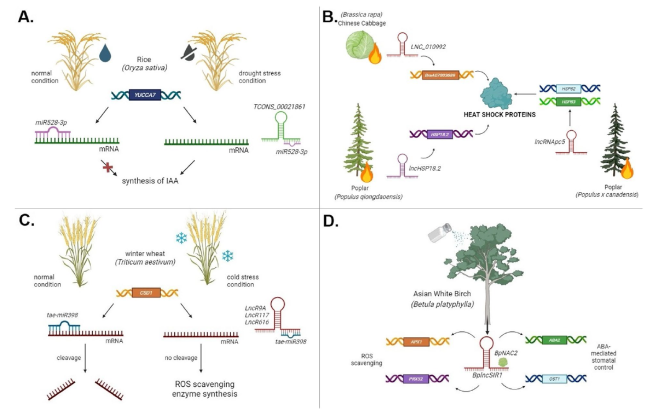
Fig. 4 Studies that investigated the role of lncRNAs in enhancing plant tolerance to abiotic stress. A The lncRNA TCONS_00021861 acts by sponging miR528-3p and preventing its binding to target mRNA, leading to increased levels of the plant growth regulator IAA to counteract the effects of drought stress in rice (Oryza sativa). B LncRNAs induced in Brassica rapa, Populus qiongdaoensis, and Populus × canadensis under heat stress regulate genes involved in the production of heat-shock proteins, which can restore misfolded proteins. C LncRNAs in wheat (Triticum aestivum) under cold stress act as ceRNAs by competing with tae-miR398 to prevent the cleavage of target mRNA, leading to the synthesis of ROS-scavenging enzymes. D The lncRNA BplncSIR1 enhances salt stress tolerance in Asian white birch (Betula platyphylla). BplncSIR1 binds to the transcription factor BpNAC2, activating genes involved in ABA-mediated stomatal control and the production of ROS-scavenging enzymes |
On exposure to salt stress, 126 and 133 lncRNAs were found in the M-81E and Roma lines of sweet sorghum (Sorghum bicolor), respectively. These lncRNAs were found to potentially control transcription by competing with miRNAs to bind to target mRNAs. For instance, lncRNA13472 and sbi-MIR169b-p3 might compete to bind to SORBI_3010G218400. This gene codes for a V-type proton ATPase subunit that is associated with membrane transport. The ceRNA network in this plant may also affect other target genes that code for proton pumps, transporters, enzymes, and TFs (Sun et al. 2020).
Chickpea (Cicer arietinum) exposed to salt stress resulted in the differential expression of 3450 lncRNAs. Functional annotation suggested that lncRNAs control salt tolerance by changing the levels of several TFs, potassium transporters, serine/threonine protein kinases, and aquaporins, as well as methylation pathways. TFs belonging to families such as WRKY, NAC, and ERF play a prominent role in stress tolerance. A total of 80 distinct lncRNAs were predicted to interact with 136 different miRNAs as endogenous target mimics of miRNAs. The study suggests that these mimics change the expression of the penta-tricopeptide repeat gene family. This could strengthen the plant’s defense by inhibiting the stomatal opening. Simple sequence repeats, which are vital molecular markers, were also reported in 614 lncRNAs. The authors of this paper suggested that leveraging lncRNA sequences was crucial to develop lncRNA-related markers for crop improvement (Kumar et al. 2021).
Heat stress
In Chinese cabbage (Brassica rapa), 1229 differentially expressed lncRNAs were identified as being responsive to heat stress, with the number expressed increasing gradually with the increase in heating time. Using functional enrichment analyses, lncRNAs were predicted to control the activity of heat-shock proteins (HSPs) and genes related to HSPs. For example, LNC_010992 was thought to regulate BraA07003689. High temperatures can cause protein misfolding, and HSPs play a pivotal role in the restoration of functional folding in heat stress-damaged proteins. Other genes whose expression was regulated in heat-treated Chinese cabbage were those related to the protein ubiquitin system, such as BraA01004433, which may assist in the degradation of denatured proteins. In addition, LNC_013535 regulated the expression of BraA09001034, a gene encoding dehydrin. Dehydrins are typically involved in protecting a plant against dehydration that may be caused by heat. LncRNAs were also co-expressed with three major latex protein-like genes. These genes positively responded to heat stress and are considered part of the ABA-mediated stress tolerance pathway. The phytohormone ABA has been shown to alleviate the effects of heat stress (Chan 2012; Song et al. 2021). However, lncRNAs were also involved in the downregulation of PYR/PYL genes, despite their coding for ABA receptors. This indicates that gene expression is not a necessity for the ABA-mediated stress tolerance pathway. Finally, most miRNAs in the constructed ceRNA network were of the two types expressed in response to heat stress in other studies as well, although their exact function is unclear (Ahmed et al. 2019).
Poplar (P. qiongdaoensis) seedlings treated with heat stress showed 25 differentially expressed lncRNAs, one of which targeted six HSP genes. This lncRNA (lncHSP18.2) could cis-regulate the expression of the HSP18.2 gene (Xu et al. 2020). Similarly, in another study where poplar (Populus × canadensis) trees underwent heat stress conditions, lncRNAPc5 could target and regulate the expression of HSP82 and HSP83 (Fig. 4) (Xu et al. 2020).
In pear (Pyrus spp.), HILinc1 induced by heat upregulated the mRNA of its target gene, PbHILT1, by complementary base pairing. PbHILT1 then interacted with the transcriptional factor PbHSFA1b, which in turn enhanced the expression of an important heat shock response gene, PbMBF1c (Table 2). Plants overexpressing HILinc1 were therefore highly thermotolerant in the presence of heat stress. This study is also significant because its methodology used several biochemical techniques to confirm the proposed mechanisms of action, unlike other studies (Zhang et al. 2022).
Table 2 Studies concerning specific lncRNAs that were predicted to enhance stress tolerance |
| Plant Species | Name of LncRNA | Stress | Reference | |
|---|---|---|---|---|
| 1 | Manihot esculenta (cassava) | DIR (DROUGHT-INDUCED INTERGENIC lncRNA) | drought | (Dong et al. 2022) |
| 2 | M. esculenta (cassava) | CRIR1 (cold-responsive intergenic lncRNA 1) | cold | (Li et al. 2022) |
| 3 | Gossypium hirsutum (cotton) | LncRNA973 | salt | (Zhang et al. 2019) |
| 4 | Medicago truncatula (barrelclover) | MtCIR2 | cold | (Zhao et al. 2023) |
| 5 | Pyrus spp. (pear) | HILinc1 (heat-induced long intergenic non-coding RNA 1) | heat | (Xu et al. 2020) |
Jujube (Ziziphus jujuba) seedlings exposed to high temperatures for different periods expressed many unique differentially expressed lncRNAs at each time point, with only 40 lncRNAs being commonly expressed at all time points. Although the potential target genes of these lncRNAs were enriched in the pathways associated with response to heat stress, the study was unable to confirm any exact mechanisms (Hao et al. 2021).
In the leaves of cucumber (Cucumis sativus), 108 lncRNAs were differentially expressed following the application of heat stress. The lncRNAs TCONS_00031790, TCONS_00014332, TCONS_00014717, and TCONS_00005674 were all predicted to competitively bind to miR9748. This miRNA was also targeted by mRNAs such as Csa1M690240.1, Csa6M091930.1, and Csa7M405830.1, which are key players in the hormone signal transduction pathway. Csa1M690240.1 and Csa7M405830.1 may specifically change the levels of indole-3-acetic acid (IAA) and ethylene in plants, both of which are synthesized less under heat stress conditions (He at al., 2020). miR9748 has also been shown to affect HSP90 levels in plants (Cakir et al. 2016).
Cold stress
In the leaves and roots of M. truncatula, 983 and 1288 lncRNAs, respectively, were responsive to cold stress. Interestingly, lncRNA distribution in the leaves and roots depicted clear locational preferences, suggesting that these lncRNAs are tissue specific. While several putative targets of the cold-responsive lncRNAs were predicted, one of the most significant was a tandem array of CBF/DREB1 genes located in a crucial cold tolerance region on chromosome 6. These genes code for transcriptional activators that are directed at CBF-targeted cold-regulated genes, which may play a role in freezing tolerance (Zhao et al. 2020).
The winter wheat (T. aestivum) cultivar Dn1 is known for its resilience in low temperatures. An miRNA isolated from this plant, tae-miR398, typically cleaves the mRNA produced by the CSD1 gene that codes for Cu/Zn superoxide dismutase (SOD), reducing its synthesis. SODs are ROS-scavenging enzymes; they eliminate ROS, which causes oxidative damage to plants. Under cold stress conditions, tae-miR398 in Dn1 was downregulated, and thus, CSD1 was upregulated. LncR9A, lncR117, and lncR616 were capable of interacting with this miRNA. These lncRNAs might compete with tae-miR398 to stop it from binding and cleaving target mRNA. This would increase SOD activity and protect the plant (Fig. 4) (Lu et al. 2020).
Grapevine (Vitis vinifera) subjected to cold stress had 813 differentially expressed lncRNAs. Some targets of these lncRNAs were genes that coded for CBF4 TF, late embryogenesis abundant (LEA) protein Lea14-A, and WRKY TF 41 (Wang et al. 2019). CBF, as mentioned earlier, as well as LEA and WRKY proteins, are vital in the freezing tolerance response of plants (Sasaki et al. 2014; Xiao et al. 2008; Zou et al. 2010). LncRNA expression may even be induced in the fruits of plants under stress conditions. For instance, 380 lncRNAs were differentially expressed in chilled bell pepper (Capsicum annuum) fruits. A ceRNA network that targeted the synthesis of key enzymes, including serine/threonine protein kinases and β-galactosidases, contained 81 of these lncRNAs (Zuo et al. 2018).
Drought stress
In a comprehensive study where rice (O. sativa) was placed in a water deficit condition, 98 lncRNAs were differentially expressed. In the constructed ceRNA network, the TCONS_00021861/miR528-3p/YUCCA7 triplet had the most significant positive correlation. The YUCCA gene family is responsible for IAA synthesis and thus subserves plant growth regulation. Drought-stressed rice showed upregulated miR528-3p expression and downregulated lncRNA TCONS_00021861 and YUCCA7 expression. The overexpression of TCONS_00021861 implies that lncRNA positively regulated YUCCA7 as IAA levels significantly increased. The opposite occurred with miR528-3p overexpression, implying that miRNA negatively regulated YUCCA7. Thus, TCONS_00021861 could increase IAA levels in the plant by sponging miR528-3p and preventing its binding to YUCCA7 (Fig. 4). As expected, the TCONS_00021861 overexpression group showed increased weight and length in the plant leaves and roots due to the amplified expression of IAA.
In addition, abiotic stress tends to result in ROS accumulation within the plant. In rice TCONS_00021861 overexpression lines, no increase in H2O2 and O2 contents was observed under drought stress. This contrasted with miR528-3p overexpression lines, where ROS content was significantly increased. Interestingly, the authors of this study also examined the ultrastructure of mesophyll cells of the plant. Compared with the control group, chloroplasts were damaged and granal stacking was disrupted, among other signs of damage to organelles in drought-stressed leaves. However, in the TCONS_00021861 overexpression group, chloroplast damage was minimal and granal stacking was unaffected. This overall mitigation of stress-induced plant damage may be a result of elevated IAA signaling caused by TCONS_00021861 lncRNA (Chen et al. 2021).
In beet (Beta vulgaris), 386 differentially expressed lncRNAs were induced under drought stress, with TCONS_00055787 being upregulated by more than 6000-fold. Flavonoids are secondary metabolites known to exert a protective effect on plants affected by drought stress. The lncRNAs TCONS_00009457 and TCONS_00088109 targeted the genes BVRB_1g007170 and BVRB_1g016280, respectively, both of which occur in the flavonoid biosynthetic pathway of plants. In addition, the lncRNAs TCONS_00055970 and TCONS_00056083 were predicted to target the BVRB_6g151690 and BVRB_6g152260 genes, which code for chalcone synthase, an enzyme necessary in flavonoid synthesis. Other lncRNAs targeted genes that encoded fructose-1,6-bisphosphatase and malate dehydrogenase, which are key players in photosynthetic processes. These lncRNAs might be involved in altering the photosynthetic processes that occur in beet under drought conditions (Zou et al. 2023).
Another study found 1395 drought-specific lncRNAs in tea (Camellia sinensis), many of which were predicted to act as target mimics of miRNAs. Analysis results showed that the initial target genes of these miRNAs were involved in pathways such as the citrate cycle, purine and thiamine metabolism, and the biosynthesis of unsaturated fatty acids. Exactly how lncRNAs perform their hypothesized function was not determined (Baruah et al. 2021).
Many of the proposed mechanisms of action discussed in the studies above have not been substantiated with evidence from biochemical experimentation. Computational prediction tools are an essential first step in characterizing newly reported lncRNAs. However, these molecular functions must be experimentally proven, a promising avenue for future research.
All these studies discuss the basal responses of plants to different stresses. However, in severe stress conditions, this response may not be sufficient to defend a plant against negative consequences.
Priming-induced acquired stress tolerance
Priming-induced acquired stress tolerance is a phenomenon in which exposure to mild stress can help a plant cope with any ensuing stresses better, compared with a previously unexposed plant (Nair et al. 2022). Priming can lead to a more rapid and amplified stress tolerance response because of the plant “remembering” the previous stress exposure. The priming stimulus and the subsequent stress the plant is exposed to may be of the same type (cis-priming) or of different types (trans-priming or cross-stress tolerance) (Johnson & Puthur 2021). An example of the former is shown in a study in which chickpea (C. arietinum cv. Anuradha) and lentil (Lens culinaris cv. Ranjan) seeds primed with NaCl displayed improved tissue tolerance under salt stress conditions (Khemka et al. 2016). Contrarily, cold stress priming of Bermuda grass (Cynodon dactylon) led to increased tolerance to salt stress and is an example of the latter (Noor et al. 2023). Priming-induced plant stress memory ranges from short-term (a few hours) to long-term (several weeks) (Bäurle and Trindade 2020). Sometimes, priming-induced stress memory is passed down to plant offspring because of direct exposure of the parent plant to a stressor, known as “intergenerational stress memory”. Conversely, “transgenerational stress memory” is demonstrated when the effects of ancestor stressor exposure were present in the offspring generation even if the parent generation was not exposed to the stressor. For instance, stress memory of two parental generations of wheat (T. aestivum) enhanced the growth and survival of offspring in drought stress conditions (Kambona et al. 2023). A study that investigated short-term stress memory in rice (O. sativa) under drought stress found that memory-related expression patterns were observed in 6.33% of identified lncRNAs. One such lncRNA, TCONS_00028567, was predicted to be a precursor of osa-MIR1428e and may act as a post-transcriptional regulator of serine/threonine protein kinase 10 gene products, which are key in the ABA signaling pathway that plays a role in drought stress tolerance (Li et al. 2019).
3 Link between lncRNAs and exogenous chemical application in plants
The exogenous application of certain chemicals that may mimic conditions of abiotic stress to plants is commonly used as a treatment to augment plant defense responses against abiotic stress. This type of chemical priming is an example of trans-priming mentioned above. For example, priming Chinese crab apple (Malus hupehensis) with ABA helped to diminish the effects of cadmium (Cd) toxicity (Deng et al. 2022). Similarly, exogenous melatonin applied to tomato (Solanum lycopersicum) under salt stress increased its salt tolerance by several mechanisms, including the regulation of enzymes involved in proline and carbohydrate metabolism in seedlings (Siddiqui et al. 2019). Exogenous spermidine alleviated the detrimental effects of heat stress in O. sativa ssp. japonica varieties Wuyunjing 24 and Ningjing 3 (Tang et al. 2018), and exogenous menadione sodium bisulfite strengthened the response of bread wheat (T. aestivum) against alkaline stress (Jiménez-Arias et al. 2019).
Exogenous chemical application can specifically regulate gene expression to promote stress tolerance, as was observed in tomato (S. lycopersicum) plants facing low light stress. Exogenous GR24 application significantly upregulated the expression of PSII genes, such as psbA and psaB, helping to maintain photosynthetic efficiency (Lu et al. 2019). Likewise, exogenous SA application improved the defense of alfalfa (M. sativa) against freezing stress by inducing the expression of specific genes that led to enhanced antioxidant enzyme production (Wang et al. 2023).
Both lncRNAs and exogenous chemical applications may play a role in plant stress response; therefore, the link between them is intriguing. Gene expression regulated by lncRNA-mediated pathways is a possible mechanism by which exogenous chemical application leads to stress tolerance.
Rice (O. sativa) plants exposed to significant Cd concentrations exhibited signs of heavy metal toxicity and were treated with melatonin. Melatonin is known to alleviate these adverse effects, especially by counteracting oxidative stress and altering Cd uptake and sequestration. About 125 lncRNAs were differentially expressed in plants in this experiment. A notably larger number of lncRNAs were expressed in plants exposed to both Cd and melatonin than in plants treated with either Cd or melatonin alone. These lncRNAs were involved in modifications of the plant cell wall by regulating the expression of genes that increased pectin content and decreased cellulose content, allowing Cd to be immobilized within the cell wall itself. In addition, lncRNAs play a role in preserving the integrity of chloroplasts by targeting genes associated with the metabolism of natural antioxidants (Qiu et al. 2024) (Fig. 5).

Fig. 5 Melatonin enhances cadmium stress tolerance in rice (O. sativa) by lncRNA-mediated pathways. 125 lncRNAs were differentially expressed in chemically treated plants. These RNAs regulate genes that are involved in cell wall modifications to increase cadmium sequestration, maintain photosynthesis by protecting chloroplasts, and reduce oxidative damage by synthesizing antioxidants |
In poplar (Populus × euramericana) leaves treated with SA, 49 lncRNAs related to the stress response were differentially expressed. The target genes of these lncRNAs were mainly involved in MAPK signaling (important for regulating plant processes), secondary metabolism, and hormone signal transduction. One such gene, cytokinin dehydrogenase 1 (target of lncRNA MSTRG.27124.2), was thought to play a role in drought stress tolerance. Another gene, fructose-diphosphate aldolase 1, was targeted by seven lncRNAs (MSTRG.18764.2, MSTRG.24214.3, MSTRG.27124.2, MSTRG.3816.2, MSTRG.3931.1, MSTRG.5940.1, and MSTRG.929.1). Fructose-diphosphate aldolase activity was found to impact cold and salt stress tolerance (Zhang et al. 2023). Moreover, 412 lncRNAs were differentially expressed in strawberry (Fragaria × ananassa) as a response to exogenous ABA application, and these lncRNAs were predicted to be involved in pathways by which plants respond to heat, drought, and osmotic stresses (Chen et al. 2022) (Table 2).
Another study investigated how lncRNAs in cassava (Manihot esculenta) were affected by treatment with polyethylene glycol (PEG) and melatonin, which induced drought stress and tolerance to drought stress, respectively. Differentially expressed lncRNAs included 75 under PEG treatment, 68 under melatonin treatment, and 42 under both treatments. In addition, 28 lncRNA-mRNA pairs involved in the regulation of neighboring genes were identified. These lncRNAs were involved in light signaling, fatty acid synthesis and elongation, secondary metabolism, and tetrapyrrole synthesis (Ding et al. 2019) (Table 3).
Table 3 Studies on the effect of chemical treatments on lncRNAs |
| Plant Species | Chemical Applied | No. of Differentially Expressed LncRNAs | Target Genes | Stress Tolerance Enhanced by Treatment | Reference |
|---|---|---|---|---|---|
| Populus × euramericana (poplar) | salicylic acid | 49 | CKX1 FBA1 | drought | (Zhang et al. 2023) |
| cold | |||||
| salt | |||||
| Fragaria × ananassa (strawberry) | ABA | 412 | - | heat | (Chen et al. 2022) |
| drought | |||||
| osmotic | |||||
| Manihot esculenta (cassava) | melatonin | 68 | - | drought | (Ding et al. 2019) |
Some researchers have studied the activity of specific lncRNAs as a result of chemical treatments. A study showed that when Arabidopsis was treated with ABA, the amount of the lncRNA TE-lincRNA11195 significantly increased. TE-lincRNA11195 expression also varied considerably under salt, heat, cold, and drought stresses, suggesting that it plays a role in abiotic stress response (Wang et al. 2017). A similar study showed that the lncRNA DRIR was strongly induced by drought and salt stresses in Arabidopsis treated with ABA. DRIR appeared to play a role in regulating the expression of genes involved in drought and salt stress tolerance, such as P5CS1 and RD29A (Qin et al. 2017) (Table 3).
The marneral cluster of Arabidopsis contains the AT5G00580 gene, which is transcribed into the MARS lncRNA. MARS is most strongly induced in response to heat stress and exogenous ABA application. The expression of other genes (such as those that influence seed germination) located in the marneral cluster is regulated by the formation of a chromatin loop between the MRN1 locus and a distal enhancer element. MARS overaccumulation leads to chromatin remodeling because of its interactions with LIKE HETEROCHROMATIN PROTEIN 1, which facilitates the process (Roulé et al. 2022) (Table 4).
Table 4 Studies on specific lncRNAs in Arabidopsis induced by chemical treatment |
However, there are studies that provide evidence contrary to this link. For example, a study of drought stress in cassava (M. esculenta) found that the major lncRNA DIR, predicted to enhance the drought tolerance response, was not significantly affected by ABA or jasmonic acid treatment (Dong et al. 2022).
There is limited research on the effects of exogenous applications of chemicals on lncRNAs in plants, especially those with horticultural value, and further investigation is required.
Limitations
According to the selected effects theory of function, the function of a trait is the function for which the trait was naturally selected; thus, a true function should have an evolutionary context (Neander 1991). Because most lncRNAs tend to show low sequence conservation, proving functionality is a difficult task (Sang et al. 2021). Most of the recent studies discussed in this paper proposed that an increased expression of lncRNAs under abiotic stress can indicate their roles in stress tolerance. In these experiments, Gene Ontology (GO) and Kyoto Encyclopedia of Genes and Genomes (KEGG) enrichment analyses were performed to determine the biological processes, cellular locations, and molecular functions impacted by the stress condition and the pathways involving lncRNAs. Despite being a good starting point to identify novel lncRNAs, studies of this nature cannot definitively prove that the relationship between lncRNAs and abiotic stress is not simply correlational. Other studies were able to identify how lncRNAs were involved in certain molecular mechanisms, but these were still causal role functions (Graur et al. 2013).
Some studies involved transgenic lines of plants that were edited with CRISPR to knock out or overexpress certain lncRNAs. This allowed for the observation of phenotype changes, which is more conclusive proof of lncRNA functionality (Wierzbicki et al. 2021). Therefore, more research of this nature is required in the future. A limited number of studied plant lncRNAs have irrefutable biological functions with well-understood molecular mechanisms. As research in this field continues, attempts must be made to establish definitive functions of other lncRNAs as well. An important step is designing biochemical experiments that do not extensively depend on computational tools to help gather evidence that could corroborate the predictions of many published studies. In terms of chemically induced abiotic stress tolerance, the small body of literature is unable to identify if the effect of the priming stimulus is lncRNA mediated or if stress tolerance is a result of other mechanisms. Nevertheless, the increased expression of lncRNAs in such conditions is compelling and worth researching.
Conclusions
Growing evidence over the past decade suggests that the bulk of the eukaryotic genome is transcribed, a phenomenon known as “pervasive transcription”, resulting in increasing research on the possible biological roles and functional mechanisms of ncRNAs, including lncRNAs. However, it is often unclear whether a lncRNA in a specific condition exerts a function or if it is just a byproduct of other noisy transcriptional processes (Jensen et al. 2013). The overall findings of this review suggest that lncRNAs coordinate gene expression in response to various environmental stimuli that have negative effects on plants. These stimuli include stresses such as heat, drought, cold, and salt. While several mechanisms of action of lncRNAs have been identified thus far, most studies focus on the identification of lncRNAs rather than their functional characterization. The latter is often only predicted computationally, and it remains a difficult endeavor to prove such mechanisms by biochemical or mechanistic studies. Thus, further research is required (Manavella et al. 2023). There is mounting evidence suggesting that the abiotic stresses discussed in this review will become more prevalent in the coming years as climate change worsens. Understanding the many regulatory mechanisms, including those involving lncRNAs, which control and promote adaptive responses to stress in different plant species is important for finding ways to maintain plant productivity and produce horticultural crop species with reduced susceptibility to stress.
Abbreviations
ABA $\ \ \ \ \ \ \ \ $ Abscisic acid
ABA2 $\ \ \ \ \ \ \ \ $ Abscisic acid-deficient 2
ALT TAS3 $\ \ \ \ \ \ \ \ $ Trans-acting small interference RNA3
APOLO $\ \ \ \ \ \ \ \ $ AUXIN-REGULATED PROMOTER LOOP
APX1 $\ \ \ \ \ \ \ \ $ Ascorbate peroxidase 1
ceRNA $\ \ \ \ \ \ \ \ $ Competing endogenous RNA
COLDAIR $\ \ \ \ \ \ \ \ $ COLD-ASSISTED INTRONIC NON-CODING RNA
COLDWRAP $\ \ \ \ \ \ \ \ $ COLD OF WINTER-INDUCED NON-CODING RNA FROM THE PROMOTER
COOLAIR $\ \ \ \ \ \ \ \ $ Cold-induced long antisense intragenic RNA
ELENA1 $\ \ \ \ \ \ \ \ $ ELF-18 induced lncRNA1
FLAIL $\ \ \ \ \ \ \ \ $ Flowering-associated intergenic lncRNA
FLC $\ \ \ \ \ \ \ \ $ FLOWERING LOCUS C
HeFP $\ \ \ \ \ \ \ \ $ Helicase family protein
HSP $\ \ \ \ \ \ \ \ $ Heat-shock proteins
IAA $\ \ \ \ \ \ \ \ $ Indole-3-acetic acid
lincRNA $\ \ \ \ \ \ \ \ $ Long intergenic lncRNA
lncRNA $\ \ \ \ \ \ \ \ $ Long non-coding RNA
MARS $\ \ \ \ \ \ \ \ $ MARneral Silencing lncRNA
miRNA $\ \ \ \ \ \ \ \ $ microRNA
ncRNA $\ \ \ \ \ \ \ \ $ Non-coding RNA
OST1 $\ \ \ \ \ \ \ \ $ Open stomata 1
PEG $\ \ \ \ \ \ \ \ $ Polyethylene glycol
PR1 $\ \ \ \ \ \ \ \ $ PATHOGENESIS-RELATED GENE 1
PRX52 $\ \ \ \ \ \ \ \ $ Peroxidase 52
ROS $\ \ \ \ \ \ \ \ $ Reactive oxygen species
rRNA $\ \ \ \ \ \ \ \ $ Ribosomal RNA
siRNA $\ \ \ \ \ \ \ \ $ Small interfering RNA
SOD $\ \ \ \ \ \ \ \ $ Superoxide dismutase
sRNA $\ \ \ \ \ \ \ \ $ Small RNA
TF $\ \ \ \ \ \ \ \ $ Transcription factor
Acknowledgments
Not applicable.
Clinical trial number
Not applicable.
Authors’ contributions
I.I. gathered data from the literature and wrote the manuscript. M.H. provided guidance on selecting topics, proofreading, and supervising the review work. All authors read and approved the final manuscript.
Funding
Not applicable.
Availability of data and materials
Not applicable.
Declarations
Ethics approval and consent to participate
Not applicable.
Consent for publication
Not applicable.
Competing interests
The authors declare that they have no competing interests.
Publisher’s Note
Springer Nature remains neutral with regard to jurisdictional claims in published maps and institutional affiliations.