

诊断学理论与实践 ›› 2025, Vol. 24 ›› Issue (06): 613-620.doi: 10.16150/j.1671-2870.2025.06.006
达展云( ), 陈海烨
收稿日期:2025-08-25
修回日期:2025-11-01
出版日期:2025-12-25
发布日期:2025-12-25
通讯作者:
达展云 E-mail:dazhanyun@163.com作者简介:第一联系人:*:现工作于启东人民医院。
基金资助:
DA Zhanyun(), CHEN Haiye
Received:2025-08-25
Revised:2025-11-01
Published:2025-12-25
Online:2025-12-25
摘要:
系统性红斑狼疮(systemic lupus erythematosus, SLE)是一种临床表现多样、异质性强、治疗方案个体化明显的自身免疫性疾病。2021年,全球SLE发病率为(1.5~11.0)/10万人年,欧洲SLE发病率为(1.5~7.4)/10万人年;2009年至2016年,美国SLE发病率高达49/10万人年;我国2013年至2017年,国家医保数据库与国家风湿病数据中心分析,我国的SLE发病率为14.09/10万人年。不同国家的数据表明SLE发病率的地域差异性较大。随着新的诊疗理念和治疗药物不断出现,SLE的治疗策略取得了显著进展。然而,我国在SLE诊治实践中仍面临诊疗不规范、长期管理不足等问题。《中国系统性红斑狼疮诊疗指南(2025版)》针对临床关注的12个问题,依据国内外最新文献研究证据和我国SLE诊疗实践,给出了符合我国国情的循证推荐意见,对推动我国SLE的标准化诊治进展、改善患者长期预后有着重要作用。《中国系统性红斑狼疮诊疗指南(2025版)》与《2020中国系统性红斑狼疮诊疗指南》相比,在治疗目标、激素维持剂量、常见器官受累的处置、生物治疗的治疗地位、新型免疫抑制剂及新型治疗方法等方面都进行了更新。本文重点围绕指南核心推荐的SLE治疗目标、病情评估方法、治疗药物(包括糖皮质激素、传统免疫抑制剂、生物制剂)的使用、常见器官受累(包括狼疮肾炎、SLE合并严重血小板减少症、SLE合并抗磷脂综合征、神经精神狼疮)的分层治疗方案以及疾病的长期管理等内容进行解读,旨在促进临床医生尽快掌握SLE诊疗新进展,推动规范化、个体化诊疗理念在临床实践中的落实,最终提升我国SLE患者的整体诊疗水平,改善SLE患者的生活质量和长期生存率。
中图分类号:
达展云, 陈海烨. 《中国系统性红斑狼疮诊疗指南(2025版)》解读[J]. 诊断学理论与实践, 2025, 24(06): 613-620.
DA Zhanyun, CHEN Haiye. Interpretation of Chinese Guidelines for the Diagnosis and Treatment of Systemic Lupus Erythematosus (2025 Edition)[J]. Journal of Diagnostics Concepts & Practice, 2025, 24(06): 613-620.
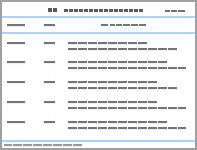
表1
SLE临床缓解和低疾病活动度定义
| 项目 | 治疗目标 | |
|---|---|---|
| 临床缓解 | 低疾病活动度 | |
| SLE疾病活动指数(SLEDAI-2000) | 0分 | ≤4分 |
| 医师整体评估 | ≤0.5分 | ≤1分 |
| 治疗方案 | 抗疟药(羟氯喹等)、低剂量糖皮质激素(泼尼松≤5 mg/d)和(或)稳定剂量的免疫抑制剂,包括生物制剂 | 抗疟药(羟氯喹等)、低剂量糖皮质激素(泼尼松≤7.5 mg/d),和(或)稳定剂量的免疫抑制剂/生物制剂 |
表2
SLE合并APLs阳性的治疗推荐
| 治疗方案 | 治疗推荐 |
|---|---|
| 血栓事件治疗方案 | |
| APLs阳性、无相关症状的SLE患者 | 阿司匹林(75~100 mg/d)一级预防 |
| 无诱因的首次静脉血栓事件者 | 长期抗凝治疗,口服维生素K拮抗剂,INR目标值为2.0~3.0 |
| 确诊APS者首次出现动脉血栓事件 | 口服维生素K拮抗剂优于单用阿司匹林,根据个体出血与血栓复发风险设定INR目标值为2.0~3.0或3.0~4.0;亦可考虑华法林标准抗凝联合阿司匹林治疗 |
| 3种抗磷脂抗体阳性且出现血栓事件者 | 不推荐应用利伐沙班 |
| 病理妊娠治疗方案 | |
| APLs持续阳性、无既往血栓事件及病理妊娠史的SLE患者 | 阿司匹林(75~100 mg/d) |
| APLs持续阳性合并既往血栓事件的SLE患者 | 阿司匹林(75~100 mg/d)联合治疗剂量低分子肝素 |
| APLs阳性合并符合APS分类标准的妊早期反复流产的SLE患者 | 阿司匹林(75~100 mg/d)联合预防剂量低分子肝素 |
| APLs阳性合并符合APS分类标准的晚期流产、胎盘功能不全相关病理妊娠的SLE患者 | 阿司匹林(75~100 mg/d)联合治疗剂量低分子肝素 |
| [1] |
BARBER M R W, DRENKARD C, FALASINNU T, et al. Global epidemiology of systemic lupus erythematosus[J]. Nat Rev Rheumatol, 2021, 17(9):515-532.
doi: 10.1038/s41584-021-00668-1 |
| [2] | MAGRO R, BORG A A. Characterisation of patients with systemic lupus erythematosus in Malta: A population based cohort cross-sectional study[J]. Biomed Res Int, 2018, 2018:2385386. |
| [3] |
GERGIANAKI I, FANOURIAKIS A, REPA A, et al. Epidemiology and burden of systemic lupus erythematosus in a Southern European population: data from the community-based lupus registry of Crete, Greece[J]. Ann Rheum Dis, 2017, 76(12):1992-2000.
doi: 10.1136/annrheumdis-2017-211206 pmid: 28780511 |
| [4] |
LI S, GONG T, PENG Y, et al. Prevalence and incidence of systemic lupus erythematosus and associated outcomes in the 2009-2016 US Medicare population[J]. Lupus, 2020, 29(1):15-26.
doi: 10.1177/0961203319888691 pmid: 31726936 |
| [5] | LI M, LI C, CAO M, et al. Incidence and prevalence of systemic lupus erythematosus in urban China, 2013-2017: A nationwide population-based study[J]. Sci Bull (Beijing), 2024, 69(19):3089-3097. |
| [6] |
DALL'ERA M, CISTERNAS M G, SNIPES K, et al. The incidence and prevalence of systemic lupus erythematosus in San Francisco County, California: The California Lupus Surveillance Project[J]. Arthritis Rheumatol, 2017, 69(10):1996-2005.
doi: 10.1002/art.v69.10 URL |
| [7] |
LI M, ZHANG W, LENG X, et al. Chinese SLE Treatment and Research group (CSTAR) registry: I. Major clinical characteristics of Chinese patients with systemic lupus erythematosus[J]. Lupus, 2013, 22(11):1192-1199.
doi: 10.1177/0961203313499086 pmid: 23963101 |
| [8] | 中华医学会风湿病学分会, 国家皮肤与免疫疾病临床医学研究中心, 中国系统性红斑狼疮研究协作组. 2020中国系统性红斑狼疮诊疗指南[J]. 中华内科杂志, 2020, 59(3):172-185. |
| Chinese Rheumatology Association, National Clinical Research Center for Dermatologic and Immunologic Di-seases, Chinese Systemic Lupus Erythematosus Treatment and Research Group. 2020 Chinese guidelines for the diagnosis and treatment of systemic lupus erythematosus[J]. Chin J Intern Med,2020, 59(3):172-185. | |
| [9] | 国家皮肤与免疫疾病临床医学研究中心, 中国系统性红斑狼疮研究协作组, 中华医学会风湿病学分会. 中国系统性红斑狼疮诊疗指南(2025版)[J]. 中华医学杂志, 2025, 105(23):1879-1906. |
| National Clinical Research Center for Dermatologic and Immunologic Diseases, Chinese Systemic Lupus Erythematosus Treatment and Research Group, Chinese Rheumatology Association. Chinese guidelines for the diagnosis and treatment of systemic lupus erythematosus (2025 edition)[J]. Natl Med J China, 2025, 105(23):1879-1906. | |
| [10] |
LI M, WANG Y, ZHAO J, et al. Chinese SLE Treatment and Research Group (CSTAR) registry 2009-2019: major clinical characteristics of Chinese patients with systemic lupus erythematosus[J]. Rheumatol Immunol Res, 2021, 2(1):43-47.
doi: 10.2478/rir-2021-0001 pmid: 36467897 |
| [11] | VAN VOLLENHOVEN R F, BERTSIAS G, DORIA A, et al. 2021 DORIS definition of remission in SLE: final re-commendations from an international task force[J]. Lupus Sci Med,2021, 8(1):e000538. |
| [12] |
FRANKLYN K, LAU C S, NAVARRA S V, et al. Definition and initial validation of a lupus low disease activity state (LLDAS)[J]. Ann Rheum Dis, 2016, 75(9):1615-1621.
doi: 10.1136/annrheumdis-2015-207726 pmid: 26458737 |
| [13] | JESUS D, MATOS A, HENRIQUES C, et al. Derivation and validation of the SLE Disease Activity Score (SLE-DAS): a new SLE continuous measure with high sensiti-vity for changes in disease activity[J]. Ann Rheum Dis, 2019, 78(3):365-371. |
| [14] |
KOSTOPOULOU M, MUKHTYAR C B, BERTSIAS G, et al. Management of systemic lupus erythematosus: a systematic literature review informing the 2023 update of the EULAR recommendations[J]. Ann Rheum Dis, 2024, 83(11):1489-1501.
doi: 10.1136/ard-2023-225319 pmid: 38777375 |
| [15] |
PITSIGAVDAKI S, NIKOLOUDAKI M, GARANTZIOTIS P, et al. Pragmatic targets for moderate/severe SLE and their implications for clinical care and trial design: sustained DORIS or LLDAS for at least 6 months is sufficient while their attainment for at least 24 months ensures high specificity for damage-free progression[J]. Ann Rheum Dis, 2024, 83(4):464-474.
doi: 10.1136/ard-2023-224919 pmid: 38233103 |
| [16] | GOLDER V, KANDANE-RATHNAYAKE R, LI N, et al. Association of sustained lupus low disease activity state with improved outcomes in systemic lupus erythematosus: a multinational prospective cohort study[J]. Lancet Rheumatol, 2024, 6(8):e528-e536. |
| [17] | GOLDER V, KANDANE-RATHNAYAKE R, HUQ M, et al. Lupus low disease activity state as a treatment endpoint for systemic lupus erythematosus: a prospective validation study[J]. Lancet Rheumatol, 2019, 1(2):e95-e102. |
| [18] | FLORIS A, CHESSA E, SEBASTIANI G D, et al. Glucocorticoid tapering and associated outcome in patients with newly diagnosed systemic lupus erythematosus: the real-world GULP prospective observational study[J]. RMD Open, 2022, 8(2):e002701. |
| [19] | PENG L, WU C, HONG R, et al. Clinical efficacy and safety of sirolimus in systemic lupus erythematosus: a real-world study and meta-analysis[J]. Ther Adv Musculoskelet Dis, 2020,12:1759720X20953336. |
| [20] | FANOURIAKIS A, KOSTOPOULOU M, ANDERSEN J, et al. EULAR recommendations for the management of systemic lupus erythematosus: 2023 update[J]. Ann Rheum Dis, 2024, 83(1):15-29. |
| [21] |
ALSHAIKI F, OBAID E, ALMUALLIM A, et al. Outcomes of rituximab therapy in refractory lupus: A meta-analysis[J]. Eur J Rheumatol, 2018, 5(2):118-126.
doi: 10.5152/eurjrheum.2018.17096 pmid: 30185361 |
| [22] | 张辉, 杨念生, 鲁静, 等. 狼疮肾炎诊疗规范[J]. 中华内科杂志, 2021, 60(9):784-790. |
| ZHANG H, YANG N S, LU J, et al. Recommendations for the diagnosis and management of lupus nephritis in China[J]. Chin J Intern Med, 2021, 60(9):784-790. | |
| [23] |
FURIE R A, ROVIN B H, GARG J P, et al. Efficacy and safety of obinutuzumab in active lupus nephritis[J]. N Engl J Med, 2025, 392(15):1471-1483.
doi: 10.1056/NEJMoa2410965 URL |
| [24] | ARNOLD J, DASS S, TWIGG S, et al. Efficacy and safety of obinutuzumab in systemic lupus erythematosus patients with secondary non-response to rituximab[J]. Rheumato-logy (Oxford), 2022, 61(12):4905-4909. |
| [25] |
CHEN Y, WANG L, LI N, et al. Tripterygium glycosides for safely controlling disease activity in systemic lupus erythematosus: a systematic review with meta-analysis and trial sequential analysis[J]. Front Pharmacol, 2023, 14:1207385.
doi: 10.3389/fphar.2023.1207385 URL |
| [26] |
WEENING J J, D'AGATI V D, SCHWARTZ M M, et al. The classification of glomerulonephritis in systemic lupus erythematosus revisited[J]. Kidney Int, 2004, 65(2):521-530.
doi: 10.1111/j.1523-1755.2004.00443.x pmid: 14717922 |
| [27] |
BAJEMA I M, WILHELMUS S, ALPERS C E, et al. Revision of the International Society of Nephrology/Renal Pathology Society classification for lupus nephritis: clarification of definitions, and modified National Institutes of Health activity and chronicity indices[J]. Kidney Int, 2018, 93(4):789-796.
doi: S0085-2538(17)30859-1 pmid: 29459092 |
| [28] |
WU Q, ZHAO M X, HUANG X S, et al. The use of belimu-mab on patients with both systemic lupus erythematosus and immune thrombocytopenia: A retrospective cohort study[J]. Lupus, 2024, 33(6):608-614.
doi: 10.1177/09612033241241576 URL |
| [29] |
BARBHAIYA M, ZUILY S, NADEN R, et al. The 2023 ACR/EULAR antiphospholipid syndrome classification criteria[J]. Arthritis Rheumatol, 2023, 75(10):1687-1702.
doi: 10.1002/art.v75.10 URL |
| [1] | 吴文娟, 田文杰, 苟雪静. 病原体宏基因组测序临床报告阈值的再讨论[J]. 诊断学理论与实践, 2025, 24(06): 576-582. |
| [2] | 邹天慧. 2025年《美国胃肠病学会临床指南:胃癌前病变诊治指南》解读[J]. 诊断学理论与实践, 2025, 24(04): 393-400. |
| [3] | 计蓓, 苏薇, 庹必光, 刘雪梅. 《中国抗癌协会神经内分泌肿瘤诊治指南(2025年版)》更新精要:消化内镜诊疗解析[J]. 诊断学理论与实践, 2025, 24(04): 401-406. |
| [4] | 白娅娅, 周春华, 邹多武. 2025年美国胃肠内镜学会《消化内镜在慢性胰腺炎管理中的作用指南:方法学及证据回顾》解读[J]. 诊断学理论与实践, 2025, 24(04): 407-414. |
| [5] | 周妍, 张旻. 中国《支气管哮喘防治指南(2024年版)》解读[J]. 诊断学理论与实践, 2025, 24(04): 415-422. |
| [6] | 吴双成, 郁胜强. 2025版KDIGO常染色体显性多囊肾病评估、管理和治疗临床实践指南要点解读[J]. 诊断学理论与实践, 2025, 24(03): 255-262. |
| [7] | 王一阳, 吕良敬. 系统性红斑狼疮CAR T细胞治疗疗效预测及安全性评估的潜在生物标志物[J]. 诊断学理论与实践, 2024, 23(03): 263-269. |
| [8] | 张昕, 赵盛楠, 冯学兵. 中国系统性红斑狼疮的诊治现状及挑战[J]. 诊断学理论与实践, 2024, 23(03): 257-262. |
| [9] | 宋陆茜, 常春康. 2023年美国国立综合癌症网络(NCCN)《骨髓增生异常综合征临床实践指南》(第1版)解读[J]. 诊断学理论与实践, 2023, 22(02): 116-120. |
| [10] | 陶怡, 糜坚青. 2023年美国国立综合癌症网络(NCCN)《多发性骨髓瘤指南》(第2版)更新解读[J]. 诊断学理论与实践, 2023, 22(02): 121-126. |
| [11] | 严福华. 《新型冠状病毒感染的肺炎诊疗方案(试行第五版)》影像部分的解读[J]. 诊断学理论与实践, 2020, 19(1): 4-6. |
| [12] | 赵红燕, 刘建民. 2019年《糖尿病患者骨折风险管理中国专家共识》解读[J]. 诊断学理论与实践, 2020, 19(03): 225-228. |
| [13] | 李贵森. 2019年《中国慢性肾脏病矿物质和骨异常诊治指南》解读[J]. 诊断学理论与实践, 2020, 19(03): 229-231. |
| [14] | 中国高血压联盟《家庭血压监测指南》委员会. 2019中国家庭血压监测指南[J]. 诊断学理论与实践, 2019, 18(03): 258-262. |
| [15] | 张旻, 张雪, 周新. 2017年《重症哮喘诊断与处理中国专家共识》解读[J]. 诊断学理论与实践, 2018, 17(06): 630-634. |
| 阅读次数 | ||||||
|
全文 |
|
|||||
|
摘要 |
|
|||||
