

诊断学理论与实践 ›› 2026, Vol. 25 ›› Issue (02): 148-156.doi: 10.16150/j.1671-2870.2026.02.005
支楠, 耿介立, 曹雯炜, 宋雅颖, 王刚( )
)
收稿日期:2025-11-06
修回日期:2025-12-09
接受日期:2026-01-06
出版日期:2026-04-25
发布日期:2026-04-25
通讯作者:
王刚 E-mail:wanggang@renji.com基金资助:
ZHI Nan, GENG Jieli, CAO Wenwei, SONG Yaying, WANG Gang()
Received:2025-11-06
Revised:2025-12-09
Accepted:2026-01-06
Published:2026-04-25
Online:2026-04-25
摘要:
《抗Aβ单克隆抗体临床应用建议(2025版)》(以下简称2025版建议)系统整合了阿杜卡单抗、仑卡奈单抗、多奈单抗的Ⅲ期临床试验数据,参考相关药物说明书、国内真实世界证据及临床实践经验,重点围绕仑卡奈单抗和多奈单抗对2024版建议进行了全面更新。2025版建议从用药前患者筛选、治疗方案评估、用药流程规范、不良反应监测、停药指征及特殊人群管理等多个方面提出了细化建议,特别在个体化停药标准方面取得重要进展,明确仑卡奈单抗推荐采用18个月固定疗程;而多奈单抗则以β-淀粉样蛋白(amyloid β-protein, Aβ)-正电子发射断层显像(positron emission tomography,PET)检测的Centiloid值达到预设阈值作为治疗完成标准,即单次Centiloid值≤11,或连续2次Centiloid值均处于11~25区间。在安全性管理方面,2025版建议进一步完善了淀粉样蛋白相关影像学异常(amyloid-related imaging abnormalities,ARIA)的分层监测与处理流程,并对接受抗凝治疗、载脂蛋白E(apolipoprotein E,APOE)ε4/ε4纯合子等特殊人群制定了精准风险管理策略。当前抗Aβ单抗的临床应用仍面临若干关键挑战,多维度生物标志物的整合应用体系尚未系统建立,制约了个体化治疗路径的构建;中国人群长期用药的真实世界证据仍显不足,影响治疗方案的本地化优化与风险精细管理。未来需围绕上述方向加强研究,以推动抗Aβ单抗治疗从标准化模式,向基于生物标志物与临床表型的个体化精准医疗持续发展。
中图分类号:
支楠, 耿介立, 曹雯炜, 宋雅颖, 王刚. 《抗Aβ单克隆抗体临床应用建议(2025版)》解读[J]. 诊断学理论与实践, 2026, 25(02): 148-156.
ZHI Nan, GENG Jieli, CAO Wenwei, SONG Yaying, WANG Gang. Interpretation of clinical application recommendations for anti-Aβ monoclonal antibodies (2025 Edition)[J]. Journal of Diagnostics Concepts & Practice, 2026, 25(02): 148-156.
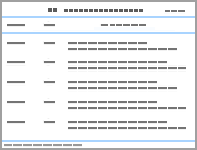
表1
2024版与2025版抗Aβ单克隆抗体临床试验入组标准和临床实践适用标准对比
| 项目 | 临床试验入组标准 | 临床实践适用标准 | ||
|---|---|---|---|---|
| 2024版 | 2025版 | 2024版 | 2025版 | |
| 年龄 | 50~85岁 | 50~90岁 | ≤85岁 | 同2024版 |
| 诊断 | AD源性MCI或轻度AD痴呆临床标准 | AD源性MCI或轻度AD痴呆临床标准 | AD源性MCI或轻度AD痴呆临床标准 | 同2024版 |
| 基线评分 | MMSE评分24~30分,CDR-GS评分0.5分,RBANS延迟记忆指数≤85分 | CDR-GS评分0.5~1.0分,MMSE评分22~30分 | MMSE评分21~30分或同等认知水平 | 同2024版 |
| 淀粉样蛋白 状态 | Aβ-PET阳性 | 淀粉样蛋白PET阳性或者脑脊液检查符合AD诊断标准 | Aβ-PET阳性或脑脊液检查符合阿尔茨海默病诊断标准并经Aβ-PET/CT或Aβ-PET/MRI验证 | 同2024版,补充建议可结合标准化Centiloid值进行评估 |
| 基因 | 包括ApoE基因型 | 非必需 | 应与患者和(或)照料者讨论基因检测的意愿和必要性 | 同2024版 |
| 神经系统检查 | 排除非AD的神经系统变性疾病、脑卒中和TIA | 排除非AD病因所致的认知功能障碍患者,或近12个月内有卒中、TIA、癫痫发作史者 | 排除非AD的神经系统变性疾病 | 排除非AD病因所致的认知功能障碍患者,或近12个月内有卒中、TIA、癫痫发作史者 |
| 心血管病病史 | 排除心绞痛、心肌梗死、充血性心力衰竭 | 排除未得到稳定或充分控制的心脏疾病 | 心血管病稳定(近3个月无症状或经心脏科评定病情稳定);根据患者安全参与治疗方案的能力制定临床决策 | 同2024版 |
| 其他基础疾病病史 | 排除其他有临床意义的系统性疾病、无法控制的糖尿病、未控制的高血压、不稳定的恶性肿瘤、肝炎或肝功能障碍、HIV感染 | 排除任何其他未得到稳定或充分控制的医疗状况,或研究者认为可能影响参与者安全或干扰研究评估的疾病 | 基础疾病稳定(主要指标如血压和血糖等无明显波动、相应药物治疗≥3个月或经专科评定病情稳定);根据患者安全参与治疗方案的能力制定临床决策 | 同2024版 |
| 精神疾病病史 | 排除既往6个月内病情不稳定的精神疾病;物质成瘾性或药物性精神障碍 | 排除2年内有已知或可疑的药物或乙醇滥用或依赖史,或在筛选时有阳性尿液药物检测结果的患者 | 精神状态稳定(经专科评定病情稳定);根据患者安全参与治疗方案的能力制定临床决策 | 同2024版 |
| 生殖 | 排除妊娠期或哺乳期女性;育龄期女性须采取避孕措施 | 排除妊娠期或哺乳期女性;育龄期女性须采取避孕措施 | 与临床试验入组标准相同 | 同2024版 |
| 凝血功能 | 排除出血性疾病、正在服用抗凝药 | 排除未得到充分控制的出血性疾病[包括血小板计数或未接受抗凝治疗者的INR>1.5。接受抗凝治疗的参与者应优化其抗凝状态,并在筛查前至少4周内保持稳定剂量 | 与临床试验入组标准相同 | 排除出血性疾病,原则上正在服用抗凝药物(如华法林、达比加群、艾多沙班、利伐沙班、阿哌沙班、贝曲沙班或肝素)的患者不推荐使用单抗治疗 |
| 合并用药 | 允许应用胆碱酯酶抑制药和美金刚 | 允许应用胆碱酯酶抑制剂和美金刚 | 与临床试验入组标准相同 | 同2024版 |
| 基线 MRI检查 | 排除急性或亚急性出血、大出血、4个以上微出血灶、皮质梗死(>1.5 cm)、1个以上梗死灶(>1.5 cm)、表面铁沉积症、弥漫性白质疾病 | 排除超过4个微出血点(定义为最大直径10 mm或更小);单一的脑出血的最大直径>10 mm;表面铁沉积证据;血管源性 水肿;多发腔隙性梗死或涉及主要血管区域的梗死;严重的脑小血管病变 | 与临床试验入组标准相同 | 与临床试验标准相同,补充对于脑内存在5~9个微出血灶(单个直径<10 mm)的患者,可在全面评估及充分沟通的基础上,谨慎考虑抗Aβ单克隆抗体治疗。如有条件,建议头颅MRI在用药前1个月内完成。 |
| 知情同意 | 须由受试者和照料者共同签署 | 须由受试者和照料者共同签署 | 受试者和照料者应了解治疗性质、要求和预期结局 | 同2024版 |

图1
淀粉样蛋白相关影像异常处理策略

| [1] |
JIA L, DU Y, CHU L, et al. Prevalence, risk factors, and management of dementia and mild cognitive impairment in adults aged 60 years or older in China: A cross-sectional study[J]. Lancet Public Health, 2020, 5(12):e661-e671.
doi: 10.1016/S2468-2667(20)30185-7 pmid: 33271079 |
| [2] | 王刚, 齐金蕾, 刘馨雅, 等. 中国阿尔茨海默病报告2024[J]. 诊断学理论与实践, 2024, 23(3):219-256. |
| WANG G, QI J L, LIU X Y, et al. China Alzheimer Report 2024[J]. J Diagn Concepts Pract, 2024, 23(3):219-256. | |
| [3] | IMBIMBO B P, IPPATI S, WATLING M, et al. Role of monomeric amyloid-β in cognitive performance in Alzheimer’s disease: Insights from clinical trials with secretase inhibitors and monoclonal antibodies[J]. Pharmacol Res, 2023,187:106631. |
| [4] |
王刚, 李彬寅, 任汝静, 等. 关于抗Aβ单克隆抗体的临床应用建议(2024版)[J]. 中国现代神经疾病杂志, 2024, 24(3):120-126.
doi: 10.3969/j.issn.1672-6731.2024.03.002 |
| WANG G, LI B Y, REN R J, et al. Recommendations for the clinical use of anti-Aβ monoclonal antibody for Alzheimer's disease(2024)[J]. Chin J Contemp Neurol Neurosurg, 2024, 24(3):120-126. | |
| [5] |
VAN DYCK C H, SWANSON C J, AISEN P, et al. Leca-nemab in early Alzheimer’s disease[J]. N Engl J Med, 2023, 388(1):9-21.
doi: 10.1056/NEJMoa2212948 URL |
| [6] |
SIMS J R, ZIMMER J A, EVANS C D, et al. Donanemab in early symptomatic Alzheimer disease: The TRAI-LBLAZER-ALZ 2 randomized clinical trial[J]. JAMA, 2023, 330(6):512-527.
doi: 10.1001/jama.2023.13239 URL |
| [7] | US Food and Drug Administration. ADUHELM® (aducanumab-avwa) injection, for intravenous use Initial U.S. Approval:2021[EB/OL]. 2021. [2025-11-06]. https://www.accessdata.fda.gov/drugsatfda_docs/label/2021/761178s000lbl.pdf. |
| [8] | US Food and Drug Administration. LEQEMBI® (lecanemab-irmb) injection, for intravenous use Initial U.S. Approval:2023[EB/OL]. 2023.[2025-11-06]. https://www.accessdata.fda.gov/drugsatfda_docs/label/2025/761269s005lbl.pdf. |
| [9] | US Food and Drug Administration. KISUNLA (donanema-bazbt) injection, for intravenous use Initial U.S. Approval:2024[EB/OL]. 2024. [2025-11-06]. https://www.accessdata.fda.gov/drugsatfda_docs/label/2024/761248s000lbl.pdf. |
| [10] | 支楠, 肖金雯, 任汝静, 等. 抗Aβ单克隆抗体临床应用建议(2025版)[J]. 重庆医科大学学报, 2025, 50(9):1133-1140. |
| ZHI N, XIAO J W, REN R J, et al. Recommendations for the clinical use of anti-amyloid-β monoclonal antibody for Alzheimer's disease(2025)[J]. J Chongqing Med University, 2025, 50(9):1133-1140. | |
| [11] | 《早期阿尔茨海默病疾病修饰治疗专家共识》编审委员会. 早期阿尔茨海默病疾病修饰治疗专家共识[J]. 中华内科杂志, 2025, 64(5):385-395. |
| Expert Consensus Review Committee on Disease-Modifying Treatments for Early Alzheimer′s Disease. Recommendations for the disease-modifying treatments of early Alzheimer′s disease[J]. Chin J Intern Med, 2025, 64(5):385-395. | |
| [12] | 黄琪, 任树华, 管一晖, 等. 18F-Florbetapir PET定量标准化Centiloid及其在中国临床前期阿尔茨海默病队列中的应用[J]. 中华核医学与分子影像杂志, 2024, 44(5):266-272. |
| HUANG Q, REN S H, GUYAN Y H, et al. Standardization of amyloid quantitation with 18F-Florbetapir SUV ratio to the Centiloid scale and its application in Chinese Preclinical Alzheimer′s Disease Study[J]. Chin J Nucl Med Mol Imaging, 2024, 44(5):266-272. | |
| [13] | 中华医学会神经病学分会痴呆与认知障碍学组, 中华医学会核医学分会. 淀粉样蛋白PET显像在阿尔茨海默病诊断中的应用专家共识[J]. 中华医学杂志, 2023, 103(45):3615-3626. |
| Chinese Society of Dementia and Cognitive lmpairment, Chinese Society of Nuclear Medicine. Expert consensus on the application of amyloid-PET imaging in the diagnosis of Alzheimer′s diseas[J]. Natl Med J China, 2023, 103(45):3615-3626. | |
| [14] | 常燕. 重视β-淀粉样蛋白PET在新时代阿尔茨海默病诊疗中的价值[J]. 神经病学与神经康复学杂志, 2025, 21(1):12-16. |
| CHANG Y. Attach importance to the value of β-amyloid-PET in the diagnosis and treatment of Alzheimer's disea-se in the new era[J]. J Neurol Neurorehabil, 2025, 21(1):12-16. | |
| [15] |
CUMMINGS J, APOSTOLOVA L, RABINOVICI G D, et al. Lecanemab: Appropriate use recommendations[J]. J Prev Alzheimers Dis, 2023, 10(3):362-377.
doi: 10.14283/jpad.2023.30 pmid: 37357276 |
| [16] |
RABINOVICI G D, SELKOE D J, SCHINDLER S E, et al. Donanemab: Appropriate use recommendations[J]. J Prev Alzheimers Dis, 2025, 12(5):100150.
doi: 10.1016/j.tjpad.2025.100150 URL |
| [17] |
CHEN C, KATAYAMA S, LEE J H, et al. Clarity AD: Asian regional analysis of a phase Ⅲ trial of lecanemab in early Alzheimer’s disease[J]. J Prev Alzheimers Dis, 2025, 12(5):100160.
doi: 10.1016/j.tjpad.2025.100160 URL |
| [18] | 张楠, 解恒革, 王刚, 等. 仑卡奈单抗治疗阿尔茨海默病患者的基线特征和短期安全性[J]. 中华老年心脑血管病杂志, 2025, 27(7):915-919. |
| ZHANG N, XIE H G, WANG G, et al. Baseline characte-ristics and short-term safety of lecanemab in treatment of Alzheimer's disease:a real-world study[J]. Chin J Geriatr Heart Brain Vessel Dis, 2025, 27(7):915-919. | |
| [19] | 支楠, 耿介立, 曹雯炜, 等. 仑卡奈单抗治疗早发型阿尔茨海默病患者:1例报告及文献复习[J]. 神经病学与神经康复学杂志, 2025, 21(3):158-166. |
| ZHI N, GENG J L, CAO W W, et al. Lecanemab treatment for early-onset Alzheimer's disease:A case report and literature review[J]. J Neurol Neurorehabil, 2025, 21(3):158-166. | |
| [20] |
JEONG S Y, SUH C H, KIM S J, et al. Amyloid-related imaging abnormalities in the era of anti-amyloid beta monoclonal antibodies for Alzheimer’s disease: Recent updates on clinical and imaging features and MRI monitoring[J]. Korean J Radiol, 2024, 25(8):726.
doi: 10.3348/kjr.2024.0105 URL |
| [21] | 初曙光, 王刚. 淀粉样蛋白相关影像学异常:一种与阿尔茨海默病治疗相关的具有影像学特征和诊断特异性的MRI表现[J]. 神经病学与神经康复学杂志, 2025, 21(1):6-11. |
| CHU S G, WANG G. Amyloid-related imaging abnormalities:an MRI manifestation associated with Alzheimer's disease-targeted therapy with imaging characteristics and diagnostic specificity[J]. J Neurol Neurorehabil, 2025, 21(1):6-11. | |
| [22] | ClinicalTrails. gov. A study to confirm safety and efficacy of lecanemab in participants with early Alzheimer's disease (clarity AD)[EB/OL]. 2025. https://clinicaltrials.gov/study/NCT03887455. |
| [23] |
REISH N J, JAMSHIDI P, STAMM B, et al. Multiple cerebral hemorrhages in a patient receiving lecanemab and treated with t-PA for stroke[J]. N Engl J Med, 2023, 388(5):478-479.
doi: 10.1056/NEJMc2215148 URL |
| [1] | 方珉, 刘静文, 曾媛媛, 金爱萍. 阿尔茨海默病诊断的血液生物标志物进展[J]. 诊断学理论与实践, 2026, 25(02): 113-120. |
| [2] | 张楠, 卢清正. 不典型阿尔茨海默病的诊断[J]. 诊断学理论与实践, 2026, 25(02): 121-130. |
| [3] | 刘小草, 曾庆泽, 李依霞, 李凯程, 罗骁, 闫少珍, 卢洁. KL-VS基因对轻度认知障碍患者内侧颞叶体积影响的磁共振研究[J]. 诊断学理论与实践, 2026, 25(02): 174-182. |
| [4] | 徐陈昊义, 刘静文, 方珉. 阿尔茨海默病采用仑卡奈单抗治疗致淀粉样蛋白相关影像学异常1例报告及风险因素文献复习[J]. 诊断学理论与实践, 2026, 25(02): 225-231. |
| [5] | 陶怡, 糜坚青. 2026年美国国立综合癌症网络《多发性骨髓瘤指南》(第3版)更新解读[J]. 诊断学理论与实践, 2026, 25(01): 30-36. |
| [6] | 蔡姣迪, 陈国群, 张文琴. 2025年NCCN非小细胞肺癌临床实践(V1-V3)指南解读[J]. 诊断学理论与实践, 2026, 25(01): 37-43. |
| [7] | 刘晶, 李勇, 向恩菲, 方旭前. 肺大细胞神经内分泌癌患者临床组织特征和可靶向分子亚型分布及意义[J]. 诊断学理论与实践, 2026, 25(01): 53-62. |
| [8] | 卢沭雄, 唐海旭, 吴萍, 采丽, 张颖, 颜霞. ARGLU1在宫颈癌组织中的表达及与临床病理特征及预后的关系[J]. 诊断学理论与实践, 2026, 25(01): 63-70. |
| [9] | 宋瑞, 吴涛, 张茜, 石亚军, 薛锋, 张君玲, 张海英. 多发性骨髓瘤免疫治疗后并发肠结核致不完全性肠梗阻一例[J]. 诊断学理论与实践, 2026, 25(01): 85-89. |
| [10] | 黄曼, 丁朔. 脓毒症的诊治现状及挑战[J]. 诊断学理论与实践, 2025, 24(06): 583-592. |
| [11] | 姜凯文, 董徽, 蒋雄京. 经导管去肾神经治疗高血压:现状与挑战[J]. 诊断学理论与实践, 2025, 24(05): 465-470. |
| [12] | 马志强, 林子昕, 吴昊, 王再佳, 张象涛, 董一飞. 难治性高血压的流行及诊治进展[J]. 诊断学理论与实践, 2025, 24(05): 471-484. |
| [13] | 曾贝贝, 黄奕, 张步腾, 黄荣鹤, 覃丽桦, 周琦婷. 血清IGF-1联合TPOAb对甲亢患者131I治疗后早期发生甲减的预测价值[J]. 诊断学理论与实践, 2025, 24(05): 505-511. |
| [14] | 王洋, 王超, 傅璠, 张敏, 李彪, 王瑾. 甲状腺乳头状癌术后肺转移清灶治疗中肝脏弥漫性131I摄取与肺转移131I摄取的功能状态相关[J]. 诊断学理论与实践, 2025, 24(05): 512-517. |
| [15] | 李雨航, 肖世富, 岳玲. 轻度行为损害与阿尔茨海默病相关研究的进展[J]. 诊断学理论与实践, 2025, 24(05): 548-554. |
| 阅读次数 | ||||||
|
全文 |
|
|||||
|
摘要 |
|
|||||
