

诊断学理论与实践 ›› 2025, Vol. 24 ›› Issue (06): 628-633.doi: 10.16150/j.1671-2870.2025.06.008
孔德艳1, 高祎阳1, 张曹阳1, 董海鹏1, 严福华1, 原子扬2, 代建琨2, 刘方韬1( )
)
收稿日期:2025-03-24
修回日期:2025-07-25
出版日期:2025-12-25
发布日期:2025-12-25
通讯作者:
刘方韬 E-mail:lft40620@rjh.com.cn
KONG Deyan1, GAO Yiyang1, Zhang Caoyang1, DONG Haipeng1, YAN Fuhua1, YUAN Ziyang2, DAI Jiankun2, LIU Fangtao1()
Received:2025-03-24
Revised:2025-07-25
Published:2025-12-25
Online:2025-12-25
摘要:
目的: 比较基于快速深度学习(deep learning speed,DLS)的三维屏气(breathe hold,BH)磁共振胰胆管成像(magnetic resonance cholangiopancreatography ,MRCP)与常规的三维屏气磁共振胰胆管成像(3D BH MRCP)在无法配合屏气的情况下的图像质量。方法: 前瞻性纳入2025年1月至3月在上海交通大学医学院附属瑞金医院50例屏气配合不佳MRCP检查的患者,先后进行BH 3D DLS MRCP、BH 3D MRCP序列的扫描。比较2个序列的扫描时间,客观评价2组图像的信噪比(signal to noise ratio, SNR)、对比噪声比(contrast to noise ratio,CNR),主观评价2组图像的整体图像质量、背景抑制、胰胆管可视化质量。结果: 3D BH DLS MRCP组平均扫描时间为11 s,3D BH MRCP组平均扫描时间为17 s,3D BH DLS MRCP扫描时间缩短(P<0.05)。客观评价显示3D BH DLS MRCP的SNR(23.76±9.23)和CNR(28.89±11.49)均好于3D BH MRCP[(17.15±6.85)、(22.03±8.79)](P<0.05);主观评价图像分析显示,3D BH DLS MRCP在图像整体质量评分[(3.80±0.32)分]、背景抑制[(3.64±0.40)分]及显示胰胆管各段[(3.53±0.37)分)]均有高于3D BH MRCP的图像整体质量[(3.10±0.44)分]、背景抑制[(3.33±0.51分])及显示胰胆管各段[(3.08±0.56)分]的趋势,但差异尚无统计学意义。3D BH DLS MRCP组50例均满足诊断要求,3D BH MRCP组有5例不满足诊断要求,2组间差异有统计学意义(P<0.05)。结论: 在无法屏气或屏气不佳的情况下,应用3D BH DLS MRCP检查可显著缩短检查时间,图像质量有保证,符合临床诊断需求。
中图分类号:
孔德艳, 高祎阳, 张曹阳, 董海鹏, 严福华, 原子扬, 代建琨, 刘方韬. 基于深度学习的快速MRCP成像在屏气困难患者检查中的应用价值[J]. 诊断学理论与实践, 2025, 24(06): 628-633.
KONG Deyan, GAO Yiyang, Zhang Caoyang, DONG Haipeng, YAN Fuhua, YUAN Ziyang, DAI Jiankun, LIU Fangtao. Application value of deep learning-based rapid MRCP imaging in examination of patients with breath holding difficulties[J]. Journal of Diagnostics Concepts & Practice, 2025, 24(06): 628-633.
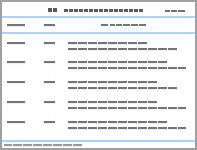
表1
3D BH DLS MRCP和3D BH MRCP图像质量客观评价($\overline{x}\pm s$)
| Group | SNR | CNR | P |
|---|---|---|---|
| 3D BH DLS MRCP | 23.76 | 28.89 | <0.05 |
| 3D BH MRCP | 17.15 | 22.03 | <0.05 |
表2
3D BH DLS MRCP和3D BH MRCP图像主观评价($\overline{x}\pm s$)
| Group | Overall image quality | Background suppression | Pancreaticobiliary duct visualization |
|---|---|---|---|
| 3D BH DLS MRCP | 3.80 | 3.64 | 3.53 |
| 3D BH MRCP | 3.10 | 3.33 | 3.08 |
| P value | 0.450 | 0.117 | 0.263 |

图1
3D BH DLS MRCP和3D BH MRCP图像质量对比 注:患者男,55岁,胆囊多发结石,3D BH DLS MRCP序列MIP图。A:整体图像质量主观评分4分,胰管远端(箭头示)显示良好;3D BH MRCP序列MIP图,B:整体图像质量主观评分2分,胰管远端(箭头示)显示不清。


图2
3D BH DLS MRCP和3D BH MRCP图像质量对比 注:患者女,73岁,胆囊切除术后。A: 3D BH DLS MRCP序列MIP图,整体图像质量主观评价4分,背景抑制好,胰胆管显示清晰;B: 3D BH MRCP序列MIP图,整体图像质量主观评分2分,伪影较重,胰胆管显示不佳。


图3
3D BH DLS MRCP和3D BH MRCP对比案例 注:患者男,74岁,胆囊,肝总管及胆总管中下段结石伴上游胆管轻度扩张。A: 3D BH DLS MRCP序列MIP图,结石(箭头示)清晰显示,具有诊断意义;B: 3D BH MRCP序列MIP图,结石(箭头示)较模糊,无法明确诊断。


图4
3D BH DLS MRCP和3D BH MRCP对比案例 注:患者女,33岁,胆总管囊肿,向上累及胆囊管开口处。A:3D BH DLS MRCP序列MIP图,整体图像质量主观评价4分,肝左、右管(箭头)可见;B:3D BH MRCP序列MIP图,整体图像质量主观评分2分,肝左、右管(箭头)较模糊。

| [1] | 王嘉琛, 何思怡, 曹梦迪, 等. 1990—2021年中国人群5种常见消化系统恶性肿瘤疾病负担变化趋势分析[J]. 中华消化外科杂志, 2025, 24(2):213-222. |
| WANG J C, HE S Y, CAO M D, et al. Analysis of the change trend in the burden of 5 common malignant tumors of digestive system in the Chinese population from 1990 to 2021[J]. Chin J Dig Surg, 2025, 24(2):213-222. | |
| [2] | 程琳, 余永强, 王成林, 等. 胰胆管汇合MRCP解剖与胰胆系疾病关系[J]. 中国CT和MRI杂志, 2012, 10(1):50-53. |
| CHENG L, YU Y Q, WANG C L, et al. MRCP study of pancreaticobiliary maljunction and pancreaticobiliary di-seases[J]. Chin J CT MRI, 2012, 10(1): 50-53. | |
| [3] |
CAI L, YEH B M, WESTPHALEN A C, et al. 3D T2-weighted and Gd-EOB-DTPA-enhanced 3D T1-weighted MR cholangiography for evaluation of biliary anatomy in living liver donors[J]. Abdom Radiol (NY), 2017, 42(3):842-850.
doi: 10.1007/s00261-016-0936-z pmid: 27714420 |
| [4] | SANDINO C M, CHENG J Y, CHEN F, et al. Compressed sensing: from research to clinical practice with deep neural networks[J]. IEEE Signal Process Mag, 2020, 37(1):111-127. |
| [5] |
SHENG R F, ZHENG L Y, JIN K P, et al. Single-breath-hold T2WI liver MRI with deep learning-based reconstruction: A clinical feasibility study in comparison to conventional multi-breath-hold T2WI liver MRI[J]. Magn Reson Imaging, 2021, 81:75-81.
doi: 10.1016/j.mri.2021.06.014 URL |
| [6] |
CHANDRA S S, BRAN LORENZANA M, LIU X, et al. Deep learning in magnetic resonance image reconstruction[J]. J Med Imaging Radiat Oncol, 2021, 65(5):564-577.
doi: 10.1111/ara.v65.5 URL |
| [7] |
UEDA T, OHNO Y, YAMAMOTO K, et al. Deep Lear-ning Reconstruction of Diffusion-weighted MRI Improves Image Quality for Prostatic Imaging[J]. Radiology, 2022, 303(2):373-381.
doi: 10.1148/radiol.204097 URL |
| [8] |
TAJIMA T, AKAI H, SUGAWARA H, et al. Feasibility of accelerated whole-body diffusion-weighted imaging using a deep learning-based noise-reduction technique in patients with prostate cancer[J]. Magn Reson Imaging, 2022, 92:169-179.
doi: 10.1016/j.mri.2022.06.014 URL |
| [9] | JOHNSON P M, LIN D J, ZBONTAR J, et al. Deep learning reconstruction enables prospectively accelerated clinical knee MRI[J]. Radiology, 2023, 307(2):e220425. |
| [10] | ALMANSOUR H, HERRMANN J, GASSENMAIER S, et al. Deep learning reconstruction for accelerated spine MRI: Prospective analysis of interchangeability[J]. Radio-logy, 2023, 306(3):e212922. |
| [11] | MALKIEL I, AHN S, SLAVENS Z, et al. Densely connected iterative network for sparse MRI reconstruction[C]. Proceedings of the International Society for Magnetic Resonance in Medicine (ISMRM), Annual Meeting, 2017. |
| [12] | 徐卓凡, 靳琪奥, 王开宇, 等. 基于CT检查的集成深度学习模型对肝门静脉定性与定量分型研究[J]. 中华消化外科杂志, 2024, 23(7):976-983. |
| XU Z F, JIN Q A, WANG K Y, et al. CT-based integrated deep learning model for qualitative and quantitative research of hepatic portal vein[J]. Chin J Dig Surg, 2024, 23(7):976-983. | |
| [13] | 陶海粟, 黎柏宏, 曾小军, 等. 基于深度学习构建微创肝切除术关键解剖结构识别模型的应用价值[J]. 中华消化外科杂志, 2024, 23(4):590-595. |
| TAO H S, LI B H, ZENG X J, et al. Application value of major anatomical structure recognition model of minimally invasive liver resection based on deep learning[J]. Chin J Dig Surg, 2024, 23(4):590-595. | |
| [14] |
KROMREY M L, FUNAYAMA S, TAMADA D, et al. Clinical evaluation of respiratory-triggered 3D MRCP with navigator echoes compared to breath-hold acquisition using compressed sensing and/or parallel imaging[J]. Magn Reson Med Sci, 2020, 19(4):318-323.
doi: 10.2463/mrms.mp-2019-0122 URL |
| [15] | 张小斌, 李宁, 陈亚明. MRCP 诊断不同直径、不同部位胆总管结石的价值[J]. 中国 CT 和 MRI 杂志, 2023, 21(4):110-111. |
| ZHANG X B, LI N, CHEN Y M. The value of MRCP in the diagnosis of common bile duct stones of different diameters and locations[J]. Chin J CT MRI, 2023, 21(4):110-111. | |
| [16] | 王淳正, 许来艳, 侯莉莉. EUS检查与MRCP成像对IPMN良恶性鉴别诊断效能对比[J]. 中国CT和MRI杂志, 2022, 20(5):139-141. |
| WANG C Z, XU L Y, HOU L L. Comparison on efficiency between EUS and MRCP imaging in the differential diagnosis of benign and malignant IPMN[J]. Chin J CT MRI, 2022, 20(5):139-141. | |
| [17] | 孟菲, 于霞. 3D MRCP及MIP图像与轴位T2WI结合诊断胆系结石的价值[J]. 武警医学, 2015, 26(7):656-658. |
| MENG F, YU X. Diagnostic value of combining 3D MRCP/MIP images with axial T2-weighted imaging for biliary calculi[J]. Med J Chin PAPF, 2015, 26(7):656-658. | |
| [18] | 宋斌, 赵厚亮, 叶莉. 三维磁共振胰胆管成像诊断小儿胆道闭锁价值分析[J]. 实用肝脏病杂志, 2021, 24(2):288-291. |
| SONG B, ZHAO H L, YE L. Application of three-dimensional magnetic resonance cholangiopancreatography in diagnosis of biliary atresia in children[J]. J Prac Hepatol, 2021, 24(2): 288-291. | |
| [19] | 王宏光, 罗漫. 肝门部胆管癌的术前评估和术中导航研究进展[J]. 中华消化外科杂志,2024,23(7):906-911. |
| WANG HG, LUO M. Research advance in preoperative evaluation and intraoperative navigation for hilar cholangio-carcinoma[J]. Chin J Dig Surg,2024,23(7):906-911. | |
| [20] | MALKIEL I, AHN S, SLAVENS Z, TAVIANI V, HARDY C J. Densely connected iterative network for sparse MRI reconstruction[C]. Proceedings of the International Society for Magnetic Resonance in Medicine (ISMRM), Annual Meeting, 2017. |
| [21] | GAO HUANG, ZHUANG LIU, LAURENS V D M, et al. Densely connected convolutional networks[C]. 2017 IEEE Conference on Computer Vision and Pattern Recognition (CVPR), Honolulu, HI, USA,2017: 2261-2269. |
| [22] |
AGGARWAL H K, MANI M P, JACOB M. MoDL: Model-based deep learning architecture for inverse problems[J]. IEEE Trans Med Imaging, 2019, 38(2):394-405.
doi: 10.1109/TMI.2018.2865356 URL |
| [23] | AHN S, MENINI A, MCKINNON G, et al. Contrast-weighted SSIM loss function for deep learning-based undersampled MRI reconstruction[C]. (ISMRM) Annual Meeting, 2020. |
| [24] | 王璇, 王皓, 万云天, 等. 肩关节加速MRI应用深度学习重建算法的可行性与临床价值[J]. 中国临床研究, 2024, 37(8):1238-1243. |
| WANG X, WANG H, WAN YT, et al. Feasibility and clinical value of deep learning reconstruction in accele-rated MRI of shoulder[J]. Chin J Clin Res, 2024, 37(8):1238-1243. |
| [1] | 龚沈初,黄胜,巴奇,陈克敏. 胰腺分裂的磁共振胰胆管成像诊断[J]. 诊断学理论与实践, 2004, 3(03): 57-59. |
| 阅读次数 | ||||||
|
全文 |
|
|||||
|
摘要 |
|
|||||
