

诊断学理论与实践 ›› 2025, Vol. 24 ›› Issue (06): 641-647.doi: 10.16150/j.1671-2870.2025.06.010
高一慧, 张会萍, 周毓青( )
)
收稿日期:2024-03-13
修回日期:2025-03-02
出版日期:2025-12-25
发布日期:2025-12-25
通讯作者:
周毓青 E-mail:doczhou@qq.com基金资助:
GAO Yihui, ZHANG Huiping, ZHOU Yuqing()
Received:2024-03-13
Revised:2025-03-02
Published:2025-12-25
Online:2025-12-25
摘要:
目的: 采用常规二维超声技术两步法,评估“产后42 d”产妇腹直肌分离(diastasis recti abdominis, DRA)发生率及其严重程度,并分析产后DRA发生的母儿危险因素。方法: 研究对象为在我院分娩,并于2022年9月至10月期间在我院行“产后42 d”检查的产妇(连续病例)。所有入组产妇在超声医生指导下先做卷腹动作,并以常规二维超声技术在腹直肌收缩状态下定位腹直肌边界(第一步),接着嘱产妇平卧在腹直肌放松状态下测量腹直肌间距(第二步),分别于脐上3 cm、脐水平及脐下3 cm三处测量腹直肌间距(inter-rectus distance, IRD)。根据欧洲疝学会DRA管理指南,确定DRA的诊断,并分为轻度、中度、重度DRA 3组,统计分析DRA的发生率以及轻度、中度、重度DRA的占比。记录产妇年龄及新生儿体重等信息,统计分析以上母儿因素与DRA发生及DRA严重程度的关系。结果: 本研究共入组400名产妇,DRA的发生率为81.75%(327/400),其中轻度DRA 171例(52.29%)、中度DRA 152例(46.48%)、重度DRA 4例(1.22%)。与无DRA组相比,DRA组新生儿体重较大(3 385 g比3 190 g, P<0.001),剖宫产率增高(114/327比13/73, P=0.005),产次超过1次者比率高(89/327比11/73, P=0.030),其他母儿因素在2组间无统计学差异。二元logistic回归分析显示,新生儿体重较大、剖宫产及产次较多是DRA的独立危险因素(OR值分别为1.001、2.549、2.053)。中度DRA组与轻度DRA组相比,新生儿出生体重较大(3 401 g比3 370 g, P=0.036),剖宫产率增高(70/152比42/171, P<0.001),产次超过1次者比率高(49/152比36/171,P=0.030),产前产妇体质量指数(body mass indes, BMI)高(26比25,P=0.023),其他参数在2组间无统计学差异。结论: 产妇DRA的发生率较高,其中中度、重度DRA约各占一半。产后运用常规二维超声技术两步法检测对于及时检出异常具有重要临床意义,便于临床根据DRA不同严重程度提供及时、精确的产后康复指导,且二维常规超声“两步法”界定腹直肌边缘具有更简便、更准确的优势。新生儿体重、剖宫产、产次及产前产妇BMI等母儿危险因素影响产妇产后DRA的发生及其严重程度。
中图分类号:
高一慧, 张会萍, 周毓青. 基于“产后42天”产妇腹直肌的超声两步法评估产后腹直肌分离及其相关危险因素分析[J]. 诊断学理论与实践, 2025, 24(06): 641-647.
GAO Yihui, ZHANG Huiping, ZHOU Yuqing. Analysis of ultrasonic two-step assessment of postpartum diastasis recti abdominis and related risk factors in parturients at 42-day postpartum[J]. Journal of Diagnostics Concepts & Practice, 2025, 24(06): 641-647.

图1
腹直肌间距的超声两步法测量 A.产妇抬头卷腹时清晰定位腹直肌边缘;B.产妇平卧放松后测量腹直肌间距。

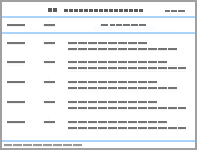
表1
DRA的发病率以及轻度、中度和重度病例的比例
| Item | Non-DRA group | DRA group | |||
|---|---|---|---|---|---|
| Total | Mild DRA | Moderate DRA | Severe DRA | ||
| Cases (n) | 73 | 327 | 171 | 152 | 4 |
| Proportion | 18.25%(73/400) | 81.75%(327/400) | 52.29%(171/327) | 46.48%(152/327) | 1.22%(4/327) |
表2
DRA组与非DRA组产妇临床资料比较
| Item | non-DRA group(n=73) | DRA group (n=327) | Z/χ2 | P |
|---|---|---|---|---|
| Newborn weight(g) | 3 190(2 094-3 390) | 3 385(3 095-3 670) | 4.409 | <0.001 |
| Age(y) | 32(28-34) | 32(30-34) | 1.098 | 0.272 |
| Height(mm) | 163.0(159.5-166.5) | 163.0(160.0-167.0) | 0.341 | 0.733 |
| Pre-pregnancy weight(kg) | 57.0(50.0-60.8) | 56.0(51.0-61.0) | 0.271 | 0.786 |
| Pre-pregnancy BMI | 21.0(19.2-23.45) | 21.0(19.3-22.8) | 0.548 | 0.584 |
| Pre-delivery weight(kg) | 67.0(62.8-75.0) | 68.0(63.0-74.0) | 0.113 | 0.910 |
| Weight gain during pregnancy(kg) | 11.0(8.0-14.8) | 12.0(10.0-15.0) | 1.181 | 0.070 |
| Pre-delivery BMI | 25.8(24.1-27.7) | 25.6(23.7-27.8) | 0.245 | 0.807 |
| Pregnancy times | 0.018 | 0.893 | ||
| 1 | 40(10.0%) | 182(45.5%) | ||
| ≥2 | 33(8.3%) | 145(36.3%) | ||
| Delivery times | 4.697 | 0.030 | ||
| 1 | 62(15.5%) | 238(59.5%) | ||
| ≥2 | 11(2.8%) | 89(22.3%) | ||
| Delivery mode | 8.010 | 0.005 | ||
| Vaginal delivery | 60(15.0%) | 213(53.3%) | ||
| Cesarean section | 13(3.3%) | 114(28.5%) | ||
| Twins | 2.525 | 0.112 | ||
| No | 73(18.3%) | 316(79.0%) | ||
| Yes | 0(0) | 11(2.3%) | ||
| Macrosomia | 3.751 | 0.051 | ||
| No | 73(18.3%) | 310(77.5%) | ||
| Yes | 0(0) | 17(4.3%) | ||
| Gestational diabetes | 0.181 | 0.670 | ||
| No | 62(15.5%) | 271(67.8%) | ||
| Yes | 11(2.8%) | 56(14.0%) | ||
| Thyroid dysfunction | 0.032 | 0.858 | ||
| No | 61(15.3%) | 276(69.0%) | ||
| Yes | 12(3.0%) | 51(12.3%) |
表3
DRA的独立危险因素
| Item | B | Standard error | Wald | P | Exp(B) |
|---|---|---|---|---|---|
| Newborn weight | 0.001 | <0.001 | 9.870 | 0.002 | 1.001 |
| Cesarean section | 0.936 | 0.338 | 7.670 | 0.006 | 2.549 |
| Delivery times | 0.719 | 0.347 | 4.288 | 0.038 | 2.053 |
表4
轻度DRA组与中度DRA组产妇临床资料比较
| Item | mild DRA group(n=171) | moderate DRA group(n=152) | Z/χ2 | P |
|---|---|---|---|---|
| Newborn weight(g) | 3 370(3 065.0-3 585.0) | 3 401(3 132.5-3 747.5) | 2.094 | 0.036 |
| Age(y) | 32(29-34) | 32(30-34) | 1.745 | 0.081 |
| Height(mm) | 163(159.5-166.6) | 162(160.0-165.0) | 1.678 | 0.093 |
| Pre-pregnancy weight (kg) | 55(51.000-61.000) | 56(51.125-60.875) | 0.704 | 0.481 |
| Pre-pregnancy BMI | 20.7(19.1-22.8) | 21.5(19.9-23.0) | 1.540 | 0.124 |
| Pre-delivery weight(kg) | 68.0(61.5-73) | 68(63.5-75.0) | 1.064 | 0.288 |
| Weight gain during pregnancy(kg) | 12.0(10.000-14.000) | 12.5(9.625-15.000) | 1.408 | 0.150 |
| Pre-delivery BMI | 25(23.400-27.400) | 26(24.125-28.300) | 2.184 | 0.029 |
| Pregnancy times | 1.091 | 0.296 | ||
| 1 | 101(31.27%) | 81(25.08%) | ||
| ≥2 | 70(21.67%) | 71(21.98%) | ||
| Delivery times | 5.191 | 0.023 | ||
| 1 | 135(41.80%) | 103(31.89%) | ||
| ≥2 | 36(11.15%) | 49(15.17%) | ||
| Delivery mode | 16.408 | <0.001 | ||
| Vaginal delivery | 129(39.94%) | 82(25.39%) | ||
| Cesarean section | 42(13.00%) | 70(21.67%) | ||
| Twins | 2.525 | 0.112 | ||
| No | 167(51.70%) | 146(45.20%) | ||
| Yes | 4(1.24%) | 6(1.86%) | ||
| Macrosomia | 3.751 | 0.051 | ||
| No | 165(51.08%) | 142(42.96%) | ||
| Yes | 6(1.86%) | 10(3.10%) | ||
| Gestational diabetes | 0.181 | 0.670 | ||
| No | 142(43.96%) | 125(38.70%) | ||
| Yes | 29(8.98%) | 27(8.36%) | ||
| Thyroid dysfunction | <0.001 | 1.000 | ||
| No | 144(44.58%) | 128(39.63%) | ||
| Yes | 27(8.36%) | 24(7.43%) |
| [1] | 孙秀丽, 李环, 苏园园, 等. 产后腹直肌分离诊断与治疗的专家共识[J]. 中国妇产科临床杂志, 2021, 22(02): 220-221. |
| SUN X L, LI H, SU Y Y, et al. Expert Consensus on the Diagnosis and Treatment of Postpartum Diastasis Recti Abdominis[J]. Chin J Clin Obstet Gynecol, 2021, 22(2): 220-221. | |
| [2] | 郑新烈, 陈潇宇, 涂素华, 等. 产后女性腹直肌分离危险因素的Meta分析[J]. 全科护理, 2022, 20(27): 3754-3758. |
| ZHENG X L, CHEN X Y, TU S H, et al. Meta-analysis of risk factors for diastasis recti abdominis in postpartum woman[J] Chin Gene Pract Nurs, 2022, 20(27): 3754-3758. | |
| [3] |
QU E, WU J, ZHANG M, et al. The ultrasound diagnostic criteria for diastasis recti and its correlation with pelvic floor dysfunction in early postpartum women[J]. Quant Imaging Med Surg, 2021, 11(2): 706.
doi: 10.21037/qims URL |
| [4] | 叶秀琴, 潘群艳. 产后腹直肌分离高频超声特征及其与分娩方式的相关性研究[J]. 中华全科医学, 2023, 21(3): 469-472. |
| YE X Q, PAN Q Y. High-frequency ultrasound characte-ristics of postpartum rectus abdominis separation after delivery and its correlation with delivery mode[J]. Chin J Gene Pract, 2023, 21(3): 469-472. | |
| [5] |
GLUPPE S B, ENGH M E, BØ K. Immediate effect of abdominal and pelvic floor muscle exercises on interrecti distance in women with diastasis recti abdominis who were parous[J]. Phys Ther, 2020, 100(8): 1372-1383.
doi: 10.1093/ptj/pzaa070 pmid: 32302393 |
| [6] | 蔡留芸, 邓芯茹, 陆彦旭, 等. 超声评估初产妇产后6周腹直肌分离情况及影响因素[J]. 中国医学影像学杂志, 2021, 29(11): 1134-1138. |
| CAI L Y, DENG X R, LU Y X, et al. Diastasis recti abdominis in primipara women at 6 weeks after childbirth measured by ultrasound and risk factors[J]. Chin J Med Imaging, 2021, 29(11): 1134-1138. | |
| [7] | 张明珠, 牛敏昌, 刘菲菲, 等. 高频超声评价产后女性腹直肌分离类型的初步研究[J]. 中国临床医学影像杂志, 2022, 33(3): 201-205. |
| ZHANG M Z, NIU M C, LIU F F, et al. Preliminary study of high frequency ultrasound on evaluating the types of diastasis recti abdominis in postpartum women[J]. J Chin Clin Med Imaging, 2022, 33(3): 201-205. | |
| [8] |
FERMANDES D A MOTA P G, PASCOAL A G, CARITA AI, et al. Prevalence and risk factors of diastasis recti abdominis from late pregnancy to 6 months postpartum, and relationship with lumbo-pelvic pain[J]. Man Ther, 2015, 20(1): 200-205.
doi: 10.1016/j.math.2014.09.002 URL |
| [9] |
SPERSTAD J B, TENNFJORD M K, HILDE G, et al. Diastasis recti abdominis during pregnancy and 12 months after childbirth: prevalence, risk factors and report of lumbopelvic pain[J]. Br J Sports Med, 2016, 50(17): 1092-1096.
doi: 10.1136/bjsports-2016-096065 URL |
| [10] | 邓炳俊, 乐连利, 肖红红. 产后女性腹直肌分离对盆底功能及性生活质量的影响[J]. 吉林医学, 2024, 45(11): 2668-2672. |
| DENG B J, LE L L, XIAO H H. The impact of postpartum diastasis rectus abdominis on pelvic floor function and sexual quality of life[J] Jilin Med, 2024, 45(11): 2668-2672. | |
| [11] | 王青, 于晓杰, 杨欣, 等. 产后腹直肌分离发生的影响因素研究[J]. 现代妇产科进展. 2019, 28(12): 913-916. |
| WANG Q, YU X J, YANG X, et al. Risk factors for diastasis recti abdominis after delivery[J]. Prog Obstet Gyneco, 2019, 28(12): 913-916 | |
| [12] |
HERNÁDEZ-GRANADOS P, HENRIKSEN NA, BERREVOET F, et al. European Hernia Society guidelines on management of rectus diastasis[J]. Br J Surg, 2021, 108(10): 1189-1191.
doi: 10.1093/bjs/znab128 URL |
| [13] | KAUFMANN R L, REINER C S, DIETZ U A, et al. Normal width of the linea alba, prevalence, and risk factors for diastasis recti abdominis in adults, a cross-sectional study[J]. Hernia, 2022: 1-10. |
| [14] | 阚晓纯, 尤玲英, 顾娟芬, 等. 产后腹直肌分离的超声诊断与分型分类研究[J]. 实用临床医药杂志, 2022, 26(15): 26-29,35. |
| KAN X C, YOU L Y, GU J F, et al. Ultrasonic diagnosis and typing classification of postpartum diastasis recti abdominis[J]. J Clin Med Pract, 2022, 26(15): 26-29+35. | |
| [15] |
MOTA P, PASCOAL AG, SANCHO F, et al. Reliability of the inter-rectus distance measured by palpation. Comparison of palpation and ultrasound measurements[J]. Man Ther, 2013, 18(4): 294-298.
doi: 10.1016/j.math.2012.10.013 URL |
| [16] |
KESHWANI N, MCLEAN L. Ultrasound imaging in postpartum women with diastasis recti: intrarater between-session reliability[J]. J Orthop Sports Phys Ther, 2015, 45(9): 713-718.
doi: 10.2519/jospt.2015.5879 URL |
| [17] | 郑嘉明, 任苓, 张朋燕, 等. 腹直肌分离诊疗研究进展[J]. 赣南医学院学报, 2023, 43(3): 315-320. |
| ZHENG J M, REN L, ZHANG P Y, et al. Advances in diagnosis and treatment of rectus abdominis separation[J]. J Gann Med Univ, 2023, 43(3): 315-320. | |
| [18] | 付鹏, 江凌, 崔立刚. 高频超声在产后女性腹直肌分离评估中的应用价值[J]. 中华医学超声杂志(电子版), 2021, 18(1): 79-83. |
| FU P, JIANG L, CUI L G. Value of high frequency ultrasound in evaluation of diastasis recti abdominis in postpartum women[J]. Chin J Med Ultrasound (Electronic Edition), 2021, 18(1): 79-83. | |
| [19] | 侯丽红, 蔡晓婷, 邱惠君. 高频彩超联合经腹超声在产后女性腹直肌分离诊断中的应用价值分析[J]. 现代诊断与治疗, 2023, 34(8): 1210-1212. |
| HOU L H, CAI X T, QIU H J. Analysis of the application value of high-frequency ultrasound combined with transabdominal ultrasound in the diagnosis of dissociation rectus abdominis in postpartum women[J]. Mod Diagn Treat, 2023, 34(8): 1210-1212. | |
| [20] | 江庆, 顾军, 冯冠男, 等. 产后42-60 d腹直肌间距的超声参考值范围[J]. 中华医学超声杂志(电子版), 2021, 18(11): 1067-1072. |
| JIANG Q, GU J, FENG G N, et al. Reference range of inter-recti distance measured by ultrasonography at 42-60 days postpartum[J]. Chin J Med Ultrasound (Electronic Edition), 2021, 18(11): 1067-1072. | |
| [21] | LIN J, SONG C X, QUE K X, et al. Real-time ultrasound feedback of transversus abdominis muscle activation on postpartum diastasis recti abdminis[J]. Chin J Clin Res, 2023, 36(5):698-703. |
| [1] | 唐春花, 郭露, 张莉莉. 2025年全球卒中报告数据解读:卒中疾病负担的梯度演变与精准治理[J]. 诊断学理论与实践, 2025, 24(05): 485-497. |
| [2] | 杨梅, 廖啟安, 谭全会, 李婷婷, 张毅, 陈洁, 汤正好. 医院获得性细菌性脑膜炎患者预后不良的危险因素分析及列线图预测模型的构建[J]. 诊断学理论与实践, 2025, 24(04): 441-448. |
| [3] | 雷朝闻尉, 饶佳玲, 周梦雪, 杨虹. 胰腺脂肪沉积的危险因素及相关疾病的研究进展[J]. 诊断学理论与实践, 2025, 24(01): 72-79. |
| [4] | 邵新淋, 朱雪梅, 曹华. 结缔组织病相关间质性肺疾病危险因素及发病机制研究进展[J]. 诊断学理论与实践, 2024, 23(02): 202-209. |
| [5] | 姚世发, 陈萍, 李亮, 牛建梅. 超声检查在无精症病因诊断中的应用价值[J]. 诊断学理论与实践, 2023, 22(04): 369-373. |
| [6] | 李蕾, 吴希, 戴菁, 武文漫, 丁秋兰, 王学锋. 中国118例颅内静脉窦血栓患者的临床特点及危险因素分析[J]. 诊断学理论与实践, 2023, 22(03): 261-269. |
| [7] | 丁燕飞, 忻笑容, 周郁芬, 谢玲, 谷雷雷, 吴云林, 陈平. 上消化道溃疡伴出血患者溃疡愈合延迟的危险因素分析[J]. 诊断学理论与实践, 2022, 21(03): 312-316. |
| [8] | 徐琛莹, 李嫣然, 倪晓枫, 徐上妍, 林青. 超声预测老年甲状腺乳头状癌患者颈部淋巴结转移的效能及相关超声征象分析[J]. 诊断学理论与实践, 2022, 21(03): 343-348. |
| [9] | 梁亚丽, 赵海港, 项广宇. 应激性高血糖比值预测急性缺血性脑卒中患者溶栓治疗后1年不良预后的价值[J]. 诊断学理论与实践, 2021, 20(06): 562-566. |
| [10] | 何碧媛, 周毓青, 姚秉彝, 曹力, 包丽. 中孕期弹性超声成像宫颈机能智能定量分析预测自发性早产的临床应用价值[J]. 诊断学理论与实践, 2021, 20(05): 450-455. |
| [11] | 刘安平, 凌枫, 史超, 孙璟. 上海社区老年脑卒中患者跌倒风险因素分析及风险识别模型的建立[J]. 诊断学理论与实践, 2021, 20(05): 475-479. |
| [12] | 施仲伟. 回眸过去30年全球和中国的心血管疾病负担及其危险因素——1990年至2019年全球心血管疾病负担及其危险因素报告解读[J]. 诊断学理论与实践, 2021, 20(04): 349-355. |
| [13] | 杨一娴, 倪仲馨, 夏蜀珺, 周伟, 詹维伟. 多灶性与单灶性甲状腺乳头状癌的临床病理特征及超声表现的比较[J]. 诊断学理论与实践, 2021, 20(02): 168-172. |
| [14] | 吴洁, 冯媛媛, 任妍, 曹久妹. 基于冠状动脉造影检查的高龄老年人群发生冠心病的危险因素调查及相应诊断模型的建立[J]. 诊断学理论与实践, 2021, 20(02): 201-206. |
| [15] | 林雨轩, 赵延华, 王筱婧. 丙泊酚镇静下无痛胃镜术中低氧血症的发生率及危险因素分析[J]. 诊断学理论与实践, 2020, 19(06): 594-599. |
| 阅读次数 | ||||||
|
全文 |
|
|||||
|
摘要 |
|
|||||
