

Journal of Internal Medicine Concepts & Practice >
Clinical application of renal artery ultrasound monitoring hemodynamic parameters and non-contrast-enhanced magnetic resonance angiography in evaluation of renal artery stenosis and anatomic abnormalities
Received date: 2024-07-31
Online published: 2025-10-27
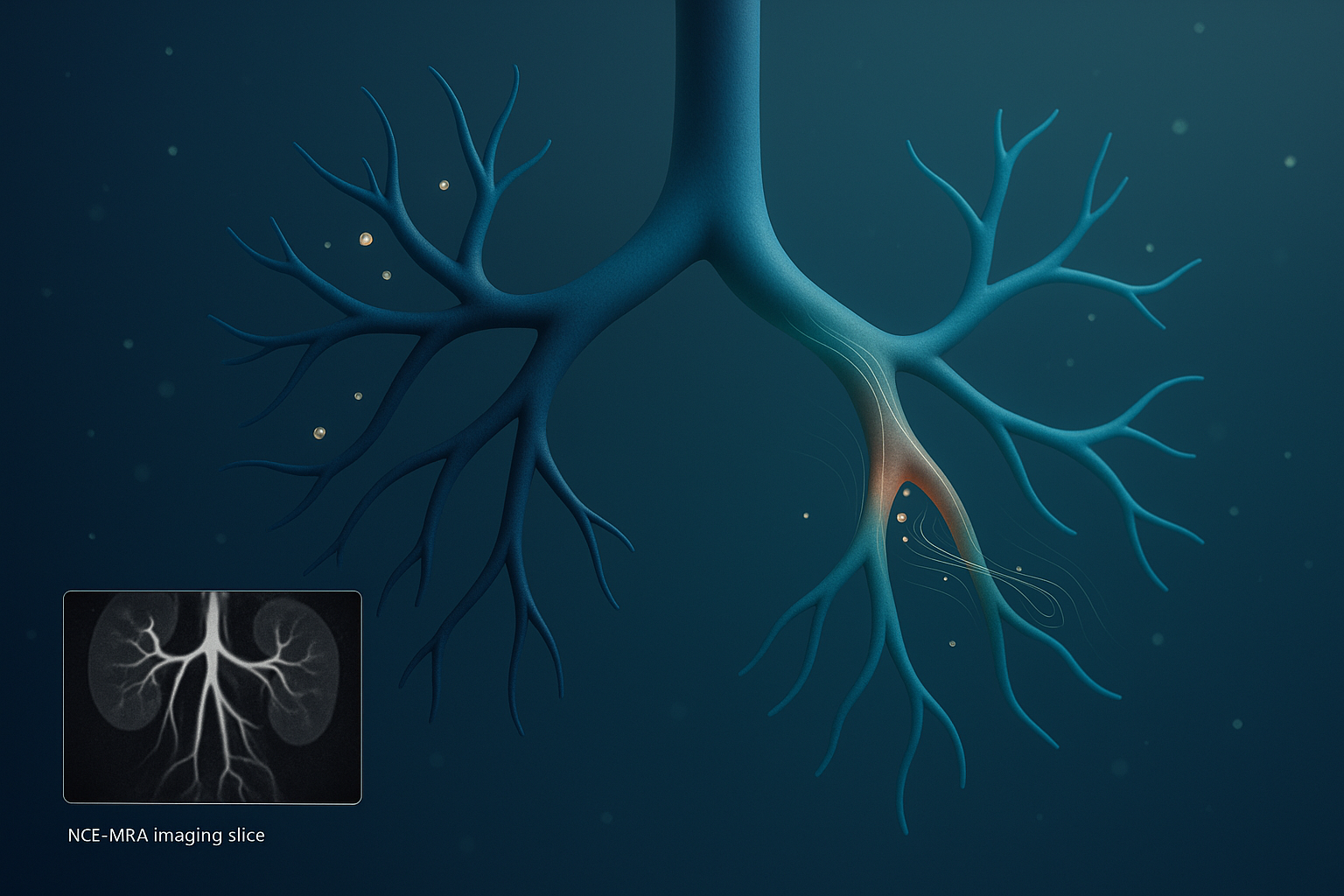
Objective To compare the clinical value of renal artery ultrasound hemodynamic parameters and non-enhanced magnetic resonance in evaluating renal artery stenosis and anatomical abnormalities. Methods A total of 149 patients with chronic kidney disease(CKD) were enrolled. Renal artery stenosis and anatomical variations were evaluated by non-enhanced renal artery magnetic resonance angiography (NEC-MRA). Color Doppler ultrasound was used to detect hemodynamic parameters of each segment of the renal artery. Renal function assessment was conducted through two methods: radionuclide renal dynamic imaging and the calculation of the estimated glomerular filtration rate (eGFR) using the CKD Epidemiology Collaboration (CKD-EPI) study equation formula. Results Among the 149 patients in this study, 17 cases (11.4%) were at CKD stage 1, 39 cases (26.2%) at stage 2, 44 cases (29.5%) at stage 3, 17 cases (11.4%) at stage 4, and 32 cases (21.5%) at stage 5. The resistance index (RI) of patients with initial renal artery stenosis was significantly higher than that of patients without stenosis (P=0.000), while there was no statistically significant difference in peak systolic velocity (PSV) (P= 0.443). There was no statistical difference in PSV and RI between the two groups with or without midstream stenosis (P=0.190, P=0.088). There was no significant difference in PSV and RI between the initial and middle segments of the anatomical variation group and the non-variation group (P > 0.05). The eGFR on the non-stenotic side of the initial segment of the renal artery was significantly higher than that on the stenotic side (Z=2.98, P=0.029), and eGFR on the non-stenotic side in the middle segment was significantly higher than that on the stenotic side (Z=4.025, P=0.001). There was no statistical difference in eGFR between the anatomical variant side and the non-variant side (Z=0.579, P=0.550). Conclusions Color Doppler ultrasound PSV and RI show higher value in diagnosing initial renal artery stenosis than middle renal artery stenosis and have no diagnostic value for anatomic variation of renal artery. Both initial and middle renal artery stenosis leads to a decrease in the ipsilateral renal GFR, while variations in renal artery anatomy does not affect ipsilateral renal GFR.
SUN Jie , XIE Jie , MA Hongkun , LIU Baolian , CHEN Xueying , HUANG Wenjie , HE Shuilin , CHEN Zijin , ZHANG Wen . Clinical application of renal artery ultrasound monitoring hemodynamic parameters and non-contrast-enhanced magnetic resonance angiography in evaluation of renal artery stenosis and anatomic abnormalities[J]. Journal of Internal Medicine Concepts & Practice, 2025 , 20(04) : 276 -281 . DOI: 10.16138/j.1673-6087.2025.04.03
| [1] | Chai JW, Lee W, Yin YH, et al. CT angiography for living kidney donors: accuracy, cause of misinterpretation and prevalence of variation[J]. Korean J Radiol, 2008, 9(4):333-339. |
| [2] | 郭震华, 那彦群. 实用泌尿外科学[M]. 2版. 北京: 人民卫生出版社,2014:112. |
| [3] | AbuRahma AF, Yacoub M. Renal imaging: duplex ultrasound, computed tomography angiography, magnetic resonance angiography, and angiography[J]. Semin Vasc Surg, 2013, 26(4):134-143. |
| [4] | Herborn CU, Watkins DM, Runge VM, et al. Renal arteries: comparison of steady-state free precession MR angiography and contrast-enhanced MR angiography[J]. Radiology, 2006, 239(1):263-268. |
| [5] | Holden A, Smith A, Dukes P, et al. Assessment of 100 live potential renal donors for laparoscopic nephrectomy with multi-detector row helical CT[J]. Radiology, 2005, 237(3):973-980. |
| [6] | Bordei P, Sapte E, Iliescu D. Double renal arteries originating from the aorta[J]. Surg Radiol Anat, 2004, 26(6):474-479. |
| [7] | H?nninen EL, Denecke T, Stelter L, et al. Preoperative evaluation of living kidney donors using multirow detector computed tomography: comparison with digital subtraction angiography and intraoperative findings[J]. Transpl Int, 2005, 18(10):1134-1141. |
| [8] | Gupta A, Tello R. Accessory renal arteries are not related to hypertension risk: a review of MR angiography data[J]. AJR Am J Roentgenol, 2004, 182(6):1521-1524. |
| [9] | Shen J, Lyu L, Wu X, et al. Correlation between renal artery anatomy and hypertension: a retrospective analysis of 3000 patients[J]. Evid Based Complement Alternat Med, 2021,2021:9957361. |
| [10] | Kang K, Ma Y, Jia C, et al. Relationship between accessory renal artery and clinical characteristics of middle-aged patients with primary hypertension[J]. Int J Hypertens, 2020,2020:7109502. |
| [11] | 刘方韬, 齐晓凤, 徐学勤, 等. 非增强磁共振血管成像在肾动脉狭窄评估方面的价值研究[J]. 诊断学理论与实践, 2019, 18(1):72-76. |
| [12] | Zhang LJ, Peng J, Wen J, et al. Non-contrast-enhanced magnetic resonance angiography: a reliable clinical tool for evaluating transplant renal artery stenosis[J]. Eur Radiol, 2018, 28(10):4195-4204. |
| [13] | Bley TA, Fran?ois CJ, Schiebler ML, et al. Non-contrast-enhanced MRA of renal artery stenosis: validation against DSA in a porcine model[J]. Eur Radiol, 2016, 26(2):547-555. |
| [14] | Fananapazir G, McGahan JP, Corwin MT, et al. Screening for transplant renal artery stenosis: ultrasound-based stenosis probability stratification[J]. AJR Am J Roentgenol, 2017, 209(5):1064-1073. |
| [15] | Granata A, Fiorini F, Andrulli S, et al. Doppler ultrasound and renal artery stenosis: an overview[J]. J Ultrasound, 2009, 12(4):133-143. |
| [16] | van Twist DJ, Houben AJ, de Haan MW, et al. Pathophysiological differences between multifocal fibromuscular dysplasia and atherosclerotic renal artery stenosis[J]. J Hypertens, 2017, 35(4):845-852. |
| [17] | Lo R, Donaldson C. Vessel tortuosity causing false positives in detecting renal artery stenosis on doppler ultrasound[J]. Ultrasound Q, 2013, 29(1):47-50. |
| [18] | Kendrick J, Chonchol M. Renal artery stenosis and chronic ischemic nephropathy: epidemiology and diagnosis[J]. Adv Chronic Kidney Dis, 2008, 15(4):355-362. |
/
| 〈 |
|
〉 |
