
Research article

Pressurization, intercalation, doping, and elements: An empirical study of superconductivity near perturbation onsets

  • Shermane M. Benjamin
Expand
  • The National High Magnetic Field Laboratory, 1800 E. Paul Dirac Drive, Tallahassee, FL 32310, USA

E-mail address:

Received date: 2024-02-29

  Revised date: 2024-04-16

  Accepted date: 2024-04-20

  Online published: 2024-04-30

Abstract

Superconductivity is a phenomenon arising from cooperative electron behavior. However, correlations among (1) the minimum tuning parameter required for emergence, (2) the superconducting transition temperature resulting from minimal tuning, and (3) the host's physical/chemical properties still elude the scientific community. Recent empirical investigations, such as those revealing ideal gas-like correlations at the onset of superconductivity in intercalated superconductors, motivate this study. Our investigation reports similar findings in systems (>170 compounds) exhibiting superconductivity through other perturbative means, such as single-element doping. In general, statistical measures, including distance correlation analyses (≠ linear regression fit) of thermodynamic variables, indicate the presence of empirical relationships near the superconducting onset of systematically tuned compounds. These relations involve unit cell volume (V), the number of valence electrons (N), and the superconducting transition temperature (Tc). Note: The author's primary aim is not to validate or challenge BCS theory; it is instead to focus on leveraging methodology led by available data to enhance the exploration and development of innovative and cost-effective superconductors.

Cite this article

Shermane M. Benjamin . Pressurization, intercalation, doping, and elements: An empirical study of superconductivity near perturbation onsets[J]. Superconductivity, 2024 , 10(0) : 100098 . DOI: 10.1016/j.supcon.2024.100098

1. Introduction

There are various pathways to superconductivity. These include unconventional routes such as gating [1], [2], [3], stacking [4], and twisting [5], and long-established techniques like intercalation [6], [7], [8], doping [9], [10], [11], and pressurization [12], [13], [14]. All methods reliably transform nonsuperconducting materials into superconductors. Pressurization has even successfully produced compounds with predicted signatures of high-temperature superconductivity [15], [16], [17].
A common characteristic of these established pathways is the generic dome-like phase diagram depicted in Fig. 1. Thus far, this hallmark feature has not been systematically linked to the chemistry or structure of superconductors. These diagrams typically illustrate superconductivity (i.e., measurable Tc) appearing within specific chemical (e.g., dopant concentration) or physical (e.g., hydrostatic pressure) control parameter values. Some also display monotonic suppression of magnetic order and/or structural transitions preceding the emergence of superconductivity [18], [19], while others allow the coexistence of these states [20], [21].
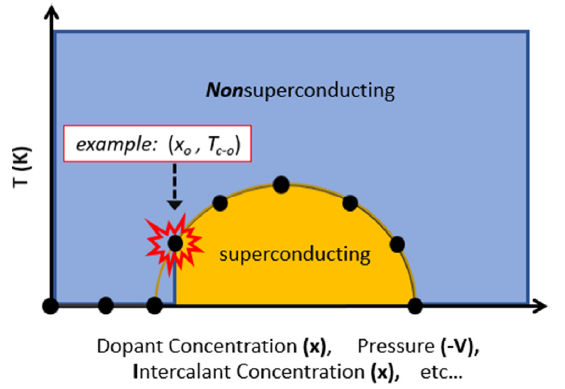
Fig. 1. Temperature versus atomic concentration x, pressurized unit cell volume V, and other control parameters, for a generic phase diagram depicting a nonsuperconducting region in blue and a dome-like superconducting region in gold. The highlighted onset point (xo, Tc−0) is defined as the minimum perturbation (e.g., atomic concentration) required for superconductivity's emergence.
The often-serendipitous appearance of the superconducting region has long perplexed the materials science community. However, recent studies [22], [23] revealed the chemical boundary between the normal and superconducting state, as illustrated in Fig. 1, empirically follows Eq. (1) for intercalated superconductors. Notably, available data suggests the rule is independent of the possible emergence and coexistence of other quantum states (e.g., magnetism) with similar energy.
$ P_{\text {int. }-o} V=x_{o} N \kappa T_{c-o}$
The variables P, V, xo, N, κ, and Tc−o are the calculated intercalant pressure (:= Pint.−o ≈ 1 atm), unit cell volume, intercalant atomic concentration at the onset of superconductivity, number of intercalant valence electrons (:= Nint.; s and d electrons for all transition elements), Boltzmann constant, and critical temperature at the onset concentration, respectively. Since the investigated compounds have similar P, essentially, Eq. (1) implies that the calculated electron perturbation density (ρint.−o = xoN/V) for intercalates at the onset of superconductivity is inversely proportional to Tc−o. The appearance of a’critical pressure’ and its average value (∼1 atm) seem to be the only empirical feature shared among intercalated superconductors reported to date.
This report delves into the emergence of superconductivity from perturbative methods beyond intercalation. It specifically investigates near onset conditions in (1) elemental superconductors, (2) doped compounds, and (3) pressurized compounds. Therefore, only a subset of superconductors, including the most cited/investigated, are analyzed out of the thousands in existence to date. Methods used in this study do not apply to compounds like XTa2S5 [X = Mg, Ca, Sr, and Ba] [24], [25], [26], [27] or MgB2 [28] and Ba2Nb3S8I [29], which superconduct under isoelectronic conditions or without obvious perturbations (chemical or physical) from a nonsuperconducting state, respectively. Investigated compounds include iron pnictides, cuprates, bismuth sulfides, nickelates, oxyhydrides, fluorides, and many others. Results are compared to onset conditions reported for intercalated compounds [22], [23]. Comparisons involve the estimation of unit cell volumes (V) and onset perturbation densities (ρo) extracted from experimental data. Both parameters are then juxtaposed with onset transition temperatures (Tc−o). The onset perturbation density is defined as the minimum number of valence electrons (N) per formula unit per unit cell volume required for superconductivity to emerge from a nonsuperconducting compound. All data utilized in this manuscript have been sourced from previously reported experiments available on Google Scholar and are duly cited throughout the text.

2. Onset of elemental superconductivity

Empirical studies like those conducted by Matthias heavily influenced the direction of superconductivity research after the first superconductor was discovered in 1904 [30]. His work highlighted the importance of counting the total number of valence electrons a compound has per atom when attempting to predict new superconductors of particular structures or chemistries. Empirical rules regarding superconductivity evolving from particular synthesis pathways like intercalation, however, had not been discovered until recently, specifically in compounds of binary constituents and greater. This section now shifts focus to the onset of superconductivity in single-element compounds. To accomplish this, similar to the approach taken with intercalated compounds, we examine the nonsuperconducting/superconducting boundary within the periodic table of elements as a function of increasing electron number at standard temperature and pressure (STP). The landscape of known superconductors is vast and ever-growing. Nevertheless, it is important to underscore that unless a new element is discovered, the data set of single-element superconductors is uniquely complete as it represents 100% of superconductors known in their simplest chemical form to date.
Firstly, it is observed that a superconducting dome, akin to Fig. 1, is present in the periodic table of elements, as illustrated in Fig. 2. This depiction is constructed by initially considering group 1 elements Na, K, Rb, Cs, and Fr, arranged here by increasing period number and depicted in blue squares in Fig. 2. These elements, each having one valence electron in their unfilled shell, do not exhibit superconductivity at STP. Superconductivity becomes evident at STP in Al, Ti, Zr, La, and Th, represented by gold squares with red borders in Fig. 2, only when 2 to 3 electrons are added to their unfilled shells and nucleons are adjusted accordingly. These elements signify the onset of superconductivity in shells n = 3 to n = 7, marking the initial boundary separating superconductors and nonsuperconductors as electrons increase from N = 1. Beyond this boundary and beneath the “dome” of superconductors shown in Fig. 2, nearly all elemental superconductors that exist at STP, excluding lithium and beryllium, are situated.
Fig. 2. Periodic table highlighting the onset of superconductivity in elements. The thick red borderline represents the boundary between nonsuperconducting elements and the onset of superconductivity within shells 3-7. Aluminum, Titanium, Zirconium, Lanthanum, and Thorium are the first elements to show superconductivity at STP as a function of increasing electron number in shells 3-7, respectively. They are shown in gold squares. Blue squares indicate elements showing no superconductivity at STP. White squares depict unspecified transport properties unless covered by the “Dome” of superconductors encapsulating most elements exhibiting superconductivity at STP.
Calculated perturbation densities, ρelem.#−o = Nelem//V, for all 5 onset elements are shown in Table 1 and Fig. 3 (blue circles). The subscript “#” represents period number. Like intercalated systems (Fig. 3 − red circles), the distance correlation coefficient [31], [32] for onset elements is high at dCor(Tc−o,ρelem.−o) =.76. For intercalates, dCor(Tc−o, ρint.−o) =.62. All distance coefficient calculations in this report were carried out with an in-house, self-designed, LabView VI utilizing algorithms reported by Szekely et al. [31].
Table 1. A list of nine elements which superconduct at STP. Bolded elements Al, Ti, Zr, La, and Th represent the onset of superconductivity in periods 3-7 (i.e., asterisked pressures). Elements V, Nb, Hf, and Pa are superconductors closest to onset in periods 4-7. Aluminum is the only superconductor at STP within n = 3.
Period (n) [ref.] Element Tc (K) $ V\left(\dot{A}^{3}\right) $ Nelem. $ \rho_{\text {elem. }}\left(\frac{N_{\text {elem. }}}{\dot{A}^{3}}\right) $ P (atm)
3 [33] Al 1.175 66.32 3 0.045 7.2*
4 [34] Ti 0.4 35.33 4 0.113 6.2*
4 [35] V 5.4 27.82 5 0.179 132.2
5 [36] Zr 0.61 46.56 4 0.0853 7.1*
5 [36] Nb 9.25 36.07 5 0.138 174.7
6 [37], [38] La (α-β) 4.88-6.3 150.29 3 0.019-0.025 13.3-16.3*
6 [37] Hf 0.128 44.53 4 0.09 1.6
7 [37] Th 1.38 131.42 4 0.03 5.7*
7 [39] Pa 1.4 48.92 4 0.081 15.6
Fig. 3. Onset perturbation density, ρo, versus transition temperature, Tc−o.
A pressure Pelem.#−o (Eq. (2)) can be assigned to onset elements. For example, the pressure for Aluminum is Pelem.3−o = 7.2 atm, where N = Nelem. = 3, V = 66.32 Å3, and Tc−o = 1.175 K. Pressure estimates for onset elements and others are noted in Table 1. The average is 7.9 atm, as opposed to 1.3 atm for intercalated compounds. Arriving at the precise value of 1 atm for intercalates relies on the resolution and precision of the experimental data used in the analysis. Pressure estimates for elements wildly deviate from one another immediately beyond onset as shown in Table 1. See Table S1 in the supporting information section for similar analyses conducted on all superconductors located under the “dome” of superconductivity in Fig. 2.
$ P_{\text {elem.\#-o }} V=N \kappa T_{c-o}$
Distance correlation coefficients for the relationship between Tc−o and Vo in onset elements and intercalates are shown in Fig. 4. They are.82 and.62, respectively. These values suggest Tc−o and Vo are highly correlated in onset elements and intercalates. Bear in mind, the periodic table also allows an examination of offset conditions. Transition temperatures in this scenario oscillate with unit cell volume (see supporting information), unlike monotonous Tc−o(V). For intercalates, phase diagrams typically possess incomplete superconducting domes due to limitations in sample stability or synthesis methods. Therefore, offset conditions are not compared in this report.
Fig. 4. Transition temperature, Tc−o, versus onset volume, Vo. Plot (a) depicts onset elements as blue squares with a distance correlation coefficient of.82 indicated. Dashed black line serves as a guide to the eye at n = −1 for Tc−o ∝ V n; it is not a fit of the data. Plot (b) depicts intercalates [6], [11], [22] as red triangles with a distance correlation coefficient of.62 indicated. Dashed black line serves as a guide to the eye at n = −1 for Tc−o ∝ V n; it is not a fit of the data.

3. Doping-induced superconductivity (non-isoelectronic)

An alternate route to chemically induce superconductivity is doping by single-element substitution. For instance, Yang et al. illustrated this with semimetallic IrTe2 through intercalation and palladium doping. [11] The resultant compounds, PdxIrTe2 and Ir1−xPdxTe2, with xo equal to 0.02 and 0.03, respectively, provide unique insights into the initiation of superconductivity specific to the processes of doping and intercalation, given that the host and control parameter remain consistent in both cases.
Based on reported resistance measurements, both compounds exhibit onset transition temperatures of Tc−o ≈ 2.5 K. Pd0.02IrTe2, the intercalate, displays a narrower transition width. Yang et al. also demonstrated that the superconductivity in PdxIrTe2 and Ir1−xPdxTe2 competes with density waves in a manner reminiscent of a quantum critical point. The calculated intercalation perturbation density ρint.−o for Pdxo IrTe2 is depicted in Fig. 3. The pressure inferred from Eq. (1) is approximately 1 atm.
To search for correlated behavior in doping-induced superconductors we define a perturbation density in non-isoelectronically doped compounds as ρdop.−o = xo|ΔN|/V. The variable |ΔN| represents the difference in the number of outer electrons between elements under exchange. For Ir1−xPdxTe2 and most other compounds the value of |ΔN| is 1. An example compound having |ΔN| = 2 is SmFe1−xNixAsO [40]. The density is 4.14·1026 electrons/m3 for Ir1−xPdxTe2 and it is plotted against Tc−o shown in Fig. 5 along with 70 other doped superconductors [9], [10], [11], [40], [41], [42], [43], [44], [45], [46], [47], [48], [49], [50], [51], [52], [53], [54], [55], [56], [57], [58], [59], [60], [61], [62], [63], [64], [65], [66], [67], [68], [69], [70], [71], [72], [73], [74], [75], [76], [77], [78], [79], [80], [81], [82], [83], [84], [85], [86], [87], [88], [89], [90], [91], [92], [93], [94], [95], [96], [97], [98], [99], [100]. Unlike onset elements and intercalates, most of these materials exhibit both magnet and structural transitions near Tc. Therefore, the data are sorted into two categories. Grey squares represent sixteen compounds which do not show structural transitions (STR) near Tc; all but two do not show magnetic transitions. Black squares represent fifty-six compounds which show structural transitions near Tc; all but four also show magnetic transitions.
Fig. 5. Onset volumetric electron density, ρdop.−o, versus transition temperature, Tc−o.
The average density is 3·1026 electrons/m3 and nearly independent of Tc−o. The latter point is emphasized by the distance correlation coefficient, dCor(Tc−o, ρdop.−o) =.29. It is even more evident in the histogram binned to 1·1026 electrons/m3 shown in Fig. 6. The histogram is centered at 3·1026 electrons/m3 and skewed to the right. Though a constant perturbation density is unexpected, its average value is reminiscent of current densities typically estimated via Hall measurements of the normal state in the vicinity of superconductivity. [101], [102], [103].
Fig. 6. Frequency of doped superconductors versus calculated onset valence electron density. Data from 71 doped superconductors (see Table S2 in supporting information) are displayed. Grey squares indicate doped superconductors which do show structural transitions, black squares indicate those which do not show structural transitions. Bin size is of width 1·1026 electrons/m3. The peak value of the gaussian fit is shown to be ρdop.−o = 3·1026 electrons/m3.
Notice correlations with temperature differ between ρint.−o and ρdop.−o. The variable ρint.−o is inversely proportional to Tc−o. If this correlation is also casual, it would imply the relevant itinerate electrons undergo a diffusive-type transport at the onset of intercalate superconductivity. This behavior mimics the typical transport behavior associated with intercalated systems like lithium-ion batteries [104], for example. The variable ρdop.−o is weakly correlated to Tc−o. If causal, it implies a more non-diffusive (e.g., ballistic) type transport at the onset of superconductivity in doped compounds for the assumed itinerant relevant electrons. These correlations and interpretation are supported by Yang et al.'s transport data for Pd0.02IrTe2 and Ir0.97Pd0.03Te2 where it is evident that the intercalated compound's electrical resistance shows a greater temperature dependence during its transition to superconductivity. Also, according to their phase diagram, data above onset suggests doped compounds are less affected by changes in electron density like our empirical result show in Fig. 5 for onset conditions. From their data, Tc in the doped remains nearly constant and persists well above onset (x > 0.09). For the intercalated, with similar perturbation, Tc peaks at x = 0.03 then quickly diminishes to almost non-existent at x = 0.1. This reveals the intimate connection between electron number density and Tc, like what is shown in Fig. 3 for onset intercalates. Summarized data comparing doping to intercalation are tabulated within Table S4 in supporting information.
Preceding sections have alluded to an ever-present critical pressure at the onset of superconductivity as a function of emergence pathways. Its origin was attributed to either the manifestation of Charles's law (T ∝ V) or the observation that onset perturbation densities are inversely proportional to onset transition temperatures. On the contrary, neither of these situations appear relevant for doped compounds. Consequently, a similar ideal gas-like interpretation of critical pressure in doped superconductors, if it exists, seems unlikely. If a non-diffusive critical pressure is to be assigned to the assumed itinerant onset electrons of doping-induced superconductors (i.e., Pdop.−o), it would likely arise from the degeneracy pressure (i.e., Pdeg. = Pdop.−o) created by these electrons, as shown in Eq. (3). The constants me and ħ represent the electron mass and reduced Planck's constant, respectively. This implies a perturbation density of ρdop.−o = 3·1026 electrons/m3 results in a critical pressure of Pdop.−o ≈ 36 atm.
$ P_{\text {deg. }}=\frac{\hbar^{2}}{5 m_{e}}\left(3 \pi^{2}\right)^{\frac{2}{3}}\left(\rho_{\text {dop.-o }}\right)^{\frac{5}{3}}$
A way to uncover evidence of this presumed critical pressure is to examine the interface superconductivity of heterostructures formed by these compounds. Given Eqs. (3), (1), the equation for Tc at the interface of an underdoped compound and an “onset” intercalated compound can be deduced. The condition xo|ΔN| = xoNint.−o leads to a simple formula for Tc expressed in Eq. (4). This is intriguing as a Tc of approximately 29 K and/or its functional dependence on sample differences are not implausible attributes of unstrained interface superconductivity. [105], [106] Eq. (5) illustrates the deduced Tc for the interface of an underdoped compound and an onset element. To date, the specific scenarios required for testing Eqs. (4) and (5) have not been reported.
$ T_{\text {dop. }- \text { int. }}^{\text {intefface }}=\mathbf{2 9} \mathbf{K}\left(\frac{V_{\text {int.-o }}}{V_{\text {dop.-o }}}\right) $
$ T_{\text {dop.- } \text { lem. }}^{\text {interfer }}=145 \mathrm{~K}\left(\frac{V_{\text {elem.-o }}}{V_{\text {dop.-o }}}\right)$

4. Discussion

The culmination of these results suggests high-temperature superconductivity favors dilute systems (i.e., ρo ∝ T1) and large unit cell volumes (i.e., Tc−o ∝ Vo) at the genesis of superconductivity. It also reveals a minimum real space density in many compounds displaying doping-induced superconductivity. It is important to note that these findings pertain to a section of the phase diagram requiring the least amount of chemical resources (i.e., onset) for the emergence of superconductivity. Therefore, this information may be crucial for the engineering of future low-cost high-temperature superconductors with less reliance on serendipity. Refer to empirical relationships summarized in Table 2.
Table 2. Summary of empirical equations at the onset of superconductivity in intercalates, single-elements, and doped compounds.
Synthesis Technique Empirical Observation
(
1 K < Tc < 40 K)
Critical Pressure
(
1 K < Tc < 40 K)
Intercalation $ \rho_{\text {int,-o }} \propto T_{\mathrm{c}-0}^{-1} $ ∼1.3 atm
Single Elements $ \rho_{\text {elem.-0 }} \propto T_{c-0}^{-1} $ ∼6.5 atm*
Doping $ \rho_{\text {dop }-0} \approx \text { constant } $ ∼36 atm**

*For shells n≥3, La: 13.3 atm.

**If related to Fermi/degeneracy pressure.

As previously mentioned, pressurization is another pathway to superconductivity. Its effects are often likened to the “chemical pressure” associated with intercalation, for example [107], [108], [109]. Preliminary data we have observed in nearly 60 compounds [18], [19], [12], [13], [14], [15], [16], [110], [111], [112], [113], [114], [115], [116], [117], [118], [119], [120], [121], [122], [123], [124], [125], [126], [127], [128], [129], [130], [131], [132], [133], [134], [135], [136], [137], [138], [139], [140], [141], [142], [143], [144], [145], [146], [147], [148], [149], [150], [151], [152], [153], [154], [155], [156], [157], [158], [159], [160], [161], [162], [163], [164], [165], [166], [167] (see Table S3 in supporting information) also lend credence to this well-accepted idea concerning the relationship between Tc−o and Vo. Fig. 7 depicts data from compounds showing only a superconducting transition when cooled after pressurization, i.e., those possessing no magnetic ordering and no structural transitions. The distance correlation coefficient in this case is highly correlated at dCor(Vo, Tc−o) =.8. More work is needed to elucidate effects like magnetism on onset conditions in pressurized compounds; see Fig. S1 in supporting information for further analysis.
Fig. 7. Onset transition temperature, Tc−o, versus onset unit cell volume, Vo for 20 pressure-induced superconductors (see Table S3 in supporting information). A distance correlation coefficient of dCor(Vo, Tc−o) =.8 is indicated. Dashed line indicates n = 1 as a guide to the eye for Tc−o ∝ Von; it is not a fit of the data.

5. Conclusion

Correlated behavior has been identified near the onset of superconductivity in systematically tuned compounds with nuanced considersations of V, N, and Tc. In addition to contributing to fundamental research efforts, the author aims for this investigation to aid in refining the physical and chemical phase space explored by the scientistific community in their quest for new and innovative superconductors.

Funding

The National High Magnetic Field Laboratory is supported by the National Science Foundation through NSF/DMR-2128556, NSF/DMR-1644779, and the State of Florida.

CRediT authorship contribution statement

Shermane M. Benjamin: Conceptualization, Data curation, Formal analysis, Investigation, Methodology, Project administration, Supervision, Validation, Visualization, Writing - original draft, Writing - review & editing.

Declaration of competing interest

The authors declare that they have no known competing financial interests or personal relationships that could have appeared to influence the work reported in this paper.

Acknowledgements

The author sincerely thanks P.M. Eugenio, J. Jaroszynski, T. Murphy, M. Ozerov, M. Lee, B. Casas, D. Chichinadze, R. Baumbach, L. Balicas, C. Moir, D. Graf, E.S. Choi, and L. Nelson for many useful discussions. The author also expresses their gratitude to the reviewers and editor for their comments and critiques toward significantly improving the manuscript.

Appendix A. Supplementary material

Supplementary material to this article can be found online at https://doi.org/10.1016/j.supcon.2024.100098.

[1]
Sajadi E, Palomaki T, Fei Z, Zhao W, Bement P, Olsen C, et al. Gate-induced superconductivity in a monolayer topological insulator. Science 2018; 362:922-5.

[2]
Costanzo D, Jo S, Berger H, Morpurgo AF. Gate-induced superconductivity in atomically thin MoS2 crystals. Nat Nanotechnol 2016; 11:339-44.

[3]
Saito Y, Nojima T, Iwasa Y. Gate-induced superconductivity in two-dimensional atomic crystals. Supercond Sci Technol 2016; 29:093001.

[4]
Rhodes DA et al. Enhanced Superconductivity in monolayer Td-MoTe2. Nano Lett 2021; 21:2505-11.

[5]
Cao Y, Fatemi V, Fang S, Watanabe K, Taniguchi T, Kaxiras E, et al. Unconventional superconductivity in magic-angle graphene superlattices. Nature 2018; 556:43-50.

[6]
Neu J, Graf D, Wei K, Gaiser A, Xin Y, Lai Y, et al. Superstructures and superconductivity linked with Pd intercalation in Nb2PdxSe5. Chem Mater 2020; 32:8361-6.

[7]
Morosan E, Zandbergen HW, Dennis BS, Bos JWG, Onose Y, Klimczuk T, et al. Superconductivity in CuxTiSe2. Nat Phys 2006; 2:544-50.

[8]
Zhang R, Tsai I-L, Chapman J, Khestanova E, Waters J, Grigorieva IV. Superconductivity in potassium-doped metallic polymorphs of MoS2. Nano Lett 2016; 16:629-36.

[9]
Hu R, Bud’ko SL, Straszheim WE, Canfield PC. Phase diagram of superconductivity and antiferromagnetism in single crystals of Sr(Fe1-xCox)2As2 and Sr1-yEuy(Fe0.88Co0.12)2As2. Phys Rev B 2011; 83:094520.

[10]
Takagi H, Ido T, Ishibashi S, Uota M, Uchida S, Tokura Y. Superconductor- to-nonsuperconductor transition in (La1-xSrx)2CuO4 as investigated by transport and magnetic measurements. Phys Rev B 1989; 40:2254-61.

[11]
Yang JJ, Choi YJ, Oh YS, Hogan A, Horibe Y, Kim K, et al. Charge-orbital density wave and superconductivity in the strong spin-orbit coupled IrTe2: Pd. Phys Rev Lett 2012; 108:116402.

[12]
Mani A, Ghosh N, Paulraj S, Bharathi A, Sundar CS. Pressure-induced superconductivity in BaFe2As2 single crystal. Europhys Lett 2009; 87:17004.

[13]
Mathur ND, Grosche FM, Julian SR, Walker IR, Freye DM, Haselwimmer RKW, et al. Magnetically mediated superconductivity in heavy fermion compounds. Nature 1998; 394:39-43.

[14]
Zhang JL et al. Pressure-induced superconductivity in topological parent compound Bi2Te3. Proc Natl Acad Sci 2011; 108:24-8.

[15]
Drozdov AP, Kong PP, Minkov VS, Besedin SP, Kuzovnikov MA, Mozaffari S, et al. Superconductivity at 250 K in lanthanum hydride under high pressures. Nature 2019; 569:528-31.

[16]
Kong P, Minkov VS, Kuzovnikov MA, Drozdov AP, Besedin SP, Mozaffari S, et al. uperconductivity up to 243 K in the yttrium-hydrogen system under high pressure. Nat Commun 2021; 12:5075.

[17]
Drozdov AP, Eremets MI, Troyan IA, Ksenofontov V, Shylin SI. Conventional superconductivity at 203 kelvin at high pressures in the sulfur hydride system. Nature 2015; 525:73-6.

[18]
Li X, Sun J, Shahi P, Gao M, MacDonald AH, Uwatoko Y, et al. Pressure-induced phase transitions and superconductivity in a black phosphorus single crystal. Proc Natl Acad Sci 2018; 115:9935-40.

[19]
Shen X, Ma H, Bhoi D, Gouchi J, Uwatoko Y, Dalan A, et al. Pressure induced superconductivity and multiple structural transitions in CsCl-Type Cubic CeZn single crystal. Crystals 2022; 12:571.

[20]
Li L, Richter C, Mannhart J, Ashoori RC. Coexistence of magnetic order and twodimensional superconductivity at LaAlO3/SrTiO3 interfaces. Nat Phys 2011; 7:762-6.

[21]
Drew AJ et al. Coexistence of static magnetism and superconductivity in SmFeAsO1-xFx as revealed by muon spin rotation. Nat Mater 2009; 8:310-4.

[22]
Benjamin SM. Estimating the single-element concentration of intercalated insulators for the emergence of superconductivity. ACS Phys Chem Au 2022; 2:108-17.

[23]
Benjamin SM. Intercalate superconductivity and van der Waals Equation. ACS Mater Au 2022; 2:436-9.

[24]
Benjamin SM, Rieders NF, Smith MG, Neumeier JJ. From Ta2S5 Wires to Ta2O5 and Ta2O5-xSx. ACS Omega 2021; 6:5445-50.

[25]
Benjamin SM, Smith MG, Neumeier JJ. Superconductivity in MgTa2S5. Physica C (Amsterdam, Neth) 2021:1353966.

[26]
Drenner AK, Benjamin SM, Smith MG, Neumeier JJ. Physical properties and superconductivity of SrTa2S5. Physica C (Amsterdam, Neth) 2019; 556:19-23.

[27]
Drenner AK, Benjamin SM, Smith MG, Neumeier JJ. Physical properties and superconductivity of BaTa2S5. Physica C (Amsterdam, Neth) 2019; 566:1353522.

[28]
Choi HJ, Roundy D, Sun H, Cohen ML, Louie SG. The origin of the anomalous superconducting properties of MgB2. Nature 2002; 418:758-60.

[29]
Smith MG, Lin Q, Benjamin SM, Baker MT, Neumeier JJ. Crystal structure and physical properties of Ba2Nb3S8I: A new misfit-layered transition-metal dichalcogenide superconductor. J Phys Chem Solid 2021; 156:110135.

[30]
Matthias BT. Empirical relation between superconductivity and the number of valence electrons per atom. Phys Rev 1955; 97:74-6.

[31]
Székely GJ, Rizzo ML, Bakirov NK. Measuring and testing dependence by correlation of distances. Ann Stat 2007; 35:2769-94.

[32]
Székely GJ, Rizzo ML. Brownian distance covariance. Ann Appl Stat 2009; 3:1236-65. Publisher Institute of Mathematical Statistics.

[33]
Caplan S, Chanin G. Critical-field study of superconducting aluminum. Phys Rev 1965; 138:A1428-33.

[34]
Steele MC, Hein RA. Superconductivity of titanium. Phys Rev 1953; 92:243-7.

[35]
Wexler A, Corak WS. Superconductivity of vanadium. Phys Rev 1952; 85:85-90.

[36]
Eisenstein J. Superconducting elements. Rev Mod Phys 1954; 26:277-91.

[37]
Matthias BT, Geballe TH, Compton VB. Superconductivity. Rev Mod Phys 1963; 35:1-22.

[38]
Debessai M, Hamlin JJ, Schilling JS. Comparison of the pressure dependences of Tc in the trivalent d-electron superconductors Sc, Y, La, and Lu up to megabar pressures. Phys Rev B 2008; 78:064519.

[39]
Fowler RD, Matthias BT, Asprey LB, Hill HH, Lindsay JDG, Olsen CE, et al. Superconductivity of protactinium. Phys Rev Lett 1965; 15:860-2.

[40]
Li YK, Lin X, Zhou T, Shen JQ, Tao Q, Cao GH, et al. Superconductivity induced by Ni doping in SmFe1-xNixAsO. J Phys Condens Matter 2009; 21:355702.

[41]
Zhang Y et al. Unusual doping dependence of the electronic structure and Coexistence of spin-density-wave and superconductor phases in single crystalline Sr1-xKxFe2As2. Phys Rev Lett 2009; 102:127003.

[42]
Gen-Fu C, Zheng L, Gang L, Wan-Zheng H, Jing D, Jun Z, et al. Superconductivity in hole-doped (Sr1-xKx)Fe2As2. Chin Phys Lett 2008; 25:3403.

[43]
Hiramatsu H, Katase T, Kamiya T, Hosono H. Superconducting properties and phase diagram of indirectly electron-doped Sr1-xLaxFe2As2 epitaxial films grown by pulsed laser deposition. IEEE Trans Appl Supercond 2013; 23:7300405.

[44]
Taddei KM, Allred JM, Bugaris DE, Lapidus SH, Krogstad MJ, Claus H, et al. Observation of the magnetic C4 phase in Ca1-xNaxFe2As2 and its universality in the hole-doped 122 superconductors. Phys Rev B 2017; 95:064508.

[45]
Han F, Zhu X, Cheng P, Mu G, Jia Y, Fang L, et al. Superconductivity and phase diagrams of the 4d- and 5d-metal-doped iron arsenides SrFe2-xMxAs2 (M = Rh, Ir, Pd). Phys Rev B 2009; 80:024506.

[46]
Saha SR, Butch NP, Kirshenbaum K, Paglione J. Evolution of bulk superconductivity in SrFe2As2 with Ni substitution. Phys Rev B 2009; 79:224519.

[47]
Hardy F, Burger P, Wolf T, Fisher RA, Schweiss P, Adelmann P, et al. Doping evolution of superconducting gaps and electronic densities of states in Ba(Fe1-xCox)2As2 iron pnictides. Europhys Lett 2010; 91:47008.

[48]
Canfield PC, Bud’ko SL, Ni N, Yan JQ, Kracher A. Decoupling of the superconducting and magnetic/structural phase transitions in electron-doped BaFe2As2. Phys Rev B 2009; 80:060501.

[49]
Ni N, Thaler A, Kracher A, Yan JQ, Bud’ko SL, Canfield PC. Phase diagrams of Ba(Fe1-xMx)2As2 single crystals (M = Rh and Pd). Phys Rev B 2009; 80:024511.

[50]
Katase T, Hiramatsu H, Kamiya T, Hosono H. Magnetic scattering and electron pair breaking by rare-earth-ion substitution in BaFe2As2 epitaxial films. New J Phys 2013; 15:073019.

[51]
Chen H, Ren Y, Qiu Y, Bao W, Liu RH, Wu G, et al. Coexistence of the spin-density wave and superconductivity in Ba1-xKxFe2As2. Europhys Lett 2009; 85:17006.

[52]
Yamagishi T, Ueda S, Takeda S, Takano S, Mitsuda A, Naito M. A study of the doping dependence of Tc in Ba1-xKxFe2As2 and Sr1-xKxFe2As2 films grown by molecular beam epitaxy. Physica C (Amsterdam, Neth) 2011; 471:1177-80.

[53]
Oner Y, Boyraz C, Hiramatsu H, Katase T, Hosono H. Coexistence of magnetism and superconductivity in thin films of the Fe-based superconductor Ba1-xLaxFe2As2. J Phys Condens Matter 2020; 32:485804.

[54]
Avci S, Allred JM, Chmaissem O, Chung DY, Rosenkranz S, Schlueter JA, et al. Structural, magnetic, and superconducting properties of Ba1-xNaxFe2As2. Phys Rev B 2013; 88:094510.

[55]
Peschke S, Stürzer T, Johrendt D. Ba1-xRbxFe2As2 and generic phase behavior of hole-doped 122-type superconductors. Zeitschrift für anorganische und allgemeine Chemie 2014;640:830-5.

[56]
Cui J, Roy B, Tanatar MA, Ran S, Bud’ko SL, Prozorov R, Canfield PC, Furukawa Y. Antiferromagnetic spin correlations and pseudogaplike behavior in Ca(Fe1-xCox)2As2 studied by 75As nuclear magnetic resonance and anisotropic resistivity. Phys Rev B 2015; 92:184504.

[57]
Ran S, Bud’ko SL, Straszheim WE, Soh J, Kim MG, Kreyssig A, Goldman AI, Canfield PC. Control of magnetic, nonmagnetic, and superconducting states in annealed Ca(Fe1-xCox)2As2. Phys Rev B 2012; 85:224528.

[58]
Zhou W, Shi ZX. Review on origin of the unusual high-Tc superconductivity in Ca1xRExFe2As2 (RE = La, Ce, Pr, Nd). Novel Supercond Mater 2015; 1:15-23.

[59]
Saha SR, Butch NP, Drye T, Magill J, Ziemak S, Kirshenbaum K, et al. Structural collapse and superconductivity in rare-earth-doped CaFe2As2. Phys Rev B 2012; 85:024525.

[60]
Gao B, Li X, Ji Q, Mu G, Li W, Hu T, et al. Phase diagram and weak-link behavior in Nd-doped CaFe2As2. New J Phys 2014; 16:113024.

[61]
Qi Y, Wang L, Gao Z, Wang D, Zhang X, Wang C, et al. Superconductivity induced by doping Rh in CaFe2-xRhxAs2. New J Phys 2011; 13:033020.

[62]
Liu Y-B, Liu Y, Cui Y-W, Wu S-Q, Ren Z, Cao G-H. Magnetic and superconducting phase diagram of Eu(Fe1-xNix)As2. Phys Rev B 2021; 104:014501.

[63]
Anupam, Paulose PL, Ramakrishnan S, Hossain Z. Doping dependent evolution of magnetism and superconductivity in Eu1-xKxFe2As2 (x = 0-1) and temperature dependence of the lower critical field Hc1. J Phys Condens Matter 2011; 23:455702.

[64]
Deguchi K, Mizuguchi Y, Demura S, Hara H, Watanabe T, Denholme SJ, et al. Evolution of superconductivity in LaO1-xFxBiS2 prepared by high-pressure technique. Europhys Lett 2013; 101:17004.

[65]
Yazici D, Huang K, White BD, Jeon I, Burnett VW, Friedman AJ, et al. Superconductivity induced by electron doping in La1-xMxOBiS2 (M = Ti, Zr, Hf, Th). Phys Rev B 2013; 87:174512.

[66]
Jha R, Awana VPS. Superconducting properties of BiS2-based superconductor NdO1-xFxBiS2 (x = 0 to 0.9). Mater Res Express 2014; 1:016002.

[67]
Jha R, Kishan H, Awana VPS. Superconducting and magneto-transport properties of BiS2 based superconductor PrO1-xFxBiS2 (x = 0 to 0.09). J Appl Phys 2014; 115:013902.

[68]
Li Y, Lin X, Li L, Zhou N, Xu X, Cao C, et al. Electronic phase diagram in a new BiS2-based Sr1-xLaxFBiS2 system. Supercond Sci Technol 2014; 27:035009.

[69]
Lin X, Ni X, Chen B, Xu X, Yang X, Dai J, et al. Superconductivity induced by La doping in Sr1-xLaxFBiS2. Phys Rev B 2013; 87:020504.

[70]
Demura S et al. Coexistence of bulk superconductivity and magnetism in CeO1-xFxBiS2. J Phys Soc Jpn 2015; 84:024709.

[71]
Xing J, Li S, Ding X, Yang H, Wen H-H. Superconductivity appears in the vicinity of semiconducting-like behavior in CeO1-xFxBiS2. Phys Rev B 2012; 86:214518.

[72]
Wang C, Li YK, Zhu ZW, Jiang S, Lin X, Luo YK, et al. Effects of cobalt doping and phase diagrams of LFe1-xCoxAsO (L = La and Sm). Phys Rev B 2009; 79:054521.

[73]
Cao G, Jiang S, Lin X, Wang C, Li Y, Ren Z, et al. Narrow superconducting window in LaFe1-xNixAsO. Phys Rev B 2009; 79:174505.

[74]
Wen H-H, Mu G, Fang L, Yang H, Zhu X. Superconductivity at 25 K in hole- doped La1-xSrxoFeAs. Europhys Lett 2008; 82:17009.

[75]
Prando G, Vakaliuk O, Sanna S, Lamura G, Shiroka T, Bonfà P, et al. Role of inplane and out-of-plane dilution in CeFeAsO: Charge doping versus disorder. Phys Rev B 2013; 87:174519.

[76]
Shang T, Jiao L, Dai J, Yuan HQ, Balakirev FF, Hu WZ, et al. Robust magnetic order of Ce 4f-electrons coexisting with superconductivity in CeFeAsO1-xFx. J Korean Phys Soc 2013; 62:2001-3.

[77]
Chen YL, Cheng CH, Cui YJ, Zhang H, Zhang Y, Yang Y, et al. Ir doping-induced superconductivity in the SmFeAsO system. J Am Chem Soc 2009; 131:10338-9.

[78]
Chen GF, Li Z, Wu D, Li G, Hu WZ, Dong J, et al. Superconductivity at 41 K and Its competition with spin-density-wave instability in layered CeO1- xFxFeAs. Phys Rev Lett 2008; 100:247002.

[79]
Cui YJ, Chen YL, Cheng CH, Yang Y, Jiang J, Wang YZ, et al. Superconductivity and magnetism in Ir-doped GdFeAsO. Physica C (Amsterdam, Neth) 2010; 470:1077-80.

[80]
Dunsiger SR, Zhao Y, Yamani Z, Buyers WJL, Dabkowska HA, Gaulin BD. Incommensurate spin ordering and fluctuations in underdoped La2-xBaxCuO4. Phys Rev B 2008; 77:224410.

[81]
Hücker M, Zimmermann MV, Gu GD, Xu ZJ, Wen JS, Xu G, Kang HJ, Zheludev A, Tranquada JM. Stripe order in superconducting La2-xBaxCuO4 (0.095 ≤ x ≥ 0.155). Phys Rev B 2011;83:104506.

[82]
Krockenberger Y, Kurian J, Winkler A, Tsukada A, Naito M, Alff L. Superconductivity phase diagrams for the electron-doped cuprates R2-xCexCuO4 (R = La, Pr, Nd, Sm, and Eu. Phys Rev B 2008; 77:060505.

[83]
Fujita M, Kubo T, Kuroshima S, Uefuji T, Kawashima K, Yamada K, et al. Magnetic and superconducting phase diagram of electron-doped Pr1-xLaCexCuO4. Phys Rev B 2003; 67:014514.

[84]
Kawashima Y, Ichimura K, Katono K, Kurosawa T, Oda M, Tanda S, et al. STM/ STS study of the superconducting gap in SmFeAsO1-xFx. Solid State Commun 2015; 204:33-6.

[85]
Cui YJ, Chen YL, Cheng CH, Yang Y, Wang YZ, Li YC, et al. Preparation of REFeAsO1-xFx (RE=Sm and Gd) superconductors at a relatively low temperature. J Phys Chem Solid 2011; 72:449-52.

[86]
Hanna ARN, Abdel-Hafiez M. Single-crystal growth and small anisotropy of the lower critical field in oxypnictides: NdFeAsO1-xFx. Crystals 2020; 10:362.

[87]
Rotundu CR, Keane DT, Freelon B, Wilson SD, Kim A, Valdivia PN, et al. Phase diagram of the PrFeAsO1-xFx superconductor. Phys Rev B 2009; 80:144517.

[88]
Kamihara Y, Watanabe T, Hirano M, Hosono H. Iron-based layered superconductor La[O1-xFx]FeAs (x = 0.05-0.12) with Tc = 26 K. J Am Chem Soc 2008; 130:3296-7.

[89]
Takahashi H, Soeda H, Nukii M, Kawashima C, Nakanishi T, Iimura S, et al. Superconductivity at 52 K in hydrogen-substituted LaFeAsO1-xHx under high pressure. Sci Rep 2015; 5:7829.

[90]
Osada M, Wang BY, Lee K, Li D, Hwang HY. Phase diagram of infinite layer praseodymium nickelate Pr1-xSrxNiO2 thin films. Phys Rev Mater 2020; 4:121801.

[91]
Osada M, Wang BY, Goodge BH, Harvey SP, Lee K, Li D, et al. Nickelate superconductivity without rare-earth magnetism: (La, Sr)NiO2. Adv Mater 2021; 33:2104083.

[92]
Zeng S et al. Phase diagram and superconducting dome of infinite-layer Nd1-xSrxNiO2 thin films. Phys Rev Lett 2020; 125:147003.

[93]
Li D, Wang BY, Lee K, Harvey SP, Osada M, Goodge BH, et al. Superconducting dome in Nd1-xSrxNiO2 infinite layer films. Phys Rev Lett 2020; 125:027001.

[94]
Karimoto S, Ueda K, Naito M, Imai T. Superconducting thin films of electrondoped infinite-layer Sr1-xLaxCuO2 grown by molecular beam epitaxy. Physica C 2002;378-381:127-30.

[95]
Kim M et al. Superconductivity in (Ba, K)SbO3. Nat Mater 2022; 21:627-33.

[96]
Pei S, Jorgensen JD, Dabrowski B, Hinks DG, Richards DR, Mitchell AW, et al. Structural phase diagram of the Ba1-xKxBiO3 system. Phys Rev B 1990; 41:4126-41.

[97]
Doan P, Gooch M, Tang Z, Lorenz B, Möller A, Tapp J, Chu PCW, Guloy AM. Ba1-xNaxTi2Sb2O (0.0 ≤ x ≤ 0.33): A layered titanium-based pnictide oxide superconductor. J Am Chem Soc 2012;134:16520-3.

[98]
Ohishi K, Yamada I, Koda A, Higemoto W, Saha SR, Kadono R, Kojima KM, Azuma M, Takano M. Magnetic phase diagram of hole-doped Ca2-xNaxCuO2Cl2 cuprate superconductor. J Phys Soc Jpn 2005; 74:2408-12.

[99]
Li LJ, Lu WJ, Zhu XD, Ling LS, Qu Z, Sun YP. Fe-doping-induced superconductivity in the charge-density-wave system 1T-TaS2. Europhys Lett 2012; 97:67005.

[100]
Pyon S, Kudo K, Nohara M. Superconductivity induced by bond breaking in the triangular lattice of IrTe2. J Phys Soc Jpn 2012; 81:053701.

[101]
Bhattacharyya A, Adroja DT, Hillier AD, Jha R, Awana VPS, Strydom AM. Superconducting gap structure in the electron doped BiS2-based superconductor. J Phys Condens Matter 2017; 29:265602.

[102]
Leng H, Cherian D, Huang YK, Orain J-C, Amato A, de Visser A. Muon spin rotation study of the topological superconductor SrxBi2Se3. Phys Rev B 2018;97. Publisher: American Physical Society

[103]
Zhou Q, Rhodes D, Zhang QR, Tang S, Schönemann R, Balicas L. Hall effect within the colossal magnetoresistive semimetallic state of MoTe2. Phys Rev B 2016;94:121101.

[104]
Goodenough JB, Park K-S. The Li-ion rechargeable battery: A perspective. J Am Chem Soc 2013; 135:1167-76.

[105]
Yang H, Zhou G, Zhu Y, Gong G-M, Zhang Q, Liao M, et al. Superconductivity above 28K in single unit cell FeSe films interfaced with GaO2-δ layer on NdGaO3(110). Sci Bull 2019;64:490-4.

[106]
Qin H, Chen X, Guo B, Pan T, Zhang M, Xu B, et al. Moiré superlattice-induced superconductivity in one- unit-cell FeTe. Nano Lett 2021; 21:1327-34.

[107]
Lin K, Li Q, Yu R, Chen J, Paul Attfield J, Xing X. Chemical pressure in functional materials. Chem Soc Rev 2022; 51:5351-64.

[108]
Guo J, Lei H, Hayashi F, Hosono H. Superconductivity and phase instability of NH3-free Na-intercalated FeSe1-zSz. Nat Commun 2014; 5:4756.

[109]
Rajapakse M, Karki B, Abu UO, Pishgar S, Musa MRK, Riyadh SMS, et al. Intercalation as a versatile tool for fabrication, property tuning, and phase transitions in 2D materials. npj 2D Mater Appl 2021; 5:1-21.

[110]
Kikegawa T, Iwasaki H. An X-ray diffraction study of lattice compression and phase transition of crystalline phosphorus. Acta Crystallogr B 1983; 39:158-64.

[111]
Zhen J, Deng W, Li C, Feng J, Zhang S, Wan S, et al. Superconductivity in In2Te3 under compression induced by electronic and structural phase transitions. J Phys Chem Lett 2022; 13:1226-33.

[112]
Hung TL, Huang CH, Deng LZ, Ou MN, Chen YY, Wu MK, et al. Pressure induced superconductivity in MnSe. Nat Commun 2021; 12:5436.

[113]
Wang S, Chen X, An C, Zhou Y, Zhou Y, Gu C, et al. Pressure-induced superconductivity in the quasi-one-dimensional charge density wave material CuTe. Phys Rev B 2021; 103:134518.

[114]
Chi Z, Chen X, Yen F, Peng F, Zhou Y, Zhu J, et al. Superconductivity in pristine 2HaMoS2 at ultrahigh pressure. Phys Rev Lett 2018; 120:037002.

[115]
Zhou Y et al. Pressure-induced superconductivity in a three-dimensional topological material ZrTe5. Proc Natl Acad Sci 2016; 113:2904-9.

[116]
Li X et al. Pressure-induced phase transitions and superconductivity in a quasi-1- dimensional topological crystalline insulator α-Bi4Br 4. Proc Natl Acad Sci 2019;116:17696-700.

[117]
Marini G, Barone P, Sanna A, Tresca C, Benfatto L, Profeta G. Superconductivity in tin selenide under pressure. Phys Rev Mater 2019; 3:114803.

[118]
Kong PP, Zhang JL, Zhang SJ, Zhu J, Liu QQ, Yu RC, et al. Superconductivity of the topological insulator Bi2Se3 at high pressure. J Phys Condens Matter 2013; 25:362204.

[119]
Cai W, Lin W, Li L-H, Malliakas CD, Zhang R, Groesbeck M, et al. Pressureinduced superconductivity and flattened Se6 rings in the wide band gap semiconductor Cu2I2Se6. J Am Chem Soc 2019; 141:15174-82.

[120]
Wang Y, Ying J, Zhou Z, Sun J, Wen T, Zhou Y, et al. Emergent superconductivity in an iron-based honeycomb lattice initiated by pressure-driven spin- crossover. Nat Commun 1914; 2018:9.

[121]
Pei C, Jin S, Huang P, Vymazalova A, Gao L, Zhao Y, et al. Pressure-induced superconductivity and structure phase transition in Pt2HgSe3. npj Quantum Mater 2021; 6:1-8.

[122]
Matsumoto R, Song P, Adachi S, Saito Y, Hara H, Yamashita A, et al. Pressureinduced superconductivity in tin sulfide. Phys Rev B 2019; 99:184502.

[123]
Ehm L, Knorr K, Dera P, Krimmel A, Bouvier P, Mezouar M. Pressure-induced structural phase transition in the IV-VI semiconductor SnS. J Phys Condens Matter 2004; 16:3545.

[124]
Malavi P, Paul A, Bera A, Muthu DVS, Majhi K, Kumar PSA, et al. Pressureinduced superconductivity in the weak topological insulator BiSe. Phys Rev B 2023; 107:024506.

[125]
Li Q, Wu Y, Fan X, Zhang Y-J, Zhu X, Zhu Z, et al. Superconductivity arising from pressure-induced emergence of a Fermi surface in the Kagome lattice chalcogenide Rb2Pd3Se4. Phys Rev B 2022; 106:214501.

[126]
Zhou Y et al. Pressure-induced metallization and robust superconductivity in pristine 1T-SnSe2. Adv Electron Mater 2018; 4:1800155.

[127]
Mu Q-G, Fan F-R, Borrmann H, Schnelle W, Sun Y, Felser C, et al. Pressureinduced superconductivity and modification of Fermi surface in type-II Weyl semimetal NbIrTe4. npj Quantum Mater 2021; 6:1-7.

[128]
Mozaffari S, Sun D, Minkov VS, Drozdov AP, Knyazev D, Betts JB, et al. Superconducting phase diagram of H3S under high magnetic fields. Nat Commun 2019; 10:2522.

[129]
Yue B, Zhong W, Deng W, Wen T, Wang Y, Yin Y, et al. Insulator-tosuperconductor transition in quasi-one-dimensional HfS3 under pressure. J Am Chem Soc 2023; 145:1301-9.

[130]
Pei C, Zhang J, Wang Q, Zhao Y, Gao L, Gong C, et al. Pressure-induced superconductivity at 32 K in MoB2. Natl Sci Rev 2023; 10:nwad034.

[131]
Liu P, Peng F, Yin S, Liu F, Wang Q, Zhu X, et al. Exploring the behavior of molybdenum diboride (MoB2): A high pressure x-ray diffraction study. J Appl Phys 2014; 115:163502.

[132]
Okada H, Igawa K, Takahashi H, Kamihara Y, Hirano M, Hosono H, et al. Superconductivity under high pressure in LaFeAsO. J Phys Soc Jpn 2008; 77:113712.

[133]
Wu W, Cheng J, Matsubayashi K, Kong P, Lin F, Jin C, et al. Superconductivity in the vicinity of antiferromagnetic order in CrAs. Nat Commun 2014; 5:5508.

[134]
Yu Z, Wu W, Hu Q, Zhao J, Li C, Yang K, et al. Anomalous anisotropic compression behavior of superconducting CrAs under high pressure. Proc Natl Acad Sci 2015; 112:14766-70.

[135]
Pei C, Xi M, Wang Q, Shi W, Wu J, Gao L, et al. Pressure-induced superconductivity in magnetic topological insulator candidate MnSb4Te7. Phys Rev Mater 2022; 6:L101801.

[136]
Kurita N, Kimata M, Kodama K, Harada A, Tomita M, Suzuki HS, et al. Phase diagram of pressure-induced superconductivity in EuFe2As2 probed by highpressure resistivity up to 3.2 GPa. Phys Rev B 2011; 83:214513.

[137]
Yu Z, Wang L, Wang L, Liu H, Zhao J, Li C, et al. Conventional empirical law reverses in the phase transitions of 122-type iron-based superconductors. Sci Rep 2014; 4:7172.

[138]
Torikachvili MS, Bud’ko SL, Ni N, Canfield PC. Pressure Induced Superconductivity in CaFe2As2. Phys Rev Lett 2008; 101:057006.

[139]
Mittal R et al. Pressure dependence of phonon modes across the tetragonal to collapsed tetragonal phase transition in CaFe2As2. Phys Rev B 2010; 81:144502.

[140]
Eguchi N, Kodama M, Ishikawa F, Nakayama A, Ohmura A, Yamada Y, et al. Powder x-ray diffraction of BaFe2As2 under hydrostatic pressure. J Phys Conf Ser 2012; 400:022017.

[141]
Takahashi H et al. Pressure-induced superconductivity in the iron-based ladder material BaFe2S3. Nat Mater 2015; 14:1008-12.

[142]
Hegger H, Petrovic C, Moshopoulou EG, Hundley MF, Sarrao JL, Fisk Z, et al. Pressure-induced superconductivity in quasi-2D CeRhIn5. Phys Rev Lett 2000; 84:4986-9.

[143]
Yamaoka H, Yamamoto Y, Schwier EF, Honda F, Zekko Y, Ohta Y, et al. Pressure and temperature dependence of the Ce valence and c-f hybridization gap in CeTIn5 (T=Co, Rh, Ir) heavy-fermion superconductors. Phys Rev B 2015; 92:235110.

[144]
Oomi G, Tabata M, Sakurai J. X-ray diffraction study of Ce(In1-xSnxCe)3 under high pressure. J Magn Magn Mater 1986;54-57:431-2.

[145]
Ohmura M, Sakai K, Nakano T, Miyagawa H, Oomi G, Sato I, et al. Anisotropic lattice compression and possible valence change in kondo compound CeAu2Si2. J Magn Soc Jpn 2009; 33:31-4.

[146]
Ren Z, Pourovskii L, Giriat G, Lapertot G, Georges A, Jaccard D. Giant overlap between the magnetic and superconducting phases of CeAu2Si2 under pressure. Phys Rev X 2014; 4:031055.

[147]
Li W, Feng J, Zhang X, Li C, Dong H, Deng W, et al. Metallization and superconductivity in the van der Waals compound CuP2Se through pressuretuning of the interlayer coupling. J Am Chem Soc 2021; 143:20343-55.

[148]
Pei C, Zhang J, Gong C, Wang Q, Gao L, Zhao Y, et al. Distinct superconducting behaviors of pressurized WB2 and ReB2 with different local B layers. Sci China Phys Mech Astron 2022; 65:287412.

[149]
Chi Z et al. Pressure-induced superconductivity in MoP. npj Quantum Mater 2018; 3:1-7.

[150]
Li Y, An C, Hua C, Chen X, Zhou Y, Zhou Y, et al. Pressure-induced superconductivity in topological semimetal NbAs2. npj Quantum Mater 2018; 3:1-6.

[151]
Zhu J et al. Superconductivity in topological insulator Sb2Te3 induced by pressure. Sci Rep 2016; 2013:3.

[152]
Yang H et al. Pressure-induced superconductivity in quasi-one-dimensional semimetal Ta2PdSe6¿. Phys Rev Mater 2022;6:084803.

[153]
Cai W, Lin W, Yan Y, Hilleke KP, Coles J, Bao J-K, et al. Pressure-induced superconductivity in the wide-band-gap semiconductor Cu2Br2Se6 with a robust framework. Chem Mater 2020; 32:6237-46.

[154]
Yuan Y, Wang W, Zhou Y, Chen X, Gu C, An C, et al. Pressure-induced superconductivity in topological semimetal candidate TaTe4. Adv Electron Mater 2020; 6:1901260.

[155]
Ganin AY, Takabayashi Y, Khimyak YZ, Margadonna S, Tamai A, Rosseinsky MJ, et al. Bulk superconductivity at 38 K in a molecular system. Nat Mater 2008; 7:367-71.

[156]
Lim J, Hire AC, Quan Y, Kim J, Fanfarillo L, Xie SR, et al. High-pressure study of the low-Z rich superconductor Be22Re. Phys Rev B 2021; 104:064505.

[157]
Wang Q, Qiu X-L, Pei C, Gong B-C, Gao L, Zhao Y, et al. Superconductivity emerging from a pressurized van der Waals kagome material Pd3P2S8. New J Phys 2023; 25:043001.

[158]
Yu FH, Hua XY, Chen T, Sun J, Shi MZ, Zhuo WZ, et al. Pressure-induced superconductivity in a shandite compound Pd3Pb2Se2 with the Kagome lattice. New J Phys 2020; 22:123013.

[159]
Zhao Y, Hou J, Fu Y, Pei C, Sun J, Wang Q, et al. Pressure-induced superconductivity in PdTeI with quasi-one-dimensional PdTe chains. Crystals 1833; 2022:12.

[160]
Wang J, Chen X, Zhou Y, An C, Zhou Y, Gu C, et al. Pressure-induced superconductivity in trigonal layered PtBi 2 with triply degenerate point fermions. Phys Rev B 2021; 103:014507.

[161]
Xu S, Zou Y, Sun J, Liu Z, Yu X, Gouchi J, et al. Physical properties and pressureinduced superconductivity in the single-crystalline band insulator SnO. Phys Rev B 2020; 101:104501.

[162]
Shirotani I, Hayashi J, Adachi T, Sekine C, Kawakami T, Nakanishi T, et al. Metal to insulator transition of filled skutterudite PrRu4P12 at low temperatures and high pressures. Phys B Condens Matter 2002; 322:408-12.

[163]
Miyake A, Shimizu K, Sekine C, Kihou K, Shirotani I. Pressure-induced superconductivity in filled skutterudite PrRu4P12. J Phys Soc Jpn 2004; 73:2370-2.

[164]
Cao W, Zhao N, Pei C, Wang Q, Zhang Q, Ying T, et al. Pressure-induced superconductivity in the noncentrosymmetric Weyl semimetals LaAlX (X = Si, Ge). Phys Rev B 2022; 105:174502.

[165]
Pan X-C, Chen X, Liu H, Feng Y, Wei Z, Zhou Y, et al. Pressure-driven domeshaped superconductivity and electronic structural evolution in tungsten ditelluride. Nat Commun 2015; 6:7805.

[166]
Yang H, Zhou Y, Wang S, Wang J, Chen X, Zhang L, et al. Pressure-induced nontrivial Z 2 band topology and superconductivity in the transition metal chalcogenideTa2Ni3Te5. Phys Rev B 2023; 107:L020503.

[167]
Zhu C, Su H, Cheng E, Guo L, Pan B, Huang Y, et al. High-pressure study of topological semimetals XCd2Sb2 (X = Eu and Yb). Chin Phys B 2022; 31:076201.

Outlines

/