

Contemporary Foreign Languages Studies ›› 2025, Vol. 25 ›› Issue (6): 124-133.doi: 10.3969/j.issn.1674-8921.2025.06.014
Previous Articles Next Articles
WU Zhihui( )
)
Online:2025-12-28
Published:2026-01-28
CLC Number:
WU Zhihui. The Development Path of Human Intelligence in Translation Education Under the Generative Learning Theory[J]. Contemporary Foreign Languages Studies, 2025, 25(6): 124-133.
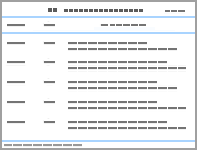
| 智能维度 | 人类智能表现 | AI技术缺陷 |
|---|---|---|
| 文化认知 | 文化图式动态更新与重构 | 训练数据依赖 |
| 情景判断 | 实时评估并优化交际策略 | 固定算法驱动 |
| 伦理协同 | 在多元价值间进行调适 | 单模态信息处理 |
| 作用机制 | 对抗异化类型 | 人类智能(HI)表现 | HI发展维度 | 生成式学习任务 |
|---|---|---|---|---|
| 认知激活 | 思维碎片化 | 主动调用先验知识,进行整体意义建构与推理。 | 情景判断 | 人机译文对比分析等(选择) |
| 文化图式生成 | 文化钝感 | 解构源语文化框架,动态建构适应目标语境的新认知框架。 | 文化认知 | 文化注释、跨文化案例修订等(组织) |
| 元认知监控 | 元认知萎缩 | 对翻译过程与策略进行实时监控、反思、评估与负责任决策。 | 伦理协同 | 翻译反思日志、有声思维等(整合) |


| [1] |
Fiorella, L. & R. E. Mayer. 2016. Eight ways to promote generative learning[J]. Educational Psychology Review 28(4): 717-741.
doi: 10.1007/s10648-015-9348-9 URL |
| [2] | Gardner, H. 1983. Frames of Mind: The Theory of Multiple Intelligences[M]. New York: Basic Books. |
| [3] | Hervais-Adelman, A., B. Moser-Mercer & N. Golestani. 2015. Brain functional plasticity associated with the emergence of expertise in extreme language control[J]. Neuro Image 114:264-274. |
| [4] | Jakobsen, A. L. 2003. Effects of think aloud on translation speed, revision, and segmentation[A]. In F.Alves(ed.). Triangulating Translation: Perspectives in Process Oriented Research[M]. Amsterdam: John Benjamins.69-95. |
| [5] |
Lawson, A. P. & R. E. Mayer. 2021. Benefits of writing an explanation during pauses in multimedia lessons[J]. Educational Psychology Review 33(4):1-27.
doi: 10.1007/s10648-021-09594-w pmid: 33776377 |
| [6] | Lave, J. & E. Wenger. 1991. Situated Learning: Legitimate Peripheral Participation[M]. Cambridge: Cambridge University Press. |
| [7] | O’Brien, S. 2020. Translation technology and disaster management[A]. In M. O’Hagan(ed.). The Routledge Handbook of Translation and Technology[M]. London: Routledge. 304-319. |
| [8] |
Risko, E. F. & S. J. Gilbert. 2016. Cognitive offloading[J]. Trends in Cognitive Sciences 20(9):676-688.
doi: S1364-6613(16)30098-5 pmid: 27542527 |
| [9] |
Rowland, C. A. 2014. The effect of testing versus restudy on retention: A meta-analytic review of the testing effect[J]. Psychological Bulletin 140(6):1432-1463.
doi: 10.1037/a0037559 pmid: 25150680 |
| [10] |
Pi, Z., Y. Zhang, W. Zhou, et al. 2021. Learning by explaining to oneself and a peer enhances learners’ theta and alphaoscillations while watching video lectures[J]. British Journal of Educational Technology 52(2):659-679.
doi: 10.1111/bjet.v52.2 URL |
| [11] | Sternberg, R. J. 1985. Beyond IQ: A Triarchic Theory of Human Intelligence[M]. New York: Cambridge University Press. |
| [12] |
Van Kesteren, M. T., M. Rijpkema, D. J. Ruiter, et al. 2012. Retrieval of associative information congruent with prior knowledge is related to increased medial prefrontal activity and connectivity[J]. Journal of Neuroscience 30(47):15888-15894.
doi: 10.1523/JNEUROSCI.2674-10.2010 URL |
| [13] | Vygotsky, L. S. 1978. Mind in Society: The Development of Higher Psychological Processes[M]. Cambridge, MA: Harvard University Press. |
| [14] |
Wittrock, M. C. 1974. Learning as a generative process[J]. Educational Psychologist 11(2):87-95.
doi: 10.1080/00461527409529129 URL |
| [15] | Yu, Yuxiu. 2024. Application of translation technology based on AI in translation teaching[J/OL]. [2025-07-22]. Systems and Soft Computing (6). https://doi.org/10.1016/j.sasc.2024.200072. |
| [16] | 胡加圣、 戚亚娟. 2023. ChatGPT时代的中国外语教育:求变与应变[J]. 外语电化教学(1):3-6,105. |
| [17] | 胡开宝、 田绪军. 2020. 语言智能背景下的MTI人才培养:挑战、对策与前景[J]. 外语界(2):59-64. |
| [18] |
姜华、 王春秀、 杨暑东. 2023. 生成式AI在教育领域的应用潜能、风险挑战及应对策略[J]. 现代教育管理(7):66-74.
doi: 10.16697/j.1674-5485.2023.07.007 |
| [19] | 王华树、 谢斐. 2024. 大语言模型技术驱动下翻译教育实践模式创新研究[J]. 中国翻译 45(2):70-78. |
| [20] | 王雪、 杨文亚、 卢鑫, 等. 2021. 生成性学习策略促进VR环境下学习发生的机制研究[J]. 远程教育杂志 39(3):65-74. |
| [21] | 祝智庭、 戴岭、 胡姣. 2023. 高意识生成式学习:AIGC技术赋能的学习范式创新[J]. 电化教育研究(6):5-14. |
| Viewed | ||||||
|
Full text |
|
|||||
|
Abstract |
|
|||||
