

诊断学理论与实践 ›› 2026, Vol. 25 ›› Issue (01): 90-95.doi: 10.16150/j.1671-2870.2026.01.013
张炜炜1, 何晓勤2, 吴瑜3, 肖勤2( ), 谭玉燕2()
收稿日期:2024-10-09
修回日期:2025-04-11
接受日期:2025-05-21
出版日期:2026-02-25
发布日期:2026-02-25
通讯作者:
谭玉燕 E-mail:yuyantan00@126.com;基金资助:
ZHANG Weiwei1, HE Xiaoqin2, WU Yu3, XIAO Qin2(), TAN Yuyan2()
Received:2024-10-09
Revised:2025-04-11
Accepted:2025-05-21
Published:2026-02-25
Online:2026-02-25
摘要:
ATP13A2基因突变与Kufor-Rakeb综合征(Kufor-Rakeb syndrome,KRS)、遗传性痉挛性截瘫78型(spastic paraplegia, SPG78)、神经元脑苷脂沉积症12型、肌萎缩侧索硬化等多种神经变性疾病相关。本文报道1例罕见的ATP13A2基因纯合突变患者(Exon12 c.1062G>T:p.Lys354Asn)。该患者为35岁女性,以双上肢不自主抖动起病,这种抖动考虑为姿势及动作诱发肌阵挛,逐渐累及双下肢,伴有运动迟缓、下肢痉挛步态、认知功能障碍及精神行为异常。肌电分析示,患者站立位和半卧位可见双下肢阵发性肌电发放,发放频率不规则;体感诱发电位检查显示,P25波幅明显增高,提示皮层来源肌阵挛。予患者左乙拉西坦联合氯硝西泮改善肌阵挛,左旋多巴/苄丝肼联合普拉克索抗帕金森症状,患者的肌阵挛、肌强直、运动迟缓均较前明显改善,可独立行走。该患者突变位点在PubMed数据库、中华医学期刊全文数据库、万方数据库、知网数据库中均未见报道,氨基酸保守性分析显示该位点在人以及大鼠、小鼠、牛、黑猩猩、猪6种脊椎动物中高度保守,根据美国医学遗传学与基因组学学会遗传变异分类标准及指南,该变异为可能致病性变异,具有KRS、SPG78表型叠加特征。皮层来源的四肢粗大肌阵挛为该基因首次报道的表型,本次报道扩大了其临床表型谱。
中图分类号:
张炜炜, 何晓勤, 吴瑜, 肖勤, 谭玉燕. 以肌阵挛起病的ATP13A2基因突变相关神经变性病一例并文献复习[J]. 诊断学理论与实践, 2026, 25(01): 90-95.
ZHANG Weiwei, HE Xiaoqin, WU Yu, XIAO Qin, TAN Yuyan. ATP13A2 gene mutation-related neurodegenerative diseases with myoclonus onset:a case report and literature review[J]. Journal of Diagnostics Concepts & Practice, 2026, 25(01): 90-95.

图1
患者全外显子测序结果显示在chr1:17323648上存在c.1062G>T(p.Lys354Asn)突变


图2
患者家系图


图3
患者头颅核磁SWI未见明显异常


图4
SEP:正中神经刺激, N20、P25波分化良好,波形稳定、潜伏期正常 注:P25 波幅异常增高,大于10 μV(图中每格代表10 μV)。


图5
不同物种ATP13A2氨基酸序列保守性分析

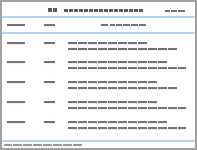
表1
ATP13A2基因相关神经变性病患者临床资料总结
| 例序 | 性别 | 发病年龄 | 国籍 | 临床表型 | 临床症状及体征 | 基因型 | 合子性 | 影像学表现 | 治疗方案 |
|---|---|---|---|---|---|---|---|---|---|
| 1[ | 男 | 18个月 | 印度 | KRS | 运动迟缓、肌强直、核上性凝视麻痹、精神行为障碍 | c.1556C >T(p.Thr5191le;c.2440G>A(p.Val814Met) | 复合杂合 | 头颅MRI未见异常 | 左旋多巴 |
| 2[ | 男 | 14 | 毛里求斯 | KRS | 右侧肢体姿势异常、运动迟缓、核上性凝视麻痹、下面部微小肌阵挛 | c.2822delG(p.Ser941Thrfs1X) | 纯合 | 头颅MRI显示双侧尾状核和皮质萎缩,SWI显示双侧尾状核头部、壳核腹侧和黑质铁沉积 | 左旋多巴、抗胆碱能药物、肉毒素注射 |
| 3[ | 女 | 青少年 | 澳大利亚 | KRS | 运动迟缓、眼睑-舌肌-手指微小肌阵挛 | c.3176T>G (p.L1059R); C.3253delc (p.L1088WfsX4) | 复合杂合 | 肌电图显示与肌阵挛一致的面部肌肉短暂、同步<50 ms肌电爆发 | / |
| 3[ | 女 | 12 | 伊朗 | KRS及SPG78 | 运动迟缓、构音障碍、核上性凝视麻痹、癫痫发作、眼睑-下面部-手指微小肌阵挛、下肢痉挛性步态 | c.2455C>T(p.Arg819*) | 纯合 | 未见异常 | 左旋多巴 |
| 4[ | 女 | 10 | 伊朗 | KRS | 运动迟缓、构音障碍、核上性凝视麻痹、头颈部姿势性肌阵挛及双上肢动作性肌阵挛、眼睑-下面部-手指微小肌阵挛、认知障碍、视幻觉 | c.2455C>T(p.Arg819*) | 纯合 | 头颅MRI显示弥漫性脑萎缩,额颞区为著 | 左旋多巴 |
| 5[ | 女 | 10 | 波兰 | KRS及SPG78 | 运动迟缓、肌强直 吞咽困难、构音障碍、核上性凝视麻痹、口周肌阵挛、下肢痉挛步态、宽基步态、双手意向性震颤、幻听、妄想、认知障碍 | c.2209C>T (p.GIn737*);c.2366_2367delTC(p.Leu789Argfs*15) | 复合杂合 | 神经传导提示轴突多发性神经病、头颅MRI提示小脑、 脑干和额叶皮质萎缩 | 左旋多巴 、奥氮平 |
| 6[ | 女 | 19 | 日本 | SPG78 | 下肢痉挛性步态、认知障碍、妄想、癫痫 | c.2654C>A (p. Ala885Asp) | 纯合 | 头颅MRI提示胼胝体变薄,额颞叶、尾状核、小脑和脑干萎缩 | / |
| 7[ | 男 | 30 | 保加利亚 | SPG78 | 下肢痉挛性步态、认知障碍、小脑性共济失调、浅感觉减退 | c.2654C>A (p. Ala885Asp) | 纯合 | 头颅MRI提示小脑和皮质萎缩。神经传导提示运动及感觉神经轴突损害 | / |
| 9[ | 男 | 24 | 中国 | KRS | 震颤、运动迟缓、肌强直、锥体束征、认知障碍 | exon28 c.3367C>G(p. Leu1123Val);exon21 c. 2278G>A(p.Val760Met) | 复合杂合 | DAT PET/CT显示双侧豆状核尾部多巴胺摄取均减少,左侧明显 | 左旋多巴 |
| 10[ | 女 | 51 | 中国 | KRS | 静止性震颤、运动迟缓、肌强直 | c.3010A>G(p. S1004G);c.1195+5G>A(splice) | 复合杂合 | 头颅SWI提示双侧黑质燕尾征观察欠清 | 左旋多巴 |
| 11 (本例) | 女 | 26 | 中国 | KRS及SPG78 | 运动迟缓、下肢痉挛步态、四肢粗大姿势及动作诱发肌阵挛、认知功能障碍、幻觉、妄想。 | Exon12 c.1062G>T(p.Lys354Asn) | 纯合 | 头颅MRI及SWI未见异常 | 左旋多巴、普拉克索、左已拉西坦、氯硝西泮 |
| [1] |
FUJII T, NAGAMORI S, WIRIYASERMKUL P, et al. Parkinson's disease-associated ATP13A2/PARK9 functions as a lysosomal H+,K+-ATPase[J]. Nat Commun, 2023, 14(1):2174.
doi: 10.1038/s41467-023-37815-z |
| [2] | CROUCHER K M, FLEMING S M. ATP13A2 (PARK9) and basal ganglia function[J]. Front Neurol, 2024,14:1252400. |
| [3] | RICHARDS S, AZIZ N, BALE S, et al. Standardsand guidelines for theInterpretation of sequence variants:ajoint consensus recommendation of the American College of Medical Geneticsand Genomics and the Association for Molecular Pathology[J]. GenetMed, 2015, 17(5):405-424. |
| [4] |
GOWDA V K, SRINIVASAN V M, SHIVAPPA S K. Kufor-Rakeb syndrome/parkinson disease type 9[J]. Indian J Pediatr, 2020, 87(3):231-232.
doi: 10.1007/s12098-019-03167-0 |
| [5] | MARTINO D, MELZI V, FRANCO G, et al. Juvenile dystonia-parkinsonism syndrome caused by a novel p.S941Tfs1X ATP13A2 (PARK9) mutation[J]. Parkinso-nism Relat Disord, 2015, 21(11):1378-1380. |
| [6] |
WALLER S E, WILLIAMS L, MORALES-BRICEÑO H, et al. Teaching video neuroimage: Facial-Faucial-Finger Myoclonus in Kufor-Rakeb syndrome[J]. Neurology, 2022, 99(4):172-173.
doi: 10.1212/WNL.0000000000200751 pmid: 35609988 |
| [7] |
ROHANI M, LANG A E, SINA F, et al. Action myoclonus and seizure in Kufor‐Rakeb syndrome[J]. Mov Disord Clin Pract, 2017, 5(2):195-199.
doi: 10.1002/mdc3.2018.5.issue-2 URL |
| [8] |
ODAKE Y, KOH K, TAKIYAMA Y, et al. Identification of a novel mutation in ATP13A2 associated with a complicated form of hereditary spastic paraplegia[J]. Neurology Genetics, 2020, 6(5):e514.
doi: 10.1212/NXG.0000000000000514 URL |
| [9] | ALEJANDRO E C, SHAUN M, TEODORA C, et al. Loss-of-function mutations in the ATP13A2/PARK9 gene cause complicated hereditary spastic paraplegia (SPG78)[J]. Brain, 2017(2):287-305. |
| [10] | 周继秀, 杨艺, 刘娟, 等. ATP13A2基因28和21号外显子的c.3367C>G和c.2278G>A突变所致Kufor-Rakeb综合征一例[J]. 中华医学杂志, 2020, 100(31):2473-2474. |
| ZHOU J X, YANG Y, LIU J, et al. A case of Kufor-Rakeb syndrome caused by c.3367C>G and c.2278G>A mutations in exons 28 and 21 of the ATP13A2 gene[J]. Chin Med J, 2020, 100(31):2473-2474. | |
| [11] | 魏小金, 钱方媛, 吴雨晨, 等. ATP13A2基因突变致Kufor-Rakeb综合征1例报道并文献复习[J]. 中华神经科杂志, 2024, 57(5):467-472. |
| WEI X J, QIAN F Y, WU Y C, et al. A case report of Kufor-Rakeb syndrome due to ATP13A2 gene mutation and a literature review[J]. Chin J Neurol, 2024, 57(5):467-472. | |
| [12] |
WILLIAMS D R, HADEED A, AL-DIN A S, et al. Kufor Rakeb disease: autosomal recessive, levodopa-responsive parkinsonism with pyramidal degeneration, supranuclear gaze palsy, and dementia[J]. Mov Disord, 2005, 20(10):1264-1271.
doi: 10.1002/mds.v20:10 URL |
| [13] |
BALINT B, DAMASIO J, MAGRINELLI F, et al. Psychia-tric manifestations of ATP13A2 mutations[J]. Mov Disord Clin Pract, 2020, 7(7):838-841.
doi: 10.1002/mdc3.v7.7 URL |
| [14] |
SATOLLI S, DI FONZO A, ZANOBIO M, et al. Kufor Rakeb syndrome and pyramidal signs due to novel ATP13A2 mutations[J]. Neurol Sci, 2023, 44(10):3723-3725.
doi: 10.1007/s10072-023-06899-2 |
| [15] |
PIETRZAK A, BADURA-STRONKA M, KANGAS-KONTIO T, et al. Clinical and ultrastructural findings in an ataxic variant of Kufor-Rakeb syndrome[J]. Folia Neuropathol, 2019, 57(3):285-294.
doi: 37906 pmid: 31588715 |
| [16] |
COVY J P, WAXMAN E A, GIASSON B I. Characterization of cellular protective effects of ATP13A2/PARK9 expression and alterations resulting from pathogenic mutants[J]. J Neurosci Res, 2012, 90(12):2306-2316.
doi: 10.1002/jnr.23112 pmid: 22847264 |
| [17] |
NITA D A, MOLE S E, MINASSIAN B A. Neuronal ceroid lipofuscinoses[J]. Epileptic Disord, 2016, 18(S2):73-88.
pmid: 27629553 |
| [18] | 王刚, 徐刚, 谢心怡, 等. 中国帕金森病报告2025[J]. 神经病学与神经康复学杂志, 2025, 21(2):63-98. |
| WAGN G, XU G, XIE X Y, et al. China Parkinson's disease report, 2025[J]. J Neurol Neurorehabil, 2025, 21(2):63-98. | |
| [19] | SU L J, WANG Y L, HAN T, et al. Antimyoclonic effect of levetiracetam and clonazepam combined treatment on myoclonic epilepsy with Ragged-Red fiber syndrome with m.8344A>G mutation[J]. Chin Med J (Engl), 2018, 131(20):2433-2438. |
| [20] |
PENA A B, CAVINESS J N. Physiology-based treatment of Myoclonus[J]. Neurotherapeutics, 2020, 17(4):1665-1680.
doi: 10.1007/s13311-020-00922-6 URL |
| [21] |
KOLA S, MEKA S S L, SYED T F, et al. Kufor Rakeb syndrome with novel mutation and the role of deep brain stimulation[J]. Mov Disord Clin Pract, 2022, 9(7):1003-1007.
doi: 10.1002/mdc3.13518 pmid: 36247915 |
| [1] | 杨慧, 李云璐, 杨康, 李世举, 何瑾. 进行性肌阵挛共济失调近亲家系全外显子测序漏诊原因分析与对策[J]. 诊断学理论与实践, 2022, 21(04): 456-461. |
| [2] | 洪震,. Lewy小体痴呆表现特点与临床诊断[J]. 诊断学理论与实践, 2007, 6(01): 13-16. |
| 阅读次数 | ||||||
|
全文 |
|
|||||
|
摘要 |
|
|||||
