

诊断学理论与实践 ›› 2026, Vol. 25 ›› Issue (02): 165-173.doi: 10.16150/j.1671-2870.2026.02.007
王佳悦1,2, 熊文魁1, 姜玮贇3, 王健3, 曾乃燕4( ), 岳玲1()
收稿日期:2026-01-31
修回日期:2026-03-10
接受日期:2026-03-11
出版日期:2026-04-25
发布日期:2026-04-25
通讯作者:
曾乃燕 E-mail:zengny@shsmu.edu.cn;基金资助:
WANG Jiayue1,2, XIONG Wenkui1, JIANG Weiyun3, WANG Jian3, ZENG Naiyan4(), YUE Ling1()
Received:2026-01-31
Revised:2026-03-10
Accepted:2026-03-11
Published:2026-04-25
Online:2026-04-25
摘要:
目的:探究空间记忆检测(spatial memory test,SMT)在中国老年人群中识别轻度认知障碍(mild cognitive impairment,MCI)的效能,并与蒙特利尔认知评估(Montreal cognitive assessment,MoCA)进行比较,为中国个体化筛查MCI提供依据。方法:本研究数据来自上海市老年人脑健康队列研究,选取自2023年1月至2024年1月期间连续入组的415名社区老年人,包括认知正常者(cognitively normal,NC)88例、主观认知下降(subjective cognitive decline, SCD)者188例和MCI患者139例。所有受试者均完成SMT与MoCA评估。以SCD、NC为对照组,以MCI为病例组,采用受试者操作特征曲线(receiver operating characteristic, ROC)曲线分析比较2种工具的筛查效能,进一步探讨SMT评分与不同神经心理学检验间的相关性,通过分层及交叉分析探讨年龄和教育水平对其筛查效能的影响。结果:SMT与MoCA均能较好地识别MCI,且SMT展现出更优的整体筛查效能。在区分SCD与MCI时,MoCA的ROC曲线的曲线下面积(area under the curve, AUC)略高于SMT(0.925比0.885),但SMT在国际常用截断值下(≤8分)具备更高的筛查特异度(91.06%)和阳性预测值(84.89%),整体准确率达(80.0%),优于不同截断值下MoCA的综合表现。相关性分析发现,SMT不仅与MoCA总分呈正相关(r=0.612,P<0.001),且与延迟记忆、视空间推理这些AD早期敏感认知领域密切相关(P均<0.01)。分层分析显示,在年龄≥75岁人群中SMT、MoCA区分SCD与MCI的AUC无差异(0.917比0.910,P=0.802);在教育程度>9年的人群中两者区分SCD与MCI效能相当(AUC:0.924比0.904,P=0.358);交叉分析进一步表明,仅在教育程度>9年且年龄≥75岁的亚组中,MoCA区分SCD与MCI(AUC:0.942比0.864, P<0.05)及NC与MCI(AUC:0.99比0.90, P<0.05)的效能略优于SMT。结论:SMT作为一种数字化早期认知障碍的筛查工具,其筛查MCI的整体效能优于MoCA,且具有高特异度、操作便捷等优势,更适用于社区大规模筛查及高龄人群快速初筛。
中图分类号:
王佳悦, 熊文魁, 姜玮贇, 王健, 曾乃燕, 岳玲. 空间记忆检测与蒙特利尔认知评估筛查中国老年人群轻度认知障碍的效度比较[J]. 诊断学理论与实践, 2026, 25(02): 165-173.
WANG Jiayue, XIONG Wenkui, JIANG Weiyun, WANG Jian, ZENG Naiyan, YUE Ling. Comparison of validity between spatial memory test (SMT) and Montreal cognitive assessment (MoCA) for screening mild cognitive impairment in Chinese elderly population[J]. Journal of Diagnostics Concepts & Practice, 2026, 25(02): 165-173.
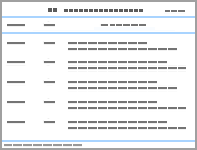
表1
参与者的人口学和临床资料
| Variables | NC(n=88) | SCD(n=188) | MCI(n=139) | F/H/χ2 | P | Post-comparison |
|---|---|---|---|---|---|---|
| Age (year) | 73.07±6.17 | 73.77±6.49 | 73.78±6.94 | 0.399 | 0.672 | |
| Gender (Male/Female) | 24(7/17) | 60(19/41) | 51(19/32) | 2.237 | 0.136 | |
| Education (year) | 10(9,121) | 12(9,12) | 11(9,14) | 1.461 | 0.482 | |
| Smoke (year) | 19(21.6%) | 26(13.8%) | 21(15.1%) | 2.799 | 0.247 | |
| Drink (year) | 16(18.2%) | 19(10.1%) | 19(13.7%) | 3.533 | 0.171 | |
| Hypertension [n(%)] | 42(47.7%) | 115(61.2%) | 88(63.3%) | 6.057 | 0.048 | |
| Diabetes [n(%)] | 18(20.5%) | 52(27.7%) | 49(35.3%) | 5.942 | 0.051 | |
| CHD [n(%)] | 7(8%) | 38(20.2%) | 31(22.3%) | 8.244 | 0.016 | |
| Hyperlipidemia [n(%)] | 22(25%) | 87(46.3%) | 53(38.1%) | 11.475 | 0.003 | |
| Cerebral hemorrhage [n(%)] | 2(2.3%) | 7(3.8%) | 2(1.4%) | 1.724 | 0.422 | |
| Stroke [n(%)] | 7(8%) | 30(16%) | 23(16.5%) | 3.842 | 0.146 | |
| MoCA [M (P25, P75)] | 25(23,27) | 25(22,26) | 19(17,21)a,b | 201.037 | 0.000 | MCI<NC, SCD |
| SMT [M (P25, P75)] | 10(9,11) | 10(9,11) | 6(5,8)a,b | 166.462 | 0.000 | MCI<NC, SCD |
| Digit span | ||||||
| Forward [M (P25, P75)] | 10(8,12) | 9(8,11) | 10(7,11) | 2.973 | 0.226 | |
| Backward [M (P25, P75)] | 5(4,7) | 5(4,6) | 5(4,6) | 1.320 | 0.517 | |
| Visual recognition | ||||||
| Functional [M (P25, P75)] | 4(4,4) | 4(4,4) | 4(3,4)a,b | 14.020 | 0.001 | MCI<NC, SCD |
| Semantic [M (P25, P75)] | 3(3,4) | 4(3,4) | 3(3,4) | 1.552 | 0.460 | |
| Correct [M (P25, P75)] | 5(4,6) | 5(4,6) | 5(4,6) | 1.090 | 0.580 | |
| Mistake [M (P25, P75)] | 1(0,1) | 1(0,1) | 1(0,1) | 0.614 | 0.736 | |
| Visual matching and reasoning [M (P25, P75)] | 5(4,7) | 5(3,7) | 5(3,7) | 1.824 | 0.402 | |
| Verbal fluency [M (P25, P75)] | 15(13,18) | 15(13,17) | 15(12,17) | 0.779 | 0.677 | |
| Trails-A [M (P25, P75)] | 56(46,72) | 54(44,69) | 59(49,69) | 2.889 | 0.236 | |
| Trails-B | 122(95,165) | 120(95,152) | 120(95,161) | 0.364 | 0.833 | |
| HVLT | ||||||
| Learning tests [M (P25, P75)] | 14(11,18) | 14(11,17) | 14(11,17) | 1.302 | 0.522 | |
| Delayed recall test [M (P25, P75)] | 5(3,7) | 5(3,6) | 5(3,6) | 1.706 | 0.426 | |
| Recognition test [M (P25, P75)] | 5(2,7) | 4(2,6) | 4(2,6) | 2.345 | 0.310 |

图1
SMT、MoCA的整体筛查的ROC曲线 A:区分SCD与MCI;B:区分NC与MCI。

表2
SMT与MoCA固定临界值的临床筛查效能比较
| Diagnostic indicators | SMT≤8 | MoCA≤26 | MoCA≤25 | MoCA≤24 |
|---|---|---|---|---|
| Sensitivity | 65.56% | 100% | 44.84% | 52.08% |
| Specificity | 91.06% | 23.90% | 100.00% | 99.33% |
| Positive predictive value | 84.89% | 39.80% | 100.00% | 99.28% |
| Negative predictive value | 77.54% | 100.00% | 38.40% | 53.99% |
| Precision | 80.00% | 49.40% | 58.50% | 69.16% |

图2
SMT、MoCA在不同年龄老人中筛查的ROC曲线 A:在<75岁老人中区分SCD与MCI;B:在<75岁老人中区分NC与MCI;C:在≥75岁老人中区分SCD与MCI;D:在≥75岁老人中区分NC与MCI。


图3
SMT、MoCA在不同受教育年限老人中筛查的ROC曲线 A:在受教育年限≤9年老人中区分SCD与MCI;B:在受教育年限≤9年老人中区分NC与MCI;C:在受教育年限>9年老人中区分SCD与MCI;D:在受教育年限>9年老人中区分NC与MCI。

表3
各年龄组中不同教育水平的MoCA和SMT在NC、SCD和MCI之间的最佳临界值、灵敏度、特异度和AUC (95%CI)
| Item | Education≤9 years and Age<75 years | Education≤9 years and Age≥75 years | Education>9 years and Age<75 years | Education>9 years and Age≥75 years | ||||
|---|---|---|---|---|---|---|---|---|
| MoCA | SMT | MoCA | SMT | MoCA | SMT | MoCA | SMT | |
| NC vs. MCI | NC=28 vs. MCI=33 | NC=28 vs. MCI=33 | NC=14 vs. MCI=24 | NC=14 vs. MCI=24 | NC=21 vs. MCI=46 | NC=21 vs. MCI=46 | NC=24 vs. MCI=36 | NC=24 vs. MCI=36 |
| Sensitivity | 0.91 | 0.85 | 0.96 | 0.92 | 0.94 | 0.87 | 0.97 | 0.67 |
| Specificity | 0.79 | 0.82 | 0.79 | 0.08 | 0.76 | 0.76 | 0.92 | 0.96 |
| Cut-off | 22.50 | 8.50 | 22.50 | 8.5 | 22.5 | 8.5 | 22.5 | 7.5 |
| AUC(95%CI) | 0.93 (0.84-0.99) | 0.86 (0.77-0.96) | 0.87 (0.71-1.00) | 0.88 (0.76-1.00) | 0.88 (0.77-0.99) | 0.87 (0.77-0.97) | 0.99 (0.98-1.00)* | 0.90 (0.82-0.98) |
| SCD vs. MCI | SCD=49 vs. MCI=33 | SCD=49 vs. MCI=33 | SCD=17 vs. MCI=24 | SCD=17 vs. MCI=24 | SCD=60 vs. MCI=46 | SCD=60 vs. MCI=46 | SCD=57 vs. MCI=36 | SCD=57 vs. MCI=36 |
| Sensitivity | 0.74 | 0.74 | 0.82 | 0.82 | 0.87 | 0.85 | 0.97 | 0.88 |
| Specificity | 0.91 | 0.85 | 0.96 | 0.75 | 0.8 | 0.87 | 0.75 | 0.67 |
| Cut-off | 22.50 | 8.50 | 22.50 | 7.5 | 21.5 | 8.5 | 20.5 | 7.5 |
| AUC(95%CI) | 0.91 (0.84-0.97) | 0.84 (0.75-0.94) | 0.95 (0.89-1.00) | 0.86 (0.74-0.98) | 0.91 (0.86-0.96) | 0.94 (0.89-0.98) | 0.94 (0.90-0.99)* | 0.86 (0.79-0.94) |
| [1] | 首都医科大学宣武医院国家神经疾病医学中心, 中国疾病预防控制中心慢性非传染性疾病预防控制中心, 国家卫生健康委能力建设和继续教育中心, 等. 中国阿尔茨海默病蓝皮书(精简版)[J]. 中华医学杂志, 2024, 104(29):2701-2727. |
| National Center for Neurological Disorders, Xuanwu Hospital, Capital Medical University; National Center for Chronic and Noncommunicable Disease Control and Prevention, Chinese Center for Disease Control and Prevention; National Health Commission Capacity Building and Continuing Education Center, et al. Blue paper on Alzheimer′s disease in China(simplified version)[J]. Natl Med J China, 2024, 104(29):2701-2727. | |
| [2] | 岳玲, 江叶昊. 阿尔茨海默病诊断和分期新标准:生物标志物引领的精准医疗时代[J]. 神经病学与神经康复学杂志, 2025, 21(1):1-5. |
| YUE L, JIANG Y H. New diagnostic and staging criteria for Alzheimer's disease:the era of precision medicine led by biomarkers[J]. J Neurol Neurorehabil, 2025, 21(1):1-5. | |
| [3] | RABIN L A, SMART C M, AMARIGLIO R E. Subjective cognitive decline in preclinical Alzheimer’s disease[J]. Annu Rev Clin Psychol, 2017,13:369-396. |
| [4] | SANFORD A M. Mild cognitive impairment[J]. Clin Geria-tr Med, 2017, 33(3):325-337. |
| [5] | 马瑾瑾, 肖卫忠. 阿尔茨海默病早期诊断方法[J]. 中国临床研究, 2024, 37(7):1113-1119. |
| MA J J, XIAO W Z. Early diagnosis of Alzheimer's di-sease[J]. Chin J Clin Res, 2024, 37(7):1113-1119. | |
| [6] | 初曙光, 王刚. 淀粉样蛋白相关影像学异常:一种与阿尔茨海默病治疗相关的具有影像学特征和诊断特异性的MRI表现[J]. 神经病学与神经康复学杂志, 2025, 21(1):6-11. |
| CHU S G, WANG G. Amyloid-related imaging abnormalities:an MRI manifestation associated with Alzheimer's disease-targeted therapy with imaging characteristics and diagnostic specificit[J]. J Neurol Neurorehabil, 2025, 21(1):6-11. | |
| [7] |
JIA X, WANG Z, HUANG F, et al. A comparison of the Mini-mental state examination (MMSE) with the Montreal cognitive assessment (MoCA) for mild cognitive impairment screening in Chinese middle-aged and older population: A cross-sectional study[J]. BMC Psychiatry, 2021, 21(1):485.
doi: 10.1186/s12888-021-03495-6 pmid: 34607584 |
| [8] |
AMRO I, AL HAMADI A M, EL SALEM A A, et al. Population-based norms for the Montreal cognitive assessment in Arab adults[J]. Brain Behav, 2025, 15(2):e70287.
doi: 10.1002/brb3.v15.2 URL |
| [9] | 夏安琪, 李军, 岳玲, 等. 蒙特利尔认知评估量表在中国社区老人中的应用[J]. 上海交通大学学报(医学版), 2021, 41(12):1661-1667. |
| XIA A Q, LI J, YUE L, et al. Application of Montreal cognitive assessment scale to the elderly in Chinese community[J]. J Shanghai Jiao Tong Univ(Med Sci), 2021, 41(12):1661-1667. | |
| [10] |
ISLAM N, HASHEM R, GAD M, et al. Accuracy of the Montreal Cognitive Assessment tool for detecting mild cognitive impairment: A systematic review and meta-analysis[J]. Alzheimers Dement, 2023, 19(7):3235-3243.
doi: 10.1002/alz.13040 pmid: 36934438 |
| [11] | VORA N, PATEL P, MARSOOL M D M, et al. Atypical Alzheimer’s dementia: Addressing the subtypes, epide-miology, atypical presentations, diagnostic biomarkers, and treatment updates[J]. Dis a Mon, 2025, 71(5):101863. |
| [12] |
SANTAGATA F, CAPPA S F, PRESTA R, et al. Visuospatial impairment in dementia: A new index to improve the clinical diagnosis of Alzheimer’s disease[J]. Aging Clin Exp Res, 2025, 37(1):127.
doi: 10.1007/s40520-025-03028-1 |
| [13] |
WANG H, FAN Z, SHI C, et al. Consensus statement on the neurocognitive outcomes for early detection of mild cognitive impairment and Alzheimer dementia from the Chinese Neuropsychological Normative (CN-NORM) Project[J]. J Glob Health, 2019, 9(2):020320.
doi: 10.7189/jogh.09.020320 URL |
| [14] |
JESSEN F, AMARIGLIO R E, VAN BOXTEL M, et al. A conceptual framework for research on subjective cognitive decline in preclinical Alzheimer’s disease[J]. Alzheimers Dement, 2014, 10(6):844-852.
doi: 10.1016/j.jalz.2014.01.001 URL |
| [15] |
PETERSEN R C, DOODY R, KURZ A, et al. Current concepts in mild cognitive impairment[J]. Arch Neurol, 2001, 58(12):1985.
doi: 10.1001/archneur.58.12.1985 URL |
| [16] | ZHANG S, QIU Q, QIAN S, et al. Determining appropriate screening tools and cutoffs for cognitive impairment in the Chinese elderly[J]. Front Psychiatry, 2021,12:773281. |
| [17] | MICHALLAT-BRAGG G, BENNETT M, FLEWITT B I, et al. Exploring the sensitivity of episodic and spatial memory tests to healthy and pathological cognitive aging[J]. Front Aging Neurosci, 2025,17:1547834. |
| [18] |
HARTLEY T, BIRD C M, CHAN D, et al. The hippocampus is required for short-term topographical memory in humans[J]. Hippocampus, 2007, 17(1):34-48.
doi: 10.1002/hipo.20240 pmid: 17143905 |
| [19] |
HONG Y, ZENG X, ZHU C W, et al. Evaluating the Beijing version of Montreal cognitive assessment for identification of cognitive impairment in monolingual Chinese American older adults[J]. J Geriatr Psychiatry Neurol, 2022, 35(4):586-593.[LinkOut]
doi: 10.1177/08919887211036182 URL |
| [20] |
PARRA-RODRÍGUEZ L, SILVA-PEREYRA J, SÁNCHEZ-GARCÍA S, et al. Normative data for the Montreal cognitive assessment (MoCA) in Mexican adults: A regression-based approach[J]. Diagnostics, 2025, 15(22):2920.
doi: 10.3390/diagnostics15222920 URL |
| [21] | 肖世富, 徐巍, 姚培芬. 世界卫生组织老年认知功能评价成套神经心理测验的临床初步应用[J]. 中华精神科杂志, 1999, 32(4):230. |
| XIAO S F, XV W, YAO P F. The preliminary clinical use of the World Health Organization battery of cognitive assessment instruments for elderly[J]. Chin J Psychiatry, 1999, 32(4):230. | |
| [22] |
YOSHIMURA T, OSAKA M, OSAWA A, et al. The classical backward digit span task detects changes in working memory but is unsuitable for classifying the severity of dementia[J]. Appl Neuropsychol Adult, 2023, 30(5):528-534.
doi: 10.1080/23279095.2021.1961774 URL |
| [23] |
LLINÀS-REGLÀ J, VILALTA-FRANCH J, LÓPEZ-POUSA S, et al. The trail making test: Association with other neuropsychological measures and normative values for adults aged 55 years and older from a Spanish-speaking population-based sample[J]. Assessment, 2017, 24(2):183-196.
doi: 10.1177/1073191115602552 URL |
| [24] | CAI Y, YANG T, YU X, et al. The alternate-form reliabi-lity study of six variants of the brief visual-spatial memory test-revised and the Hopkins verbal learning test-revised[J]. Front Public Health, 2023,11:1096397. |
| [25] | CHEN K L, XU Y, CHU A Q, et al. Validation of the Chinese Version of Montreal cognitive assessment basic for screening mild cognitive impairment[J]. J Am Geriatr Soc, 2016, 64(12):e285-e290. |
| [26] | SONG C S, LEE H S, CHUN B Y. Comparison of Montreal cognitive assessment in Korean version for predic-ting mild cognitive assessment in 65-year and over indi-viduals[J]. Occup Ther Int, 2022,2022:4108434. |
| [27] |
CLASSON E, VAN DEN HURK W, LYTH J, et al. Montreal cognitive assessment: Normative data for cognitively healthy Swedish 80- to 94-year-olds[J]. J Alzheimers Dis, 2022, 87(3):1335-1344.
doi: 10.3233/JAD-215629 pmid: 35431248 |
| [28] | CHAN D, GALLAHER L M, MOODLEY K, et al. The 4 mountains test: A short test of spatial memory with high sensitivity for the diagnosis of pre-dementia Alzheimer’s disease[J]. J Vis Exp, 2016,116:54454. |
| [29] |
IWATSUBO T, SPERLING R A, ALGECIRAS-SCHIMNICH A, et al. Modernizing diagnosis of Alzheimer's disease: A review of global trends and Asia-specific perspectives[J]. Alzheimers Dement, 2025, 21(8):e70536.
doi: 10.1002/alz.v21.8 URL |
| [1] | 汤朝毅, 黄荣荣, 乔露, 李维辛. 血浆抵抗素作为初筛老年肌少症的标志物研究[J]. 诊断学理论与实践, 2026, 25(02): 209-217. |
| [2] | 刘小草, 曾庆泽, 李依霞, 李凯程, 罗骁, 闫少珍, 卢洁. KL-VS基因对轻度认知障碍患者内侧颞叶体积影响的磁共振研究[J]. 诊断学理论与实践, 2026, 25(02): 174-182. |
| [3] | 张红, 朱梦梦. 新型冠状病毒肺炎疫情期间老年人进食安全护理[J]. 诊断学理论与实践, 2022, 21(02): 277-280. |
| [4] | 刘安平, 凌枫, 史超, 孙璟. 上海社区老年脑卒中患者跌倒风险因素分析及风险识别模型的建立[J]. 诊断学理论与实践, 2021, 20(05): 475-479. |
| [5] | 吴洁, 冯媛媛, 任妍, 曹久妹. 基于冠状动脉造影检查的高龄老年人群发生冠心病的危险因素调查及相应诊断模型的建立[J]. 诊断学理论与实践, 2021, 20(02): 201-206. |
| [6] | 吴霖, 郑戈, 陶婷. ACE基因多态性与老年人肾功能下降的相关性研究[J]. 诊断学理论与实践, 2019, 18(2): 204-208. |
| [7] | 侯亚楠, 禤立平, 赵志云, 李勉, 陈宇红, 戴蒙, 徐敏, 毕宇芳, 王卫庆, 高金丽. 上海社区中老年人群血尿酸/肌酐比值与代谢综合征关联性的流行病学调查[J]. 诊断学理论与实践, 2019, 18(1): 44-50. |
| [8] | 吴雪妍, 马丽娜, 程棣, 杜瑞, 徐瑜, 徐敏, 陆洁莉, 陈宇红, 毕宇芳, 王卫庆, 高金丽, 钱晓忠. 上海市宝山区淞南社区中老年人群静息心率与糖尿病相关性的流行病学调查[J]. 诊断学理论与实践, 2018, 17(01): 45-50. |
| [9] | 周妍, 顾祎. 血清维生素D水平与老年人社区获得性肺炎严重程度的相关性研究[J]. 诊断学理论与实践, 2017, 16(06): 612-616. |
| [10] | 王翠霞, 章晓炎, 巩云霞, 吴方. 老年人骨代谢状态指标与动脉粥样硬化性疾病的相关性研究[J]. 诊断学理论与实践, 2017, 16(06): 633-638. |
| [11] | 王琳琳, 祝程诚, 张庆五, 陈婷, 吴舜. 血清PCT、IL-6、CRP水平在老年社区获得性肺炎鉴别诊断中的价值[J]. 诊断学理论与实践, 2017, 16(05): 532-536. |
| [12] | 谷晓岚, 魏雪, 牛敏, 罗兰, 李欣宇, 高政南,. 大连地区中老年人群中颈围与高血压的相关性研究[J]. 诊断学理论与实践, 2016, 15(04): 371-375. |
| [13] | 邓霖, 缪飞, 赵雪松,. 轻度认知障碍及轻度阿尔茨海默病的MRI研究进展[J]. 诊断学理论与实践, 2011, 10(03): 284-286. |
| [14] | 赵咏桔,. 重视老年人水钠平衡的异常[J]. 诊断学理论与实践, 2007, 6(05): 402-405. |
| [15] | 沈琳辉, 崔斌, 赵咏桔, 颜美珠, 林云, 巩云霞, 吴方,. 老年男性雄激素受体基因CAG重复序列长度多态性与代谢综合征的关系[J]. 诊断学理论与实践, 2007, 6(05): 412-416. |
| 阅读次数 | ||||||
|
全文 |
|
|||||
|
摘要 |
|
|||||
