

诊断学理论与实践 ›› 2026, Vol. 25 ›› Issue (02): 183-192.doi: 10.16150/j.1671-2870.2026.02.009
何懿蓓, 朱卓非( ), 李岩()
收稿日期:2026-01-19
修回日期:2026-02-13
接受日期:2026-03-11
出版日期:2026-04-25
发布日期:2026-04-25
通讯作者:
朱卓非 E-mail:zhufeifei@shsmu.edu.cn;
HE Yibei, ZHU Zhuofei(), LI Yan()
Received:2026-01-19
Revised:2026-02-13
Accepted:2026-03-11
Published:2026-04-25
Online:2026-04-25
摘要:
目的:利用2023年全球疾病负担研究(Global Burden of Disease Study 2023, GBD 2023)数据,系统分析1990年至2023年间全球及中国10~19岁青少年的精神疾病负担及其变化趋势,探讨性别、年龄、社会人口指数(sociodemographic index, SDI)及疾病亚型构成的影响,并预测至2050年的青少年精神疾病发病趋势。方法:从GBD 2023数据库中提取全球及中国10~19岁青少年精神疾病及其亚型的发病率、患病率和伤残调整寿命年(disa-bility-adjusted life years, DALYs)数据。分析其变化趋势及年龄、性别、SDI分层差异,并利用自回归移动平均(auto-regressive integrated moving average, ARIMA)模型预测至2050年的青少年精神疾病发病率。结果:1990年至2023年间,全球青少年精神疾病患病率和DALYs分别增长31.43%和39.61%,中国青少年精神疾病患病率和DALYs分别增长21.00%和26.39%。2021年,青少年精神疾病发病率达到峰值(全球9 641/10万,中国6 265/10万),后续虽有回落,但仍维持在较高水平。受人口结构变动影响,1990年至2023年,中国10~19岁青少年精神疾病患病人数下降了10.75%;然而,患病率和发病率却呈现上升趋势,分别由1990年的14 401.99/10万和4 473.53/10万,升至2023年的17 425.46/10万和5 716.24/10万,涨幅分别达到21.00%和27.78%,且15~19岁女性的疾病负担远高于同龄男性。全球范围内,焦虑障碍和抑郁障碍是主要的精神疾病负担,合计贡献了超2/3的DALYs。中国青少年的焦虑障碍(中国43.5%比全球42.2%)、多动症(中国9%比全球4.5%)占本国精神疾病的构成比高于全球平均水平。ARIMA模型预测结果显示,至2050年,全球和中国的青少年精神疾病发病率将进入新的高水平平台期,并伴随潜在的波动风险。全球发病率预计将维持在约6 300/10万的水平[95%UI为(4 500~8 000)/10万],中国预计为约5 700/10万[95%UI为(4 000~7 000)/10万]。结论:过去30年间,全球及中国青少年精神疾病负担均有实质性增长,中国增长水平高于全球平均。中国焦虑障碍及多动症负担突出,且青春期中晚期的女生群体是风险防范的核心群体。值得注意的是,2021年后青少年精神疾病负担虽有所回落,但仍维持于高位平台。中国迫切需要基于性别、年龄和疾病亚型特点,制定精准的预防和干预策略。
中图分类号:
何懿蓓, 朱卓非, 李岩. 1990年至2023年全球及中国青少年精神疾病负担趋势分析及2050年发病预测[J]. 诊断学理论与实践, 2026, 25(02): 183-192.
HE Yibei, ZHU Zhuofei, LI Yan. Trend analysis of global burden of adolescent mental disorders from 1990 to 2023 and incidence projection for 2050[J]. Journal of Diagnostics Concepts & Practice, 2026, 25(02): 183-192.
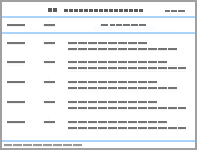
表1
1990、2021和2023年全球10~19岁青少年精神疾病的负担现状与趋势
| Measure | 1990 [Estimate (95%UI)] | 2021 [Estimate (95%UI)] | 2023 [Estimate (95%UI)] | Percent change (%) (1990 vs 2023) |
|---|---|---|---|---|
| Incidence | ||||
| Number | 58 635 591 (49 305 687-70 375 530) | 125 008 496 (103 625 582-154 906 728) | 84 772 624 (69 773 382-103 964 822) | 44.57% |
| Rate | 5 544.29 (4 662.10-6 654.36) | 9 641.12 (7 991.99-11 946.98) | 6 387.96 (5 257.71-7 834.17) | 15.22% |
| Prevalence | ||||
| Number | 142 171 069 (121 967 265-165 851 820) | 210 234 599 (176 578 987-257 986 078) | 234 462 580 (189 088 766-305 090 248) | 64.92% |
| Rate | 13 442.98 (11 532.61-15 682.12) | 16 214.07 (13 618.43-19 896.84) | 17 667.71 (14 248.61-22 989.79) | 31.43% |
| DALYs | ||||
| Number | 18 312 444 (12 680 793-24 661 371) | 28 918 143 (20 117 567-40 868 878) | 32 081 436 (22 180 841-46 255 952) | 75.19% |
| Rate | 1 731.53 (1 199.03-2 331.86) | 2 230.27 (1 551.54-3 151.96) | 2 417.47 (1 671.42-3 485.57) | 39.61% |
表2
2023年全球10~19岁青少年精神疾病发病率的区域比较
| Country/Region | Incidence rate [Estimate (95%UI)] |
|---|---|
| Asia | |
| China | 5 716.24 (4 655.58-7 253.35) |
| Syrian Arab Republic | 11 578.85 (8 969.86-14 239.11) |
| Israel | 10 296.32 (8 396.25-12 738.85) |
| Cyprus | 9 373.05 (7 892.09-11 031.08) |
| Europe | |
| United Kingdom | 17 280.48 (14 672.61-20 464.85) |
| Netherlands | 14 760.04 (12 346.36-17 939.40) |
| Greece | 11 674.41 (9 567.25-15 057.51) |
| Africa | |
| Congo | 9 154.58 (7 368.05-11 017.99) |
| Central African Republic | 8 618.81 (6 906.51-10 502.10) |
| Tunisia | 8 485.48 (6 803.63-10 527.17) |
| Americas | |
| Greenland | 9 268.62 (7 716.38-11 209.89) |
| Chile | 9 122.05 (7 350.94-11 064.09) |
| United States of America | 8 725.34 (7 223.50-10 431.03) |
| Oceania | |
| Australia | 11 117.00 (9 426.59-13 272.16) |
| New Zealand | 9 628.79 (7 984.16-11 979.48) |
| Tonga | 5 926.34 (4 619.63-8 184.50) |
表3
2023年全球10~19岁青少年精神疾病患病率的区域比较
| Country/Region | Prevalence rate [Estimate (95%UI)] |
|---|---|
| Asia | |
| China | 17 425.46 (13 703.45-24 455.42) |
| Cyprus | 31 748.07 (27 633.79-36 825.22) |
| Iran (Islamic Republic of) | 27 966.82 (20 983.57-38 675.14) |
| Saudi Arabia | 23 317.48 (17 107.35-33 005.54) |
| Europe | |
| Malta | 35 259.26 (30 471.15-40 878.57) |
| Ireland | 34 396.99 (25 451.17-47 562.13) |
| United Kingdom | 33 770.54 (29 311.24-39 762.50) |
| Africa | |
| Togo | 27 914.79 (18 188.63-43 241.23) |
| Nigeria | 24 965.48 (16 509.39-37 994.27) |
| Chad | 24 751.20 (18 264.76-34 051.51) |
| Americas | |
| Greenland | 22 755.81 (18 580.70-30 593.66) |
| Chile | 22 496.66 (18 302.22-29 230.73) |
| Argentina | 21 326.10 (17 161.41-28 779.07) |
| Oceania | |
| Australia | 25 469.81 (21 729.84-30 675.91) |
| New Zealand | 23 643.32 (18 910.50-31 095.35) |
| Tonga | 20 578.36 (13 203.23-36 531.38) |
表4
2023年全球10~19岁青少年精神疾病DALYs率的区域比较
| Country/Region | Prevalence rate [Estimate (95%UI)] |
|---|---|
| Asia | |
| China | 2 156.62 (1 367.03-3 497.29) |
| Cyprus | 4 435.69 (3 145.42-6 199.92) |
| Iran (Islamic Republic of) | 3 778.36 (2 502.14-5 693.23) |
| Syrian Arab Republic | 3 588.24 (2 487.38-5 176.93) |
| Europe | |
| United Kingdom | 5 234.42 (3 719.10-7 030.97) |
| Ireland | 4 803.87 (3 220.88-7 256.90) |
| Malta | 4 803.10 (3 378.24-6 652.38) |
| Africa | |
| Togo | 3 855.15 (2 221.72-6 710.69) |
| Chad | 3 464.83 (2 257.15-5 230.68) |
| Nigeria | 3 415.61 (1 946.92-5 715.29) |
| Americas | |
| Chile | 3 416.86 (2 210.62-4 855.12) |
| Greenland | 3 342.53 (2 253.40-4 571.09) |
| Argentina | 3 192.78 (2 094.25-4 656.94) |
| Oceania | |
| Australia | 3 587.76 (2 538.07-4 723.53) |
| New Zealand | 3 363.93 (2 257.91-4 774.00) |
| Tonga | 2 878.02 (1 548.51-5 938.81) |
表5
1990、2021和2023年中国10~19岁青少年精神疾病的负担现状与趋势
| Measure | Metric | 1990 [Estimate (95% UI)] | 2021 [Estimate (95% UI)] | 2023 [Estimate (95% UI)] | Percent change (%) (1990 vs 2023) |
|---|---|---|---|---|---|
| Incidence | Number | 10 269 280 (8 454 526 - 12 231 305) | 10 093 591 (8 358 467 - 12 790 043) | 9 679 243 (7 883 242 - 12 282 013) | -5.75% |
| Rate | 4 473.53 (3 682.98 - 5 328.23) | 6 264.94 (5 187.97 - 7 938.59) | 5 716.24 (4 655.58 - 7 253.35) | 27.78% | |
| Prevalence | Number | 33 060 733 (27 823 672 - 39 558 730) | 26 677 747 (21 639 756 - 36 445 479) | 29 506 336 (23 203 898 - 41 410 080) | -10.75% |
| Rate | 14 401.99 (12 120.61 - 17 232.67) | 16 558.48 (13 431.47 - 22 621.16) | 17 425.46 (13 703.45 - 24 455.42) | 21.00% | |
| DALYs | Number | 3 917 132 (2 639 224 - 5 389 366) | 3 270 192 (2 125 553 - 4 896 523) | 3 651 776 (2 314 780 - 5 921 917) | -6.77% |
| Rate | 1 706.39 (1 149.70 - 2 347.73) | 2 029.76 (1 319.30 - 3 039.20) | 2 156.62 (1 367.03 - 3 497.29) | 26.39% |

图1
2023年全球精神疾病负担的年龄和性别分布 注:数据来源于全球疾病负担研究 2023 (GBD 2023)。


图2
1990年至2023年全球10~19年青少年精神疾病负担趋势(按SDI分层) 注:数据来源于全球疾病负担研究 2023 (GBD 2023)。


图3
2023年全球与中国青少年精神疾病DALYs构成 注:数据来源于全球疾病负担研究 2023 (GBD 2023)。


图4
1990年至2023年全球与中国10~19岁青少年精神疾病负担的长期趋势:发病率(A)、患病率(B)、DALYs(C) 注:数据来源于全球疾病负担研究 2023 (GBD 2023)。


图5
全球与中国青少年精神疾病发病率预测趋势 注:数据来源于全球疾病负担研究 2023 (GBD 2023)。

| [1] |
POLANCZYK G V, SALUM G A, SUGAYA L S, et al. Annual research review: A meta-analysis of the worldwide prevalence of mental disorders in children and adolescents[J]. J Child Psychol Psychiatry, 2015, 56(3): 345-365. DOI:10.1111/jcpp.12381.
pmid: 25649325 |
| [2] | World Health Organization. World mental health today: latest data[EB/OL]. 2022 [2025-12-29]. https://www.who.int/publications/i/item/9789240113817. |
| [3] | 程海威, 孟震宇, 孙鑫, 等. 青少年心理健康症状的网络分析[J]. 中国临床心理学杂志, 2025, 33(3): 608-614. |
| CHENG H W, MENG Z Y, SUN X, et al. Network analysis of mental health symptoms in adolescents[J]. Chin J Clin Psychol, 2025, 33(3): 608-614. | |
| [4] | 高月红, 徐旭娟, 陈芸, 等. 青少年抑郁症患者非自杀性自伤心理体验的质性研究[J]. 护理学杂志, 2023, 38(14): 91-95. |
| GAO Y H, XU X J, CHEN Y, et al. Qualitative study on psychological experience of non-suicidal self-injury in adolescent depression patients[J]. J Nurs Sci, 2023, 38(14): 91-95. | |
| [5] | HICKIE I B, SCOTT E M, CROSS S P, et al. Right care, first time: a highly personalised and measurement-based care model to manage youth mental health[J]. Med J Aust, 2019, 211 Suppl 9: S3-S46. DOI:10.5694/mja2.50383. |
| [6] | 郁嘉铭, 高美慧, 李倩, 等. 新冠肺炎疫情下青少年心理健康研究现状: 基于CiteSpace的可视化计量分析[J]. 四川精神卫生, 2023, 36(6): 538-546. |
| YU J M, GAO M H, LI Q, et al. Research status of adolescent mental health under COVID-19 pandemic: a visua-lized bibliometric analysis based on CiteSpace[J]. Sichuan Ment Health, 2023, 36(6): 538-546. | |
| [7] | 国家统计局. 2020年中国儿童人口状况: 事实与数据[M]. 北京: 中国统计出版社, 2021. |
| National Bureau of Statistics. Status of child population in China 2020: facts and data[M]. Beijing: China Statistics Press, 2021. | |
| [8] | GBD 2019 MENTAL DISORDERS COLLABORATORS. Global, regional, and national burden of 12 mental disorders in 204 countries and territories, 1990-2019: a systematic analysis for the Global Burden of Disease Study 2019[J]. Lancet Psychiatry, 2022, 9(2): 137-150. DOI:10.1016/S2215-0366(21)00395-3. |
| [9] |
KIELING C, BUCHWEITZ C, CAYE A, et al. Worldwide prevalence and disability from mental disorders across childhood and adolescence: evidence from the Global Burden of Disease Study[J]. JAMA Psychiatry, 2024, 81(4):347-356.
doi: 10.1001/jamapsychiatry.2023.5051 pmid: 38294785 |
| [10] | Institute for Health Metrics and Evaluation. GBD 2023 data resources[EB/OL]. 2025 [2025-12-29]. https://ghdx.healthdata.org/gbd-2023. |
| [11] | PADHANI ZA, AVERY JC, MEHERALI S, et al. Burdens and risk factors for mortality in adolescents and young adults aged 10-24 years in Australia and comparison with OECD countries between 2000 and 2021: Global Burden of Disease Study 2021[J]. BMJ Public Health, 2025, 3: e002986. |
| [12] | CORLISS D J. Non-temporal ARIMA models in statistical research[C]// Proceedings of the SAS Global Forum 2013. Cary, NC: SAS Institute Inc. 2013[2025-12-29]. https://support.sas.com/resources/papers/proceedings13/458-2013.pdf. |
| [13] | 王丛, 吕小康, 张涵玉. 新冠疫情相关压力对青少年心理健康损害的研究进展[J]. 医学与哲学, 2022, 43(21): 55-59. |
| WANG C, LÜ X K, ZHANG H Y. Research progress on damage of COVID-19 related stress to adolescent mental health[J]. Med Philos, 2022, 43(21): 55-59. | |
| [14] | 罗玉晗, 徐梓婧, 周晴, 等. COVID-19疫情压力对青少年生命史策略的影响及其行为表现[J]. 心理发展与教育, 2025, 41(3): 398-409. |
| LUO Y H, XU Z J, ZHOU Q, et al. Effect of COVID-19 pandemic stress on life history strategy and its behavioral manifestation in adolescents[J]. Psychol Dev Educ, 2025, 41(3):398-409. | |
| [15] |
杨之旭, 彭海云, 辛素飞. 疫情后期青少年的抑郁和焦虑变迁趋势及其潜在因果: 一项追踪研究[J]. 心理学报, 2024, 56(4):482-496.
doi: 10.3724/SP.J.1041.2024.00482 |
|
YANG Z X, PENG H Y, XIN S F. Trend and potential causality of adolescent depression and anxiety in late pandemic period: a longitudinal study[J]. Acta Psychol Sin, 2024, 56(4):482-496.
doi: 10.3724/SP.J.1041.2024.00482 URL |
|
| [16] |
ZHOU J, TANG W, SUN Z, et al. Parental expectation and psychological distress of Chinese youth: the chain mediating effects of core self-worth and perceived stress[J]. BMC Public Health, 2025, 25(1):3457.
doi: 10.1186/s12889-025-24759-w |
| [17] | 鲍力, 钮敏俊, 王建红. 青少年焦虑情绪障碍现状及影响因素分析[J]. 中国妇幼保健, 2025, 40(18):3433-3436. |
| BAO L, NIU M J, WANG J H. Status and influencing factors of anxiety disorders in adolescents[J]. Matern Child Health Care China, 2025, 40(18):3433-3436. | |
| [18] | 中华医学会儿科学分会发育行为学组. 注意缺陷多动障碍早期识别、规范诊断和治疗的儿科专家共识[J]. 中华儿科杂志, 2020, 58(3):188-193. |
| Subspecialty Group of Developmental and Behavioral Pediatrics, Society of Pediatrics, Chinese Medical Association. Expert consensus on early identification, standardized diagnosis and treatment of attention deficit hyperactivity disorder in children[J]. Chin J Pediatr, 2020, 58(3):188-193. | |
| [19] |
丁艳虹, 董强利, 张兰. 不同人群对抑郁症的认知及污名化态度的研究进展[J]. 新医学, 2023, 54(1): 7-12.
doi: 10.3969/j.issn.0253-9802.2023.01.002 |
| DING Y H, DONG Q L, ZHANG L. Research progress on cognition and stigmatizing attitudes towards depression among different populations[J]. J New Med, 2023, 54(1):7-12. | |
| [20] |
罗学荣, 汤信海, 申艳梅. 青少年抑郁症的评估与管理[J]. 中国儿童保健杂志, 2024, 32(7): 700-703.
doi: 10.11852/zgetbjzz2024-0694 |
| LUO X R, TANG X H, SHEN Y M. Assessment and mana-gement of adolescent depression[J]. Chin J Child Health Care, 2024, 32(7):700-703. | |
| [21] | JOHNCO C, RAPEE R M. Depression literacy and stigma influence how parents perceive and respond to adolescent depressive symptoms[J]. J Affect Disord, 2018,241:599-607. |
| [22] |
YOON Y, KIM J, KIM Y. Gender difference in the change of adolescents' mental health and subjective wellbeing trajectories[J]. Eur Child Adolesc Psychiatry, 2023, 32(9): 1569-1578.
doi: 10.1007/s00787-022-01961-4 |
| [23] | DONG W, et al. The prevalence and associated disability burden of mental disorders in children and adolescents in China: a systematic analysis of data from the Global Burden of Disease Study[J]. Lancet Reg Health West Pac, 2025,46:101056. |
| [24] | 黄羚, 王俊宏. 儿童注意力缺陷多动障碍(ADHD)治疗进展[J]. 中国中医基础医学杂志, 2015, 21(7): 909-911. |
| HUANG L, WANG J H. Treatment progress of attention deficit hyperactivity disorder in children[J]. J Basic Chin Med, 2015, 21(7): 909-911. | |
| [25] |
李丹丹. 近20年我国ADHD儿童干预的研究趋势与热点: 基于CiteSpace的可视化分析[J]. 心理月刊, 2023, 18(11):7-11.
doi: 10.19738/j.cnki.psy.2023.11.002 |
| LI D D. Research trends and hotspots of ADHD children intervention in China in recent 20 years: a visual analysis based on CiteSpace[J]. Psychol Mon, 2023, 18(11): 7-11. | |
| [26] | ZHENG P, QIU X, ZHANG L, et al. Comparative analysis of oral disorder burden in China and globally from 1990 to 2021 based on GBD data[J]. Sci Rep, 2025,15:10061. |
| [1] | 史曼曼, 马毓华, 郑金鑫, 柯燕容, 王语欣, 刘剑, 王伟铭. 1990年至2021年全球及中国2型糖尿病导致的慢性肾脏病疾病负担及危险因素分析[J]. 诊断学理论与实践, 2025, 24(03): 268-278. |
| [2] | 范伯男, 李岩. 全球主要疾病负担及健康状况趋势分析——1990年至2021年全球疾病和伤害负担报告解读[J]. 诊断学理论与实践, 2024, 23(05): 474-483. |
| [3] | 唐春花, 郭露, 李琼, 张莉莉. 2022年全球卒中数据报告解读[J]. 诊断学理论与实践, 2023, 22(03): 238-246. |
| [4] | 包爱民, 吴娟利. 中国人脑组织库建设的意义及国内外现状[J]. 诊断学理论与实践, 2018, 17(04): 373-376. |
| [5] | 陈福国. 心理健康问题的全科医学处理[J]. 诊断学理论与实践, 2005, 4(03): 271-276. |
| 阅读次数 | ||||||
|
全文 |
|
|||||
|
摘要 |
|
|||||
