

Journal of Diagnostics Concepts & Practice ›› 2026, Vol. 25 ›› Issue (02): 131-140.doi: 10.16150/j.1671-2870.2026.02.003
• Expert forum • Previous Articles Next Articles
ZHANG Bei1, GUAN Ai2,*, ZHANG Xiaoyu2, LI Wanlin2, TANG Liufeng2, ZHAO Zhenbo2, WANG Hualong1( )
)
Received:2025-12-29
Revised:2026-03-17
Accepted:2026-03-18
Online:2026-04-25
Published:2026-04-25
Contact:
WANG Hualong
E-mail:wanghualong@renji.com
CLC Number:
ZHANG Bei, GUAN Ai, ZHANG Xiaoyu, LI Wanlin, TANG Liufeng, ZHAO Zhenbo, WANG Hualong. Features and advances in diagnosis and treatment of atypical Parkinson syndromes[J]. Journal of Diagnostics Concepts & Practice, 2026, 25(02): 131-140.

Figure 1
Diagnostic flowchart

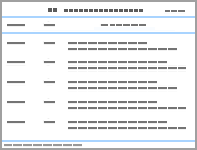
Table 1
Comparison of key characteristics of subtypes of APS
| 亚型 | 主要病理蛋白 | 核心临床特征 | 影像学特征(代表性) | 诊断标准要点 | 治疗要点 |
|---|---|---|---|---|---|
| MSA | α突触核蛋白(少突胶质细胞;主要累及纹状体-黑质、小脑-脑桥-橄榄及自主神经中枢) | 早期自主神经功能障碍(直立性低血压、泌尿生殖功能障碍),帕金森样症状或小脑共济失调 | MRI:桥脑“十字征”、壳核边缘征。FDG-PET:纹状体/小脑低代谢 | 四级诊断:神经病理确诊、临床确诊、临床很可能、前驱可能。临床确诊需满足散发、进展性、成年起病(>30岁)的基本特征,同时具有核心临床表现,至少存在2项支持性临床表现(包括运动特征如快速进展、姿势不稳、吞咽困难、巴宾斯基征等,以及非运动特征如喘鸣、手足发冷、病理性哭笑等),至少存在1项MRI标志,不存在排除性的临床表现 | 以自主神经症状管理为核心,运动症状对左旋多巴反应有限,重视康复支持 |
| DLB | α突触核蛋白(神经元;以大脑皮层和边缘系统为主) | 波动性认知障碍、视幻觉、帕金森样症状、快速眼动睡眠行为障碍 | DAT-SPECT/PET:纹状体摄取下降。FDG-PET:枕叶低代谢伴“扣带回岛征”。¹²³I-MIBG:心肌摄取降低 | 二级诊断:很可能DLB,可能的DLB。很可能的DLB需满足≥2项核心特征,或1项核心+1项指示性生物标志物。可能的DLB需仅具有1个核心特征,或者1个或多个提示性生物标志物阳性 | 首选胆碱酯酶抑制剂改善认知与精神症状,慎用抗精神病药物 |
| PSP | 4R-tau(以中脑、基底节等深部结构为主) | 垂直性核上性眼肌麻痹,早期姿势不稳和跌倒,中轴性强直 | MRI:中脑萎缩,“蜂鸟征”,中脑-脑桥比值降低。FDG-PET:额叶、丘脑低代谢 | 四级诊断:确诊PSP,很可能PSP,可能PSP,提示PSP。基于眼动障碍、姿势不稳、运动不能、认知障碍四大功能域的组合进行诊断,并纳入了8个临床亚型 | 以对症和康复治疗为主,抗帕金森药物尝试,重在防跌倒管理 |
| CBD | 4R-tau(主要累及额顶叶皮层及皮层下结构,呈不对称分布) | 非对称性运动障碍,显著皮层征(失用、异己肢、皮质感觉障碍) | MRI:额-顶叶不对称萎缩。FDG-PET:对应皮层低代谢 | 三级诊断:病理确诊CBD、很可能CBD、可能CBD 核心在于区分病理CBD与临床CBS。诊断基于四大临床表型:经典型CBS、额叶行为空间综合征、非流利性原发性进行性失语及进行性核上性麻痹综合征 | 对症治疗为主,肉毒毒素缓解局灶性肌张力障碍,强调多学科康复 |

Figure 2
Brain imaging of MSA


Figure 3
Brain imaging of DLB


Figure 4
Brain imaging of PSP


Figure 5
Brain imaging of CBD

| [1] | 王刚, 徐刚, 谢心怡, 等. 中国帕金森病报告2025[J]. 神经病学与神经康复学杂志, 2025, 21(2):63-98. |
| WANG G, XV G, XIE X Y, et al. China Parkinson's di-sease report,2025[J]. J Neurol Neurorehabil, 2025, 21(2):63-98. | |
| [2] |
DI BIASE L, PECORARO P M, DI LAZZARO V. Valida-ting the accuracy of Parkinson’s disease clinical diagnosis: A UK brain bank case-control study[J]. Ann Neurol, 2025, 97(6):1110-1121.
doi: 10.1002/ana.v97.6 URL |
| [3] |
POSTUMA R B, BERG D, STERN M, et al. MDS clinical diagnostic criteria for Parkinson’s disease[J]. Mov Disord, 2015, 30(12):1591-1601.
doi: 10.1002/mds.v30.12 URL |
| [4] |
TOLOSA E, GARRIDO A, SCHOLZ S W, et al. Challenges in the diagnosis of Parkinson’s disease[J]. Lancet Neurol, 2021, 20(5):385-397.
doi: 10.1016/S1474-4422(21)00030-2 URL |
| [5] | GÓMEZ-BENITO M, GRANADO N, GARCÍA-SANZ P, et al. Modeling Parkinson’s disease with the alpha-synuclein protein[J]. Front Pharmacol, 2020,11:356. |
| [6] | NDAYISABA A, HALLIDAY G M, KHURANA V. Multiple system atrophy: Pathology, pathogenesis, and path forward[J]. Annu Rev Pathol Mech Dis, 2025,20:245-273. |
| [7] | 张宇晨, 唐军. 多系统萎缩的机制及中西医诊疗进展[J]. 神经病学与神经康复学杂志, 2025, 21(5):368-375. |
| ZHANG Y C, TANG J. Mechanism of multiple system atrophy and progress in diagnosis and treatment with traditional Chinese and western medicine[J]. J Neurol Neurorehabil, 2025, 21(5):368-375. | |
| [8] |
KOGA S, SEKIYA H, KONDRU N, et al. Neuropathology and molecular diagnosis of synucleinopathies[J]. Mol Neurodegener, 2021, 16(1):83.
doi: 10.1186/s13024-021-00501-z pmid: 34922583 |
| [9] |
GRAHAM J G, OPPENHEIMER D R. Orthostatic hypotension and nicotine sensitivity in a case of multiple system atrophy[J]. J Neurol Neurosurg Psychiatry, 1969, 32(1):28-34.
doi: 10.1136/jnnp.32.1.28 URL |
| [10] |
Consensus statement on the definition of orthostatic hypotension, pure autonomic failure, and multiple system atrophy[J]. J Neurol Sci, 1996, 144(1-2):218-219.
pmid: 8994128 |
| [11] |
GILMAN S, LOW P, QUINN N, et al. Consensus statement on the diagnosis of multiple system atrophy[J]. Clin Auton Res, 1998, 8(6):359-362.
doi: 10.1007/BF02309628 URL |
| [12] | WENNING G K, GILMAN S, SEPPI K. Second consensus statement on the diagnosis of multiple system atrophy[J]. Akt Neurol, 2008, 35(S 01):M394. |
| [13] |
WENNING G K, STANKOVIC I, VIGNATELLI L, et al. The movement disorder society criteria for the diagnosis of multiple system atrophy[J]. Mov Disord, 2022, 37(6):1131-1148.
doi: 10.1002/mds.v37.6 URL |
| [14] | 中华医学会神经病学分会帕金森病及运动障碍学组, 中国医师协会神经内科医师分会, 帕金森病及运动障碍学组. 多系统萎缩诊断标准中国专家共识(2022)[J]. 中华神经科杂志, 2023, 56(1):15-29. |
| Chinese Society of Parkinson′s Disease and Movement Disorders, Parkinson′s Disease and Movement Disorder Section of Neurologist Branch of Chinese Medical Doctor Association. Expert consensus on diagnostic criteria for multiple system atrophy in China (2022)[J]. Chin J Neurol, 2023, 56(1):15-29. | |
| [15] |
WENNING G K, BEN SHLOMO Y, MAGALHÃES M, et al. Clinical features and natural history of multiple system atrophy: An analysis of 100 cases[J]. Brain, 1994, 117(4):835-845.
doi: 10.1093/brain/117.4.835 URL |
| [16] | JIANG Q, ZHANG L, LIN J, et al. Orthostatic hypotension in multiple system atrophy: Related factors and di-sease prognosis[J]. J Park Dis, 2023, 13(8):1313-1320. |
| [17] |
FULDA S. Idiopathic REM sleep behavior disorder as a long-term predictor of neurodegenerative disorders[J]. EPMA J, 2011, 2(4):451-458.
doi: 10.1007/s13167-011-0096-8 pmid: 23199180 |
| [18] |
CHELBAN V, BOCCHETTA M, HASSANEIN S, et al. An update on advances in magnetic resonance imaging of multiple system atrophy[J]. J Neurol, 2019, 266(4):1036-1045.
doi: 10.1007/s00415-018-9121-3 pmid: 30460448 |
| [19] | 卢钟娇, 戴若莲, 杜芸兰, 等. 认识脑干中的十字面包征[J]. 神经病学与神经康复学杂志, 2025, 21(2):143-146. |
| LU Z J, DAI R L, DU Y L, et al. The hot cross bun sign in the brainstem[J]. J Neurol Neurorehabil, 2025, 21(2):143-146. | |
| [20] |
PELLECCHIA M T, STANKOVIC I, FANCIULLI A, et al. Can autonomic testing and imaging contribute to the early diagnosis of multiple system atrophy? a systematic review and recommendations by the movement disorder society multiple system atrophy study group[J]. Movement Disord Clin Pract, 2020, 7(7):750-762.
doi: 10.1002/mdc3.v7.7 URL |
| [21] |
KRISMER F, BELIVEAU V, SEPPI K, et al. Automated analysis of diffusion-weighted magnetic resonance imagi-ng for the differential diagnosis of multiple system atrophy from Parkinson’s disease[J]. Mov Disord, 2021, 36(1):241-245.
doi: 10.1002/mds.v36.1 URL |
| [22] |
刘陈晨, 高阳, 王炜, 等. 多系统萎缩的临床和影像学特征分析[J]. 中风与神经疾病杂志, 2025, 42(4):300-305.
doi: 10.19845/j.cnki.zfysjjbzz.2025.0060 |
| LIU C C, GAO Y, WANG W, et al. Clinical and radiological features of multiple system atrophy[J]. J Apoplexy Nerv Dis, 2025, 42(4):300-305. | |
| [23] |
ESCHLBÖCK S, WENNING G, FANCIULLI A. Evidence-based treatment of neurogenic orthostatic hypotension and related symptoms[J]. J Neural Transm, 2017, 124(12):1567-1605.
doi: 10.1007/s00702-017-1791-y pmid: 29058089 |
| [24] |
HERAS-GARVIN A, WECKBECKER D, RYAZANOV S, et al. Anle138b modulates α-synuclein oligomerization and prevents motor decline and neurodegeneration in a mouse model of multiple system atrophy[J]. Mov Disord, 2019, 34(2):255-263.
doi: 10.1002/mds.v34.2 URL |
| [25] |
HERAS-GARVIN A, REFOLO V, SCHMIDT C, et al. ATH434 reduces α-synuclein-related neurodegeneration in a murine model of multiple system atrophy[J]. Mov Disord, 2021, 36(11):2605-2614.
doi: 10.1002/mds.v36.11 URL |
| [26] |
MEISSNER W G, TRAON A P, FOUBERT-SAMIER A, et al. A phase 1 randomized trial of specific active α- synuclein immunotherapies PD01A and PD03A in multiple system atrophy[J]. Mov Disord, 2020, 35(11):1957-1965.
doi: 10.1002/mds.v35.11 URL |
| [27] |
MCKEITH I G. Consensus guidelines for the clinical and pathologic diagnosis of dementia with Lewy bodies (DLB): Report of the Consortium on DLB International Workshop[J]. J Alzheimers Dis, 2006, 9(s3):417-423.
doi: 10.3233/JAD-2006-9S347 URL |
| [28] |
MCKEITH I G, DICKSON D W, LOWE J, et al. Diagnosis and management of dementia with Lewy bodies: third report of the DLB Consortium[J]. Neurology, 2005, 65(12):1863-1872.
doi: 10.1212/01.wnl.0000187889.17253.b1 pmid: 16237129 |
| [29] |
MCKEITH I G. Author response: Diagnosis and management of dementia with Lewy bodies: Fourth consensus report of the DLB Consortium[J]. Neurology, 2018, 90(6):300-301.
doi: 10.1212/WNL.0000000000004919 pmid: 29438029 |
| [30] | 中国微循环学会神经变性病专业委员会. 路易体痴呆诊治中国专家共识[J]. 中华老年医学杂志, 2015, 34(4):339-344. |
| Neurodegenerative disease professional committee of Chinese Microcirculation Society. Chinese expert consensus on diagnosis and treatment of dementia with Lewy bodies[J]. Chin J Geriatr, 2015, 34(4):339-344. | |
| [31] | 中国微循环学会神经变性病专业委员会. 中国路易体痴呆诊断与治疗指南[J]. 中华老年医学杂志, 2021, 40(12):1473-1484. |
| Chinese Society of Microcirculation Neurodegenerative Diseases Committee. Guidelines for the diagnosis and treatment of dementia with Lewy bodies in China[J]. Chin J Geriatr, 2021, 40(12):1473-1484. | |
| [32] |
BURTON E J, BARBER R, MUKAETOVA-LADINSKA E B, et al. Medial temporal lobe atrophy on MRI differentiates Alzheimer’s disease from dementia with Lewy bodies and vascular cognitive impairment: A prospective study with pathological verification of diagnosis[J]. Brain, 2009, 132(1):195-203.
doi: 10.1093/brain/awn298 URL |
| [33] |
YOUSAF T, DERVENOULAS G, VALKIMADI P E, et al. Neuroimaging in lewy body dementia[J]. J Neurol, 2019, 266(1):1-26.
doi: 10.1007/s00415-018-8892-x pmid: 29761296 |
| [34] | O’SHEA D M, ARKHIPENKO A, GALASKO D, et al. Practical use of DAT SPECT imaging in diagnosing dementia with Lewy bodies: A US perspective of current guidelines and future directions[J]. Front Neurol, 2024,15:1395413. |
| [35] |
HIGUCHI M. Imaging of proteinopathies in the brains of Parkinsonian disorders[J]. Cells, 2025, 14(18):1418.
doi: 10.3390/cells14181418 URL |
| [36] |
FERREIRA D, PRZYBELSKI S A, LESNICK T G, et al. Longitudinal FDG-PET metabolic change along the lewy body continuum[J]. JAMA Neurol, 2025, 82(3):285.
doi: 10.1001/jamaneurol.2024.4643 pmid: 39804619 |
| [37] |
D’ANGREMONT E, BEGEMANN M J H, VAN LAAR T, et al. Cholinesterase inhibitors for treatment of psychotic symptoms in Alzheimer disease and Parkinson disease: A meta-analysis[J]. JAMA Neurol, 2023, 80(8):813.
doi: 10.1001/jamaneurol.2023.1835 pmid: 37358841 |
| [38] | JIN Y, LI F, LI Z, et al. Modeling Lewy body disease withSNCAtriplication iPSC-derived cortical organoids and identifying therapeutic drugs[J]. Sci Adv, 2024, 10(37):eadk3700. |
| [39] |
PAGAN F, TORRES-YAGHI Y, HEBRON M, et al. Safety, cognitive, and behavioral outcomes in patients with dementia with lewy bodies treated with nilotinib[J]. J Clin Med, 2025, 14(12):4245.
doi: 10.3390/jcm14124245 URL |
| [40] | HO Y J, SHEN M S, TAI C H, et al. Use of ceftriaxone in treating cognitive and neuronal deficits associated with dementia with lewy bodies[J]. Front Neurosci, 2019,13:507. |
| [41] |
LITVAN I, AGID Y, CALNE D, et al. Clinical research criteria for the diagnosis of progressive supranuclear palsy (Steele-Richardson-Olszewski syndrome): Report of the NINDS-SPSP International Workshop[J]. Neurology, 1996, 47(1):1-9.
doi: 10.1212/wnl.47.1.1 pmid: 8710059 |
| [42] |
LITVAN I. Update on epidemiological aspects of progressive supranuclear palsy[J]. Mov Disord, 2003, 18(S6):43-50.
doi: 10.1002/(ISSN)1531-8257 URL |
| [43] |
HÖGLINGER G U, RESPONDEK G, STAMELOU M, et al. Clinical diagnosis of progressive supranuclear palsy: The movement disorder society criteria[J]. Mov Disord, 2017, 32(6):853-864.
doi: 10.1002/mds.v32.6 URL |
| [44] |
BATLA A, NEHRU R, VIJAY T. Vertical wrinkling of the forehead or procerus sign in progressive supranuclear palsy[J]. J Neurol Sci, 2010, 298(1/2):148-149.
doi: 10.1016/j.jns.2010.08.010 URL |
| [45] |
BHATTACHARJEE S. Procerus sign: Mechanism, clinical usefulness, and controversies[J]. Ann Indian Acad Neurol, 2018, 21(2):164.
doi: 10.4103/aian.AIAN_408_17 URL |
| [46] |
SOMME J, GÓMEZ-ESTEBAN J C, TIJERO B, et al. The applause sign and neuropsychological profile in progressive supranuclear palsy and Parkinson’s disease[J]. Clin Neurol Neurosurg, 2013, 115(8):1230-1233.
doi: 10.1016/j.clineuro.2012.11.013 URL |
| [47] |
CHATTERJEE K, CHOUDHURY S, TRIVEDI S, et al. Clinical significance of applause sign in patients with progressive supranuclear palsy[J]. Can J Neurol Sci, 2022, 49(6):809-812.
doi: 10.1017/cjn.2021.216 URL |
| [48] |
ARABIA G, QUATTRONE A. The midbrain to Pons ratio: A simple and specific MRI sign of progressive supranuclear palsy[J]. Neurology, 2013, 81(24):2147.
doi: 10.1212/01.WNL.0000437347.92583.fc pmid: 24323440 |
| [49] |
QUATTRONE A, BIANCO MG, ANTONINI A, et al. Development and validation of automated magnetic resonance Parkinsonism index 2.0 to distinguish progressive supranuclear palsy-parkinsonism from parkinson's disease[J]. Mov Disord, 2022, 37(6):1272-1281.
doi: 10.1002/mds.v37.6 URL |
| [50] | 葛璟洁, 吴平, 左传涛, 等. 进行性核上性麻痹患者脑部葡萄糖代谢特征分析[J]. 中国临床神经科学, 2012, 20(6):601-606. |
| GE J J, WU P, ZUO C T, et al. Characteristics of cerebral glucose metabolism in patients with progressive supranuclear palsy[J]. Chin J Clin Neurosci, 2012, 20(6):601-606. | |
| [51] |
ECKERT T, BARNES A, DHAWAN V, et al. FDG PET in the differential diagnosis of Parkinsonian disorders[J]. NeuroImage, 2005, 26(3):912-921.
doi: 10.1016/j.neuroimage.2005.03.012 pmid: 15955501 |
| [52] | ALSTER P, VAN EIMEREN T, MADETKO-ALSTER N. Tau positron emission tomography in the Parkinson and Richardson subtypes of progressive supranuclear palsy[J]. Park Relat Disord, 2025,137:107939. |
| [53] |
SHOEIBI A, OLFATI N, LITVAN I. Preclinical, phase I, and phase Ⅱ investigational clinical trials for treatment of progressive supranuclear palsy[J]. Expert Opin Investig Drugs, 2018, 27(4):349-361.
doi: 10.1080/13543784.2018.1460356 URL |
| [54] |
OLFATI N, GHODSI H, BAYRAM E, et al. Why therapeutic trials fail in primary tauopathies[J]. Mov Disord, 2023, 38(4):545-550.
doi: 10.1002/mds.v38.4 URL |
| [55] | REBEIZ J J, KOLODNY E H, RICHARDSON E P JR. Corticodentatonigral degeneration with neuronal achromasia: a progressive disorder of late adult life[J]. Trans Am Neurol Assoc, 1967,92:23-26. |
| [56] |
BOEVE B F, LANG A E, LITVAN I. Corticobasal degene-ration and its relationship to progressive supranuclear palsy and frontotemporal dementia[J]. Ann Neurol, 2003, 54(S5):S15-S19.
doi: 10.1002/(ISSN)1531-8249 URL |
| [57] | ARMSTRONG M J, LITVAN I, LANG A E, et al. Criteria for the diagnosis of corticobasal degeneration[J]. Neuro-logy, 2013, 80(5):496-503. |
| [58] | 中华医学会神经病学分会帕金森病及运动障碍学组, 中国医师协会帕金森病及运动障碍专业委员会. 皮质基底节变性诊断标准及治疗中国专家共识[J]. 中国神经免疫学和神经病学杂志, 2019, 26(4):240-245. |
| Parkinson's disease and movement disorder group, neurology branch, Chinese Medical Association; Parkinson's disease and movement disorder professional committee, Chinese Medical Association. Chinese expert consensus on diagnostic criteria and treatment of corticobasal ganglia degeneration[J]. Chin J Neuroimmunol Neurol, 2019, 26(4):240-245. | |
| [59] |
GIANNAKIS A, KLOUFETOU E, PECHLIVANI L, et al. A review of FDG-PET in progressive supranuclear palsy and corticobasal syndrome[J]. Int J Mol Sci, 2025, 26(17):8278.
doi: 10.3390/ijms26178278 URL |
| [60] |
MENA A M, CHEN R, GRAFF-GUERRERO A, et al. Tau in atypical Parkinsonisms: A meta-analysis of in vivo PET imaging findings[J]. Mov Disord Clin Pract, 2023, 10(12):1725-1737.
doi: 10.1002/mdc3.13885 pmid: 38094644 |
| [1] | ZOU Yang, CUI Hailun, HU Yongbo, GAO Ying, ZHANG Yueqi, CHEN Shengdi, WANG Gang. Motor evoked potentials for the differential diagnosis of idiopathic Parkinson's disease and multiple system atrophy [J]. Journal of Diagnostics Concepts & Practice, 2018, 17(04): 409-413. |
| [2] | MENG Jie, CUI Shishuang, MENG Yunxia, WANG Gang. Comparative analysis of 2005 and 2017 version of diagnostic criteria for dementia with Lewy bodies [J]. Journal of Diagnostics Concepts & Practice, 2018, 17(04): 414-418. |
| [3] | . [J]. Journal of Diagnostics Concepts & Practice, 2007, 6(03): 236-239. |
| Viewed | ||||||
|
Full text |
|
|||||
|
Abstract |
|
|||||
