

SMARCA4表达缺失型非小细胞肺癌的临床与CT特点
收稿日期: 2025-04-14
网络出版日期: 2025-10-27
Clinical and CT features of non-small cell lung cancer SMARCA4 expression deficiency
Received date: 2025-04-14
Online published: 2025-10-27
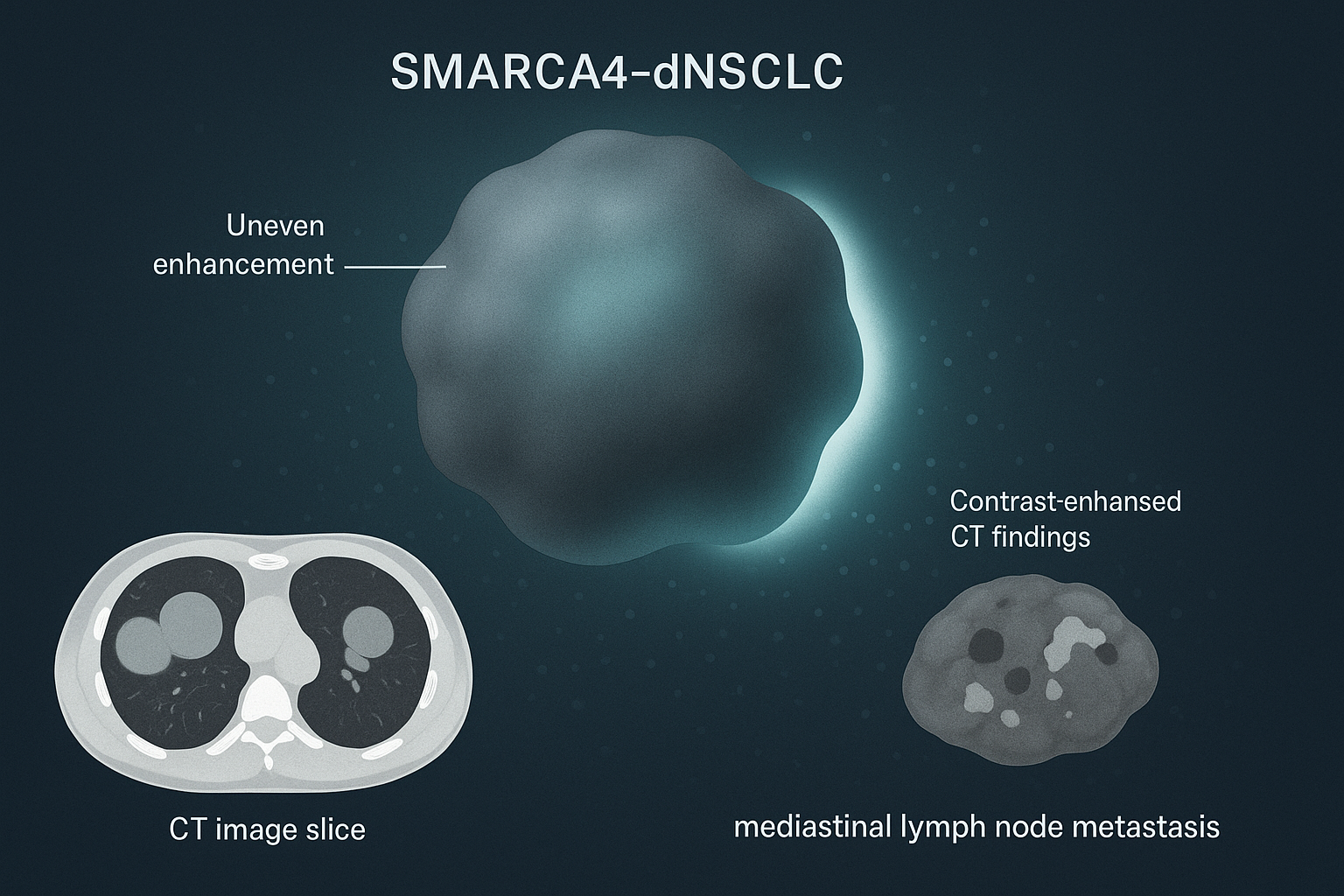
目的:探讨SMARCA4 缺失型非小细胞肺癌(SMARCA4-deficient non-small cell lung cancer, SMARCA4-dNSCLC)的临床与CT影像特征。方法:回顾性收集我院2018年1月至2022年1月期间经组织病理学证实的SMARCA4-dNSCLC患者,以同期收治SMARCA4表达完整的非小细胞肺癌(SMARCA4-intact non-small cell lung cancer, SMARCA4-iNSCLC)患者作为对照组。观察并记录SMARCA4-dNSCLC的临床资料与CT表现,并与SMARCA4-iNSCLC组比较。结果:共纳入SMARCA4-dNSCLC组42例,SMARCA4-iNSCLC组43例。SMARCA4-dNSCLC组男性、吸烟者及患慢性阻塞性肺疾病者比例更高。SMARCA4-dNSCLC组较SMARCA4-iNSCLC组更易出现上腔静脉综合征,而SMARCA4-idNSCLC组更常见咯血。CT表现上,SMARCA4-dNSCLC组肿瘤密度相对更均匀,囊变、坏死及钙化更少见,边界更模糊,且伴发阻塞性肺炎/肺不张比例较低。结论:SMARCA4-dNSCLC多见于老年男性,重度吸烟者,常伴有慢性阻塞性肺疾病。病灶好发于两肺上叶。CT多表现为密度相对均匀的软组织占位,边界不清,无囊变或坏死,罕见钙化。增强后不均匀强化。纵隔淋巴结转移常见。具备上述临床与CT特征者应警惕这一独特亚型的可能。
关键词: SMARCA4表达缺失肺癌; 非小细胞肺癌; CT
张雪坤 , 陈晓炎 , 夏鑫芸 , 程增辉 . SMARCA4表达缺失型非小细胞肺癌的临床与CT特点[J]. 内科理论与实践, 2025 , 20(04) : 282 -288 . DOI: 10.16138/j.1673-6087.2025.04.04
Objective To explore the clinical and CT features of SMARCA4-deficient non-small cell lung cancer (SMARCA4-dNSCLC ). Methods SMARCA4-dNSCLC cases confirmed histopathologically were enrolled and analyzed retrospectively in our hospital from January 2018 to January 2022. Using SMARCA4-intact NSCLC (SMARCA4-iNSCLC) cases admitted during the same period as control, the clinical characteristics and CT features of SMARCA4-dNSCLC cases were observed, recorded and compared. Results There were 42 cases in the SMARCA4-dNSCLC group and 43 cases in SMARCA4-iNSCLC control group, respectively. Compared with the control, the SMARCA4-dNSCLC group had a higher proportion of males, smokers, and chronic obstructive pulmonary disease (COPD). Clinically, the SMARCA4-dNSCLC group exhibited a higher incidence of superior vena cava syndrome, while the SMARCA4-iNSCLC group presented with hemoptysis more frequently. On CT imaging, tumors in the SMARCA4-dNSCLC group showed relatively homogeneous density, fewer cystic changes, necrosis, or calcification, more ill-defined borders, and a lower rate of associated obstructive pneumonia/atelectasis. Conclusions SMARCA4-dNSCLC was more frequently seen in elderly males and heavy smokers and was frequently accompanied by COPD. Occasionally, it could present with superior vena cava syndrome. The tumors were prone to locate in the upper lobes of both lungs. On CT imaging, it mostly presented as a soft tissue mass with relatively homogenous density, ill-defined boundaries, without cystic changes or cavities, and calcification was rare. The vast majority showed significant heterogenous enhancement after contrast. Mediastinal lymph node metastasis was common. This unique subtype of NSCLC should be considered in patients with the above clinical and CT features.
| [1] | Nicholson AG, Tsao MS, Beasley MB, et al. The 2021 WHO classification of lung tumors: impact of advances since 2015[J]. J Thorac Oncol, 2022, 17(3):362-387. |
| [2] | Crombé A, Alberti N, Villard N, et al. Imaging features of SMARCA4-deficient thoracic sarcomas: a multi-centric study of 21 patients[J]. Eur Radiol, 2019, 29(9):4730-4741. |
| [3] | Rekhtman N, Montecalvo J, Chang JC, et al. SMARCA4-deficient thoracic sarcomatoid tumors represent primarily smoking-related undifferentiated carcinomas rather than primary thoracic sarcomas[J]. J Thorac Oncol, 2020, 15(2):231-247. |
| [4] | Yoshida A, Kobayashi E, Kubo T, et al. Clinicopathological and molecular characterization of SMARCA4-deficient thoracic sarcomas with comparison to potentially related entities[J]. Mod Pathol, 2017, 30(6):797-809. |
| [5] | Parikh SA, French CA, Costello BA, et al. NUT midline carcinoma: an aggressive intrathoracic neoplasm[J]. J Thorac Oncol, 2013, 8(10):1335-1338. |
| [6] | 朱培培, 李新星, 刘佳涵, 等. SMARCA4缺失性肿瘤的临床病理学特征[J]. 中华病理学杂志, 2022, 51(8):792-798. |
| Zhu PP, Li XX, Liu JH, et al. Clinicopathological features of SMARCA4-deficient tumors[J]. Chinese Journal of Pathology, 2022, 51(8):792-798. | |
| [7] | Wong AK, Shanahan F, Chen Y, et al. BRG1, a component of the SWI-SNF complex, is mutated in multiple human tumor cell lines[J]. Cancer Res, 2000, 60(21):6171-6177. |
| [8] | Kim JH, Woo JH, Lim CY, et al. SMARCA4-deficient non-small cell lung carcinoma: clinicodemographic, computed tomography, and positron emission tomography-computed tomography features[J]. J Thorac Dis, 2024, 16(3):1753-1764. |
| [9] | Okazaki T, Yokoyama K, Tsuchiya J, et al. SMARCA4-deficient thoracic tumor detected by [18F]FDG PET/CT[J]. Eur J Hybrid Imaging, 2021, 5(1):8. |
| [10] | 曹新娜, 李钊, 王全义. SMARCA4缺失型胸部肿瘤17例临床特征及预后分析[J]. 中华结核和呼吸杂志, 2024, 47(4):325-331. |
| Cao XN, Li Z, Wang QY. Clinical characteristics and prognosis analysis of 17 cases of SMARCA4-deficient chest tumors[J]. Chinese Journal of Tuberculosis and Respiratory Diseases, 2024, 47(4):325-331. | |
| [11] | Carter BW, Glisson BS, Truong MT, et al. Small cell lung carcinoma: staging, imaging, and treatment considerations[J]. Radiographics, 2014, 34(6):1707-1721. |
/
| 〈 |
|
〉 |
