

Journal of Internal Medicine Concepts & Practice ›› 2025, Vol. 20 ›› Issue (05): 405-409.doi: 10.16138/j.1673-6087.2025.05.11
Previous Articles Next Articles
LIU Qilong( ), JIN Zhengyi, HU Jiaqi, MIN Dumu, MA Taiyan, GAO Jie()
Received:2024-11-07
Online:2025-12-10
Published:2025-12-26
Contact:
GAO Jie
E-mail:2211246050@qq.com;chyygaojie@163.com
CLC Number:
LIU Qilong, JIN Zhengyi, HU Jiaqi, MIN Dumu, MA Taiyan, GAO Jie. Advances in the study of intestinal microbes and rheumatic immune diseases[J]. Journal of Internal Medicine Concepts & Practice, 2025, 20(05): 405-409.
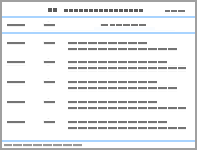
Table 1
Intestinal microbial changes and immune regulatory mechanisms in different rheumatic immune diseases
| 疾病 | 肠道微生物变化 | 关键代谢产物异常 | 免疫调控机制 |
| ↑:升高,↓:减少。pSS:原发性干燥综合征(primary Sjögren syndrome);SSc:系统性硬化症(systemic sclerosis);CCP:环瓜氨酸肽(cyclic citrullinated peptide);dsDNA:双链DNA(double-stranded DNA);HLA:人类白细胞抗原(human leucocyte antigen);TGF:转化生长因子(transforming growth factor) | |||
| RA | 厚壁菌门↓,拟杆菌门↓,放线菌门↑,变形菌门↑,普雷沃氏菌属↑ | SCFA↓ | Th17/Treg失衡,促炎细胞因子(IL-17、TNF-α)↑,自身抗体(抗CCP抗体、RF)产生↑ |
| SLE | 厚壁菌门↓,拟杆菌门失衡,噬菌体多样性改变 | SCFA↓,色氨酸代谢紊乱 | Treg功能受损,抗炎因子(IL-10)↓,B细胞过度活化→自身抗体(抗dsDNA)产生↑ |
| AS | 巨单胞菌属↑,Dorea↑,布劳特氏菌属↑,毛螺菌↓,瘤胃球菌↓,梭菌属Clostridium_XlVb↓ | SCFAs↓,次级胆汁酸↓ | 肠道通透性↑→细菌易位,IL-23/IL-17轴活化↑,HLA-B27与微生物交叉反应 |
| pSS | 肠道/口腔/阴道菌群α多样性↓,链球菌属↑,乳杆菌属↓ | 未明确报道 | 黏膜屏障破坏→自身抗原暴露,B细胞异常活化→抗SSA/SSB抗体↑ |
| SSc | 厚壁菌门↑,放线菌门↑,拟杆菌门↓ | SCFA↓ | 纤维化相关通路(TGF-β、Wnt)激活,Th2细胞优势→促纤维化因子(IL-4、IL-13)↑ |
| [1] |
Lu ZF, Hsu CY, Younis NK, et al. Exploring the significance of microbiota metabolites in rheumatoid arthritis: uncovering their contribution from disease development to biomarker potential[J]. APMIS, 2024, 132(6): 382-415.
doi: 10.1111/apm.13401 |
| [2] |
Lian FP, Zhang F, Zhao CM, et al. Gut microbiota regulation of T lymphocyte subsets during systemic lupus erythematosus[J]. BMC Immunol, 2024, 25(1): 41.
doi: 10.1186/s12865-024-00632-0 |
| [3] |
Kalayci FNC, Ozen S. Possible role of dysbiosis of the gut microbiome in SLE[J]. Curr Rheumatol Rep, 2023, 25(12): 247-258.
doi: 10.1007/s11926-023-01115-8 |
| [4] |
Zhao Y, Cheng M, Zou L, et al. Hidden link in gut-joint axis: gut microbes promote rheumatoid arthritis at early stage by enhancing ascorbate degradation[J]. Gut, 2022, 71(5): 1041-1043.
doi: 10.1136/gutjnl-2021-325209 |
| [5] |
Bao Y, Dong C, Ji J, et al. Dysregulation of gut microbiome is linked to disease activity of rheumatic diseases[J]. Clin Rheumatol, 2020, 39(9): 2523-2528.
doi: 10.1007/s10067-020-05170-9 |
| [6] |
Krautkramer KA, Fan J, Bäckhed F. Gut microbial metabolites as multi-kingdom intermediates[J]. Nat Rev Microbiol, 2021, 19(2): 77-94.
doi: 10.1038/s41579-020-0438-4 |
| [7] | Dubik M, Pilecki B, Moeller JB. Commensal intestinal protozoa-underestimated members of the gut microbial community[J]. Biology (Basel), 2022, 11(12): 1742. |
| [8] | Wu G, Xu T, Zhao N, et al. A core microbiome signature as an indicator of health [J]. Cell, 2024, 187(23): 6550-6565. |
| [9] |
Bi Y, Tu Y, Zhang N, et al. Multiomics analysis reveals the presence of a microbiome in the gut of fetal lambs[J]. Gut, 2021, 70(5): 853-864.
doi: 10.1136/gutjnl-2020-320951 |
| [10] |
Enriquez AB, Ten Caten F, Ghneim K, et al. Regulation of immune homeostasis, inflammation, and HIV persistence by the microbiome, short-chain fatty acids, and bile acids[J]. Annu Rev Virol, 2023, 10(1): 397-422.
doi: 10.1146/annurev-virology-040323-082822 |
| [11] |
Yang W, Cong Y. Gut microbiota-derived metabolites in the regulation of host immune responses and immune-related inflammatory diseases[J]. Cell Mol Immunol, 2021, 18(4): 866-877.
doi: 10.1038/s41423-021-00661-4 |
| [12] |
Ghosh S, Whitley CS, Haribabu B, et al. Regulation of intestinal barrier function by microbial metabolites[J]. Cell Mol Gastroenterol Hepatol, 2021, 11(5): 1463-1482.
doi: 10.1016/j.jcmgh.2021.02.007 |
| [13] |
Kayama H, Okumura R, Takeda K. Interaction between the microbiota, epithelia, and immune cells in the intestine[J]. Annu Rev Immunol, 2020, 38: 23-48.
doi: 10.1146/annurev-immunol-070119-115104 |
| [14] |
Zhao T, Wei Y, Zhu Y, et al. Gut microbiota and rheumatoid arthritis: from pathogenesis to novel therapeutic opportunities[J]. Front Immunol, 2022, 13: 1007165.
doi: 10.3389/fimmu.2022.1007165 |
| [15] |
Zhang L, Qing P, Yang H, et al. Gut microbiome and metabolites in systemic lupus erythematosus: link, mechanisms and intervention[J]. Front Immunol, 2021, 12: 686501.
doi: 10.3389/fimmu.2021.686501 |
| [16] |
Huang T, Pu Y, Wang X, et al. Metabolomic analysis in spondyloarthritis: a systematic review[J]. Front Microbiol, 2022, 13: 965709.
doi: 10.3389/fmicb.2022.965709 |
| [17] |
Wang Q, Zhang SX, Chang MJ, et al. Characteristics of the gut microbiome and its relationship with peripheral CD4+ T cell subpopulations and cytokines in rheumatoid arthritis[J]. Front Microbiol, 2022, 13: 799602.
doi: 10.3389/fmicb.2022.799602 |
| [18] |
Drago L. Prevotella copri and microbiota in rheumatoid arthritis: fully convincing evidence?[J]. J Clin Med, 2019, 8(11): 1837.
doi: 10.3390/jcm8111837 |
| [19] |
Guo R, Li S, Zhang Y, et al. Dysbiotic oral and gut viromes in untreated and treated rheumatoid arthritis patients[J]. Microbiol Spectr, 2022, 10(5): e0034822.
doi: 10.1128/spectrum.00348-22 |
| [20] |
Toumi E, Goutorbe B, Plauzolles A, et al. Gut microbiota in systemic lupus erythematosus patients and lupus mouse model: a cross species comparative analysis for biomarker discovery[J]. Front Immunol, 2022, 13: 943241.
doi: 10.3389/fimmu.2022.943241 |
| [21] |
Chen C, Yan Q, Yao X, et al. Alterations of the gut virome in patients with systemic lupus erythematosus[J]. Front Immunol, 2023, 13: 1050895.
doi: 10.3389/fimmu.2022.1050895 |
| [22] |
Zhang L, Han R, Zhang X, et al. Fecal microbiota in patients with ankylosing spondylitis: correlation with dietary factors and disease activity[J]. Clin Chim Acta, 2019, 497: 189-196.
doi: 10.1016/j.cca.2019.07.038 |
| [23] |
Li C, Zhang Y, Yan Q, et al. Alterations in the gut virome in patients with ankylosing spondylitis[J]. Front Immunol, 2023, 14: 1154380.
doi: 10.3389/fimmu.2023.1154380 |
| [24] |
So J, Tam LS. Gut microbiome and its interaction with immune system in spondyloarthritis[J]. Microorganisms, 2020, 8(11): 1727.
doi: 10.3390/microorganisms8111727 |
| [25] |
Wang X, Pang K, Wang J, et al. Microbiota dysbiosis in primary Sjögren's syndrome and the ameliorative effect of hydroxychloroquine[J]. Cell Rep, 2022, 40(11): 111352.
doi: 10.1016/j.celrep.2022.111352 |
| [26] | Tan TC, Chandrasekaran L, Leung YY, et al. Gut microbiome profiling in systemic sclerosis: a metagenomic approach[J]. Clin Exp Rheumatol, 2023, 41(8): 1578-1588. |
| [27] |
Yang Y, Hong Q, Zhang X, et al. Rheumatoid arthritis and the intestinal microbiome: probiotics as a potential therapy[J]. Front Immunol, 2024, 15: 1331486.
doi: 10.3389/fimmu.2024.1331486 |
| [28] |
Balasundaram D, Veerasamy V, Sylvia Singarayar M, et al. Therapeutic potential of probiotics in gut microbial homeostasis and rheumatoid arthritis[J]. Int Immunopharmacol, 2024, 137: 112501.
doi: 10.1016/j.intimp.2024.112501 |
| [29] | Bodkhe R, Balakrishnan B, Taneja V. The role of microbiome in rheumatoid arthritis treatment [J]. Ther Adv Musculoskelet Dis, 2019, 11:1759720X19844632. |
| [30] |
Ferro M, Charneca S, Dourado E, et al. Probiotic supplementation for rheumatoid arthritis: a promising adjuvant therapy in the gut microbiome era[J]. Front Pharmacol, 2021, 12: 711788.
doi: 10.3389/fphar.2021.711788 |
| [31] | Fan Z, Yang B , Ross RP, et al. The prophylactic effects of different lactobacilli on collagen-induced arthritis in rats [J]. Food Funct, 2020, 11(4): 3681-3694. |
| [32] | Zeng J, Peng L, Zheng W, et al. Fecal microbiota transplantation for rheumatoid arthritis: a case report[J]. Clin Case Rep, 2020, 9(2): 906-909. |
| [33] |
Huang C, Yi P, Zhu M, et al. Safety and efficacy of fecal microbiota transplantation for treatment of systemic lupus erythematosus: an EXPLORER trial[J]. J Autoimmun, 2022, 130: 102844.
doi: 10.1016/j.jaut.2022.102844 |
| [34] |
Wang L, Wei Z, Pan F, et al. Case report: fecal microbiota transplantation in refractory ankylosing spondylitis[J]. Front Immunol, 2023, 14: 1093233.
doi: 10.3389/fimmu.2023.1093233 |
| [1] | LIU Shumeng, AI Penghui, XIAO Qin, YANG Xiaodong. Interaction between bile acids and gut microbiota and their role in Parkinson disease [J]. Journal of Internal Medicine Concepts & Practice, 2025, 20(04): 345-350. |
| [2] | CEN Xing, ZHAO Chunmiao, BU Yujie, ZHAO Guifang, YANG Jinhua, CHEN Junwei. Investigating correlation between gut microbiota and peripheral lymphocyte subsets in patients with systemic lupus erythematosus [J]. Journal of Internal Medicine Concepts & Practice, 2025, 20(02): 140-145. |
| [3] | YANG Jin, WEI Yao, JIN Jun. Interaction of bile acids with the gut microbiota and their effects on sepsis [J]. Journal of Internal Medicine Concepts & Practice, 2024, 19(03): 207-211. |
| [4] | ZHU Xiaowen, WANG Hongchao, WU Wenjun. Role of gut microbiota in mediating metabolic and cardiovascular abnormalities in patients with obstructive sleep apnea and related mechanisms [J]. Journal of Internal Medicine Concepts & Practice, 2024, 19(02): 130-135. |
| [5] | LIN Weiyi, GE Chengwang, TANG Xiaowei, et al. Research progress of probiotics in chronic wound healing [J]. Journal of Tissue Engineering and Reconstructive Surgery, 2023, 19(6): 602-. |
| [6] | CHEN Congyan, WANG Junqing, CHEN Yongjun. Gut microbiota and mechanism of liver cancer [J]. Journal of Surgery Concepts & Practice, 2022, 27(03): 256-260. |
| [7] | XU Fei, YIN Mingyue, WANG Wei, DONG Zhiya, LU Wenli, YU Yi, WANG Xinqiong, WANG Junqi, XIAO Yuan. Metagenomic analysis of gut microbiota and antibiotic resistome in girls with precocious puberty [J]. Journal of Diagnostics Concepts & Practice, 2022, 21(01): 52-61. |
| Viewed | ||||||
|
Full text |
|
|||||
|
Abstract |
|
|||||
