

Contemporary Foreign Languages Studies ›› 2026, Vol. 26 ›› Issue (2): 89-100.doi: 10.3969/j.issn.1674-8921.2026.02.007
Previous Articles Next Articles
FAN Wuqiu( ), WANG Chujun()
Online:2026-04-28
Published:2026-05-22
CLC Number:
FAN Wuqiu, WANG Chujun. The Local Legitimation and Global Recognition of Knowledge: A Comparative Review and Reflection on Pragmatic Translation Studies (2016-2025)[J]. Contemporary Foreign Languages Studies, 2026, 26(2): 89-100.
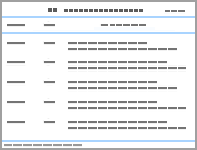
| 一阶分类 | 二阶分类 | 一阶分类 | 二阶分类 | 一阶分类 | 二阶分类 |
|---|---|---|---|---|---|
| 一般理论 A | 宏观研究A1 | 文类研究 D | 科技翻译D1 | 翻译技术 E | 机器翻译E1 |
| 中观研究A2 | 商务翻译D2 | 技术伦理E2 | |||
| 微观研究A3 | 法律翻译D3 | 软件工程E3 | |||
| 术语与 术语库 B | 术语翻译B1 | 旅游翻译D4 | 本地化E4 | ||
| 术语管理B2 | 学术翻译D5 | 翻译管理 F | 语言服务F1 | ||
| 术语库建设B3 | (非文学) 典籍翻译D6 | 人力资源与 行业生态F2 | |||
| 教学培训 C | 教材研究C1 | 外宣翻译D7 | 翻译质量管理F3 | ||
| 人才培养C2 | 视听翻译D8 | 项目管理F4 | |||
| 课程研究C3 | 行业口译D9 | 应用 翻译史 G | |||
| 翻译测试C4 | 类型学研究D10 | ||||
| 教学路径C5 | 其他翻译D11 |


| 研究方法 | 国内论文数量 | 占比 | 国际论文数量 | 占比 |
|---|---|---|---|---|
| 定性研究 | 1709 | 90.28% | 513 | 49.47% |
| 定量研究 | 184 | 9.72% | 524 | 50.53% |
| [1] |
Bednárová-Gibová K. 2021. Organizational ergonomics of translation as a powerful predictor of translators’ happiness at work?[J]. Perspectives 29(3): 391-406.
doi: 10.1080/0907676X.2020.1753788 URL |
| [2] | Havelka I. 2020. Video-mediated remote interpreting in healthcare[J]. Babel 66(2): 326-345. |
| [3] | Loupaki E. 2017. Multilingualism, multiculturalism and translational practice in the European Union[J]. The Journal of Specialised Translation 28(2): 52-68. |
| [4] | Romero-Fresco P. 2020. The dubbing effect: An eye-tracking study on how viewers make dubbing work[J]. The Journal of Specialised Translation 33(1): 17-40. |
| [5] | 方梦之. 2014. 应用(文体)翻译学的内部体系[J]. 上海翻译(2):1-6. |
| [6] | 方梦之. 2025. 翻译研究学科归属的尴尬——兼论外国语言文学下的翻译(学)[J]. 上海翻译(1):1-6. |
| [7] | 方群. 2020. 应用翻译研究二十年(2000—2019)——基于17种外语类核心期刊的统计分析[J]. 上海翻译(1):62-67. |
| [8] | 傅敬民. 2019. 我国应用翻译研究:回顾与反思[J]. 上海大学学报(社会科学版)(5):93-104. |
| [9] | 蒋辰雪. 2019. 文树德《黄帝内经》英译本的“深度翻译”探究[J]. 中国翻译(5):112-120,190. |
| [10] |
李瑞林. 2022. 知识翻译学的知识论阐释[J]. 当代外语研究(1):47-59,161.
doi: 10.3969/j.issn.1674-8921.2022.01.003 |
| [11] | 李亚峰. 2025. 应用翻译研究:基于学术期刊个案的知识生产考察[J]. 外语与翻译(3):49-54. |
| [12] | 田希波. 2017. 民国时期《科学》杂志刊文翻译概况[J]. 中国科技翻译(1):53-55,58. |
| [13] | 卫思谕. 2022. 知识翻译学的创新探索[N]. 中国社会科学报(6-13):A01. |
| [14] | 文炳、 刘可欣. 2024. 中医药知识翻译中的概念重构和跨文化传通——以《红楼梦》两个经典译本的医案英译为例[J]. 上海翻译(6):81-85. |
| [15] | 杨枫. 2021a. 知识翻译学宣言[J]. 当代外语研究(5):2,27. |
| [16] | 杨枫. 2021b. 翻译是文化还是知识?[J]. 当代外语研究(6):2,36. |
| [17] | 杨枫. 2022. 知识的地方性与翻译的世界性[J]. 当代外语研究(3):1-2. |
| [18] | 杨枫. 2026. 种子与大地的约定——从“知识翻译学宣言”到“五梁十二柱”[J]. 当代外语研究(2):1-8. |
| [19] | 曾利沙. 2014. 论方梦之应用翻译学研究系统思想与特点[J]. 当代外语研究(2):7-11,76. |
| [20] | 赵永华 等. 2023. “人类命运共同体”俄文翻译与传播的话语实践研究[J]. 中国翻译(4):104-111. |
| Viewed | ||||||
|
Full text |
|
|||||
|
Abstract |
|
|||||
