

诊断学理论与实践 ›› 2025, Vol. 24 ›› Issue (06): 605-612.doi: 10.16150/j.1671-2870.2025.06.005
杨蕊馨1,2, 于颖彦1,2( )
)
收稿日期:2025-07-04
修回日期:2025-10-30
出版日期:2025-12-25
发布日期:2025-12-25
通讯作者:
于颖彦 E-mail:ruijinhospitalyyy@163.com基金资助:
YANG Ruixin1,2, YU Yingyan1,2()
Received:2025-07-04
Revised:2025-10-30
Published:2025-12-25
Online:2025-12-25
摘要:
近年来,随着人工智能(artificial intelligence, AI)算法模型的快速发展,出现了以图像分类为主要功能的卷积神经网络(convolutional neural network, CNN)算法、决策分类的决策树和支持向量机模型、提高模型识别精准性的注意力机制模型、完成图像中病灶识别定位的目标检测模型,以及实现图像中病灶精准分割的语义分割和实例分割模型等。AI的CNN与医学影像深度融合,显著提高了疾病诊断的效率和精准率。随着数字医学水平提高,AI在疾病诊疗路径中图像数据结合点进一步拓宽。除了传统的放射学、超声学、内镜学和病理学等图像,手术切除标本图像和类器官图像等非经典图像也逐步被纳入了AI研究范畴。AI的深度介入有助于解码多维数据中的隐性信息,不断改变疾病的诊治模式。可以预见,未来AI算法与各类疾病诊疗设备镶嵌整合,将成为疾病诊断、治疗乃至发展趋势预判的有力工具。
中图分类号:
杨蕊馨, 于颖彦. 人工智能在消化道肿瘤医学图像数据处理的应用[J]. 诊断学理论与实践, 2025, 24(06): 605-612.
YANG Ruixin, YU Yingyan. Application of artificial intelligence in medical image data processing for digestive tract tumors[J]. Journal of Diagnostics Concepts & Practice, 2025, 24(06): 605-612.
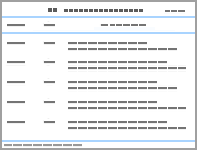
表1
AI模型常用算法实现功能及评估参数。
| AI 模型 | 算法 | 功能 | 参数 |
|---|---|---|---|
| CNN | VGG、Inception、ResNet、InceptionResNetV2、DenseNet、EfficientNet、Xception、MobileNet | 图像分类 | 精确度、准确率、召回率、特异性、阳性预测值、阴性预测值、受试者操作特征曲线和曲线下面积 |
| SVM | SVM、S3VM | 图像聚类 | 精确度、准确率、召回率、特异度、阳性预测值、阴性预测值、受试者操作特征曲线和曲线下面积 |
| 注意力机制 | 软注意力、硬注意力 | 注意力 | 提高AI模型的训练效果 |
| 目标检测 | YOLO、SSD、CenterNet、EfficientNet | 病变检测 | mAP |
| 语义分割 | FCN、SegNet、U-Net、V-Net、DeepLab、PSPNet | 病变分割 | mIoU |
| 实例分割 | 掩码 R-CNN、级联掩码 R-CNN、YOLACT、CondInst、SOLO | 单一病变分割 | mIoU |
表2
不同AI算法在医学图像领域应用进展
| 应用 | AI 模型 | 图像类型 | 功能 | 评估参数 |
|---|---|---|---|---|
| 内镜图像 | SSD | 彩色内镜图像 | 早期胃癌检测 | mAP |
| DeepLab v3+ | 白光内镜图像 | 上消化道肿瘤评估 | mIoU | |
| UNet++ | 彩色内镜图像或白光内镜图像 | 早期胃癌边缘勾画 | mIoU | |
| FCN-8 | 白光内镜图像 | 结直肠息肉分割 | mIoU | |
| EfficientNetB7 | 白光内镜图像 | 胃癌与非胃癌、幽门螺旋杆菌感染与非幽门螺旋杆菌感染的分类,淋巴结转移的预测 | 精确度、准确率、召回率、AUC | |
| 放射影像 | SVM | CT | 淋巴结转移的预测 | mIoU |
| Faster R-CNN | CT | 淋巴结转移的预测 | mAP | |
| R-CNN | MRI | 手术目标勾画 | mIoU | |
| 手术切除标本图像 | RFB-SSD ResNet50-PSPNet | 胃切除标本图像 | 病变检测与分割,淋巴结转移的预测 | mAP、mIoU |
| 病理图像 | InceptionV3 | 全切片数字图像 | 正常、慢性胃炎和肠型胃癌的分类 | 精确度、准确率、召回率、AUC |
| YOLOv4 | 全切片数字图像 | 胃癌诊断 | mAP | |
| ResNet18 | 全切片数字图像 | 幽门螺旋杆菌的预测 | 精确度、准确率、召回率、AUC | |
| 类器官图像 | SSD | 白光类器官图像 | 类器官的检测与追踪 | mAP |
| Faster R-CNN | 白光类器官图像 | 人体肠道类器官的定位与量化 | mAP | |
| CBAM-YOLOv3 | 白光类器官图像 | 类器官活力评估 | mAP | |
| U-Net、SVM | 白光类器官图像 | 结直肠癌类器官亚型分类 | mAP、mIoU |
| [1] |
PESAPANE F, CODARI M, SARDANELLI F. Artificial intelligence in medical imaging: threat or opportunity? Radiologists again at the forefront of innovation in medicine[J]. Eur Radiol Exp, 2018, 2(1):35.
doi: 10.1186/s41747-018-0061-6 |
| [2] |
HIRASAWA T, AOYAMA K, TANIMOTO T, et al. Application of artificial intelligence using a convolutional neural network for detecting gastric cancer in endoscopic images[J]. Gastric Cancer, 2018, 21(4):653-660.
doi: 10.1007/s10120-018-0793-2 pmid: 29335825 |
| [3] |
YANG R, YU Y. Artificial convolutional neural network in object detection and semantic segmentation for medical imaging analysis[J]. Front Oncol, 2021, 11:638182.
doi: 10.3389/fonc.2021.638182 URL |
| [4] |
SHUKLA P, VERMA A, ABHISHEK, et al. Interpreting SVM for medical images using Quadtree[J]. Multimed Tools Appl, 2020, 79(39-40):29353-29373.
doi: 10.1007/s11042-020-09431-2 |
| [5] | NGUYEN THI CAM H, SARLAN A, ARSHAD N I. A hybrid model integrating recurrent neural networks and the semi-supervised support vector machine for identification of early student dropout risk[J]. Peer J Comput Sci, 2024, 10:e2572. |
| [6] |
SCHLEMPER J, OKTAY O, SCHAAP M, et al. Attention gated networks: Learning to leverage salient regions in medical images[J]. Med Image Anal, 2019, 53:197-207.
doi: S1361-8415(18)30613-3 pmid: 30802813 |
| [7] |
ZHOU Q, ZHOU Y, HOU N, et al. DFA-UNet: dual-stream feature-fusion attention U-Net for lymph node segmentation in lung cancer diagnosis[J]. Front Neurosci, 2024, 18:1448294.
doi: 10.3389/fnins.2024.1448294 URL |
| [8] |
LI H, NAN Y, DEL SER J, et al. Large-kernel attention for 3D medical image segmentation[J]. Cognit Comput, 2024, 16(4):2063-2077.
doi: 10.1007/s12559-023-10126-7 |
| [9] |
VENHUIZEN F G, VAN GINNEKEN B, LIEFERS B, et al. Deep learning approach for the detection and quantification of intraretinal cystoid fluid in multivendor optical coherence tomography[J]. Biomed Opt Express, 2018, 9(4):1545-1569.
doi: 10.1364/BOE.9.001545 pmid: 29675301 |
| [10] |
HE W, LI C, NIE X, et al. Recognition and detection of aero-engine blade damage based on Improved Cascade Mask R-CNN[J]. Appl Opt, 2021, 60(17):5124-5133.
doi: 10.1364/AO.423333 pmid: 34143079 |
| [11] |
TIAN Z, ZHANG B, CHEN H, et al. Instance and panoptic segmentation using conditional convolutions[J]. IEEE Trans Pattern Anal Mach Intell, 2023, 45(1):669-680.
doi: 10.1109/TPAMI.2022.3145407 URL |
| [12] | MA X B, XU Q L, LI N, et al. A decision tree model to distinguish between benign and malignant pulmonary nodules on CT scans[J]. Eur Rev Med Pharmacol Sci, 2023, 27(12):5692-5699. |
| [13] |
LUO H, XU G, LI C, et al. Real-time artificial intelligence for detection of upper gastrointestinal cancer by endoscopy: a multicentre, case-control, diagnostic study[J]. Lancet Oncol, 2019, 20(12):1645-1654.
doi: S1470-2045(19)30637-0 pmid: 31591062 |
| [14] |
AN P, YANG D, WANG J, et al. A deep learning method for delineating early gastric cancer resection margin under chromoendoscopy and white light endoscopy[J]. Gastric Cancer, 2020, 23(5):884-892.
doi: 10.1007/s10120-020-01071-7 pmid: 32356118 |
| [15] |
WICKSTRØM K, KAMPFFMEYER M, JENSSEN R. Uncertainty and interpretability in convolutional neural networks for semantic segmentation of colorectal polyps[J]. Med Image Anal, 2020, 60:101619.
doi: 10.1016/j.media.2019.101619 URL |
| [16] |
YANG R, ZHANG J, ZHAN F, et al. Artificial intelligence efficiently predicts gastric lesions, Helicobacter pylori infection and lymph node metastasis upon endoscopic images[J]. Chin J Cancer Res, 2024, 36(5):489-502.
doi: 10.21147/j.issn.1000-9604.2024.05.03 URL |
| [17] | 中华医学会肿瘤学分会早诊早治学组, 苗智峰, 徐忠法, 等. 胃癌早诊早治中国专家共识(2023版)[J]. 中华消化外科杂志, 2024, 23(1):23-36. |
| Early Diagnosis and Treatment Group, Chinese Society of Oncology, Chinese Medical Association, Miao ZF, Xu ZF, et al. Chinese expert consensus on early diagnosis and treatment of gastric cancer (2023 edition)[J]. Chin J Dig Surg, 2024, 23(1): 23-36. | |
| [18] | 杨鋆, 辛城霖, 张忠涛. 中低位直肠癌的精准诊断与规范治疗[J]. 中华消化外科杂志, 2024, 23(1):85-90. |
| YANG Y, XIN C L, ZHANG Z T. Precision diagnosis and standardized treatment of midlow rectal cancer[J]. Chin J Dig Surg, 2024, 23(1): 85-90. | |
| [19] |
FENG Q X, LIU C, QI L, et al. An intelligent clinical decision support system for preoperative prediction of lymph node metastasis in gastric cancer[J]. J Am Coll Radiol, 2019, 16(7):952-960.
doi: 10.1016/j.jacr.2018.12.017 URL |
| [20] | GAO Y, ZHANG Z D, LI S, et al. Deep neural network-assisted computed tomography diagnosis of metastatic lymph nodes from gastric cancer[J]. Chin Med J (Engl), 2019, 132(23):2804-2811. |
| [21] |
LIU Y, CHEN L, FAN M, et al. Application of AI-assisted MRI for the identification of surgical target areas in pediatric hip and periarticular infections[J]. BMC Musculoskelet Disord, 2024, 25(1):428.
doi: 10.1186/s12891-024-07548-1 |
| [22] |
YANG R, YAN C, LU S, et al. Tracking cancer lesions on surgical samples of gastric cancer by artificial intelligent algorithms[J]. J Cancer, 2021, 12(21):6473-6483.
doi: 10.7150/jca.63879 pmid: 34659538 |
| [23] |
MA B, GUO Y, HU W, et al. Artificial intelligence-based multiclass classification of benign or malignant mucosal lesions of the stomach[J]. Front Pharmacol, 2020, 11:572372.
doi: 10.3389/fphar.2020.572372 URL |
| [24] |
TUNG C L, CHANG H C, YANG B Z, et al. Identifying pathological slices of gastric cancer via deep learning[J]. J Formos Med Assoc, 2022, 121(12):2457-2464.
doi: 10.1016/j.jfma.2022.05.004 URL |
| [25] | ZHU M, GUO M, LIU C Q, et al. Deep-learning model AIBISI predicts bacterial infection across cancer types based on pathological images[J]. Heliyon, 2023, 9(4):e15400. |
| [26] | 姚金玉, 卢庆苗, 鲁一兵. 甲状腺类器官研究进展[J]. 中华内分泌代谢杂志, 2024, 40(1):73-76. |
| YAO J Y, LU Q M, LU Y B. Advances in the research of thyroid organoid[J]. Chin J Endocrinol Metab, 2024, 40(1):73-76. | |
| [27] | 黄立颖, 张欢, 李裕明, 等. 胃肠内分泌细胞分化和功能研究进展[J]. 中华内分泌代谢杂志, 2024, 40(6):538-544. |
| HUANG L Y, ZHANG H, LI Y M. Enteroendocrine cell differentiation and function: An update[J]. Chin J Endocrinol Metab, 2024, 40(6):538-544. | |
| [28] |
BIAN X, LI G, WANG C, et al. A deep learning model for detection and tracking in high-throughput images of organoid[J]. Comput Biol Med, 2021, 134:104490.
doi: 10.1016/j.compbiomed.2021.104490 URL |
| [29] |
KASSIS T, HERNANDEZ-GORDILLO V, LANGER R, et al. OrgaQuant: Human intestinal organoid localization and quantification using deep convolutional neural networks[J]. Sci Rep, 2019, 9(1):12479.
doi: 10.1038/s41598-019-48874-y pmid: 31462669 |
| [30] | YANG R, DU Y, KWAN W, et al. A quick and reliable image-based AI algorithm for evaluating cellular senescence of gastric organoids[J]. Cancer Biol Med, 2023, 20(7):519-536. |
| [31] |
OKAMOTO T, NATSUME Y, DOI M, et al. Integration of human inspection and artificial intelligence-based morphological typing of patient-derived organoids reveals interpatient heterogeneity of colorectal cancer[J]. Cancer Sci, 2022, 113(8):2693-2703.
doi: 10.1111/cas.v113.8 URL |
| [32] | 田捷, 王坤, 董迪, 等. 基于人工智能和医疗大数据的肿瘤荧光手术导航与量化评估策略[J]. 中华消化外科杂志, 2024, 23(4):536-542. |
| TIAN J, WANG K, DONG D, et al. Navigation and quantitative evaluation strategies for tumor fluorescent surgery based on artificial intelligence and medical big data[J]. Chin J Dig Surg, 2024, 23(4): 536-542. |
| [1] | 余梦思, 宁聪华, 孟存仁, 帕丽扎提.阿不都热依木, 钟笛, 时瑛, 薛黎. 人工智能阅片平台在医学检验专业实习生血细胞形态教学中的应用研究[J]. 诊断学理论与实践, 2025, 24(06): 668-672. |
| [2] | 戴敏, 蒋裕雄, 史玉玲. 2023年至2024年银屑病诊治进展[J]. 诊断学理论与实践, 2025, 24(06): 593-604. |
| [3] | 刘淦, 戴媛媛, 常文娇, 马筱玲. 脓毒症筛查技术进展[J]. 诊断学理论与实践, 2025, 24(06): 567-575. |
| [4] | 洪烨娜, 张宇, SHI Kuangyu, 李彪, 郭睿. 放射性核素诊疗一体化的若干问题及对策[J]. 诊断学理论与实践, 2025, 24(03): 263-267. |
| [5] | 徐梦迪, 高峰, 朱剑, 陈蕾, 秦雨萌, 黄越, 唐银萍, 沙杰. 新型海绵胶囊联合人工智能细胞DNA检测在早期食管癌筛查中的价值[J]. 诊断学理论与实践, 2024, 23(06): 580-586. |
| [6] | 李卓含, 黄新韵, 郭睿, 李彪. 18F-FDG PET/CT在滤泡性淋巴瘤诊断和预后评估中的研究进展[J]. 诊断学理论与实践, 2024, 23(04): 439-444. |
| [7] | 吴娜明, 李军, 陶娟. 恶性黑色素瘤的诊断热点[J]. 诊断学理论与实践, 2023, 22(03): 215-220. |
| [8] | 唐静仪, 余群, 刘军. 结合人工智能的结构影像分析对阿尔茨海默病的早期预测及精准诊断研究进展[J]. 诊断学理论与实践, 2022, 21(01): 12-17. |
| [9] | 徐浩, 张治, 解学乾, 杨文艺, 刘少稳. 冠脉生理功能评估软件(DEEPVESSEL FFR)与有创FFR在评估冠脉缺血中的对比研究[J]. 诊断学理论与实践, 2021, 20(04): 384-390. |
| [10] | 许晶晶, 张敏鸣. 人工智能机器学习方法在阿尔茨海默病中的应用现状[J]. 诊断学理论与实践, 2018, 17(04): 466-470. |
| 阅读次数 | ||||||
|
全文 |
|
|||||
|
摘要 |
|
|||||
