

诊断学理论与实践 ›› 2026, Vol. 25 ›› Issue (01): 53-62.doi: 10.16150/j.1671-2870.2026.01.008
刘晶a, 李勇a, 向恩菲b, 方旭前c
收稿日期:2024-11-06
接受日期:2026-01-28
出版日期:2026-02-25
发布日期:2026-02-28
基金资助:LIU Jinga, LI Yonga, XIANg Enfeib, FANG Xuqianc
Received:2024-11-06
Accepted:2026-01-28
Published:2026-02-25
Online:2026-02-28
摘要:
目的:观察中国人群肺大细胞神经内分泌癌(large cell neuroendocrine carcinoma, LCNEC)靶向突变分布特征及靶向治疗临床获益。方法:回顾性收集2021年1月至2023年12月上海交通大学医学院附属瑞金医院北部院区44例连续初治LCNEC患者。采用免疫组化检测其病理组织中的PD-L1表达情况,荧光定量PCR法检测11个驱动基因(ALK、ROS1、RET、NTRK1-3、MET、EGFR、BRAF、KRAS、HER2)突变情况。对所有患者的治疗及结局进行随访,中位随访期24个月。结果:44例LCNEC患者以男性为主(93.2%,41/44);中位年龄70.5岁;就诊时Ⅲ、Ⅳ期占77.2%(34/44),淋巴结转移率68.2%,远处转移率47.7%。44例患者中11.4%(5例)存在可靶向突变,包括EGFR 19Del(1例)、ALK重排(1例)、MET ex14(1例)、KRAS G12C(2例)。79.5%(35/44)的患者LCNEC病理组织中程序性死亡受体配体1(programmed death-ligand 1, PD-L1)呈阴性,仅6.8%(3/44)呈PD-L1高表达(≥50%)。在34例晚期患者中,3例接受靶向治疗者的中位无进展生存期(progression free survival, PFS)为6.6个月,优于31例非靶向治疗者的4.8个月(P<0.05),EGFR突变和ALK重排患者的PFS分别达7个月和11个月,而MET ex14突变患者对靶向治疗反应不佳(PFS为2个月)。结论:在中国人群真实世界中,LCNEC侵袭性高,患者就诊时Ⅲ、Ⅳ期占七成以上,肿瘤组织中PD-L1低表达(阴性率79.5%),提示免疫治疗潜在获益人群有限;11.4%患者存在可靶向突变,携带EGFR突变和ALK重排者靶向治疗的疗效较好。分子分型对筛选LCNEC治疗优势人群可能具有重要指导价值。
中图分类号:
刘晶, 李勇, 向恩菲, 方旭前. 肺大细胞神经内分泌癌患者临床组织特征和可靶向分子亚型分布及意义[J]. 诊断学理论与实践, 2026, 25(01): 53-62.
LIU Jing, LI Yong, XIANg Enfei, FANG Xuqian. Clinicopathological characteristics and distribution and significance of targetable molecular subtypes in patients with pulmonary large cell neuroendocrine carcinoma[J]. Journal of Diagnostics Concepts & Practice, 2026, 25(01): 53-62.
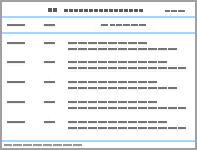
表1
LCNEC队列的临床和组织学特征
| Item | LCNEC (n = 44) | pLCNEC (n = 34) | CoLCNEC (n = 10) | P value |
|---|---|---|---|---|
| Age (year,median) | 70.50 (66.25, 76.00) | 71.00 (66.75, 77.25) | 68.50 (61.25, 73.50) | 0.08 |
| Sex (n, %) | ||||
| Male | 41 (93.2) | 32 (94.1) | 9 (90.0) | 0.64 |
| Female | 3 (6.8) | 2 (5.9) | 1 (10.0) | |
| T (Tumor size) | ||||
| T1 | 11 (25.0) | 7 (20.6) | 4 (40.0) | 0.63 |
| T2 | 9 (20.4) | 7 (20.6) | 2 (20.0) | |
| T3 | 7 (15.9) | 6 (17.6) | 1 (10.0) | |
| T4 | 17 (38.6) | 14 (41.1) | 3 (30.0) | |
| N (Lymph node metastasis) | ||||
| N0 | 14 (31.8) | 13 (38.2) | 1 (10.0) | 0.09 |
| N1-N3 | 30 (68.2) | 21 (61.8) | 9 (90.0) | |
| M (Distant metastasis) | ||||
| M0 | 23 (52.3) | 19 (55.9) | 4 (40.0) | 0.37 |
| M1 | 21 (47.7) | 15 (44.1) | 6 (60.0) | |
| Clinical stage | ||||
| Ⅰ | 5 (11.4) | 5 (14.7) | 0 (0.0) | 0.07 |
| Ⅱ | 5 (11.4) | 3 (8.8) | 2 (20.0) | |
| Ⅲ | 13 (29.5) | 11 (32.3) | 2 (20.0) | |
| Ⅳ | 21 (47.7) | 15 (44.1) | 6 (60.0) | |
| PD-L1 | ||||
| <1% | 35 (79.5) | 27 (79.4) | 8 (80.0) | 0.85 |
| 1%-50%(exduding 50%) | 6 (13.6) | 5 (14.7) | 1 (10.0) | |
| ≥50% | 3 (6.8) | 2 (5.8) | 1 (10.0) | |
表2
LCNEC中可靶向治疗病例
| Cases | Genetic mutation | Tumor type | Gender | Age (year) | TNM | Clinical stage | Metastasis | PFS (month) | Clinical outcome | OS (month) |
|---|---|---|---|---|---|---|---|---|---|---|
| 1 | EGFR 19Del | CoLCNEC | Female | 69 | pT2N2M0 rTxN0M1c | ⅢA ⅣB | Brain | First line (Osimertinib): 4; Second line (Gefitinib + Anlotinib): 3 | PR | 17 |
| 2 | ALK | LCNEC | Female | 59 | cT4N3M1c | ⅣB | Brain, liver | Alectinib: 11 | PR | 12 |
| 3 | MET ex14 | LCNEC | Male | 71 | cT3N1M0 | ⅢA | No | First line (Savolitinib): 2 Second line (EP): 6 | PD | 14 |
| 4 | KRAS G12C | LCNEC | Male | 73 | pT3N3M0 | ⅢC | No | EP + immunotherapy: 1 | PD | 6.5 |
| 5 | KRAS G12C | CoLCNEC | Male | 70 | pT2aN0M0 rT0N0M1b | ⅠB ⅣA | Abdominal wall | Fist line (EP chemotherapy): 2 Second line (Anlotinib + Toripalimab): 2 | PD | NA |

图1
携带可靶向的驱动基因突变并接受靶向治疗的LCNEC病理图片 A:EGFR 19Del突变患者,CD56强(+)、SYN弥漫(+)、CGA阴性;B:ALK重排患者,SYN弥漫(+)、CGA弥漫(+)以及ALK强(+);C:MET ex14突变患者,CD56强(+)、SYN弥漫(+)、CGA弥漫(+)。


图2
EGFR 19Del 突变LCNEC 患者术后脑转移的头颅MRI 动态变化 注:患者术后2个月出现脑转移病灶,经奥希替尼治疗后脑病灶缩小,后再次进展。


图3
携带可靶向的驱动基因突变患者的治疗过程及生存时间线 A:EGFR 19Del突变患者;B:ALK 重排患者;C:MET ex14突变患者。


图4
ALK重排LCNEC患者治疗后发生脑部多发转移及肝脏转移 注:患者的脑转移病灶在靶向治疗期间维持稳定,至治疗后13个月时出现脑部多发病灶及肝脏转移。A:脑部多发转移,上行为大脑上部层面,下行为靠近颅底的层面。B:肝脏转移,左右图分别为肝脏增强MRI不同的扫描层面。


图5
MET ex14突变LCNEC患者右肺下叶(A)及右肺中叶(B)病灶治疗后的变化 注:上行,肺窗;下行,纵隔窗(治疗前为增强CT扫描,治疗后为平扫CT)。右肺下叶病灶略增大,右肺中叶病灶略缩小,总体评估对靶向治疗反应不佳。

| [1] |
FASANO M, DELLA CORTE C M, PAPACCIO F, et al. Pulmonary large-cell neuroendocrine carcinoma: From epidemiology to therapy[J]. J Thorac Oncol, 2015, 10(8):1133-1141.
doi: 10.1097/JTO.0000000000000589 pmid: 26039012 |
| [2] |
BATTAFARANO R J, FERNANDEZ F G, RITTER J, et al. Large cell neuroendocrine carcinoma: An aggressive form of non-small cell lung cancer[J]. J Thorac Cardiovasc Surg, 2005, 130(1):166-172.
doi: 10.1016/j.jtcvs.2005.02.064 URL |
| [3] |
TRAVIS W D, BRAMBILLA E, BURKE A P, et al. Introduction to the 2015 World Health Organization classification of tumors of the lung, pleura, thymus, and heart[J]. J Thorac Oncol, 2015, 10(9):1240-1242.
doi: S1556-0864(15)33570-X pmid: 26291007 |
| [4] |
NICHOLSON A G, TSAO M S, BEASLEY M B, et al. The 2021 WHO classification of lung tumors: Impact of advances since 2015[J]. J Thorac Oncol,2022, 17(3):362-387.
doi: 10.1016/j.jtho.2021.11.003 URL |
| [5] |
PELOSI G, LAFFI A, PAPOTTI M, et al. Clinical needs and pathology’s answers in neuroendocrine neoplasms of the lung[J]. Pathologica, 2025, 117(3):220-242.
doi: 10.32074/1591-951X-N1102 URL |
| [6] |
DERKS J L, LEBLAY N, THUNNISSEN E, et al. Molecular subtypes of pulmonary large-cell neuroendocrine carcinoma predict chemotherapy treatment outcome[J]. Clin Cancer Res, 2018, 24(1):33-42.
doi: 10.1158/1078-0432.CCR-17-1921 pmid: 29066508 |
| [7] |
MIYOSHI T, UMEMURA S, MATSUMURA Y, et al. Genomic profiling of large-cell neuroendocrine carcinoma of the lung[J]. Clin Cancer Res, 2017, 23(3):757-765.
doi: 10.1158/1078-0432.CCR-16-0355 pmid: 27507618 |
| [8] | GEORGE J, WALTER V, PEIFER M, et al. Integrative genomic profiling of large-cell neuroendocrine carcinomas reveals distinct subtypes of high-grade neuroendocrine lung tumors[J]. Nat Commun, 2018,9:1048. |
| [9] | ZHU S, WANG X, LI H, et al. Advances in genetic profile and therapeutic strategy of pulmonary large cell neuroendocrine carcinoma[J]. Front Med, 2024,11:1326426. |
| [10] | BURNS L, TUKACHINSKY H, RASKINA K, et al. Real-World comprehensive genomic profiling data for diagnostic clarity in pulmonary large-cell neuroendocrine carcinoma[J]. Lung Cancer, 2024,188:107454. |
| [11] | CHAE Y K, TAMRAGOURI K B, CHUNG J, et al. Large-cell neuroendocrine carcinoma of the lung: A focused analysis of BRAF Alterations and case report of a BRAF Non-V600-mutated tumor responding to targeted therapy[J]. JCO Precis Oncol, 2018(2):1-12. |
| [12] |
HAYASHI N, FUJITA A, SAIKAI T, et al. Large cell neuroendocrine carcinoma harboring an anaplastic lymphoma kinase (ALK) rearrangement with response to alectinib[J]. Intern Med, 2018, 57(5):713-716.
doi: 10.2169/internalmedicine.9368-17 URL |
| [13] |
MASUDA K, SAIKI M, SHIMAMURA S, et al. Dramatic response to alectinib in an ALK-positive LCNEC patient with a poor performance status: A case report[J]. Respirol Case Rep, 2021, 9(9):e0817.
doi: 10.1002/rcr2.v9.9 URL |
| [14] |
MUTO S, OZAKI Y, OKABE N, et al. Successful treatment of combined large cell neuroendocrine carcinoma harboring an EGFR mutation with EGFR-TKIs plus bevacizumab: A case report[J]. Case Rep Oncol, 2021, 13(3):1387-1392.
doi: 10.1159/000511112 URL |
| [15] | ZHENG Q, ZHENG M, JIN Y, et al. ALK-rearrangement neuroendocrine carcinoma of the lung: A comprehensive study of a rare case series and review of literature[J]. Onco Targets Ther, 2018,11:4991-4998. |
| [16] |
Travis W D, Brambilla E, Nicholson A G, et al. The 2015 World Health Organization classification of lung tumors: impact of genetic, clinical and radiologic advances since the 2004 classification[J]. J Thorac Oncol, 2015, 10(9):1243-1260.
doi: S1556-0864(15)33571-1 pmid: 26291008 |
| [17] |
LE TREUT J, SAULT M C, LENA H, et al. Multicentre phase Ⅱ study of cisplatin-etoposide chemotherapy for advanced large-cell neuroendocrine lung carcinoma: The GFPC 0302 study[J]. Ann Oncol, 2013, 24(6):1548-1552.
doi: 10.1093/annonc/mdt009 URL |
| [18] |
NIHO S, KENMOTSU H, SEKINE I, et al. Combination chemotherapy with irinotecan and cisplatin for large-cell neuroendocrine carcinoma of the lung: A multicenter phase Ⅱ study[J]. J Thorac Oncol, 2013, 8(7):980-984.
doi: 10.1097/JTO.0b013e31828f6989 URL |
| [19] | ATIEH T, HUANG C H. Treatment of advanced-stage large cell neuroendocrine cancer (LCNEC) of the lung: A tale of two diseases[J]. Front Oncol, 2021,11:667468. |
| [20] | DE PAS T M, GIOVANNINI M, MANZOTTI M, et al. Large-cell neuroendocrine carcinoma of the lung Harbo-ring EGFR Mutation and responding to gefitinib[J]. J Clin Oncol, 2011, 29(34):e819-e822. |
| [21] | SAKAI Y, YAMASAKI T, KUSAKABE Y, et al. Large-cell neuroendocrine carcinoma of lung with epidermal growth factor receptor (EGFR) gene mutation and co-expression of adenocarcinoma markers: A case report and review of the literature[J]. Multidiscip Respir Med, 2013,8:47. |
| [22] |
AROLDI F, BERTOCCHI P, MERIGGI F, et al. Tyrosine kinase inhibitors in EGFR-mutated large-cell neuroendocrine carcinoma of the lung a case report[J]. Case Rep Oncol, 2014, 7(2):478-483.
doi: 10.1159/000365413 URL |
| [23] | AKHOUNDOVA D, HABERECKER M, FRITSCH R, et al. Targeting ALK in neuroendocrine tumors of the lung[J]. Front Oncol, 2022,12:911294. |
| [24] |
SHIMIZU N, AKASHI Y, FUJII T, et al. Use of ALK immunohistochemistry for optimal therapeutic strategy of pulmonary large-cell neuroendocrine carcinoma and identification of a novel KIF5B-ALK fusion oncokinase[J]. Anticancer Res, 2019, 39(1):413-420.
doi: 10.21873/anticanres.13127 URL |
| [25] | CHEN Q, ZHANG J, WANG X, et al. Two case reports: EML4-ALK rearrangement large cell neuroendocrine carcinoma and literature review[J]. Front Oncol, 2023,13:1227980. |
| [26] | WIEDEMANN C, KAZDAL D, CVETKOVIC J, et al. Lorlatinib and compound mutations in ALK+ large-cell neuroendocrine lung carcinoma: A case report[J]. Cold Spring Harb Mol Case Stud, 2022:mcs.a006234. |
| [27] | LI Y, GAO L, MA D, et al. Identification of MET exon14 skipping by targeted DNA- and RNA-based next-generation sequencing in pulmonary sarcomatoid carcinomas[J]. Lung Cancer, 2018,122:113-119. |
| [28] |
ROSSI G, CAVAZZA A, MARCHIONI A, et al. Role of chemotherapy and the receptor tyrosine kinases KIT, PDGFRα, PDGFRβ, and met in large-cell neuroendocrine carcinoma of the lung[J]. J Clin Oncol, 2005, 23(34):8774-8785.
doi: 10.1200/JCO.2005.02.8233 URL |
| [1] | 蔡姣迪, 陈国群, 张文琴. 2025年NCCN非小细胞肺癌临床实践(V1-V3)指南解读[J]. 诊断学理论与实践, 2026, 25(01): 37-43. |
| [2] | 林莉亚, 吴希, 毛胤祺, 陈光明, 武文漫, 戴菁, 王学锋, 丁秋兰. 三种位于ADAMTS13编码去整合素样结构域上的基因突变可导致蛋白产物功能缺陷并又发血栓形成[J]. 诊断学理论与实践, 2025, 24(04): 431-440. |
| [3] | 周丽华, 沈茹, 屈柯暄, 王爱华, 陈有会, 袁志敏. ABO血型基因第7外显子695 T>C突变导致Bw11亚型的研究[J]. 诊断学理论与实践, 2024, 23(04): 392-397. |
| [4] | 朱维维, 李倩, 吴凡, 翟志敏. 100例骨髓增生异常性肿瘤患者基因突变及其与临床特征间的关系[J]. 诊断学理论与实践, 2024, 23(03): 305-312. |
| [5] | 刘洪江, 谢其冰. 免疫介导坏死性肌病诊治进展[J]. 诊断学理论与实践, 2024, 23(03): 270-277. |
| [6] | 李一林, 陈杨, 李艳艳, 冯旭娇, 章程, 李健, 沈琳. 循环肿瘤细胞检测在常见恶性肿瘤精准医学中的应用和展望[J]. 诊断学理论与实践, 2023, 22(04): 332-340. |
| [7] | 郝旭, 王伟铭. 依靠肾活检确诊的以肾脏病变为主要表现的法布里病1例报告[J]. 诊断学理论与实践, 2022, 21(04): 527-529. |
| [8] | 李佳, 吕良敬. 靶向治疗时代议自身免疫病的感染挑战[J]. 诊断学理论与实践, 2022, 21(03): 299-303. |
| [9] | 周璐, 雷航, 洪叶, 金爽, 董永勤, 王学锋, 蔡晓红. 一个新的ABO*A等位基因导致的AwB亚型及其分子机制研究[J]. 诊断学理论与实践, 2021, 20(06): 547-551. |
| [10] | 雷航, 范亮峰, 蔡晓红, 王钰箐, 刘曦, 金沙, 沈伟, 陆琼, 向东, 王学锋, 邹纬. 中国人群血型ABO亚型的分子基础研究[J]. 诊断学理论与实践, 2020, 19(04): 364-369. |
| [11] | 彭真萍, 项喜喜, 张苏江, 李佳明. 以类白血病反应为首发表现的慢性中性粒细胞白血病二例并文献复习[J]. 诊断学理论与实践, 2020, 19(02): 122-128. |
| [12] | 蔡蓉, 闵学文, 陈美蓉, 沈娅婷, 石群立, 周晓蝶. BRAF V600E(VE1)在甲状腺乳头状癌中的表达及其临床意义[J]. 诊断学理论与实践, 2018, 17(05): 552-556. |
| [13] | 马韵芳, 潘丽娜, 张培培, 何清, 徐志红, 胡家安. 人类表皮生长因子受体2基因扩增的非小细胞肺癌一例报告[J]. 诊断学理论与实践, 2018, 17(04): 462-465. |
| [14] | 王登峰, 崔文燕, 邹纬, 李芳, 王学锋, 蔡晓红. α-1,3- N-乙酰半乳糖胺基转移酶p.M142I突变导致Ax亚型的分子机制研究[J]. 诊断学理论与实践, 2018, 17(03): 260-265. |
| [15] | 陆静, 胥雨菲, 卿艳荣, 韩聪, 李牛, 郁婷婷, 姚如恩, 王剑. 一个Rett综合征合并努南综合征家系的基因诊断[J]. 诊断学理论与实践, 2018, 17(02): 147-150. |
| 阅读次数 | ||||||
|
全文 |
|
|||||
|
摘要 |
|
|||||
