

诊断学理论与实践 ›› 2026, Vol. 25 ›› Issue (01): 63-70.doi: 10.16150/j.1671-2870.2026.01.009
卢沭雄, 唐海旭, 吴萍, 采丽, 张颖, 颜霞( )
)
收稿日期:2025-06-25
修回日期:2026-01-01
接受日期:2026-01-04
出版日期:2026-02-25
发布日期:2026-02-25
通讯作者:
颜霞 E-mail: yxyzytk@126.com基金资助:
LU Shuxiong, TANG Haixu, WU Ping, CAI Li, ZHANG Ying, YAN Xia()
Received:2025-06-25
Revised:2026-01-01
Accepted:2026-01-04
Published:2026-02-25
Online:2026-02-25
摘要:
目的:探讨富含精氨酸和谷氨酸蛋白1(arginine and glutamate rich 1,ARGLU1)在宫颈癌组织中的表达,及其与宫颈癌患者临床病理特征及预后之间的关系,为探索宫颈癌发生分子机制的研究提供新线索。方法:收集本院2024年1月至2024年11月间连续入组的32例宫颈癌患者的癌组织和癌旁组织新鲜组织样本;另收集152例宫颈癌患者的癌组织石蜡样本,其中本院病例63例(2020年6月至2023年3月收集,术后随访至2025年6月,随访时间为2.33~5.08年),组织芯片病例89例(2010年1月至2011年10月收集,术后随访至2017年3月,随访时间为5.50~7.25年),采用实时荧光定量聚合酶链式反应(quantita-tive real-time polymerase chain reaction, qRT-PCR)检测、免疫组织化学方法检测宫颈癌与相应癌旁组织中的ARGLU1 mRNA和蛋白表达差异,分析ARGLU1表达与宫颈癌患者临床病理特征之间的关系,并应用Kaplan-Meier法进行预后评估。结果:宫颈癌组织中的ARGLU1 mRNA相对表达量显著高于癌旁组织[(2.72±0.52)比(1.33±0.44),P<0.05],且宫颈癌组织中ARGLU1蛋白的高表达率也显著高于癌旁组织(68.75%比28.13%,χ²=10.573,P<0.05)。有淋巴结转移的宫颈癌患者的ARGLU1高表达率、ARGLU1 mRNA相对表达量均高于无淋巴结转移宫颈癌患者[86.49%(32/37)比66.09%(76/115),χ²=5.664,P<0.05;(3.177±0.255)比(2.539±0.482),t=-3.748,P<0.05],且不同临床分期的宫颈癌患者间的ARGLU1高表达率、ARGLU1 mRNA相对表达量差异有统计学意义[Ⅰ期58.18%(32/55),Ⅱ期69.23%(27/39),Ⅲ期77.78%(28/36),Ⅳ期95.45%(21/22),χ²=11.654,P<0.05;Ⅰ期(2.489±0.518),Ⅱ期(2.919±0.426),Ⅲ期(2.930±0.257),Ⅳ期(3.340±0.071),t=3.393,P<0.05]。单因素生存分析显示,宫颈癌患者的年龄、宫颈癌分期、淋巴结是否转移以及ARGLU1表达的高低是影响宫颈癌患者预后的因素(P<0.05)。多因素Cox风险模型分析结果表明,年龄、宫颈癌分期、淋巴结转移以及ARGLU1表达量是宫颈癌患者预后的独立影响因子(P<0.05)。Kaplan-Meier法预后分析显示,ARGLU1高表达患者的5年总生存率、5年无病生存率均明显低于低表达患者(44%比84%,Log-rank χ²=14.580,P<0.05;43%比83%,Log-rank χ²=14.736,P<0.05)。结论:ARGLU1在宫颈癌组织中高表达,且与不良病理特征及不良预后密切相关,提示ARGLU1可能在宫颈癌发生、发展中起重要作用,有望作为潜在的预后标志物和治疗靶点。
中图分类号:
卢沭雄, 唐海旭, 吴萍, 采丽, 张颖, 颜霞. ARGLU1在宫颈癌组织中的表达及与临床病理特征及预后的关系[J]. 诊断学理论与实践, 2026, 25(01): 63-70.
LU Shuxiong, TANG Haixu, WU Ping, CAI Li, ZHANG Ying, YAN Xia. Expression of ARGLU1 in cervical cancer tissues and its relationship with clinicopathological characteristics and prognosis[J]. Journal of Diagnostics Concepts & Practice, 2026, 25(01): 63-70.
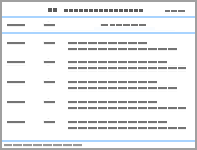
表1
ARGLU1 mRNA在宫颈癌和癌旁组织中的表达
| Groups | Case (n) | Low expression of ARGLU1 mRNA | High expression of ARGLU1 mRNA | P | χ² |
|---|---|---|---|---|---|
| Cervical cancer tissues | 32 | 10 | 22 | 0.002 | 10.573 |
| Adjacent normal tissues | 32 | 23 | 9 |

图1
ARGLU1在宫颈癌和癌旁组织中的表达(×200) A:宫颈鳞癌组织;B:宫颈腺癌组织;C:相应的癌旁组织。

表2
32例宫颈癌患者中ARGLU1 mRNA相对表达量与临床因素的关系
| Clinicopathological features | Case(n) | ARGLU1 mRNA | t | P |
|---|---|---|---|---|
| Age (year) | ||||
| ≤45 | 12 | 2.673±0.625 | -0.382 | 0.705 |
| >45 | 20 | 2.746±0.454 | ||
| Lymph node metastasis | ||||
| No | 23 | 2.539±0.482 | -3.748 | 0.001 |
| Yes | 9 | 3.177±0.255 | ||
| Clinical staging | ||||
| Ⅰ | 17 | 2.489±0.518 | 3.393 | 0.032 |
| Ⅱ | 10 | 2.919±0.426 | ||
| Ⅲ | 3 | 2.930±0.257 | ||
| Ⅳ | 2 | 3.340±0.071 | ||
| Pathology type | ||||
| Squamous cell carcinoma | 26 | 2.707±0.487 | -0.252 | 0.803 |
| Adenocarcinoma | 6 | 2.767±0.681 | ||
| Histological differentiation | ||||
| Low-moderate | 25 | 2.714±0.513 | -0.092 | 0.927 |
| High | 7 | 2.734±0.568 |
表3
152例宫颈癌患者中ARGLU1蛋白的表达水平与临床因素间的关系
| Clinicopathological features | n | ARGLU1 expression | χ² | P | |
|---|---|---|---|---|---|
| Low | High | ||||
| Age (year) | |||||
| ≤45 | 65 | 22 | 43 | 1.325 | 0.281 |
| >45 | 87 | 22 | 65 | ||
| Lymph node metastasis | |||||
| No | 115 | 39 | 76 | 5.664 | 0.021 |
| Yes | 37 | 5 | 32 | ||
| Clinical staging | |||||
| Ⅰ | 55 | 23 | 32 | 11.654 | 0.008 |
| Ⅱ | 39 | 12 | 27 | ||
| Ⅲ | 36 | 8 | 28 | ||
| Ⅳ | 22 | 1 | 21 | ||
| Pathology type | |||||
| Squamous cell carcinoma | 134 | 37 | 97 | 0.981 | 0.406 |
| Adenocarcinoma | 18 | 7 | 11 | ||
| Histological differentiation | |||||
| Low-moderate | 32 | 6 | 26 | 2.049 | 0.191 |
| High | 120 | 38 | 82 | ||
表4
单因素和多因素Cox风险模型分析
| Variables | Univariate analysis | Multivaria analysis | |||||
|---|---|---|---|---|---|---|---|
| HR | 95%CI | P | HR | 95%CI | P | ||
| Age | 2.544 | 1.459-4.435 | 0.001 | 2.186 | 1.229-3.889 | 0.008 | |
| Lymph node metastasis | 3.287 | 1.998-5.408 | <0.001 | 0.473 | 0.266-0.843 | 0.011 | |
| Clinical staging | 4.024 | 2.908-5.569 | <0.001 | 4.657 | 3.197-6.782 | <0.001 | |
| Pathology type | 0.901 | 0.411-1.393 | 0.794 | 1.076 | 0.470-2.463 | 0.862 | |
| Histological differentiation | 0.645 | 0.371-1.122 | 0.121 | 0.812 | 0.458-1.440 | 0.476 | |
| ARGLU1 expression level | 0.246 | 0.112-0.539 | <0.001 | 0.427 | 0.191-0.955 | 0.038 | |

图2
Kaplan-Meier生存曲线

| [1] | BRAY F, FERLAY J, SOERJOMATARAM I, et al. Global cancer statistics 2018: GLOBOCAN estimates of incidence and mortality worldwide for 36 cancers in 185 countries[J]. CA Cancer J Clin, 2018, 68(6):394-424. |
| [2] | XIA C, DONG X, LI H, et al. Cancer statistics in China and United States, 2022: profiles, trends, and determinants[J]. Chin Med J (Engl), 2022, 135(5):584-590. |
| [3] | 中国抗癌协会宫颈癌专业委员会. 局部晚期子宫颈癌治疗指南(2025年版)[J]. 中国实用妇科与产科杂志, 2025, 41(2):186-193. |
| Cervical Cancer Committee of China Anti-Cancer Association. Treatment guidelines for locally advanced cervical cancer(2025 edition)[J]. Chin J Pract Gynecol Obstet, 2025, 41(2):186-193. | |
| [4] |
WEI F, GEORGES D, MAN I, et al. Causal attribution of human papillomavirus genotypes to invasive cervical cancer worldwide: a systematic analysis of the global lite-rature[J]. Lancet, 2024, 404(10451):435-444.
doi: 10.1016/S0140-6736(24)01097-3 URL |
| [5] | 吴琪, 范伯男, 李岩. 2022全球癌症统计报告分析解读:中国与世界癌症疾病负担与流行趋势[J]. 诊断学理论与实践, 2025, 24(2):135-145. |
| WU Q, FAN B N, LI Y. Analysis and interpretation of the 2022 Global Cancer Statistics Report:cancer burden and epidemiological trends in China and the world[J]. J Diagn Concepts Pract, 2025, 24(02):135-145. | |
| [6] |
ESKANDER R N, TEWARI K S. Immunotherapy: an evolving paradigm in the treatment of advanced cervical cancer[J]. Clin Ther, 2015, 37(1):20-38.
doi: 10.1016/j.clinthera.2014.11.010 pmid: 25592089 |
| [7] |
ZHANG Q, LI W, KANIS M J, et al. Oncologic and obstetrical outcomes with fertility-sparing treatment of cervical cancer:a systematic review and meta-analysis[J]. Oncotarget, 2017, 8(28): 46580-46592.
doi: 10.18632/oncotarget.v8i28 URL |
| [8] |
CHEN T, WEI M, LIU Y, et al. Rising Mortality Rate of Cervical Cancer in Younger Women in Urban China[J]. J Gen Intern Med, 2020, 35(2):593.
doi: 10.1007/s11606-019-05174-5 pmid: 31309406 |
| [9] |
MAGOMEDOVA L, TIEFENBACH J, ZILBERMAN E, et al. ARGLU1 is a transcriptional coactivator and splicing regulator important for stress hormone signaling and development[J]. Nucleic Acids Res, 2019, 47(6):2856-2870.
doi: 10.1093/nar/gkz010 pmid: 30698747 |
| [10] |
HAN H, BRAUNSCHWEIG U, GONATOPOULOS-POURNATZIS T, et al. Multilayered control of alternative splicing regulatory networks by transcription factors[J]. Mol Cell, 2017, 65(3):539-553.e7.
doi: S1097-2765(17)30037-0 pmid: 28157508 |
| [11] |
BACHUS S, AKKERMAN N, FULHAM L, et al. ARGLU1 enhances promoter-proximal pausing of RNA polymerase Ⅱ and stimulates DNA damage repair[J]. Nucleic Acids Res, 2024, 52(10):5658-5675.
doi: 10.1093/nar/gkae208 URL |
| [12] |
LI L, HAN W, CHEN Y, et al. MiR-3613-3p inhibits hypertrophic scar formation by down-regulating arginine and glutamate-rich 1[J]. Mol Cell Biochem, 2021, 476(2):1025-1036.
doi: 10.1007/s11010-020-03968-4 pmid: 33165823 |
| [13] |
ZHANG D, JIANG P, XU Q, et al. Arginine and glutamate-rich 1 (ARGLU1) interacts with mediator su-bunit 1 (MED1) and is required for estrogen receptor-mediated gene transcription and breast cancer cell growth[J]. J Biol Chem, 2011, 286(20):17746-17754.
doi: 10.1074/jbc.M110.206029 URL |
| [14] | LI F, LI J, YU J, et al. Identification of ARGLU1 as a potential therapeutic target for gastric cancer based on genome-wide functional screening data[J]. EBioMedicine, 2021,69:103436. |
| [15] |
SHI J, YU X, LI G, et al. DTL promotes head and neck squamous cell carcinoma progression by mediating the degradation of ARGLU1 to regulate the Notch signaling pathway[J]. Int J Biol Macromol, 2024, 259(Pt 2):129184.
doi: 10.1016/j.ijbiomac.2023.129184 URL |
| [16] |
LI T, LAI Y, YUAN J. The diagnostic accuracy of TCT + HPV-DNA for cervical cancer: systematic review and meta-analysis[J]. Ann Transl Med, 2022, 10(14):761.
doi: 10.21037/atm-22-1732 pmid: 35965790 |
| [17] |
LI H, LI L, SUN J, et al. Value of TCT combined with serum CA153 and CA50 in early diagnosis of cervical cancer and precancerous lesions[J]. Pak J Med Sci, 2022, 38(6): 1471-1476.
doi: 10.12669/pjms.38.6.5503 pmid: 35991263 |
| [18] |
ARBYN M, SIMON M, DE SANJOSÉ S, et al. Accuracy and effectiveness of HPV mRNA testing in cervical cancer screening: a systematic review and meta-analysis[J]. Lancet Oncol, 2022, 23(7):950-960.
doi: 10.1016/S1470-2045(22)00294-7 pmid: 35709810 |
| [19] |
LEE J H, CHOI Y S, PARK J H, et al. MiR-150-5p may contribute to pathogenesis of human leiomyoma via regulation of the Akt/p27Kip1 pathway in vitro[J]. Int J Mol Sci, 2019, 20(11):2684.
doi: 10.3390/ijms20112684 URL |
| [20] | LU J L, ZHAO L, HAN S C, et al. MiR-129 is involved in the occurrence of uterine fibroid through inhibiting TET1[J]. Eur Rev Med Pharmacol Sci, 2018, 22(14):4419-4426. |
| [21] | SHANG X, WANG H, GU J, et al. Ferroptosis-related gene transferrin receptor protein 1 expression correlates with the prognosis and tumor immune microenvironment in cervical cancer[J]. PeerJ, 2024,12:e17842. |
| [1] | 徐图, 史春桃, 韩玮, 姚丽倩, 陈超波, 房灵, 顾婷婷. 乳腺癌组织中Survivin与TK1的协同表达现象及临床意义[J]. 诊断学理论与实践, 2025, 24(05): 518-528. |
| [2] | 杨梅, 廖啟安, 谭全会, 李婷婷, 张毅, 陈洁, 汤正好. 医院获得性细菌性脑膜炎患者预后不良的危险因素分析及列线图预测模型的构建[J]. 诊断学理论与实践, 2025, 24(04): 441-448. |
| [3] | 吴双成, 郁胜强. 2025版KDIGO常染色体显性多囊肾病评估、管理和治疗临床实践指南要点解读[J]. 诊断学理论与实践, 2025, 24(03): 255-262. |
| [4] | 周晓蝶, 戚荣鑫, 王璇, 余波, 王建军, 石群立, 饶秋, 鲍炜. 尿路上皮癌PD-L1、AR及P53表达及其与临床预后相关性[J]. 诊断学理论与实践, 2025, 24(03): 286-292. |
| [5] | 李卓含, 黄新韵, 郭睿, 易红梅, 许彭鹏, 武志芳, 李彪. 滤泡合并弥漫大B细胞淋巴瘤的PET/CT特征及其联合IPI在预后评估中的价值[J]. 诊断学理论与实践, 2025, 24(02): 178-186. |
| [6] | 龚静青, 曹端荣, 庄义欣, 邱立, 李晓鸣. 双表型鼻腔鼻窦肉瘤1例临床病理分析[J]. 诊断学理论与实践, 2025, 24(01): 100-105. |
| [7] | 罗海军, 练亿香, 王志敢, 蒋莎莉. 基因GYPC甲基化检测在HR-HPV阳性妇女子宫颈癌筛查中的应用[J]. 诊断学理论与实践, 2025, 24(01): 65-71. |
| [8] | 张俊花, 李一林, 谢静远, 张春丽, 徐静. C3肾病临床预后相关病理特征分析[J]. 诊断学理论与实践, 2024, 23(06): 587-593. |
| [9] | 阮淼, 笪倩, 许海敏, 董磊, 费晓春. HER2低表达乳腺癌临床病理学特征及预后研究[J]. 诊断学理论与实践, 2024, 23(05): 500-508. |
| [10] | 王玉蓉, 汪元元, 翁海燕. 胃肠道平滑肌肉瘤临床病理分析3例报告[J]. 诊断学理论与实践, 2024, 23(05): 537-541. |
| [11] | 付溪娜, 许新, 李天杰, 金影. 宫颈锥切术后高危型人乳头瘤病毒持续感染的高危因素[J]. 诊断学理论与实践, 2024, 23(04): 416-423. |
| [12] | 李卓含, 黄新韵, 郭睿, 李彪. 18F-FDG PET/CT在滤泡性淋巴瘤诊断和预后评估中的研究进展[J]. 诊断学理论与实践, 2024, 23(04): 439-444. |
| [13] | 朱维维, 李倩, 吴凡, 翟志敏. 100例骨髓增生异常性肿瘤患者基因突变及其与临床特征间的关系[J]. 诊断学理论与实践, 2024, 23(03): 305-312. |
| [14] | 倪亚平, 陈一峰, 杨晓群, 陈晓炎. 原发性肺腺癌伴肠母细胞分化2例临床病理及预后分析[J]. 诊断学理论与实践, 2024, 23(03): 324-329. |
| [15] | 王书奎, 顾心亮. tsRNA作为肿瘤诊断和预后标志物的研究进展[J]. 诊断学理论与实践, 2023, 22(05): 413-420. |
| 阅读次数 | ||||||
|
全文 |
|
|||||
|
摘要 |
|
|||||
