

诊断学理论与实践 ›› 2026, Vol. 25 ›› Issue (02): 200-208.doi: 10.16150/j.1671-2870.2026.02.011
陈光明a,b, 林莉亚a, 吴灏洋a, 武文漫a, 丁秋兰a, 王学锋a( ), 戴菁a()
收稿日期:2026-02-10
修回日期:2026-03-16
接受日期:2026-03-20
出版日期:2026-04-25
发布日期:2026-04-25
通讯作者:
王学锋 E-mail:wangxuefeng6336@hotmail.com;基金资助:
CHEN Guangminga,b, LIN Liyaa, WU Haoyanga, WU Wenmana, DING Qiulana, WANG Xuefenga(), DAI Jinga()
Received:2026-02-10
Revised:2026-03-16
Accepted:2026-03-20
Published:2026-04-25
Online:2026-04-25
摘要:
目的:一期法检测(one-stage clotting assay,OSA)测定凝血因子Ⅷ活性(FⅧ:C)是目前临床最常用的方法,但在携带特定错义突变的血友病A患者中,OSA测得的FⅧ:C水平可能高于临床出血表型所提示的水平,导致疾病严重程度被低估,甚至造成血友病的漏诊,而发色底物法检测(chromogenic substrate assay,CSA)常用于OSA的补充。本研究分析轻型血友病A(mild hemophilia A, MHA)患者的基因型及实验室表型,并探讨OSA、CSA及凝血酶生成试验(thrombin generation test,TGT)在MHA诊断中的应用价值。方法:2019年6月至2025年9月,回顾性收集我院疑诊为MHA,且OSA的FⅧ:C水平与实际出血表型不符的男性患者5例,为连续入组,患者年龄范围为24~75岁。收集所有患者临床资料,采用OSA和CSA检测患者的FⅧ:C,并比较2种方法的检测结果间的差异;采用TGT评估患者的整体凝血潜力;采用二代测序结合桑格测序确定患者的F8基因型,并采用PyMOL软件对FⅧ结构域及关键氨基酸残基进行可视化分析,探讨突变对FⅧ空间结构的影响。结果:OSA提示,5例患者(A-E)中,3例(A、C、E)患者的FⅧ:C<40% ,而2例(B、D)患者FⅧ:C分别为55.3%、63.7%。CSA结果提示,5例患者CSA的FⅧ:C水平在7.8%~25.7%之间,5例患者均诊断为MHA。OSA结果/CSA结果比值为1.3~5.5,CSA结果更符合患者的临床出血表型。5例患者中,4例进行了TGT,与正常人混合血浆相比,患者的凝血酶生成潜力、凝血酶峰值及凝血酶生成速率均降低,达峰时间延长。5例患者中,共检出4种已报道的F8错义突变,分别为p.V285M(患者A)、p.A303P(患者C)、p.S308L(患者B、D)、p.R546W(患者E)。PyMOL软件分析提示,前3个突变位于FⅧ的A1、A3与A2结构域相互作用界面,可能通过影响活化的FⅧ(FⅧa)的稳定性,造成OSA检测结果与临床出血表型不一致。p.R546W突变则位于该相互作用界面附近,对FⅧa稳定性的影响相对较小。结论:OSA测得的FⅧ:C水平可能与部分MHA患者的临床出血表型不一致,联合应用OSA和CSA有助于提高诊断准确率。TGT可用于辅助评估患者的整体凝血功能,为疾病精准诊断提供参考。
中图分类号:
陈光明, 林莉亚, 吴灏洋, 武文漫, 丁秋兰, 王学锋, 戴菁. 轻型血友病A患者采用一期法与发色底物法检测凝血因子Ⅷ促凝活性结果差异分析及机制研究[J]. 诊断学理论与实践, 2026, 25(02): 200-208.
CHEN Guangming, LIN Liya, WU Haoyang, WU Wenman, DING Qiulan, WANG Xuefeng, DAI Jing. Analysis of discrepancies between one-stage clotting assay and chromogenic substrate assay for coagulation factor Ⅷ activity and their underlying mechanisms in patients with mild hemophilia A[J]. Journal of Diagnostics Concepts & Practice, 2026, 25(02): 200-208.

图1
5例MHA患者的家系图 A:患者A,B:患者B,C:患者C,D:患者D,E:患者E。箭头所示为先证者,圆形代表女性,方形代表男性,带小黑点的圆形代表女性携带者,黑色方形代表患病男性。

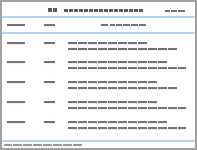
表1
患者凝血筛查及2种方法检测FⅧ:C结果
| Patients | APTT (s) | FⅧ:C (OSA, %) | FⅧ:C (CSA, %) | Ratio (OSA/CSA) | Variant |
|---|---|---|---|---|---|
| (HGVS) | |||||
| Patient A | 29.1 | 38.5 | 12.3 | 3.1 | c.853G>A, p.V285M |
| Patient B | 26.8 | 55.3 | 13.7 | 4.0 | c.923C>T, p.S308L |
| Patient C | 33.7 | 15.3 | 7.8 | 2.0 | c.907G>C, p.A303P |
| Patient D | 27.2 | 63.7 | 11.6 | 5.5 | c.923C>T, p.S308L |
| Patient E | 28.4 | 34.4 | 25.7 | 1.3 | c.1636C>T, p.R546W |

图2
患者A、B、C和D的凝血酶生成曲线

表2
患者A、B、C、D的TGT结果
| Patients | ETP(nmol·L-1·min-1) | Peak (nmol/L) | TTP (min) | Velocity (nmol·L-1·min-1) | LT (min) |
|---|---|---|---|---|---|
| NPP | 1250.75 | 153.06 | 9.00 | 32.80 | 4.33 |
| Patient A | 780.68 | 40.83 | 13.67 | 4.00 | 3.50 |
| Patient B | 291.87 | 21.50 | 10.67 | 2.93 | 3.33 |
| Patient C | 527.89 | 30.91 | 13.33 | 3.31 | 4.00 |
| Patient D | 554.47 | 34.58 | 11.33 | 4.43 | 3.50 |

图3
5例MHA患者的Sanger测序结果


图4
4种错义突变氨基酸在FⅧ分子结构中的空间定位 注:B结构域缺失的重组人FⅧ((PDB ID: 2R7E)的结构示意图。结构域颜色标注为,A1:蓝色、A2:绿色、A3:橙色、C1;紫色、C2:红色。A:本研究检出4种突变的变氨基酸在FⅧ中的位置(粉红色标记);B:4个氨基酸残基在空间上相互靠近。V285、A303和S308位于A1-A2-A3结构域界面的界面稳定核心区域,R546位于A2结构域内。氨基酸残基编号采用HGVS形式,并映射至PDB结构上。

| [1] |
BLANCHETTE V S, KEY N S, LJUNG L R, et al. Definitions in hemophilia: Communication from the SSC of the ISTH[J]. J Thromb Haemost, 2014, 12(11):1935-1939.
doi: 10.1111/jth.12672 pmid: 25059285 |
| [2] |
MÜLLER J, MIESBACH W, PRÜLLER F, et al. An update on laboratory diagnostics in haemophilia a and B[J]. Hämostaseologie, 2022, 42(4):248-260.
doi: 10.1055/a-1665-6232 URL |
| [3] |
PEYVANDI F, OLDENBURG J, FRIEDMAN K D. A critical appraisal of one-stage and chromogenic assays of factor Ⅷ activity[J]. J Thromb Haemost, 2016, 14(2):248-261.
doi: 10.1111/jth.13215 URL |
| [4] | 薛峰, 戴菁, 陈丽霞, 等. 中国血友病诊治报告2023[J]. 诊断学理论与实践, 2023, 22(2):89-115. |
| XUE F, DAI J, CHEN L X, et al. Report on diagnosis and treatment of hemophilia in China 2023[J]. J Diagn Concepts Pract, 2023, 22(2):89-115. | |
| [5] |
POTGIETER J J, DAMGAARD M, HILLARP A. One-stage vs. chromogenic assays in haemophilia A[J]. European J Haematology, 2015, 94(s77):38-44.
doi: 10.1111/ejh.2015.94.issue-s77 URL |
| [6] |
KITCHEN S, SIGNER-ROMERO K, KEY N S. Current laboratory practices in the diagnosis and management of haemophilia: A global assessment[J]. Haemophilia, 2015, 21(4):550-557.
doi: 10.1111/hae.12639 pmid: 25688866 |
| [7] |
POULSEN A L, PEDERSEN L H, HVAS A M, et al. Assay discrepancy in mild haemophilia A: Entire population study in a National Haemophilia Centre[J]. Haemophilia, 2009, 15(1):285-289.
doi: 10.1111/j.1365-2516.2008.01899.x pmid: 19149854 |
| [8] |
PIPE S W, SAENKO E L, EICKHORST A N, et al. Hemophilia A mutations associated with 1-stage/2-stage activi-ty discrepancy disrupt protein-protein interactions within the triplicated A domains of thrombin-activated factor Ⅷa[J]. Blood, 2001, 97(3):685-691.
doi: 10.1182/blood.V97.3.685 URL |
| [9] |
PAVLOVA A, DELEV D, PEZESHKPOOR B, et al. Haemophilia A mutations in patients with non-severe phenotype associated with a discrepancy between one-stage and chromogenic factor Ⅷ activity assays[J]. Thromb Haemost, 2014, 112(5):851-861.
doi: 10.1160/TH13-08-0690 URL |
| [10] |
CID A R, CALABUIG M, CORTINA V, et al. One-stage and chromogenic FⅧ: C assay discrepancy in mild haemophilia A and the relationship with the mutation and bleeding phenotype[J]. Haemophilia, 2008, 14(5):1049-1054.
doi: 10.1111/hae.2008.14.issue-5 URL |
| [11] |
MUMFORD A D, LAFFAN M, O’DONNELL J, et al. A Tyr346→Cys substitution in the interdomain acidic region a1 of factor Ⅷ in an individual with factor Ⅷ: C assay discrepancy[J]. Br J Haematol, 2002, 118(2):589-594.
doi: 10.1046/j.1365-2141.2002.03617.x URL |
| [12] |
MAKRIS M, OLDENBURG J, MAUSER-BUNSCHOTEN E P, et al. The definition, diagnosis and management of mild hemophilia A: Communication from the SSC of the ISTH[J]. J Thromb Haemost, 2018, 16(12):2530-2533.
doi: 10.1111/jth.14315 pmid: 30430726 |
| [13] | 李蕾, 吴希, 许冠群, 等. 基于新一代测序技术的易栓症基因检测Panel的建立及其在中国静脉血栓患者遗传背景研究中的临床应用[J]. 诊断学理论与实践, 2019, 18(4):394-401. |
| LI L, WU X, XV G Q, et al. Establishment and application of thrombophilia gene detection panel based on next generation sequencing in identification of genetic background of Chinese patients with venous thromboembolism[J]. J Diagn Concepts Pract, 2019, 18(4):394-401. | |
| [14] |
JOHNSEN J M, FLETCHER S N, HUSTON H, et al. Novel approach to genetic analysis and results in 3000 hemophilia patients enrolled in the My Life, Our Future initiative[J]. Blood Adv, 2017, 1(13):824-834.
doi: 10.1182/bloodadvances.2016002923 pmid: 29296726 |
| [15] |
SUZUKI A, SUZUKI N, KANEMATSU T, et al. Impact of variation in reagent combinations for one-stage clotting assay on assay discrepancy in nonsevere haemophilia A[J]. Int J Lab Hematology, 2021, 43(1):131-138.
doi: 10.1111/ijlh.v43.1 URL |
| [16] |
AL-HUNITI A, SHARATHKUMAR A, KRANTZ M, et al. Discrepant hemophilia A: An underdiagnosed disease entity[J]. Am J Clin Pathol, 2020, 154(1):78-87.
doi: 10.1093/ajcp/aqaa024 URL |
| [17] |
TROSSAERT M, LIENHART A, NOUGIER C, et al. Diagnosis and management challenges in patients with mild haemophilia A and discrepant FⅧ measurements[J]. Haemophilia, 2014, 20(4):550-558.
doi: 10.1111/hae.2014.20.issue-4 URL |
| [18] | KITCHEN S, HAYWARD C, NEGRIER C, et al. New developments in laboratory diagnosis and monitoring[J]. Haemophilia, 2010, 16(s5):61-66. |
| [19] |
BOWYER A E, DUNCAN E M, ANTOVIC J P. Role of chromogenic assays in haemophilia A and B diagnosis[J]. Haemophilia, 2018, 24(4):578-583.
doi: 10.1111/hae.13520 pmid: 29808946 |
| [20] |
KITCHEN S, BOWYER A, MAKRIS M. Both one-stage and chromogenic factor Ⅷ assays are required for the diagnosis of mild hemophilia A[J]. J Thromb Haemost, 2023, 21(4):773-775.
doi: 10.1016/j.jtha.2022.12.013 URL |
| [21] |
SRIVASTAVA A, SANTAGOSTINO E, DOUGALL A, et al. WFH guidelines for the management of hemophilia, 3rd edition[J]. Haemophilia, 2020, 26(S6):1-158.
doi: 10.1111/hae.v26.s1 URL |
| [22] |
TROSSAËRT M, REGNAULT V, SIGAUD M, et al. Mild hemophilia A with factor Ⅷ assay discrepancy: Using thrombin generation assay to assess the bleeding phenotype[J]. J Thromb Haemost, 2008, 6(3):486-493.
doi: 10.1111/j.1538-7836.2007.02861.x URL |
| [23] |
BINDER N B, DEPASSE F, MUELLER J, et al. Clinical use of thrombin generation assays[J]. J Thromb Haemost, 2021, 19(12):2918-2929.
doi: 10.1111/jth.15538 pmid: 34592058 |
| [24] | 张丽亚, 闫露露, 李海波, 等. 1例新生儿血友病A的临床表型与遗传学分析[J]. 中华全科医学, 2025, 23(11):1992-1994. |
| ZHANG L Y, YAN L L, LI H B, et al. Clinical phenotype and genetic analysis of a case of haemophilia A in a newborn baby[J]. Chin J Gen Pract, 2025, 23(11):1992-1994. |
| [1] | 刘佳婕, 邵妍妍, 梁茜, 丁秋兰. 6个遗传性凝血因子Ⅹ缺陷症家系的表型与基因型诊断[J]. 诊断学理论与实践, 2020, 19(1): 20-27. |
| [2] | 梁茜, 陆峥菁, 邵妍妍, 丁秋兰, 王鸿利, 王学锋. 凝血酶生成试验在预测血管性血友病患者出血倾向中的作用[J]. 诊断学理论与实践, 2020, 19(04): 370-374. |
| [3] | 汪萍, 沈立松, 张冬青. 多发性骨髓瘤及相关疾病的实验室诊断认识[J]. 诊断学理论与实践, 2017, 16(05): 477-483. |
| [4] | 陈华云, 杨芳, 许冠群, 陆晔玲, 张利伟, 戴菁, 丁秋兰, 奚晓东, 王学锋, 王鸿利,. 凝血酶生成试验在血友病患者中的应用[J]. 诊断学理论与实践, 2008, 7(05): 503-506. |
| [5] | 谢飞, 王鸿利, 王学锋,. 遗传性血管性血友病7例实验诊断和分子发病机制研究[J]. 诊断学理论与实践, 2006, 5(05): 384-389. |
| [6] | 林善锬. 全面认识肾脏疾病实验室诊断的范畴与意义[J]. 诊断学理论与实践, 2003, 2(04): 6-8. |
| 阅读次数 | ||||||
|
全文 |
|
|||||
|
摘要 |
|
|||||
