

诊断学理论与实践 ›› 2026, Vol. 25 ›› Issue (02): 209-217.doi: 10.16150/j.1671-2870.2026.02.012
汤朝毅1, 黄荣荣1, 乔露1, 李维辛1,2( )
)
收稿日期:2025-07-19
修回日期:2025-11-17
接受日期:2025-11-18
出版日期:2026-04-25
发布日期:2026-04-25
通讯作者:
李维辛 E-mail:1051742798@qq.com基金资助:
TANG Chaoyi1, HUANG Rongrong1, QIAO Lu1, LI Weixin1,2()
Received:2025-07-19
Revised:2025-11-17
Accepted:2025-11-18
Published:2026-04-25
Online:2026-04-25
摘要:
目的:探讨血浆抵抗素水平与老年肌少症的临床关联性,并评估其对老年肌少症的初步筛查价值,为老年肌少症的早期识别及干预提供参考。方法:采用病例对照研究设计,纳入2021年12月至2023年12月期间在兰州大学第一医院老年病科住院的符合纳排标准的363例老年患者作为研究对象。肌少症的诊断依据2019年亚洲肌少症工作组发布的诊疗共识,根据肌少症发生情况将患者分为肌少症组和非肌少症组,比较2组患者的血浆抵抗素水平差异。采用Pearson相关分析血浆抵抗素水平与肌少症指标,如握力、五次起坐时间、步速、四肢骨骼肌质量指数(appendicular skeletal muscle mass index,ASMI)等的相关性。采用Logistic回归分析血浆抵抗素水平与老年肌少症的独立相关性,并通过受试者操作特征(receiver operating characteristic, ROC)曲线评估其识别老年肌少症高危人群的效能。结果:共纳入363例老年住院患者,肌少症组178例(其中男性80例,女性98例),非肌少症组185例(其中男性98例,女性87例),肌少症组的血浆抵抗素水平明显高于非肌少症组[(7.04±1.63) ng/mL比(6.11±1.26) ng/mL,P<0.05]。Pearson相关分析显示,老年人群的血浆抵抗素水平与握力、步速、ASMI呈负相关(P<0.05)。同时,Mann-Whitney U检验显示老年男性与老年女性人群血浆抵抗素水平无差异(P>0.05),提示老年人抵抗素水平不受性别影响。在多因素Logistic回归分析中,校正年龄、吸烟史、饮酒史、老年营养风险指数(geriatric nutritional risk index, GNRI)、红细胞计数、体质量指数(body mass index, BMI)、高血压、甘油三酯及高密度脂蛋白混杂因素后,结果显示,血浆抵抗素水平仍为老年肌少症的独立危险因素(OR=1.663,P<0.01)。分层Logistic回归分析显示,在老年高血压人群与无高血压人群中,血浆抵抗素水平升高均为老年肌少症的危险因素(OR值分别为1.46、2.66,P<0.01);然而,交互作用检验显示,高血压对血浆抵抗素与肌少症之间关联的效应修饰作用尚无统计学意义(交互项P=0.078)。ROC曲线分析显示,血浆抵抗素水平用于初筛识别老年肌少症的曲线下面积为0.712(P=0.027),最佳临界值为5.83 ng/mL,此时其灵敏度为87.1%,特异度为48.1%。结论:血浆抵抗素水平在老年肌少症患者中显著升高,且与肌少症独立相关,可能可作为老年肌少症的初筛生物标志物,而高血压对该关联未见显著效应修饰作用。
中图分类号:
汤朝毅, 黄荣荣, 乔露, 李维辛. 血浆抵抗素作为初筛老年肌少症的标志物研究[J]. 诊断学理论与实践, 2026, 25(02): 209-217.
TANG Chaoyi, HUANG Rongrong, QIAO Lu, LI Weixin. Study on plasma resistin as a biomarker for preliminary screening of sarcopenia in elderly adults[J]. Journal of Diagnostics Concepts & Practice, 2026, 25(02): 209-217.
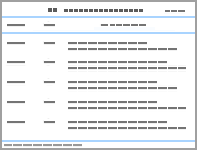
表1
一般临床资料比较
| Item | No sarcopenia(n=185) | Sarcopenia(n=178) | P value |
|---|---|---|---|
| Gender | |||
| Male(%) | 98(52.97) | 80(44.94) | 0.126 |
| Female(%) | 87(47.03) | 98(55.06) | |
| Smoking(%) | 30(16.22) | 28(15.73) | 0.899 |
| Drinking(%) | 19(10.27) | 16(8.99) | 0.679 |
| Hypertension(%) | 131(70.81) | 96(53.93) | <0.001 |
| Diabetes(%) | 71(38.38) | 52(29.21) | 0.065 |
| Stroke(%) | 90(48.65) | 93(52.25) | 0.864 |
| Fasting blood glucose (mmol/L) | 5.40(4.71,6.28) | 5.10(4.58,6.07) | 0.117 |
| Age(years) | 72.06±7.89 | 74.25±8.54 | 0.006 |
| Body weight(kg) | 65.70(59.50,73.75) | 56.00(49.45,68.70) | <0.001 |
| Height(cm) | 165.00(160.00,170.00) | 164.22(158.00,170.00) | 0.268 |
| BMI(kg/m2) | 24.20(22.50,26.45) | 21.30(19.78,23.23) | <0.001 |
| Grip strength(kg) | 18.45±6.45 | 15.02±5.30 | <0.001 |
| Gait speed(m/s) | 1.02±0.34 | 0.89±0.31 | 0.011 |
| Chair stand(s) | 11.91±3.65 | 13.55±4.31 | 0.020 |
| ASMI(kg/m2) | 7.51±1.25 | 5.58±0.94 | <0.001 |
| GNRI | 109.89±9.40 | 102.81±9.55 | <0.001 |
| Resistin(ng/mL) | 6.11±1.26 | 7.04±1.63 | <0.001 |
| Erythrocyte (×1012/L) | 4.72(4.29,5.05) | 4.41(4.11,4.77) | <0.001 |
| Leukocyte (×109/L) | 5.43(4.57,6.51) | 5.3(4.24,6.62) | 0.249 |
| Platelet (×109/L) | 192.00(152.00,229.00) | 194.00(150.25,243.50) | 0.420 |
| Hemoglobin (g/L) | 145.00(135.00,157.00) | 137.5(125.75,147.25) | <0.001 |
| Total protein (g/L) | 72.80±6.90 | 71.20±7.30 | 0.038 |
| Albumin (g/L) | 43.9(40.70,46.70) | 43.3(39.4,46.00) | 0.084 |
| Globulin (g/L) | 29.00(26.25,32.05) | 28.15(25.28,31.83) | 0.081 |
| Triglyceride (mmol/L) | 1.34(1.02,1.82) | 1.11(0.87,1.56) | <0.001 |
| HDL-C(mmol/L) | 1.11(0.98,1.35) | 1.26(1.07,1.55) | <0.001 |
| Total cholesterol (mmol/L) | 4.17(3.51,4.91) | 4.35(3.55,5.11) | 0.239 |
| LDL-C(mmol/L) | 2.65(2.18,3.29) | 2.69(2.09,3.36) | 0.926 |
| Apolipoprotein a (mmol/L) | 1.32(1.15,1.56) | 1.43(1.22,1.68) | 0.060 |
| Serum creatinine (ummol/L) | 55.90(62.30,84.35) | 67.15(58.18,78.18) | 0.050 |
表2
Pearson 相关分析抵抗素与肌少症诊断指标的相关性
| Item | Grip strength | Gait speed | Chair stand | ASMI | Age | BMI |
|---|---|---|---|---|---|---|
| Resistin | ||||||
| r | -0.192 | -0.114 | 0.102 | -0.274 | 0.108 | -0.169 |
| P | <0.001 | 0.030 | 0.051 | <0.001 | 0.04 | 0.01 |
表3
肌少症相关因素的条件Logistic回归分析
| Model | Variable | β | SE | Wald χ2 | OR(95%CI) | P value |
|---|---|---|---|---|---|---|
| 1 | Resistin | 0.533 | 0.098 | 29.523 | 1.704(1.406-2.065) | <0.001 |
| 2 | Resistin | 0.501 | 0.103 | 23.803 | 1.651(1.350-2.019) | <0.001 |
| Age | 0.031 | 0.016 | 3.862 | 1.031(1.000-1.064) | 0.049 | |
| BMI | 0.288 | 0.056 | 26.535 | 0.749(0.672-0.836) | <0.001 | |
| GNRI | 0.019 | 0.017 | 1.165 | 0.981(0.948-1.016) | 0.280 | |
| Drinking | 0.095 | 0.554 | 0.029 | 0.91(0.307-2.295) | 0.864 | |
| Smoking | 0.332 | 0.437 | 0.574 | 1.393(0.591-3.283) | 0.449 | |
| 3 | Resistin | 0.509 | 0.104 | 23.938 | 1.663(1.357-2.039) | <0.001 |
| Age | 0.037 | 0.016 | 5.159 | 1.037(1.005-1.071) | 0.023 | |
| BMI | 0.285 | 0.056 | 25.526 | 0.752(0.673-0.840) | <0.001 | |
| GNRI | 0.021 | 0.018 | 1.349 | 0.980(0.946-1.014) | 0.246 | |
| Drinking | 0.159 | 0.563 | 0.08 | 0.853(0.283-2.570) | 0.777 | |
| Smoking | 0.252 | 0.443 | 0.323 | 1.286(1.540-3.064) | 0.570 | |
| Hypertension | 0.859 | 0.264 | 10.578 | 0.423(0.252-0.711) | 0.001 | |
| 4 | Resistin | 0.509 | 0.108 | 22.324 | 1.663(1.347-2.054) | <.001 |
| Age | 0.037 | 0.017 | 4.918 | 1.038(1.004-1.072) | 0.027 | |
| BMI | 0.264 | 0.061 | 19.041 | 0.768(0.682-0.865) | <.001 | |
| GNRI | 0.023 | 0.021 | 1.209 | 0.978(0.939-1.018) | 0.272 | |
| Drinking | 0.037 | 0.584 | 0.004 | 0.964(0.307-3.125) | 0.950 | |
| Smoking | 0.463 | 0.425 | 0.843 | 1.529(0.617-3.789) | 0.359 | |
| Hypertension | 0.743 | 0.273 | 7.393 | 0.476(0.279-0.813) | 0.007 | |
| Erythrocyte | 0.401 | 0.227 | 3.116 | 0.670(0.429-1.045) | 0.078 | |
| Triglyceride | 0.195 | 0.106 | 0.297 | 0.899(0.614-1.318) | 0.586 | |
| HDL-C | 1.455 | 0.42 | 12.01 | 4.286(1.882-9.763) | <.001 |

图1
老年高血压患者的抵抗素水平与肌少症的Logistic回归森林图


图2
血浆抵抗素水平初步筛查肌少症的 ROC曲线图


图3
高血压组血浆抵抗素水平筛查肌少症的ROC曲线图


图4
非高血压组血浆抵抗素水平筛查肌少症的ROC曲线图

| [1] | SAYER A A, COOPER R, ARAI H, et al. Sarcopenia[J]. Nat Rev Dis Primers, 2024,10:68. |
| [2] | YUAN S, LARSSON S C. Epidemiology of sarcopenia: Prevalence, risk factors, and consequences[J]. Metabolism, 2023,144:155533. |
| [3] | 景海蓉, 陈雅雯, 付泓博, 等. 肌少症的血清生物标志物[J]. 中华老年多器官疾病杂志, 2022, 21(8):616-620. |
| JING H R, CHEN Y W, FU H B, et al. Serum biomarkers for sarcopenia[J]. Chin J Mult Organ Dis Elderly, 2022, 21(8):616-620. | |
| [4] | ZHOU L, LI J Y, HE P P, et al. Resistin: Potential biomarker and therapeutic target in atherosclerosis[J]. Clin Chim Acta, 2021,512:84-91. |
| [5] |
DEB A, DESHMUKH B, RAMTEKE P, et al. Resistin: A journey from metabolism to cancer[J]. Transl Oncol, 2021, 14(10):101178.
doi: 10.1016/j.tranon.2021.101178 URL |
| [6] |
WILHELMSEN A, TSINTZAS K, JONES S W. Recent advances and future avenues in understanding the role of adipose tissue cross talk in mediating skeletal muscle mass and function with ageing[J]. Geroscience, 2021, 43(1):85-110.
doi: 10.1007/s11357-021-00322-4 pmid: 33528828 |
| [7] | DE LUIS D, PRIMO D, IZAOLA O, et al. Relationship of circulating resistin levels with muscle mass determined by bioelectrical impedance in females with obesity[J]. Endocrinol Diabetes Nutr, 2023, 70(7):468-475. |
| [8] | 孙蓉媛, 郭丽艳, 王方方, 等. KPS、SMS评分及GNRI对急诊老年脓毒症患者病情程度及28 d死亡的评估价值[J]. 中国老年学杂志, 2025, 45(16):3935-3939. |
| SUN R Y, GUO L Y, WANG F F, et al. Evaluation value of KPS, SMS score and GNRI on the severity of illness and 28 day death in elderly patients with sepsis in emergency department[J]. Chin J Gerontol, 2025, 45(16):3935-3939. | |
| [9] |
CHEN L K, WOO J, ASSANTACHAI P, et al. Asian working group for sarcopenia: 2019 consensus update on sarcopenia diagnosis and treatment[J]. J Am Med Dir Assoc, 2020, 21(3):300-307.e2.
doi: 10.1016/j.jamda.2019.12.012 URL |
| [10] | 邹慧敏, 王遂军. 中国糖尿病诊断标准演变及特殊人群血糖管理[J]. 诊断学理论与实践, 2025, 24(1):14-20. |
| ZOU H M, WANG S J. Evolution of diagnosis standards for diabetes in China and blood glucose management for special populations[J]. J Diagn Concepts Pract, 2025, 24(1):14-20. | |
| [11] | CHEN S, HE T, SUN S, et al. Prognostic significance of pre- to postoperative dynamics of sarcopenia for patients with renal cell carcinoma undergoing laparoscopic nephrectomy[J]. Front Surg, 2022,9:871731. |
| [12] |
OZER F F, AKIN S, TASCI İ, et al. Risk of sarcopenia in hospitalized patients and related clinical factors: A multicenter study from Turkey[J]. Eur Geriatr Med, 2021, 12(4):863-870.
doi: 10.1007/s41999-021-00499-z pmid: 33866525 |
| [13] |
HSU K J, CHIEN K Y, TSAI S C, et al. Effects of exercise alone or in combination with high-protein diet on muscle function, aerobic capacity, and physical function in middle-aged obese adults: A randomized controlled trial[J]. J Nutr Health Aging, 2021, 25(6):727-734.
doi: 10.1007/s12603-021-1599-1 pmid: 34179925 |
| [14] |
RAGHUPATHY R, MCLEAN R R, KIEL D P, et al. Higher abdominal adiposity is associated with higher lean muscle mass but lower muscle quality in middle-aged and older men and women: The Framingham Heart Study[J]. Aging Clin Exp Res, 2023, 35(7):1477-1485.
doi: 10.1007/s40520-023-02427-6 pmid: 37166563 |
| [15] |
VAN HOLLEBEKE R B, CUSHMAN M, SCHLUETER E F, et al. Abdominal muscle density is inversely related to adiposity inflammatory mediators[J]. Med Sci Sports Exerc, 2018, 50(7):1495-1501.
doi: 10.1249/MSS.0000000000001570 URL |
| [16] | BOTERO J P, SHIGUEMOTO G E, PRESTES J, et al. Effects of long-term periodized resistance training on body composition, leptin, resistin and muscle strength in elderly post-menopausal women[J]. J Sports Med Phys Fitness, 2013, 53(3):289-294. |
| [17] | GAO J, DENG M, LI Y, et al. Resistin as a systemic inflammation-related biomarker for sarcopenia in patients with chronic obstructive pulmonary disease[J]. Front Nutr, 2022,9:921399. |
| [18] |
RAVA A, PIHLAK A, KUMS T, et al. Resistin concentration is inversely associated with objectively measured physical activity in healthy older women[J]. Aging Clin Exp Res, 2020, 32(3):475-481.
doi: 10.1007/s40520-019-01222-6 pmid: 31115876 |
| [19] | SCHMIDT M, WEIDEMANN A, POSER C, et al. Stimulation of non-canonical NF-κB through lymphotoxin-β-receptor impairs myogenic differentiation and regeneration of skeletal muscle[J]. Front Cell Dev Biol, 2021,9:721543. |
| [20] | REN Y, ZHAO H, YIN C, et al. Adipokines, hepatokines and myokines: Focus on their role and molecular mechanisms in adipose tissue inflammation[J]. Front Endocrinol, 2022,13:873699. |
| [21] |
MALLARDO M, DANIELE A, MUSUMECI G, et al. A narrative review on adipose tissue and overtraining: Shedding light on the interplay among adipokines, exercise and overtraining[J]. Int J Mol Sci, 2024, 25(7):4089.
doi: 10.3390/ijms25074089 URL |
| [22] |
CHEN Z, TAO S, LI X, et al. Resistin destroys mitochondrial biogenesis by inhibiting the PGC-1α/NRF1/TFAM signaling pathway[J]. Biochem Biophys Res Commun, 2018, 504(1):13-18.
doi: 10.1016/j.bbrc.2018.08.027 URL |
| [23] |
KWAK M K, BAEK J Y, PARK S J, et al. Higher circula-ting resistin levels linked to increased sarcopenia risk in older adults[J]. J Clin Endocrinol Metab, 2025, 110(9):e2994-e3001.
doi: 10.1210/clinem/dgae894 URL |
| [24] |
YU H, ZHU G, WANG D, et al. PI3K/AKT/FOXO3a pathway induces muscle atrophy by ubiquitin-proteasome system and autophagy system in COPD rat model[J]. Cell Biochem Biophys, 2024, 82(2):805-815.
doi: 10.1007/s12013-024-01232-w pmid: 38386223 |
| [25] | WANG K, LIU Q, TANG M, et al. Chronic kidney disease-induced muscle atrophy: Molecular mechanisms and promising therapies[J]. Biochem Pharmacol, 2023,208:115407. |
| [26] |
RIZVI A A, RIZZO M. Age-related changes in insulin resistance and muscle mass: Clinical implications in obese older adults[J]. Medicina, 2024, 60(10):1648.
doi: 10.3390/medicina60101648 URL |
| [27] |
VOULGARIDOU G, TYROVOLAS S, DETOPOULOU P, et al. Diagnostic criteria and measurement techniques of sarcopenia: A critical evaluation of the up-to-date evidence[J]. Nutrients, 2024, 16(3):436.
doi: 10.3390/nu16030436 URL |
| [28] |
VOELKER S N, MICHALOPOULOS N, MAIER A B, et al. Reliability and concurrent validity of the SARC-F and its modified versions: A systematic review and meta-analysis[J]. J Am Med Dir Assoc, 2021, 22(9):1864-1876.e16.
doi: 10.1016/j.jamda.2021.05.011 pmid: 34144049 |
| [1] | 方珉, 刘静文, 曾媛媛, 金爱萍. 阿尔茨海默病诊断的血液生物标志物进展[J]. 诊断学理论与实践, 2026, 25(02): 113-120. |
| [2] | 张楠, 卢清正. 不典型阿尔茨海默病的诊断[J]. 诊断学理论与实践, 2026, 25(02): 121-130. |
| [3] | 王佳悦, 熊文魁, 姜玮贇, 王健, 曾乃燕, 岳玲. 空间记忆检测与蒙特利尔认知评估筛查中国老年人群轻度认知障碍的效度比较[J]. 诊断学理论与实践, 2026, 25(02): 165-173. |
| [4] | 孔雪莹, 洪桢. 自身免疫性脑炎生物标志物研究现状及挑战[J]. 诊断学理论与实践, 2026, 25(02): 218-224. |
| [5] | 蔡姣迪, 陈国群, 张文琴. 2025年NCCN非小细胞肺癌临床实践(V1-V3)指南解读[J]. 诊断学理论与实践, 2026, 25(01): 37-43. |
| [6] | 黄曼, 丁朔. 脓毒症的诊治现状及挑战[J]. 诊断学理论与实践, 2025, 24(06): 583-592. |
| [7] | 李雨航, 肖世富, 岳玲. 轻度行为损害与阿尔茨海默病相关研究的进展[J]. 诊断学理论与实践, 2025, 24(05): 548-554. |
| [8] | 刘敬浩, 郭海艳, 甘桂芳, 陈福祥. miR-2355-3p、miR-337-3p和miR-99a-5p检测在头颈部鳞状细胞癌早期筛查中的价值[J]. 诊断学理论与实践, 2025, 24(02): 204-211. |
| [9] | 王一阳, 吕良敬. 系统性红斑狼疮CAR T细胞治疗疗效预测及安全性评估的潜在生物标志物[J]. 诊断学理论与实践, 2024, 23(03): 263-269. |
| [10] | 秦晓丹, 孙慧玲, 潘蓓, 潘玉琴, 王书奎. miR-1229-3p抑制结直肠癌疾病进展及作为潜在生物标志物的研究[J]. 诊断学理论与实践, 2023, 22(05): 429-440. |
| [11] | 常宇宸, 李京波. 心肌梗死中铁死亡标志物研究进展[J]. 诊断学理论与实践, 2023, 22(02): 197-202. |
| [12] | 陈国群, 蔡姣迪. 2022年美国国立综合癌症网络(NCCN)《非小细胞肺癌临床诊疗指南》(第4版及第5版)解读[J]. 诊断学理论与实践, 2023, 22(01): 8-13. |
| [13] | 武冬冬, 陈玉辉, 刘芳, 刘银红, 蒋景文. 脑小血管疾病合并中枢神经系统退行性疾病机制的研究进展[J]. 诊断学理论与实践, 2022, 21(05): 644-649. |
| [14] | 周思锋, 徐海舒, 范欣生. 基于不同生物样本代谢组学的OSAHS生物标志物研究进展[J]. 诊断学理论与实践, 2022, 21(04): 535-540. |
| [15] | 张红, 朱梦梦. 新型冠状病毒肺炎疫情期间老年人进食安全护理[J]. 诊断学理论与实践, 2022, 21(02): 277-280. |
| 阅读次数 | ||||||
|
全文 |
|
|||||
|
摘要 |
|
|||||
