

Journal of Diagnostics Concepts & Practice ›› 2026, Vol. 25 ›› Issue (02): 148-156.doi: 10.16150/j.1671-2870.2026.02.005
• Interpretation of the Guidelines • Previous Articles Next Articles
ZHI Nan, GENG Jieli, CAO Wenwei, SONG Yaying, WANG Gang( )
)
Received:2025-11-06
Revised:2025-12-09
Accepted:2026-01-06
Online:2026-04-25
Published:2026-04-25
Contact:
WANG Gang
E-mail:wanggang@renji.com
CLC Number:
ZHI Nan, GENG Jieli, CAO Wenwei, SONG Yaying, WANG Gang. Interpretation of clinical application recommendations for anti-Aβ monoclonal antibodies (2025 Edition)[J]. Journal of Diagnostics Concepts & Practice, 2026, 25(02): 148-156.
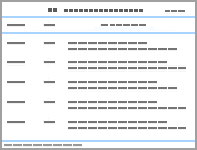
Table 1
Comparison of clinical trial inclusion criteria and clinical practice suitability between the 2024 and 2025 Editions of Anti-Aβ Monoclonal Antibody Guidelines
| 项目 | 临床试验入组标准 | 临床实践适用标准 | ||
|---|---|---|---|---|
| 2024版 | 2025版 | 2024版 | 2025版 | |
| 年龄 | 50~85岁 | 50~90岁 | ≤85岁 | 同2024版 |
| 诊断 | AD源性MCI或轻度AD痴呆临床标准 | AD源性MCI或轻度AD痴呆临床标准 | AD源性MCI或轻度AD痴呆临床标准 | 同2024版 |
| 基线评分 | MMSE评分24~30分,CDR-GS评分0.5分,RBANS延迟记忆指数≤85分 | CDR-GS评分0.5~1.0分,MMSE评分22~30分 | MMSE评分21~30分或同等认知水平 | 同2024版 |
| 淀粉样蛋白 状态 | Aβ-PET阳性 | 淀粉样蛋白PET阳性或者脑脊液检查符合AD诊断标准 | Aβ-PET阳性或脑脊液检查符合阿尔茨海默病诊断标准并经Aβ-PET/CT或Aβ-PET/MRI验证 | 同2024版,补充建议可结合标准化Centiloid值进行评估 |
| 基因 | 包括ApoE基因型 | 非必需 | 应与患者和(或)照料者讨论基因检测的意愿和必要性 | 同2024版 |
| 神经系统检查 | 排除非AD的神经系统变性疾病、脑卒中和TIA | 排除非AD病因所致的认知功能障碍患者,或近12个月内有卒中、TIA、癫痫发作史者 | 排除非AD的神经系统变性疾病 | 排除非AD病因所致的认知功能障碍患者,或近12个月内有卒中、TIA、癫痫发作史者 |
| 心血管病病史 | 排除心绞痛、心肌梗死、充血性心力衰竭 | 排除未得到稳定或充分控制的心脏疾病 | 心血管病稳定(近3个月无症状或经心脏科评定病情稳定);根据患者安全参与治疗方案的能力制定临床决策 | 同2024版 |
| 其他基础疾病病史 | 排除其他有临床意义的系统性疾病、无法控制的糖尿病、未控制的高血压、不稳定的恶性肿瘤、肝炎或肝功能障碍、HIV感染 | 排除任何其他未得到稳定或充分控制的医疗状况,或研究者认为可能影响参与者安全或干扰研究评估的疾病 | 基础疾病稳定(主要指标如血压和血糖等无明显波动、相应药物治疗≥3个月或经专科评定病情稳定);根据患者安全参与治疗方案的能力制定临床决策 | 同2024版 |
| 精神疾病病史 | 排除既往6个月内病情不稳定的精神疾病;物质成瘾性或药物性精神障碍 | 排除2年内有已知或可疑的药物或乙醇滥用或依赖史,或在筛选时有阳性尿液药物检测结果的患者 | 精神状态稳定(经专科评定病情稳定);根据患者安全参与治疗方案的能力制定临床决策 | 同2024版 |
| 生殖 | 排除妊娠期或哺乳期女性;育龄期女性须采取避孕措施 | 排除妊娠期或哺乳期女性;育龄期女性须采取避孕措施 | 与临床试验入组标准相同 | 同2024版 |
| 凝血功能 | 排除出血性疾病、正在服用抗凝药 | 排除未得到充分控制的出血性疾病[包括血小板计数或未接受抗凝治疗者的INR>1.5。接受抗凝治疗的参与者应优化其抗凝状态,并在筛查前至少4周内保持稳定剂量 | 与临床试验入组标准相同 | 排除出血性疾病,原则上正在服用抗凝药物(如华法林、达比加群、艾多沙班、利伐沙班、阿哌沙班、贝曲沙班或肝素)的患者不推荐使用单抗治疗 |
| 合并用药 | 允许应用胆碱酯酶抑制药和美金刚 | 允许应用胆碱酯酶抑制剂和美金刚 | 与临床试验入组标准相同 | 同2024版 |
| 基线 MRI检查 | 排除急性或亚急性出血、大出血、4个以上微出血灶、皮质梗死(>1.5 cm)、1个以上梗死灶(>1.5 cm)、表面铁沉积症、弥漫性白质疾病 | 排除超过4个微出血点(定义为最大直径10 mm或更小);单一的脑出血的最大直径>10 mm;表面铁沉积证据;血管源性 水肿;多发腔隙性梗死或涉及主要血管区域的梗死;严重的脑小血管病变 | 与临床试验入组标准相同 | 与临床试验标准相同,补充对于脑内存在5~9个微出血灶(单个直径<10 mm)的患者,可在全面评估及充分沟通的基础上,谨慎考虑抗Aβ单克隆抗体治疗。如有条件,建议头颅MRI在用药前1个月内完成。 |
| 知情同意 | 须由受试者和照料者共同签署 | 须由受试者和照料者共同签署 | 受试者和照料者应了解治疗性质、要求和预期结局 | 同2024版 |

Figure 1
Management strategy for amyloid-related imaging abnormalities

| [1] |
JIA L, DU Y, CHU L, et al. Prevalence, risk factors, and management of dementia and mild cognitive impairment in adults aged 60 years or older in China: A cross-sectional study[J]. Lancet Public Health, 2020, 5(12):e661-e671.
doi: 10.1016/S2468-2667(20)30185-7 pmid: 33271079 |
| [2] | 王刚, 齐金蕾, 刘馨雅, 等. 中国阿尔茨海默病报告2024[J]. 诊断学理论与实践, 2024, 23(3):219-256. |
| WANG G, QI J L, LIU X Y, et al. China Alzheimer Report 2024[J]. J Diagn Concepts Pract, 2024, 23(3):219-256. | |
| [3] | IMBIMBO B P, IPPATI S, WATLING M, et al. Role of monomeric amyloid-β in cognitive performance in Alzheimer’s disease: Insights from clinical trials with secretase inhibitors and monoclonal antibodies[J]. Pharmacol Res, 2023,187:106631. |
| [4] |
王刚, 李彬寅, 任汝静, 等. 关于抗Aβ单克隆抗体的临床应用建议(2024版)[J]. 中国现代神经疾病杂志, 2024, 24(3):120-126.
doi: 10.3969/j.issn.1672-6731.2024.03.002 |
| WANG G, LI B Y, REN R J, et al. Recommendations for the clinical use of anti-Aβ monoclonal antibody for Alzheimer's disease(2024)[J]. Chin J Contemp Neurol Neurosurg, 2024, 24(3):120-126. | |
| [5] |
VAN DYCK C H, SWANSON C J, AISEN P, et al. Leca-nemab in early Alzheimer’s disease[J]. N Engl J Med, 2023, 388(1):9-21.
doi: 10.1056/NEJMoa2212948 URL |
| [6] |
SIMS J R, ZIMMER J A, EVANS C D, et al. Donanemab in early symptomatic Alzheimer disease: The TRAI-LBLAZER-ALZ 2 randomized clinical trial[J]. JAMA, 2023, 330(6):512-527.
doi: 10.1001/jama.2023.13239 URL |
| [7] | US Food and Drug Administration. ADUHELM® (aducanumab-avwa) injection, for intravenous use Initial U.S. Approval:2021[EB/OL]. 2021. [2025-11-06]. https://www.accessdata.fda.gov/drugsatfda_docs/label/2021/761178s000lbl.pdf. |
| [8] | US Food and Drug Administration. LEQEMBI® (lecanemab-irmb) injection, for intravenous use Initial U.S. Approval:2023[EB/OL]. 2023.[2025-11-06]. https://www.accessdata.fda.gov/drugsatfda_docs/label/2025/761269s005lbl.pdf. |
| [9] | US Food and Drug Administration. KISUNLA (donanema-bazbt) injection, for intravenous use Initial U.S. Approval:2024[EB/OL]. 2024. [2025-11-06]. https://www.accessdata.fda.gov/drugsatfda_docs/label/2024/761248s000lbl.pdf. |
| [10] | 支楠, 肖金雯, 任汝静, 等. 抗Aβ单克隆抗体临床应用建议(2025版)[J]. 重庆医科大学学报, 2025, 50(9):1133-1140. |
| ZHI N, XIAO J W, REN R J, et al. Recommendations for the clinical use of anti-amyloid-β monoclonal antibody for Alzheimer's disease(2025)[J]. J Chongqing Med University, 2025, 50(9):1133-1140. | |
| [11] | 《早期阿尔茨海默病疾病修饰治疗专家共识》编审委员会. 早期阿尔茨海默病疾病修饰治疗专家共识[J]. 中华内科杂志, 2025, 64(5):385-395. |
| Expert Consensus Review Committee on Disease-Modifying Treatments for Early Alzheimer′s Disease. Recommendations for the disease-modifying treatments of early Alzheimer′s disease[J]. Chin J Intern Med, 2025, 64(5):385-395. | |
| [12] | 黄琪, 任树华, 管一晖, 等. 18F-Florbetapir PET定量标准化Centiloid及其在中国临床前期阿尔茨海默病队列中的应用[J]. 中华核医学与分子影像杂志, 2024, 44(5):266-272. |
| HUANG Q, REN S H, GUYAN Y H, et al. Standardization of amyloid quantitation with 18F-Florbetapir SUV ratio to the Centiloid scale and its application in Chinese Preclinical Alzheimer′s Disease Study[J]. Chin J Nucl Med Mol Imaging, 2024, 44(5):266-272. | |
| [13] | 中华医学会神经病学分会痴呆与认知障碍学组, 中华医学会核医学分会. 淀粉样蛋白PET显像在阿尔茨海默病诊断中的应用专家共识[J]. 中华医学杂志, 2023, 103(45):3615-3626. |
| Chinese Society of Dementia and Cognitive lmpairment, Chinese Society of Nuclear Medicine. Expert consensus on the application of amyloid-PET imaging in the diagnosis of Alzheimer′s diseas[J]. Natl Med J China, 2023, 103(45):3615-3626. | |
| [14] | 常燕. 重视β-淀粉样蛋白PET在新时代阿尔茨海默病诊疗中的价值[J]. 神经病学与神经康复学杂志, 2025, 21(1):12-16. |
| CHANG Y. Attach importance to the value of β-amyloid-PET in the diagnosis and treatment of Alzheimer's disea-se in the new era[J]. J Neurol Neurorehabil, 2025, 21(1):12-16. | |
| [15] |
CUMMINGS J, APOSTOLOVA L, RABINOVICI G D, et al. Lecanemab: Appropriate use recommendations[J]. J Prev Alzheimers Dis, 2023, 10(3):362-377.
doi: 10.14283/jpad.2023.30 pmid: 37357276 |
| [16] |
RABINOVICI G D, SELKOE D J, SCHINDLER S E, et al. Donanemab: Appropriate use recommendations[J]. J Prev Alzheimers Dis, 2025, 12(5):100150.
doi: 10.1016/j.tjpad.2025.100150 URL |
| [17] |
CHEN C, KATAYAMA S, LEE J H, et al. Clarity AD: Asian regional analysis of a phase Ⅲ trial of lecanemab in early Alzheimer’s disease[J]. J Prev Alzheimers Dis, 2025, 12(5):100160.
doi: 10.1016/j.tjpad.2025.100160 URL |
| [18] | 张楠, 解恒革, 王刚, 等. 仑卡奈单抗治疗阿尔茨海默病患者的基线特征和短期安全性[J]. 中华老年心脑血管病杂志, 2025, 27(7):915-919. |
| ZHANG N, XIE H G, WANG G, et al. Baseline characte-ristics and short-term safety of lecanemab in treatment of Alzheimer's disease:a real-world study[J]. Chin J Geriatr Heart Brain Vessel Dis, 2025, 27(7):915-919. | |
| [19] | 支楠, 耿介立, 曹雯炜, 等. 仑卡奈单抗治疗早发型阿尔茨海默病患者:1例报告及文献复习[J]. 神经病学与神经康复学杂志, 2025, 21(3):158-166. |
| ZHI N, GENG J L, CAO W W, et al. Lecanemab treatment for early-onset Alzheimer's disease:A case report and literature review[J]. J Neurol Neurorehabil, 2025, 21(3):158-166. | |
| [20] |
JEONG S Y, SUH C H, KIM S J, et al. Amyloid-related imaging abnormalities in the era of anti-amyloid beta monoclonal antibodies for Alzheimer’s disease: Recent updates on clinical and imaging features and MRI monitoring[J]. Korean J Radiol, 2024, 25(8):726.
doi: 10.3348/kjr.2024.0105 URL |
| [21] | 初曙光, 王刚. 淀粉样蛋白相关影像学异常:一种与阿尔茨海默病治疗相关的具有影像学特征和诊断特异性的MRI表现[J]. 神经病学与神经康复学杂志, 2025, 21(1):6-11. |
| CHU S G, WANG G. Amyloid-related imaging abnormalities:an MRI manifestation associated with Alzheimer's disease-targeted therapy with imaging characteristics and diagnostic specificity[J]. J Neurol Neurorehabil, 2025, 21(1):6-11. | |
| [22] | ClinicalTrails. gov. A study to confirm safety and efficacy of lecanemab in participants with early Alzheimer's disease (clarity AD)[EB/OL]. 2025. https://clinicaltrials.gov/study/NCT03887455. |
| [23] |
REISH N J, JAMSHIDI P, STAMM B, et al. Multiple cerebral hemorrhages in a patient receiving lecanemab and treated with t-PA for stroke[J]. N Engl J Med, 2023, 388(5):478-479.
doi: 10.1056/NEJMc2215148 URL |
| [1] | CAI Jiaodi, CHEN Guoqun, ZHANG Wenqin. Interpretation of the 2025 NCCN clinical practice guidelines for non-small cell lung cancer (V1-V3) [J]. Journal of Diagnostics Concepts & Practice, 2026, 25(01): 37-43. |
| [2] | TAO Yi, MI Jianqing. Interpretation of 2026 update of Clinical Practice Guidelines in Oncology: Multiple Myeloma (Version 3) of National Comprehensive Cancer Network [J]. Journal of Diagnostics Concepts & Practice, 2026, 25(01): 30-36. |
| [3] | HUANG Man, DING Shuo. Current status and challenges in sepsis diagnosis and treatment [J]. Journal of Diagnostics Concepts & Practice, 2025, 24(06): 583-592. |
| [4] | ZENG Beibei, HUANG Yi, ZHANG Buteng, HUANG Ronghe, QIN Lihua, ZHOU Qiting. Predictive value of serum IGF-1 combined with TPOAb for the occurrence of hypothyroidism after 131I treatment in patients with hyperthyroidism [J]. Journal of Diagnostics Concepts & Practice, 2025, 24(05): 505-511. |
| [5] | MA Zhiqiang, LIN Zixin, WU Hao, WANG Zaijia, ZHANG Xiangtao, DONG Yifei. Prevalence, diagnosis, and treatment progress of resistant hypertension [J]. Journal of Diagnostics Concepts & Practice, 2025, 24(05): 471-484. |
| [6] | ZHOU Yan, ZHANG Min. Interpretation of Chinese Guidelines for the Prevention and Management of Bronchial Asthma (2024 Edition) [J]. Journal of Diagnostics Concepts & Practice, 2025, 24(04): 415-422. |
| [7] | BAI Yaya, ZHOU Chunhua, ZOU Duowu. Interpretation of 2025 American Society for Gastrointestinal Endoscopy guideline on the role of endoscopy in the management of chronic pancreatitis: methodology and review of evidence [J]. Journal of Diagnostics Concepts & Practice, 2025, 24(04): 407-414. |
| [8] | JI Bei, SU Wei, TUO Biguang, LIU Xuemei. Key updates of China Anti-Cancer Association Guidelines for Diagnosis and Treatment of Neuroendocrine Neoplasms (2025 Edition): Analysis of gastrointestinal endoscopic diagnosis and treatment [J]. Journal of Diagnostics Concepts & Practice, 2025, 24(04): 401-406. |
| [9] | YANG Cuiping, CHEN Ping. Analysis of global trends and current status of diagnosis and treatment of inflammatory bowel diseas [J]. Journal of Diagnostics Concepts & Practice, 2025, 24(04): 373-382. |
| [10] | ZHAO Ran, ZHAN Weiwei, LI Cheng, TANG Hailang, BO Yulian, LIU Kun. Application value of transrectal contrast-enhanced ultrasound combined with magnetic resonance imaging in T staging and treatment decision-making for middle and low rectal cancer [J]. Journal of Diagnostics Concepts & Practice, 2025, 24(03): 293-300. |
| [11] | HONG Yena, ZHANG Yü, SHI Kuangyu, LI Biao, GUO Rui. Issues and solutions in integrated radionuclide diagnosis and treatment [J]. Journal of Diagnostics Concepts & Practice, 2025, 24(03): 263-267. |
| [12] | SHEN Qian. Current status and prospects of diagnosis and treatment of genetic kidney diseases in Chinese children [J]. Journal of Diagnostics Concepts & Practice, 2025, 24(03): 241-248. |
| [13] | QIAN Lingling, PEI Xiaoping, SUN Aihong, HEI Bin, SUN Mei. A single-center retrospective clinical study of 7 cases of acquired hemophilia A [J]. Journal of Diagnostics Concepts & Practice, 2024, 23(05): 524-530. |
| [14] | LI Jing, SHAN Zhongyan. Current status and challenges of diagnosis and treatment of hyperthyroidism in China [J]. Journal of Diagnostics Concepts & Practice, 2024, 23(04): 347-353. |
| [15] | MDS Professional Committee of Hematology Branch of Chinese Geriatrics Society. The consensus on the diagnosis and treatment of elderly myelodysplastic neoplasm in China (2024) [J]. Journal of Diagnostics Concepts & Practice, 2024, 23(03): 285-296. |
| Viewed | ||||||
|
Full text |
|
|||||
|
Abstract |
|
|||||
