

Journal of Diagnostics Concepts & Practice ›› 2026, Vol. 25 ›› Issue (02): 209-217.doi: 10.16150/j.1671-2870.2026.02.012
• Original articles • Previous Articles Next Articles
TANG Chaoyi1, HUANG Rongrong1, QIAO Lu1, LI Weixin1,2( )
)
Received:2025-07-19
Revised:2025-11-17
Accepted:2025-11-18
Online:2026-04-25
Published:2026-04-25
Contact:
LI Weixin
E-mail:1051742798@qq.com
CLC Number:
TANG Chaoyi, HUANG Rongrong, QIAO Lu, LI Weixin. Study on plasma resistin as a biomarker for preliminary screening of sarcopenia in elderly adults[J]. Journal of Diagnostics Concepts & Practice, 2026, 25(02): 209-217.
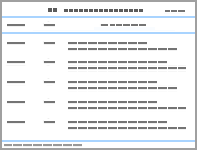
Table 1
Comparison of general clinical data of patients
| Item | No sarcopenia(n=185) | Sarcopenia(n=178) | P value |
|---|---|---|---|
| Gender | |||
| Male(%) | 98(52.97) | 80(44.94) | 0.126 |
| Female(%) | 87(47.03) | 98(55.06) | |
| Smoking(%) | 30(16.22) | 28(15.73) | 0.899 |
| Drinking(%) | 19(10.27) | 16(8.99) | 0.679 |
| Hypertension(%) | 131(70.81) | 96(53.93) | <0.001 |
| Diabetes(%) | 71(38.38) | 52(29.21) | 0.065 |
| Stroke(%) | 90(48.65) | 93(52.25) | 0.864 |
| Fasting blood glucose (mmol/L) | 5.40(4.71,6.28) | 5.10(4.58,6.07) | 0.117 |
| Age(years) | 72.06±7.89 | 74.25±8.54 | 0.006 |
| Body weight(kg) | 65.70(59.50,73.75) | 56.00(49.45,68.70) | <0.001 |
| Height(cm) | 165.00(160.00,170.00) | 164.22(158.00,170.00) | 0.268 |
| BMI(kg/m2) | 24.20(22.50,26.45) | 21.30(19.78,23.23) | <0.001 |
| Grip strength(kg) | 18.45±6.45 | 15.02±5.30 | <0.001 |
| Gait speed(m/s) | 1.02±0.34 | 0.89±0.31 | 0.011 |
| Chair stand(s) | 11.91±3.65 | 13.55±4.31 | 0.020 |
| ASMI(kg/m2) | 7.51±1.25 | 5.58±0.94 | <0.001 |
| GNRI | 109.89±9.40 | 102.81±9.55 | <0.001 |
| Resistin(ng/mL) | 6.11±1.26 | 7.04±1.63 | <0.001 |
| Erythrocyte (×1012/L) | 4.72(4.29,5.05) | 4.41(4.11,4.77) | <0.001 |
| Leukocyte (×109/L) | 5.43(4.57,6.51) | 5.3(4.24,6.62) | 0.249 |
| Platelet (×109/L) | 192.00(152.00,229.00) | 194.00(150.25,243.50) | 0.420 |
| Hemoglobin (g/L) | 145.00(135.00,157.00) | 137.5(125.75,147.25) | <0.001 |
| Total protein (g/L) | 72.80±6.90 | 71.20±7.30 | 0.038 |
| Albumin (g/L) | 43.9(40.70,46.70) | 43.3(39.4,46.00) | 0.084 |
| Globulin (g/L) | 29.00(26.25,32.05) | 28.15(25.28,31.83) | 0.081 |
| Triglyceride (mmol/L) | 1.34(1.02,1.82) | 1.11(0.87,1.56) | <0.001 |
| HDL-C(mmol/L) | 1.11(0.98,1.35) | 1.26(1.07,1.55) | <0.001 |
| Total cholesterol (mmol/L) | 4.17(3.51,4.91) | 4.35(3.55,5.11) | 0.239 |
| LDL-C(mmol/L) | 2.65(2.18,3.29) | 2.69(2.09,3.36) | 0.926 |
| Apolipoprotein a (mmol/L) | 1.32(1.15,1.56) | 1.43(1.22,1.68) | 0.060 |
| Serum creatinine (ummol/L) | 55.90(62.30,84.35) | 67.15(58.18,78.18) | 0.050 |
Table 2
Pearson correlation analysis of the correlation between resistin and diagnostic indicators of sarcopenia
| Item | Grip strength | Gait speed | Chair stand | ASMI | Age | BMI |
|---|---|---|---|---|---|---|
| Resistin | ||||||
| r | -0.192 | -0.114 | 0.102 | -0.274 | 0.108 | -0.169 |
| P | <0.001 | 0.030 | 0.051 | <0.001 | 0.04 | 0.01 |
Table 3
Conditional Logistic regression analysis of factors related to sarcopenia
| Model | Variable | β | SE | Wald χ2 | OR(95%CI) | P value |
|---|---|---|---|---|---|---|
| 1 | Resistin | 0.533 | 0.098 | 29.523 | 1.704(1.406-2.065) | <0.001 |
| 2 | Resistin | 0.501 | 0.103 | 23.803 | 1.651(1.350-2.019) | <0.001 |
| Age | 0.031 | 0.016 | 3.862 | 1.031(1.000-1.064) | 0.049 | |
| BMI | 0.288 | 0.056 | 26.535 | 0.749(0.672-0.836) | <0.001 | |
| GNRI | 0.019 | 0.017 | 1.165 | 0.981(0.948-1.016) | 0.280 | |
| Drinking | 0.095 | 0.554 | 0.029 | 0.91(0.307-2.295) | 0.864 | |
| Smoking | 0.332 | 0.437 | 0.574 | 1.393(0.591-3.283) | 0.449 | |
| 3 | Resistin | 0.509 | 0.104 | 23.938 | 1.663(1.357-2.039) | <0.001 |
| Age | 0.037 | 0.016 | 5.159 | 1.037(1.005-1.071) | 0.023 | |
| BMI | 0.285 | 0.056 | 25.526 | 0.752(0.673-0.840) | <0.001 | |
| GNRI | 0.021 | 0.018 | 1.349 | 0.980(0.946-1.014) | 0.246 | |
| Drinking | 0.159 | 0.563 | 0.08 | 0.853(0.283-2.570) | 0.777 | |
| Smoking | 0.252 | 0.443 | 0.323 | 1.286(1.540-3.064) | 0.570 | |
| Hypertension | 0.859 | 0.264 | 10.578 | 0.423(0.252-0.711) | 0.001 | |
| 4 | Resistin | 0.509 | 0.108 | 22.324 | 1.663(1.347-2.054) | <.001 |
| Age | 0.037 | 0.017 | 4.918 | 1.038(1.004-1.072) | 0.027 | |
| BMI | 0.264 | 0.061 | 19.041 | 0.768(0.682-0.865) | <.001 | |
| GNRI | 0.023 | 0.021 | 1.209 | 0.978(0.939-1.018) | 0.272 | |
| Drinking | 0.037 | 0.584 | 0.004 | 0.964(0.307-3.125) | 0.950 | |
| Smoking | 0.463 | 0.425 | 0.843 | 1.529(0.617-3.789) | 0.359 | |
| Hypertension | 0.743 | 0.273 | 7.393 | 0.476(0.279-0.813) | 0.007 | |
| Erythrocyte | 0.401 | 0.227 | 3.116 | 0.670(0.429-1.045) | 0.078 | |
| Triglyceride | 0.195 | 0.106 | 0.297 | 0.899(0.614-1.318) | 0.586 | |
| HDL-C | 1.455 | 0.42 | 12.01 | 4.286(1.882-9.763) | <.001 |

Figure 1
Binary Logistic regression forest plot for corre lationship of resistin levels with sarcopenia in older patients with or without hypertension


Figure 2
ROC curve of preliminary screening for sarcopenia using plasma resistin levels


Figure 3
ROC curve of screening for sarcopenia based on plasma resistin levels in hypertensive group


Figure 4
ROC curve of screening for sarcopenia based on plasma resistin levels in non hypertensive group

| [1] | SAYER A A, COOPER R, ARAI H, et al. Sarcopenia[J]. Nat Rev Dis Primers, 2024,10:68. |
| [2] | YUAN S, LARSSON S C. Epidemiology of sarcopenia: Prevalence, risk factors, and consequences[J]. Metabolism, 2023,144:155533. |
| [3] | 景海蓉, 陈雅雯, 付泓博, 等. 肌少症的血清生物标志物[J]. 中华老年多器官疾病杂志, 2022, 21(8):616-620. |
| JING H R, CHEN Y W, FU H B, et al. Serum biomarkers for sarcopenia[J]. Chin J Mult Organ Dis Elderly, 2022, 21(8):616-620. | |
| [4] | ZHOU L, LI J Y, HE P P, et al. Resistin: Potential biomarker and therapeutic target in atherosclerosis[J]. Clin Chim Acta, 2021,512:84-91. |
| [5] |
DEB A, DESHMUKH B, RAMTEKE P, et al. Resistin: A journey from metabolism to cancer[J]. Transl Oncol, 2021, 14(10):101178.
doi: 10.1016/j.tranon.2021.101178 URL |
| [6] |
WILHELMSEN A, TSINTZAS K, JONES S W. Recent advances and future avenues in understanding the role of adipose tissue cross talk in mediating skeletal muscle mass and function with ageing[J]. Geroscience, 2021, 43(1):85-110.
doi: 10.1007/s11357-021-00322-4 pmid: 33528828 |
| [7] | DE LUIS D, PRIMO D, IZAOLA O, et al. Relationship of circulating resistin levels with muscle mass determined by bioelectrical impedance in females with obesity[J]. Endocrinol Diabetes Nutr, 2023, 70(7):468-475. |
| [8] | 孙蓉媛, 郭丽艳, 王方方, 等. KPS、SMS评分及GNRI对急诊老年脓毒症患者病情程度及28 d死亡的评估价值[J]. 中国老年学杂志, 2025, 45(16):3935-3939. |
| SUN R Y, GUO L Y, WANG F F, et al. Evaluation value of KPS, SMS score and GNRI on the severity of illness and 28 day death in elderly patients with sepsis in emergency department[J]. Chin J Gerontol, 2025, 45(16):3935-3939. | |
| [9] |
CHEN L K, WOO J, ASSANTACHAI P, et al. Asian working group for sarcopenia: 2019 consensus update on sarcopenia diagnosis and treatment[J]. J Am Med Dir Assoc, 2020, 21(3):300-307.e2.
doi: 10.1016/j.jamda.2019.12.012 URL |
| [10] | 邹慧敏, 王遂军. 中国糖尿病诊断标准演变及特殊人群血糖管理[J]. 诊断学理论与实践, 2025, 24(1):14-20. |
| ZOU H M, WANG S J. Evolution of diagnosis standards for diabetes in China and blood glucose management for special populations[J]. J Diagn Concepts Pract, 2025, 24(1):14-20. | |
| [11] | CHEN S, HE T, SUN S, et al. Prognostic significance of pre- to postoperative dynamics of sarcopenia for patients with renal cell carcinoma undergoing laparoscopic nephrectomy[J]. Front Surg, 2022,9:871731. |
| [12] |
OZER F F, AKIN S, TASCI İ, et al. Risk of sarcopenia in hospitalized patients and related clinical factors: A multicenter study from Turkey[J]. Eur Geriatr Med, 2021, 12(4):863-870.
doi: 10.1007/s41999-021-00499-z pmid: 33866525 |
| [13] |
HSU K J, CHIEN K Y, TSAI S C, et al. Effects of exercise alone or in combination with high-protein diet on muscle function, aerobic capacity, and physical function in middle-aged obese adults: A randomized controlled trial[J]. J Nutr Health Aging, 2021, 25(6):727-734.
doi: 10.1007/s12603-021-1599-1 pmid: 34179925 |
| [14] |
RAGHUPATHY R, MCLEAN R R, KIEL D P, et al. Higher abdominal adiposity is associated with higher lean muscle mass but lower muscle quality in middle-aged and older men and women: The Framingham Heart Study[J]. Aging Clin Exp Res, 2023, 35(7):1477-1485.
doi: 10.1007/s40520-023-02427-6 pmid: 37166563 |
| [15] |
VAN HOLLEBEKE R B, CUSHMAN M, SCHLUETER E F, et al. Abdominal muscle density is inversely related to adiposity inflammatory mediators[J]. Med Sci Sports Exerc, 2018, 50(7):1495-1501.
doi: 10.1249/MSS.0000000000001570 URL |
| [16] | BOTERO J P, SHIGUEMOTO G E, PRESTES J, et al. Effects of long-term periodized resistance training on body composition, leptin, resistin and muscle strength in elderly post-menopausal women[J]. J Sports Med Phys Fitness, 2013, 53(3):289-294. |
| [17] | GAO J, DENG M, LI Y, et al. Resistin as a systemic inflammation-related biomarker for sarcopenia in patients with chronic obstructive pulmonary disease[J]. Front Nutr, 2022,9:921399. |
| [18] |
RAVA A, PIHLAK A, KUMS T, et al. Resistin concentration is inversely associated with objectively measured physical activity in healthy older women[J]. Aging Clin Exp Res, 2020, 32(3):475-481.
doi: 10.1007/s40520-019-01222-6 pmid: 31115876 |
| [19] | SCHMIDT M, WEIDEMANN A, POSER C, et al. Stimulation of non-canonical NF-κB through lymphotoxin-β-receptor impairs myogenic differentiation and regeneration of skeletal muscle[J]. Front Cell Dev Biol, 2021,9:721543. |
| [20] | REN Y, ZHAO H, YIN C, et al. Adipokines, hepatokines and myokines: Focus on their role and molecular mechanisms in adipose tissue inflammation[J]. Front Endocrinol, 2022,13:873699. |
| [21] |
MALLARDO M, DANIELE A, MUSUMECI G, et al. A narrative review on adipose tissue and overtraining: Shedding light on the interplay among adipokines, exercise and overtraining[J]. Int J Mol Sci, 2024, 25(7):4089.
doi: 10.3390/ijms25074089 URL |
| [22] |
CHEN Z, TAO S, LI X, et al. Resistin destroys mitochondrial biogenesis by inhibiting the PGC-1α/NRF1/TFAM signaling pathway[J]. Biochem Biophys Res Commun, 2018, 504(1):13-18.
doi: 10.1016/j.bbrc.2018.08.027 URL |
| [23] |
KWAK M K, BAEK J Y, PARK S J, et al. Higher circula-ting resistin levels linked to increased sarcopenia risk in older adults[J]. J Clin Endocrinol Metab, 2025, 110(9):e2994-e3001.
doi: 10.1210/clinem/dgae894 URL |
| [24] |
YU H, ZHU G, WANG D, et al. PI3K/AKT/FOXO3a pathway induces muscle atrophy by ubiquitin-proteasome system and autophagy system in COPD rat model[J]. Cell Biochem Biophys, 2024, 82(2):805-815.
doi: 10.1007/s12013-024-01232-w pmid: 38386223 |
| [25] | WANG K, LIU Q, TANG M, et al. Chronic kidney disease-induced muscle atrophy: Molecular mechanisms and promising therapies[J]. Biochem Pharmacol, 2023,208:115407. |
| [26] |
RIZVI A A, RIZZO M. Age-related changes in insulin resistance and muscle mass: Clinical implications in obese older adults[J]. Medicina, 2024, 60(10):1648.
doi: 10.3390/medicina60101648 URL |
| [27] |
VOULGARIDOU G, TYROVOLAS S, DETOPOULOU P, et al. Diagnostic criteria and measurement techniques of sarcopenia: A critical evaluation of the up-to-date evidence[J]. Nutrients, 2024, 16(3):436.
doi: 10.3390/nu16030436 URL |
| [28] |
VOELKER S N, MICHALOPOULOS N, MAIER A B, et al. Reliability and concurrent validity of the SARC-F and its modified versions: A systematic review and meta-analysis[J]. J Am Med Dir Assoc, 2021, 22(9):1864-1876.e16.
doi: 10.1016/j.jamda.2021.05.011 pmid: 34144049 |
| [1] | FANG Min, LIU Jingwen, ZENG Yuanyuan, JIN Aiping. Progress in blood-based biomarkers for diagnosis of Alzheimer's disease [J]. Journal of Diagnostics Concepts & Practice, 2026, 25(02): 113-120. |
| [2] | WANG Jiayue, XIONG Wenkui, JIANG Weiyun, WANG Jian, ZENG Naiyan, YUE Ling. Comparison of validity between spatial memory test (SMT) and Montreal cognitive assessment (MoCA) for screening mild cognitive impairment in Chinese elderly population [J]. Journal of Diagnostics Concepts & Practice, 2026, 25(02): 165-173. |
| [3] | KONG Xueying, HONG Zhen. Current status and challenges of biomarker research in autoimmune encephalitis [J]. Journal of Diagnostics Concepts & Practice, 2026, 25(02): 218-224. |
| [4] | CAI Jiaodi, CHEN Guoqun, ZHANG Wenqin. Interpretation of the 2025 NCCN clinical practice guidelines for non-small cell lung cancer (V1-V3) [J]. Journal of Diagnostics Concepts & Practice, 2026, 25(01): 37-43. |
| [5] | HUANG Man, DING Shuo. Current status and challenges in sepsis diagnosis and treatment [J]. Journal of Diagnostics Concepts & Practice, 2025, 24(06): 583-592. |
| [6] | LI Yuhang, XIAO Shifu, YUE Ling. Advances in research on association between mild behavioral impairment and Alzheimer′s disease [J]. Journal of Diagnostics Concepts & Practice, 2025, 24(05): 548-554. |
| [7] | LIU Jinghao, GUO Haiyan, GAN Guifang, CHEN Fuxiang. Value of miR-2355-3p,miR-337-3p and miR-99a-5p detection in early screening of head and neck squamous cell carcinoma [J]. Journal of Diagnostics Concepts & Practice, 2025, 24(02): 204-211. |
| [8] | WANG Yiyang, LÜ Liangjing. Potential biomarkers for prediction of the efficacy and safety of CAR T cell treatment in systemic lupus erythematosus [J]. Journal of Diagnostics Concepts & Practice, 2024, 23(03): 263-269. |
| [9] | CHEN Guoqun, CAI Jiaodi. Interpretation of the Clinical Practice Guidelines for Non-small Lung Cancer (version 4 and version 5) of 2022 National Comprehensive Cancer Nerwork(NCCN) [J]. Journal of Diagnostics Concepts & Practice, 2023, 22(01): 8-13. |
| [10] | ZHOU Sifeng, XU Haishu, FAN Xinsheng. Application of metabolomics of different biological samples in study of OSAHS biomarkers [J]. Journal of Diagnostics Concepts & Practice, 2022, 21(04): 535-540. |
| [11] | XU Chenying, LI Yanran, NI Xiaofeng, XU Shangyan, LIN Qing. Efficacy of ultrasonic examination in predicting cervical lymph node metastasis in elderly patients with papillary thyroid carcinoma and analysis of related ultrasound signs [J]. Journal of Diagnostics Concepts & Practice, 2022, 21(03): 343-348. |
| [12] | LIU Anping, LING Feng, SHI Chao, SUN Jing. Analysis of fall risk factors and establishment of risk identification model in elderly stroke patients in Shanghai community [J]. Journal of Diagnostics Concepts & Practice, 2021, 20(05): 475-479. |
| [13] | WU Jie, FENG Yuanyuan, REN Yan, CAO Jiumei. Survey of risk factors of coronary heart disease in elderly patients with coronary angiography and establishment of relevant diagnostic model [J]. Journal of Diagnostics Concepts & Practice, 2021, 20(02): 201-206. |
| [14] | ZHOU Yufen, WONG Bokai, LUO Fangxiu, XU Ying, DING Yanfei, YUAN Xiaoqin, CHEN Ping, WU Yunlin. Detection rate of gastric polyps and its clinical characteristics in 36 857 subjects in Shanghai [J]. Journal of Diagnostics Concepts & Practice, 2020, 19(04): 420-425. |
| [15] | HONG Guiping, CHEN Xiaoyan, ZHOU Jianping, CHEN Wei, XIANG Yi, ZHOU Min, LI Qingyun. Diagnostic value of endobronchial ultrasound-guided transbronchial needle aspiration in elderly patients with hilar and mediastinal lesions and analysis of missed diagnosis [J]. Journal of Diagnostics Concepts & Practice, 2020, 19(04): 397-401. |
| Viewed | ||||||
|
Full text |
|
|||||
|
Abstract |
|
|||||
