

Journal of Internal Medicine Concepts & Practice ›› 2026, Vol. 21 ›› Issue (01): 53-58.doi: 10.16138/j.1673-6087.2026.01.07
Previous Articles Next Articles
ZHANG Xian( ), HU Yucong, FENG Wenqing, ZHOU Shuying, YAN Hua*()
Received:2025-02-24
Online:2026-02-25
Published:2026-04-08
CLC Number:
ZHANG Xian, HU Yucong, FENG Wenqing, ZHOU Shuying, YAN Hua. A survey of knowledge status regarding hyponatremia among general practitioners in a standardized residency training base at a tertiary grade-A hospital in Shanghai and an analysis of related influencing factors[J]. Journal of Internal Medicine Concepts & Practice, 2026, 21(01): 53-58.
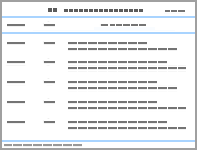
Table 1
Comparison of baseline characteristics between the two groups of general practice residents (n, $\bar{x}±s$)
| 项目 | 高分组(n = 21) | 低分组(n = 20) | χ2/t | P |
| 性别(男性/女性) | 11/10 | 9/11 | 0.223 | 0.793 |
| 年龄(岁) | 25.14 ± 1.15 | 25.20 ± 0.95 | −0.173 | 0.318 |
Table 2
Binary Logistic regression analysis of factors influencing the total score of hyponatremia assessment among general practice residents
| 变量 | OR | 95%CI | P |
| 住培年限(参照=3年) | |||
| 1年 | 0.055 | 0.002~1.433 | 0.081 |
| 2年 | 0.470 | 0.017~12.886 | 0.655 |
| 参加低钠血症相关讲课培训 (参照=否) | |||
| 是 | 39.127 | 2.358~649.180 | 0.011 |
| 研读共识指南 (参照=否) | |||
| 是 | 19.189 | 1.300~283.287 | 0.031 |
| 参与管理低钠血症住院患者 (参照=否) | |||
| 是 | 5.820 | 0.363~274.953 | 0.213 |
| 四证合一 (参照=否) | |||
| 是 | 3.239 | 0.038~274.952 | 0.604 |
Table 3
Comparison of assessment scores between the training and non-training groups ($\bar{x}±s$,score)
| 成绩 | 培训组(n = 23) | 未培训组(n = 18) | t | P |
| 定义与分类 | 16.78 ± 1.16 | 14.78 ± 1.41 | 4.721 | < 0.001 |
| 病因 | 15.48 ± 1.72 | 12.55 ± 1.79 | 5.291 | < 0.001 |
| 诊断与评估 | 16.43 ± 1.70 | 13.22 ± 1.55 | 6.229 | < 0.001 |
| 治疗 | 15.48 ± 3.26 | 11.78 ± 1.35 | 4.512 | < 0.001 |
| 生活方式干预 | 15.04 ± 1.90 | 13.22 ± 1.22 | 3.543 | < 0.001 |
Table 4
Comparison of assessment scores between the group studying consensus guidelines and the group not studying ($\bar{x}±s$,score)
| 成绩 | 研读组(n = 17) | 未研读组(n = 24) | t | P |
| 定义与分类 | 17.29 ± 0.98 | 14.91 ± 1.31 | 6.295 | < 0.001 |
| 病因 | 16.23 ± 1.71 | 12.75 ± 1.29 | 7.423 | < 0.001 |
| 诊断与评估 | 16.47 ± 2.29 | 14.00 ± 1.66 | 3.998 | < 0.001 |
| 治疗 | 16.48 ± 2.40 | 12.00 ± 2.20 | 6.163 | < 0.001 |
| 生活方式干预 | 15.76 ± 0.97 | 13.16 ± 1.55 | 6.100 | < 0.001 |
Table 5
Comparison of assessment scores between the clinical practice group and the non-clinical practice group ($\bar{x}±s$,score)
| 成绩 | 参加诊治组(n = 17) | 未参加诊治组(n = 24) | t | P |
| 定义与分类 | 16.82 ± 1.42 | 15.25 ± 1.54 | 3.324 | < 0.001 |
| 病因 | 15.41 ± 2.32 | 13.33 ± 1.83 | 3.203 | < 0.001 |
| 诊断与评估 | 16.59 ± 1.84 | 13.92 ± 1.91 | 4.481 | < 0.001 |
| 治疗 | 15.88 ± 2.78 | 12.42 ± 2.64 | 4.054 | < 0.001 |
| 生活方式干预 | 15.17 ± 1.59 | 13.58 ± 1.77 | 2.962 | < 0.001 |
Table 6
Results of the subjective questionnaire on hyponatremia among general practice residents [n(%)]
| 项目 | 是 | 否 | 难以确定 |
| 认为低钠血症知识点较难掌握 | 40(97.56) | 0(0.0) | 1(2.43) |
| 认为需要低钠血症相关教学 | 40(97.56) | 0(0.0) | 1(2.43) |
| 认为低钠血症小讲课对临床工作有所帮助 | 41(100.0) | 0(0.0) | 0(0.0) |
| 认为有必要学习低钠血症相关共识指南 | 41(100.0) | 0(0.0) | 0(0.0) |
| [1] |
关月宁, 陈适, 段炼, 等. 低钠血症流行病学研究进展[J]. 中国临床医生杂志, 2015, 43(11):19-22.
doi: 10.3969/j.issn.2095-8552.2015.11.006 |
|
Guan YN, Chen S, Duan L, et al. Research advances in the epidemiology of hyponatremia[J]. Chin J Clin, 2015, 43(11):19-22.
doi: 10.3969/j.issn.2095-8552.2015.11.006 |
|
| [2] |
Collins AJ, Pitt B, Reaven N, et al. Association of serum potassium with all-cause mortality in patients with and without heart failure, chronic kidney disease, and/or diabetes[J]. Am J Nephrol, 2017, 46(3):213-221.
doi: 10.1159/000479802 |
| [3] | Burst V. Etiology and epidemiology of hyponatremia[J]. Front Horm Res, 2019, 52:24-35. |
| [4] |
Kinoshita T, Mlodzinski E, Xiao Q, et al. Effects of correction rate for severe hyponatremia in the intensive care unit on patient outcomes[J]. J Crit Care, 2023, 77:154325.
doi: 10.1016/j.jcrc.2023.154325 |
| [5] | Pillai KS, Trivedi TH, Moulick ND. Hyponatremia in ICU[J]. J Assoc Physicians India, 2018, 66(5):48-52. |
| [6] |
梁思宇, 陈适, 潘慧, 等. COVID-19与低钠血症[J]. 基础医学与临床, 2021, 41(12):1843-1847.
doi: 10.3969/j.issn.1001-6325.2021.12.025 |
|
Liang SY, Chen S, Pan H, et al. COVID-19 and hyponatremia[J]. Basic Clin Med, 2021, 41(12):1843-1847.
doi: 10.3969/j.issn.1001-6325.2021.12.025 |
|
| [7] | 王贞贞, 童建菁, 张晨莉, 等. 全科规培医师高血压慢病管理知识现状评估及改进策略[J]. 内科理论与实践, 2024, 19(3):180-184. |
| Wang ZZ, Tong JJ, Zhang CL, et al. Current situation of knowledge of hypertension management among general practice residents and improvement strategies[J]. J Intern Med Concepts Pract, 2024, 19(3):180-184. | |
| [8] |
中华医学会内分泌学分会电解质紊乱学组. 低钠血症的中国专家共识[J]. 中华内分泌代谢杂志, 2023, 39(12):999-1009.
doi: 10.3760/cma.j.cn311282-20230526-00236 |
|
Electrolyte Disorder Group of Chinese Society of Endocrinology of Chinese Medical Association. Management of hyponatremia: a Chinese expert consensus statement[J]. Chin J Endocrinol Metab, 2023, 39(12):999-1009.
doi: 10.3760/cma.j.cn311282-20230526-00236 |
|
| [9] |
Zhang X, Li XY. Prevalence of hyponatremia among older inpatients in a general hospital[J]. Eur Geriatr Med, 2020, 11(4):685-692.
doi: 10.1007/s41999-020-00320-3 |
| [10] | 王一杰, 于婷婷, 李梦涵, 等. 全科师资胜任力现状及国内外评价标准研究[J]. 中国毕业后医学教育, 2020, 4(6):561-564. |
| Wang YJ, Yu TT, Li MH, et al. Competence and evaluation of teachers of general practitioners[J]. Chinese Journal of Graduate Medical Education, 2020, 4(6):561-564. | |
| [11] | 任文, 李婷, 刘颖, 等. 基于四象限法则的全科住院医师规范化培训专科轮转病种数据库研究[J]. 中国毕业后医学教育, 2022, 6(5):505-508. |
| Ren W, Li T, Liu Y, et al. Research on database of diseases in standardized training of general practitioners based on the four-quadrant rule[J]. Chinese Journal of Graduate Medical Education, 2022, 6(5):505-508. | |
| [12] |
杨辉, 韩建军, 许岩丽, 等. 中国全科医学行业十年发展: 机会和挑战并存[J]. 中国全科医学, 2022, 25(1):1-13.
doi: 10.12114/j.issn.1007-9572.2021.00.337 |
|
Yang H, Han JJ, Xu YL, et al. Ten-year development of general practice in China: opportunities and challenges[J]. Chin Gen Pract, 2022, 25(1):1-13.
doi: 10.12114/j.issn.1007-9572.2021.00.337 |
|
| [13] | 陈昕, 葛剑力, 耿莎莎, 等. 我国全科医师继续医学教育发展现状、存在的问题与改进建议: 基于PCIC理念[J]. 中华全科医师杂志, 2024, 23(4):384-388. |
| Chen X, Ge JL, Geng SS, et al. Status quo and challenges of continuing medical education for general practitioners in China: suggestions based on the concept of people centered and integrated health care[J]. Chin J Gen Pract, 2024, 23(4):384-388. | |
| [14] |
葛剑力, 耿莎莎, 任光为, 等. 全科医学专业住院医师规范化培训结业学员公共卫生服务能力现状与培训需求[J]. 中华医学教育杂志, 2024, 44(6):450-453.
doi: 10.3760/cma.j.cn115259-20230714-00690 |
|
Ge JL, Geng SS, Ren GW, et al. Current status and training need of public health service ability for graduates of standardized training for general practice resident physicians[J]. Chin J Med Edu, 2024, 44(6):450-453.
doi: 10.3760/cma.j.cn115259-20230714-00690 |
|
| [15] | 中华人民共和国国务院. 国务院办公厅关于改革完善全科医生培养与使用激励机制的意见 [EB/OL].(2018-01-24) [2025-01-20]. https://www.gov.cn/zhengce/content/2018-01/24/content_5260073.htm. |
| The State Council of the People’s Republic of China. Opinions of the General Office of the State Council on reforming and improving the training of general practitioners and the utilization of incentive mechanism [EB/OL].(2018-01-24) [2025-01-20]. https://www.gov.cn/zhengce/content/2018-01/24/content_5260073.htm. | |
| [16] |
李艾为, 王冠, 孙晓燕, 等. 基于移动端的实时核心胜任力评估在内科住院医师规范化培训中的应用[J]. 中华医学教育探索杂志, 2025, 24(1):121-125.
doi: 10.3760/cma.j.cn116021-20240220-01818 |
|
Li AW, Wang G, Sun XY, et al. Real-time core competency assessment by mobile terminal in the standardized training of internal medicine residents[J]. Chinese Journal of Medical Education Research, 2025, 24(1):121-125.
doi: 10.3760/cma.j.cn116021-20240220-01818 |
| Viewed | ||||||
|
Full text |
|
|||||
|
Abstract |
|
|||||
