

Journal of Internal Medicine Concepts & Practice ›› 2026, Vol. 21 ›› Issue (01): 46-52.doi: 10.16138/j.1673-6087.2026.01.06
Previous Articles Next Articles
WANG Minhuia( ), KANG Leib,*()
Received:2025-04-03
Online:2026-02-25
Published:2026-04-08
CLC Number:
WANG Minhui, KANG Lei. Analysis of the status and influencing factors of patient dignity in the intensive care unit[J]. Journal of Internal Medicine Concepts & Practice, 2026, 21(01): 46-52.
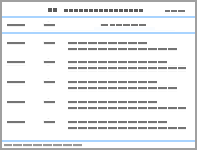
Table 1
Baseline characteristics of the participants[n=240,n(%)]
| 项目 | 例数(占比)[n(%)] |
| 性别 | |
| 男性 | 148(61.67) |
| 女性 | 92(38.33) |
| 年龄(岁) | |
| 18~35 | 39(16.25) |
| 36~60 | 78(32.50) |
| ≥61 | 123(51.25) |
| 文化程度 | |
| 小学及以下 | 48(20.00) |
| 初中 | 89(37.08) |
| 中专/高中及以上 | 103(42.92) |
| 婚姻状况 | |
| 已婚 | 167(69.58) |
| 离异/丧偶/未婚 | 73(30.42) |
| 子女情况(名) | |
| 0 | 43(17.92) |
| 1 | 124(51.67) |
| ≥2 | 73(30.42) |
| 家庭人均月收入(元) | |
| ≤1 000 | 24(10.00) |
| 1 001~3 000 | 87(36.25) |
| 3 001~5 000 | 85(35.42) |
| ≥5 001 | 44(18.33) |
| 就业情况 | |
| 在职 | 89(37.08) |
| 退休 | 104(43.33) |
| 其他 | 47(19.58) |
| 居住方式 | |
| 独居 | 53(22.08) |
| 与家人居住 | 187(77.92) |
| 医疗费用支付方式 | |
| 医保 | 213(88.75) |
| 自费 | 27(11.25) |
| 主要陪护者 | |
| 直系亲属 | 202(84.17) |
| 其他 | 38(15.83) |
| 家庭关系 | |
| 良好 | 146(60.83) |
| 一般 | 94(39.17) |
| 入住ICU天数(d) | |
| <7 | 134(55.83) |
| 7~14 | 62(25.83) |
| ≥14 | 44(18.33) |
| 接受手术 | |
| 是 | 47(19.58) |
| 否 | 193(80.42) |
| HADS-焦虑 | |
| 发生 | 152(63.33) |
| 未发生 | 88(36.67) |
| HADS-抑郁 | |
| 发生 | 147(61.25) |
| 未发生 | 93(38.75) |
Table 2
Status of dignity among ICU patients (n=240, $\bar{x}±s$, score)
| 项目 | 条目数(个) | 总分(分) | 总分均分(分) | 条目均分(分) |
| PDI总分 | 25 | 25~125 | 70.48±10.67 | 2.82±0.43 |
| 症状困扰 | 5 | 5~25 | 16.75±2.42 | 3.35±0.48 |
| 心理状况 | 6 | 6~30 | 17.34±3.57 | 2.89±0.60 |
| 依赖性 | 4 | 4~20 | 11.67±2.04 | 2.92±0.51 |
| 精神安宁 | 7 | 7~35 | 19.37±2.25 | 2.77±0.32 |
| 社会支持 | 3 | 3~15 | 5.35±0.39 | 1.78±0.13 |
Table 3
Univariate analysis of PDI scores among ICU patients with different characteristics (n=240, $\bar{x}±s$, score)
| 项目 | 例数(n) | PDI评分 | t/F | P |
| 性别 | 1.129 | 0.260 | ||
| 男性 | 148 | 71.25±7.57 | ||
| 女性 | 92 | 70.07±8.34 | ||
| 年龄(岁) | 27.180 | <0.001 | ||
| 18~35 | 39 | 64.35±6.44 | ||
| 36~60 | 78 | 69.41±6.78 | ||
| ≥61 | 123 | 73.52±7.34 | ||
| 文化程度 | 7.130 | 0.001 | ||
| 小学及以下 | 48 | 73.18±8.57 | ||
| 初中及以上 | 89 | 70.25±9.41 | ||
| 中专/高中及以上 | 103 | 67.43±8.67 | ||
| 婚姻状况 | 1.488 | 0.138 | ||
| 已婚 | 167 | 69.44±8.31 | ||
| 其他 | 73 | 71.25±9.45 | ||
| 子女数量(名) | 1.550 | 0.214 | ||
| 0 | 43 | 69.78±6.79 | ||
| 1 | 124 | 71.34±5.67 | ||
| ≥2 | 73 | 70.23±5.25 | ||
| 家庭人均月收入(元) | 13.580 | <0.001 | ||
| ≤1 000 | 24 | 75.67±6.44 | ||
| 1 001~3 000 | 87 | 72.64±5.37 | ||
| 3 001~5 000 | 85 | 70.18±6.38 | ||
| ≥5 001 | 44 | 67.34±5.42 | ||
| 就业情况 | 1.080 | 0.342 | ||
| 在职 | 89 | 71.25±7.25 | ||
| 退休 | 104 | 69.70±6.79 | ||
| 其他 | 47 | 70.18±8.74 | ||
| 居住方式 | 5.844 | <0.001 | ||
| 独居 | 53 | 73.41±8.43 | ||
| 与家人居住 | 187 | 67.58±5.72 | ||
| 医疗费用支付方式 | 1.735 | 0.084 | ||
| 医保 | 213 | 69.28±8.15 | ||
| 自费 | 27 | 72.15±7.68 | ||
| 主要陪护者 | 6.416 | <0.001 | ||
| 直系 | 202 | 65.73±6.48 | ||
| 其他 | 38 | 73.45±8.35 | ||
| 家庭关系 | 5.839 | <0.001 | ||
| 良好 | 146 | 68.77±7.23 | ||
| 一般 | 94 | 74.65±8.18 | ||
| 入住ICU天数(d) | 35.280 | <0.001 | ||
| <7 | 134 | 67.25±6.38 | ||
| 7~14 | 62 | 71.38±7.29 | ||
| ≥14 | 44 | 76.41±5.32 | ||
| 接受手术 | 1.122 | 0.263 | ||
| 是 | 47 | 71.14±8.63 | ||
| 否 | 193 | 69.45±9.41 |
Table 4
Results of Pearson correlation analysis between PDI and HADS dimension scores in ICU patients (n=240,r)
| 项目 | HADS总分 | 焦虑 | 抑郁 |
| 与HADS对应维度得分比较,*:P<0.05;**:P<0.01。 | |||
| PDI总分 | 0.725** | 0.685** | 0.711** |
| 症状困扰 | 0.654** | 0.675** | 0.639** |
| 心理状况 | 0.748** | 0.697** | 0.776** |
| 依赖性 | 0.547* | 0.534* | 0.615** |
| 精神安宁 | 0.575* | 0.464* | 0.519* |
| 社会支持 | 0.398* | 0.343* | 0.436* |
Table 5
Variable assignment for the multiple linear regression analysis
| 项目 | 赋值方式 |
| 年龄(岁) | 18~35岁=0;36~60岁=1;≥61岁=2 |
| 文化程度 | 小学及以下=0;初中=1; 中专/高中及以上=2 |
| 家庭人均月收入(元) | ≤1 000=0;1 001~3 000=1; 3 001~5 000=2;≥5 001=3 |
| 居住方式 | 与家人居住=0;独居=1 |
| 主要陪护者 | 配偶/父母/子女=0;其他=1 |
| 家庭关系 | 良好=0;一般=1 |
| 入住ICU天数(d) | <7=0;7~14=1;≥14=2 |
| HADS-焦虑 | 原始得分(连续变量) |
| HADS-抑郁 | 原始得分(连续变量) |
Table 6
Results of multiple linear regression analysis on factors influencing the dignity of ICU patients (total PDI score)
| 变量 | 未标准化系数 | 标准化系数 | ||||
| B | SE | β | t | P | ||
| R²=0.856,调整后R²=0.843。 | ||||||
| 常量 | −10.256 | 2.105 | − | −4.871 | <0.001 | |
| 年龄 | 5.187 | 0.223 | 0.537 | 3.847 | 0.025 | |
| 文化程度 | −5.439 | 0.275 | −0.520 | 4.035 | 0.017 | |
| 家庭人均月收入 | −2.039 | 0.115 | −0.165 | 1.934 | 0.153 | |
| 居住方式 | 1.492 | 0.215 | 0.263 | 1.320 | 0.222 | |
| 主要陪护者 | 4.910 | 0.117 | 0.488 | 3.763 | 0.027 | |
| 家庭关系 | 13.985 | 0.479 | 0.871 | 10.974 | <0.001 | |
| 入住ICU天数 | 5.330 | 0.240 | 0.523 | 3.952 | 0.021 | |
| HADS-焦虑 | 12.759 | 0.437 | 0.753 | 10.137 | <0.001 | |
| HADS-抑郁 | 10.608 | 0.390 | 0.635 | 9.832 | 0.002 | |
| [1] | 陈恩平, 胡旭钢, 李秀央, 等. 医院重症监护室院内感染及预后的影响因素分析[J]. 国际流行病学传染病学杂志, 2022, 49(3):192-195. |
| Chen EP, Hu XG, Li XY, et al. Influencing factors of nosocomial infection and prognosis in intensive care unit[J]. Inter J Epidemiol Infect Dis, 2022, 49(3):192-195. | |
| [2] |
郑洪君, 李涛. ICU治疗实践的伦理问题辨析[J]. 医学与哲学, 2022, 43(1):28-33.
doi: 10.12014/j.issn.1002-0772.2022.01.07 |
|
Zheng HJ, Li T. Analysis of ethical issues in ICU treatment practice[J]. Medicine and Philosophy, 2022, 43(1):28-33.
doi: 10.12014/j.issn.1002-0772.2022.01.07 |
|
| [3] | 许娟, 莫蓓蓉, 胡玉娜, 等. 重症监护病房成人患者护理人文关怀专家共识[J]. 护理学杂志, 2022, 37(18):1-4. |
| Xu J, Mo BR, Hu YN, et al. Expert consensus on nursing human caring for ICU adult patients[J]. Journal of Nursing Science, 2022, 37(18):1-4. | |
| [4] | 黄瑶, 周英, 汪国成. 患者尊严的研究现状[J]. 中华现代护理杂志, 2020, 26(30):4278-4282. |
| Huang Y, Zhou Y, Wang GC. Research status of patient dignity[J]. Chin J Mod Nurs, 2020, 26(30):4278-4282. | |
| [5] | 梁健媛, 刘小婷, 王园园, 等. 重症监护室患者尊严感的研究进展[J]. 护理学杂志, 2020, 35(1):107-110. |
| Liang JY, Liu XT, Wang YY, et al. A literature review of dignity in ICU patients[J]. Journal of Nursing Science, 2020, 35(1):107-110. | |
| [6] |
Obispo B, Cruz-Castellanos P, Hernandez R, et al. Perceived dignity of advanced cancer patients and its relationship to sociodemographic, clinical, and psychological factors[J]. Front Psychol, 2022, 13:855704.
doi: 10.3389/fpsyg.2022.855704 |
| [7] |
鞠洪杰, 刘卫, 王杰, 等. 住院患者尊严影响因素的研究进展[J]. 护理学报, 2023, 30(2):44-47.
doi: 10.16460/j.issn1008-9969.2023.02.044 |
|
Ju HJ, Liu W, Wang J, et al. Research advances in factors influencing dignity among hospitalized patients[J]. Journal of Nursing, 2023, 30(2):44-47.
doi: 10.16460/j.issn1008-9969.2023.02.044 |
|
| [8] |
孙振晓, 刘化学, 焦林瑛, 等. 医院焦虑抑郁量表的信度及效度研究[J]. 中华临床医师杂志(电子版), 2017, 11(2):198-201.
doi: 10.3877/cma.j.issn.1674-0785.2017.02.005 |
|
Sun ZX, Liu HX, Jiao LY, et al. Reliability and validity of hospital anxiety and depression scale[J]. Chin J Clinicians (Electronic Edition), 2017, 11(2):198-201.
doi: 10.3877/cma.j.issn.1674-0785.2017.02.005 |
|
| [9] |
刘方, 徐琳. 中文版患者尊严量表的信效度研究[J]. 中国实用护理杂志, 2015, 31(1):26-29.
doi: 10.3760/cma.j.issn.1672-7088.2015.01.008 |
|
Liu F, Xu L. Reliability and validity of Chinese version of Patient Dignity Inventory[J]. Chin J Prac Nurs, 2015, 31(1):26-29.
doi: 10.3760/cma.j.issn.1672-7088.2015.01.008 |
|
| [10] |
Zhuang Z, Zeng L. Reflecting on ICU patient’s dignity using Taylor’s emancipatory reflection model[J]. Nurs Ethics, 2024, 31(5):777-790.
doi: 10.1177/09697330231202229 |
| [11] |
Mergler BD, Goldshore MA, Shea JA, et al. The patient dignity inventory and dignity-related distress among the critically ill[J]. J Pain Symptom Manage, 2022, 63(3):359-365.
doi: 10.1016/j.jpainsymman.2021.12.001 |
| [12] |
Sun X, Zhang G, Yu Z, et al. The meaning of respect and dignity for intensive care unit patients: a meta-synthesis of qualitative research[J]. Nurs Ethics, 2024, 31(4):652-669.
doi: 10.1177/09697330231222598 |
| [13] |
Fuseini AG, Ley L, Rawson H, et al. A systematic review of patient-reported dignity and dignified care during acute hospital admission[J]. J Adv Nurs, 2022, 78(11):3540-3558.
doi: 10.1111/jan.15370 |
| [14] |
杨丰华, 白献红, 卢红梅, 等. 晚期肝癌患者尊严感调查及影响因素分析[J]. 护士进修杂志, 2019, 34(7):660-662.
doi: 10.16821/j.cnki.hsjx.2019.07.024 |
|
Yang FH, Bai XH, Lu HM, et al. Survey and analysis of the sense of dignity and its influencing factors in patients with advanced liver cancer[J]. Journal of Nurses Training, 2019, 34(7):660-662.
doi: 10.16821/j.cnki.hsjx.2019.07.024 |
|
| [15] | 禹小燕, 王花芹, 唐莉, 等. ICU护理人文关怀障碍及促进因素的质性研究[J]. 中华急危重症护理杂志, 2024, 5(5):408-413. |
| Yu XY, Wang HQ, Tang L, et al. The barriers and enablers to implementing humanistic care in ICU: a qualitative study[J]. Chin J Emerg Crit Care Nurs, 2024, 5(5):408-413. | |
| [16] | 杨丹琳. 晚期肝癌住院患者尊严感状况及影响因素[J]. 护理实践与研究, 2021, 18(5):673-676. |
| Yang DL. The status of dignity and the influencing factors in inpatients with advanced liver cancer[J]. Nursing Practice and Research, 2021, 18(5):673-676. | |
| [17] |
黄瑶, 周英, 汪国成, 等. 住院患者尊严现状及影响因素分析[J]. 护理学杂志, 2021, 36(20):93-96.
doi: 10.3870/j.issn.1001-4152.2021.20.093 |
|
Huang Y, Zhou Y, Wang GC, et al. Patients’ perception of dignity and its influencing factors[J]. Journal of Nursing Science, 2021, 36(20):93-96.
doi: 10.3870/j.issn.1001-4152.2021.20.093 |
|
| [18] | 卢美玲, 罗志芹. 中青年与老年晚期癌症患者尊严受损水平的比较分析[J]. 护士进修杂志, 2019, 34(16):1499-1502. |
| Lu ML, Luo ZQ. Comparative analysis of dignity-related distress levels between middle-aged/young adult and elderly patients with advanced cancer[J]. Journal of Nurses Training, 2019, 34(16):1499-1502. | |
| [19] | 胡乐乐, 胡晓亚, 谢红. 重症监护室患者尊严现状及其相关因素调查[J]. 护理管理杂志, 2017, 17(1):29-31. |
| Hu LL, Hu XY, Xie H. Current status and related factors of dignity among patients in intensive care unit[J]. Journal of Nursing Administration, 2017, 17(1):29-31. |
| [1] | CHEN Lijuan, LUO Canwei, LIU Linshan, LI Jiajia, HUANG Shaolan, LI Linghua, LIU Cong. Status and influencing factors of optimism among reproductive-aged women with HIV [J]. Journal of Internal Medicine Concepts & Practice, 2026, 21(01): 39-45. |
| [2] | WANG Guojun, WANG Liye, WANG Lifang, LIAO Chenglin. Electric Vehicle Charging Load Modeling Based on Influence Factor Analysis [J]. J Shanghai Jiaotong Univ Sci, 2025, 30(6): 1232-1241. |
| [3] | TANG Yuhang, YU Kun, ZENG Xiangjun, NI Yanru, CHENG Xinxiang, HAN Wei. Calculation Method for Underground Metal Corrosion Due to Stray Current Based on Ground Potential Distribution [J]. Journal of Shanghai Jiao Tong University, 2025, 59(3): 424-434. |
| [4] | LIU Xinyi, ZHOU Yanchun, ZHANG Yili, et al . The status and influencing factors of anxiety and depression in patients with congenital microtia [J]. Journal of Tissue Engineering and Reconstructive Surgery, 2025, 21(1): 68-. |
| [5] | WANG Tian, YANG Minli. Influencing factors and prediction model construction of preoperative respiratory tract infection and postoperative prognosis of cleft lip and palate#br# [J]. Journal of Tissue Engineering and Reconstructive Surgery, 2025, 21(1): 40-. |
| [6] | CAI Hui, LI Yousheng, HUANG Yuhua, XU Jingjing, LIU Qingfen, GU Fen. Analysis of current status and influencing factors of opportunistic infections in Crohn disease [J]. Journal of Internal Medicine Concepts & Practice, 2025, 20(06): 440-448. |
| [7] | YANG Cuiping, CHEN Ping. Analysis of global trends and current status of diagnosis and treatment of inflammatory bowel diseas [J]. Journal of Diagnostics Concepts & Practice, 2025, 24(04): 373-382. |
| [8] | YU Meiling, LI Jiaoyan, LI Jian, CHEN Ying, ZHAO Bing, MAO Enqiang, YANG Zhitao. Clostridioides difficile toxin positivity prolongs hospital stay and increases costs for critically ill patients in emergency patients [J]. Journal of Internal Medicine Concepts & Practice, 2025, 20(03): 216-223. |
| [9] | SUN Xin, WANG Simin, XIE Jingdong, JIANG Hailin, WANG Sen. Improved Transformer-PSO Short-Term Electricity Price Prediction Method Considering Multidimensional Influencing Factors [J]. Journal of Shanghai Jiao Tong University, 2024, 58(9): 1420-1431. |
| [10] |
JIANG Yan, Ran Xuehui, LIN Xiaoxi, et al.
Status and influencing factors of stigma in patients with port wine stains in the head and neck [J]. Journal of Tissue Engineering and Reconstructive Surgery, 2024, 20(3): 335-. |
| [11] | Gong Tingting, Qian Aihua, Chen Xi. Construction of a Nomogram model for personalized prediction of the risk of delayed postoperative bleeding after endoscopic submucosal dissection for early gastric cancer [J]. Journal of Surgery Concepts & Practice, 2024, 29(03): 236-242. |
| [12] | ZHANG Huiyu, YU Yejiao. The Expectations of MTI Students and the Realities of the Programme [J]. Contemporary Foreign Languages Studies, 2023, 23(4): 119-129. |
| [13] | TAN Ruoming, QU Hongping. Prevention and control of multidrug-resistant bacteria infection in surgical patients [J]. Journal of Surgery Concepts & Practice, 2023, 28(05): 420-424. |
| [14] | CUI Jiasong, ZHANG Enming, WANG Suxing, GAN Lu, DAI Zhengyue, FANG Qiong. The current status of intensive care unit competency and infectious disease emergency response capability of nurses involved in the critical care of COVID-19 in Shanghai [J]. Journal of Internal Medicine Concepts & Practice, 2023, 18(01): 43-47. |
| [15] |
LIU Yu, WANG Rui, LI Shijie, et al.
Research progress of mediating factors affecting the formation of foreign body giant cell [J]. Journal of Tissue Engineering and Reconstructive Surgery, 2022, 18(6): 527-. |
| Viewed | ||||||
|
Full text |
|
|||||
|
Abstract |
|
|||||
