

Journal of Surgery Concepts & Practice ›› 2026, Vol. 31 ›› Issue (01): 50-57.doi: 10.16139/j.1007-9610.2026.01.09
• Original article • Previous Articles Next Articles
ZHOU Xueping, WENG Hao,*, WENG Mingzhe, SHU Yijun, ZHAO Mingning, GU Jun, WANG Xuefeng( )
)
Received:2025-05-31
Online:2026-02-25
Published:2026-04-21
Contact:
WANG Xuefeng
E-mail:wxxfd@live.cn
CLC Number:
ZHOU Xueping, WENG Hao, WENG Mingzhe, SHU Yijun, ZHAO Mingning, GU Jun, WANG Xuefeng. Application of single balloon enteroscopy-assisted endoscopic retrograde pancreatography in patients with pancreaticojejunal anastomotic stenosis[J]. Journal of Surgery Concepts & Practice, 2026, 31(01): 50-57.
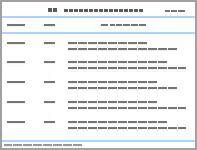
Tab 1
Anastomotic site identification failure and related factors
| Factors | Anastomotic site identification success(n=7) | Anastomotic site identification failure(n=7) | t value | P value |
|---|---|---|---|---|
| The time of first abdominal pain after the operation (month) | 44.7 | 19.9 | 2.251 | 0.044 |
| The time from the operation to the first ECRP treatment (month) | 53.1 | 42.3 | 0.927 | 0.372 |
| The time from the symptom onset to ERP treatment (month) | 8.4 | 22.4 | -2.658 | 0.021 |
Tab 2
Single-factor analysis of anastomotic site identification failure
| Factors | Category | Anastomotic site identification success | Anastomotic site identification failure | χ2 value | P value |
|---|---|---|---|---|---|
| Age (year) | <60 | 3 | 3 | 0.000 | 1.000 |
| ≥60 | 4 | 4 | |||
| Sex | Male | 4 | 3 | 0.265 | 0.606 |
| Female | 3 | 4 | |||
| The primary disease (benign or malignant) | Benign | 4 | 4 | 0.000 | 1.000 |
| Malignant | 3 | 3 | |||
| Digestive tract reconstruction method | Child | 7 | 3 | 5.200 | 0.001 |
| Whipple | 0 | 4 | |||
| Methods of pancreaticojejunostomy | Invagination | 4 | 0 | 5.200 | 0.001 |
| Duct to mucosa | 3 | 7 | |||
| Pancreatic duct dilation before PD | Yes | 6 | 2 | 4.333 | 0.037 |
| No | 1 | 5 | |||
| Pancreatic duct tube placement during PD | Yes | 6 | 2 | 4.333 | 0.037 |
| No | 1 | 5 | |||
| Postoperative pancreatic fistula | Yes | 1 | 6 | 6.633 | 0.010 |
| No | 6 | 1 | |||
| Pancreatic duct dilation before ERP | Yes | 3 | 3 | 0.000 | 1.000 |
| No | 4 | 4 | |||
| Pancreatic duct stones | Yes | 1 | 2 | 0.394 | 0.530 |
| No | 6 | 5 | |||
| AMY increases before ERP | Yes | 5 | 4 | 0.289 | 0.591 |
| No | 2 | 3 |
Tab 3
Detailed treatment process of successful ERP patients
| Patient No. | Number of ERP treatments | Duration and course of ERP treatment | Follow-up time (month) | Relapse or not | Time of recurrence after the last ERP (month) | Stent indwelling time (month) | BMI change(kg/m2) |
|---|---|---|---|---|---|---|---|
| A | 1 | 2018.1 5Fr dilation catheter tip dilated anastomotic site | 39.0 | Yes | 1.0 | 0 | -1.81 |
| B | 2 | 2016.8 5Fr stent was inserted after 5Fr catheter dilation | 20.2 | Yes | 1.2 | 15.7(5Fr) | -0.34 |
| 2017.11 Removal of pancreatic duct stent | |||||||
| C | 2 | 2019.6 7Fr stent was inserted after 5Fr catheter dilation | 21.8 | No | / | 13.3(7Fr) | +3.90 |
| 2020.7 Removal of pancreatic duct stent | |||||||
| D | 2 | 2019.11 4 mm cylindrical balloon dilated anastomotic site, 5Fr stent was inserted | 17.7 | No | / | 15.0(5Fr)+2.7(7Fr) | +0.32 |
| 2021.2 4 mm cylindrical balloon dilated anastomotic site, 7Fr stent was inserted | |||||||
| E | 2 | 2020.12 Anastomotic site could not be found | 2.7 | No | / | 2.7(7Fr) | 0 |
| 2021.1 Cannulation was successful with a combination of enteroscopy and EUS-PD, 7Fr dilation catheter dilated anastomotic site, and 7Fr stent was inserted until now | |||||||
| F | 1 | 2016.3 7Fr stent was inserted after 7Fr catheter dilation until now | 61.5 | No | / | 61.5(7Fr) | +6.76 |
| G | 3 | 2015.2 5Fr catheter dilated anastomotic site, 5Fr stent was inserted | 75.1 | No | / | 29.8(5Fr)+25.5(7Fr) | +2.00 |
| 2017.8 7Fr catheter dilated anastomotic site, 7Fr stent was inserted | |||||||
| 2019.8 Removal of pancreatic duct stent | |||||||
| H | 2 | 2020.7 6 mm cylindrical balloon dilated anastomotic site, partial stone, 5Fr stent was inserted 2021.1 6 mm cylindrical balloon dilated anastomotic site + all stones extraction, 7Fr stent was inserted until now | 9.0 | No | / | 6.0(5Fr) +3.0(7Fr) | +1.83 |
| [1] |
WOLFGANG C L, PAWLIK T M. Pancreaticoduodenectomy: time to change our approach?[J]. Lancet Oncol, 2013, 14(7):573-575.
doi: 10.1016/S1470-2045(13)70159-1 URL |
| [2] |
NASSOUR I, CHOTI M A. Pancreatic operations[J]. JAMA, 2016, 316(18):1932.
doi: 10.1001/jama.2016.11165 pmid: 27825010 |
| [3] |
REGIMBEAU J M, REBIBO L, DOKMAK S, et al. The short- and long-term outcomes of pancreaticoduodenectomy for cancer in Child A patients are acceptable: a patient-control study from the Surgical French Association report for pancreatic surgery[J]. J Surg Oncol, 2015, 111(6):776-783.
doi: 10.1002/jso.v111.6 URL |
| [4] |
ZARZAVADJIAN LE BIAN A, CESARETTI M, TABCHOURI N, et al. Late pancreatic anastomosis stricture following pancreaticoduodenectomy: a systematic review[J]. J Gastrointest Surg, 2018, 22(11):2021-2028.
doi: 10.1007/s11605-018-3859-x pmid: 29980974 |
| [5] |
DEMIRJIAN A N, KENT T S, CALLERY M P, et al. The inconsistent nature of symptomatic pancreatico-jejunostomy anastomotic strictures[J]. HPB (Oxford), 2010, 12(7):482-487.
doi: 10.1111/j.1477-2574.2010.00214.x URL |
| [6] |
KIDA A, SHIROTA Y, HOUDO Y, et al. Endoscopic characteristics and usefulness of endoscopic dilatation of anastomotic stricture following pancreaticojejunostomy: case series and a review of the literature[J]. Therap Adv Gastroenterol, 2016, 9(6):913-919.
pmid: 27803744 |
| [7] |
KOGURE H, SATO T, NAKAI Y, et al. Endoscopic management of pancreatic diseases in patients with surgically altered anatomy: clinical outcomes of combination of double-balloon endoscopy- and endoscopic ultrasound-guided interventions[J]. Dig Endosc, 2021, 33(3):441-450.
doi: 10.1111/den.v33.3 URL |
| [8] |
KIDA A, SHIROTA Y, KAWANE T, et al. Long-term outcomes after endoscopic retrograde pancreatic drainage for symptomatic pancreaticojejunal anastomotic stenosis[J]. Sci Rep, 2021, 11(1):4489.
doi: 10.1038/s41598-021-84024-z pmid: 33627731 |
| [9] |
COTTON P B, LEHMAN G, VENNES J, et al. Endoscopic sphincterotomy complications and their management: an attempt at consensus[J]. Gastrointest Endosc, 1991, 37(3):383-393.
doi: 10.1016/s0016-5107(91)70740-2 pmid: 2070995 |
| [10] |
COTTON P B, EISEN G M, AABAKKEN L, et al. A lexicon for endoscopic adverse events: report of an ASGE workshop[J]. Gastrointest Endosc, 2010, 71(3):446-454.
doi: 10.1016/j.gie.2009.10.027 pmid: 20189503 |
| [11] |
MÖNKEMÜLLER K, FRY L C, BELLUTTI M, et al. ERCP with the double balloon enteroscope in patients with Roux-en-Y anastomosis[J]. Surg Endosc, 2009, 23(9):1961-1967.
doi: 10.1007/s00464-008-0239-8 pmid: 19067052 |
| [12] |
ITOI T, ISHII K, SOFUNI A, et al. Single-balloon entero-scopy-assisted ERCP in patients with Billroth Ⅱ gastrectomy or Roux-en-Y anastomosis (with video)[J]. Am J Gastroenterol, 2010, 105(1):93-99.
doi: 10.1038/ajg.2009.559 URL |
| [13] |
SIDDIQUI A A, CHAAYA A, SHELTON C, et al. Utility of the short double-balloon enteroscope to perform pancreaticobiliary interventions in patients with surgically altered anatomy in a US multicenter study[J]. Dig Dis Sci, 2013, 58(3):858-864.
doi: 10.1007/s10620-012-2385-z URL |
| [14] |
KATANUMA A, YANE K, OSANAI M, et al. Endoscopic retrograde cholangiopancreatography in patients with surgically altered anatomy using balloon-assisted enteroscope[J]. Clin J Gastroenterol, 2014, 7(4):283-289.
doi: 10.1007/s12328-014-0505-3 pmid: 26185874 |
| [15] |
MENON K V, SANAKA M. Successful single-balloon enteroscopic dilation of late anastomotic pancreaticojejunostomy stricture following whipple procedure[J]. Pancreas, 2010, 39(1):115-116.
doi: 10.1097/MPA.0b013e3181b65ccd URL |
| [16] |
KIKUYAMA M, ITOI T, OTA Y, et al. Therapeutic endoscopy for stenotic pancreatodigestive tract anastomosis after pancreatoduodenectomy (with videos)[J]. Gastrointest Endosc, 2011, 73(2):376-382.
doi: 10.1016/j.gie.2010.10.015 pmid: 21295649 |
| [17] | PARK J H, YE B D, BYEON J S, et al. Approaching pancreatic duct through pancreaticojejunostomy site with double ballon enteroscope in patients with Roux-en-Y anatomy[J]. Hepatogastroenterology, 2013, 60(127):1753-1758. |
| [18] |
SHIMATANI M, MATSUSHITA M, TAKAOKA M, et al. Effective "short" double-balloon enteroscope for diagnostic and therapeutic ERCP in patients with altered gastrointestinal anatomy: a large case series[J]. Endoscopy, 2009, 41(10):849-854.
doi: 10.1055/s-0029-1215108 pmid: 19750447 |
| [19] |
FARRELL J, CARR-LOCKE D, GARRIDO T, et al. Endoscopic retrograde cholangiopancreatography after pancreaticoduodenectomy for benign and malignant disease: indications and technical outcomes[J]. Endoscopy, 2006, 38(12):1246-1249.
pmid: 17163327 |
| [20] |
CIOFFI J L, MCDUFFIE L A, ROCH A M, et al. Pancreaticojejunostomy stricture after pancreatoduodenectomy: outcomes after operative revision[J]. J Gastrointest Surg, 2016, 20(2):293-299.
doi: 10.1007/s11605-015-3012-z pmid: 26553264 |
| [21] |
ELMUNZER B J, PIRAKA C R. EUS-guided methylene blue injection to facilitate pancreatic duct access after unsuccessful ERCP[J]. Gastroenterology, 2016, 151(5):809-810.
doi: S0016-5085(16)35037-5 pmid: 27639800 |
| [22] |
WIDMER J, SHARAIHA R Z, KAHALEH M. Endoscopic ultrasonography-guided drainage of the pancreatic duct[J]. Gastrointest Endosc Clin N Am, 2013, 23(4):847-861.
doi: 10.1016/j.giec.2013.06.011 pmid: 24079794 |
| [23] |
ERGUN M, AOUATTAH T, GILLAIN C, et al. Endoscopic ultrasound-guided transluminal drainage of pancreatic duct obstruction: long-term outcome[J]. Endoscopy, 2011, 43(6):518-525.
doi: 10.1055/s-0030-1256333 pmid: 21437853 |
| [24] |
HODO Y, SHIROTA Y, SUDA T, et al. Successful EUS-guided retrograde pancreatic duct stent placement for refractory pancreaticojejunostomy stricture after pancreaticoduodenectomy with a forward-viewing echoendoscope[J]. VideoGIE, 2018, 3(6):196-198.
doi: 10.1016/j.vgie.2018.03.009 URL |
| [25] |
MOREELS T G. Endoscopic retrograde cholangiopancreatography in patients with altered anatomy: how to deal with the challenges?[J]. World J Gastrointest Endosc, 2014, 6(8):345-351.
doi: 10.4253/wjge.v6.i8.345 pmid: 25132917 |
| [26] |
TAKIKAWA T, KANNO A, MASAMUNE A, et al. Pancreatic duct drainage using EUS-guided rendezvous technique for stenotic pancreaticojejunostomy[J]. World J Gastroenterol, 2013, 19(31):5182-5186.
doi: 10.3748/wjg.v19.i31.5182 URL |
| [27] |
SANO I, KATANUMA A, KUWATANI M, et al. Long-term outcomes after therapeutic endoscopic retrograde cholangiopancreatography using balloon-assisted enteroscopy for anastomotic stenosis of choledochojejunostomy/pancreaticojejunostomy[J]. J Gastroenterol Hepatol, 2019, 34(3):612-619.
doi: 10.1111/jgh.2019.34.issue-3 URL |
| [28] |
MATSUBAYASHI H, KISHIDA Y, SHINJO K, et al. Endoscopic ultrasound-guided retrograde pancreatic stent placement for the treatment of stenotic jejunopancreatic anastomosis after a Whipple procedure[J]. Endoscopy, 2013, 45(Suppl 2 UCTN):E435-E436.
doi: 10.1055/s-00000012 URL |
| [29] |
MORGAN D E, SMITH J K, HAWKINS K, et al. Endoscopic stent therapy in advanced chronic pancreatitis: relationships between ductal changes, clinical response, and stent patency[J]. Am J Gastroenterol, 2003, 98(4):821-826.
doi: 10.1111/j.1572-0241.2003.07381.x pmid: 12738462 |
| [30] |
SMITS M E, BADIGA S M, RAUWS E A, et al. Long-term results of pancreatic stents in chronic pancreatitis[J]. Gastrointest Endosc, 1995, 42(5):461-467.
doi: 10.1016/s0016-5107(95)70051-x pmid: 8566639 |
| [1] | OU Huiyi, JIN Kaizhou, YE Longyun, WU Weiding. Anatomical classification and intraoperative management strategies of dorsal pancreatic artery in 576 standard pancreatic surgeries [J]. Journal of Surgery Concepts & Practice, 2025, 30(06): 483-487. |
| [2] | WANG Jingyuan, FAN Jiayu, ZHANG Pingping, MA Hongyun, CHEN Ying, LI Gang, JIN Zhendong, JIN Gang, WANG Kaixuan. Characteristics of cyst fluid can predict the benign or malignant nature of intraductal papillary mucinous neoplasms [J]. Journal of Surgery Concepts & Practice, 2025, 30(06): 509-516. |
| [3] | CHEN Haoda, SHEN Baiyong. Advances of prevention and management for post-pancreatectomy acute pancreatitis [J]. Journal of Surgery Concepts & Practice, 2025, 30(06): 524-528. |
| [4] | YU Qiang, YANG Yulong. Upper digestive tract obstruction caused by annular pancreas combined with duodenal bulb stenosis: a case report [J]. Journal of Surgery Concepts & Practice, 2025, 30(03): 264-267. |
| [5] | WANG Jiwen, WANG Chunyan, SHEN Sheng, LIU Han, ZHANG Wei, LIU Houbao. Clinical value of DSA in diagnosis and treatment of delayed pancreaticoduodenectomy hemorrhage [J]. Journal of Surgery Concepts & Practice, 2025, 30(02): 125-131. |
| [6] | LÜ Beining, HOU Nianzong, XIANG Yukai, DA Xuanbo, YANG Yulong, TIAN Fuzhou. Anatomical simulation analysis of pancreaticobiliary junction in occult pancreaticobiliary reflux: based on Fluent study [J]. Journal of Surgery Concepts & Practice, 2024, 29(05): 426-433. |
| [7] | MA Yubo, LI Qi, ZHANG Dong, GENG Zhimin. Advances in research of pancreaticobiliary maljunction-associated gallbladder cancer [J]. Journal of Surgery Concepts & Practice, 2024, 29(04): 365-369. |
| [8] | LI Wei, WU Sheng, TIAN Yujian, TANG Xiaoming, CAI Chuang, XU Zhiwei. Risk factors and prevention strategies for intraperitoneal hemorrhage after pancreaticoduodenectomy [J]. Journal of Surgery Concepts & Practice, 2024, 29(03): 243-248. |
| [9] | QI Yang, YAO Wenfei, LI Qianyi, YAO Wei, KONG Lei, XU Ruiyun, WU Yuquan, LI Nengping. Efficacy of different methods for difficult biliary cannulation in ERCP: systematic review and network meta-analysis [J]. Journal of Surgery Concepts & Practice, 2023, 28(06): 540-550. |
| [10] | WANG Zhenyu. Endoscopic diagnosis and treatment of benign pancreatic diseases [J]. Journal of Surgery Concepts & Practice, 2023, 28(04): 288-295. |
| [11] | HOU Senlin, YU Tingting, LIU Pengxiang, ZHANG Lichao. Application of endoscopic ultrasound interventional therapy in biliary and pancreatic diseases [J]. Journal of Surgery Concepts & Practice, 2023, 28(04): 300-306. |
| [12] | DONG Yuanhang, CHEN Jie. Endoscopic intervention strategy for pancreaticoduodenectomy-related cholangiopancreatic diseases [J]. Journal of Surgery Concepts & Practice, 2023, 28(04): 307-309. |
| [13] | ZHANG Ling, ZOU Duowu. The role of ERCP in the diagnosis and treatment of chronic pancreatitis [J]. Journal of Surgery Concepts & Practice, 2023, 28(04): 283-287. |
| [14] | WEN Yi, NI Tongtian, CHEN Ying, MAO Enqiang. Current status on anti-infective treatment of acute pancreatitis [J]. Journal of Surgery Concepts & Practice, 2022, 27(06): 563-568. |
| [15] | WEN Chenlei, SHEN Baiyong. Internally and externally to inherit the history——the 3rd Oriental Congress of General Surgery [J]. Journal of Surgery Concepts & Practice, 2022, 27(06): 569-570. |
| Viewed | ||||||
|
Full text |
|
|||||
|
Abstract |
|
|||||
