

Journal of Diagnostics Concepts & Practice ›› 2026, Vol. 25 ›› Issue (01): 30-36.doi: 10.16150/j.1671-2870.2026.01.005
• Interpretation of the guidelines • Previous Articles Next Articles
TAO Yi1,2,3, MI Jianqing1,2,3( )
)
Received:2025-12-16
Revised:2026-01-09
Accepted:2026-01-12
Online:2026-02-25
Published:2026-02-25
Contact:
MI Jianqing
E-mail:jianqingmi@shsmu.edu.cn
CLC Number:
TAO Yi, MI Jianqing. Interpretation of 2026 update of Clinical Practice Guidelines in Oncology: Multiple Myeloma (Version 3) of National Comprehensive Cancer Network[J]. Journal of Diagnostics Concepts & Practice, 2026, 25(01): 30-36.
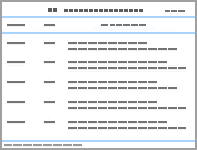
Table 1
Key comparison points between the 2026.V1 and 2025.V2 guidelines
| 对比维度 | 2025.V2 版指南(旧版) | 2026.V1版指南(新版) |
|---|---|---|
| 新增核心章节 | - | 新增“特殊人群治疗”章节; 新增“MM伴CNS病变”专项诊疗路 径; 新增“MIDD”管理章节 |
| 优化诊断检查 | 未强制要求NGS检测TP53突变;无明确肾活检指征; | 明确NGS检测TP53突变作为初始诊断必做项目;明确“白蛋白尿或肾功能异常时需行肾活检”; |
| 优化危险分层 | 未纳入IMS-IMWG分层体系;高危定义未明确多种因素组合要求; | 纳入IMS-IMWG风险分层标准,优化高危定义,需≥2个传统高危因素才界定为高危(原双打击MM) |
| 优化治疗方案 | 初诊患者以三药联合为主;复发患者免疫治疗推荐靠后; | 初诊患者四药联合优先、复发患者免疫治疗前移 |
| 优化随访监测 | 孤立性浆细胞瘤随访无明确影像评估频次;未明确PET/CT应用节点 | 软组织/头颈部病变初始3个月后可按需降低频次; 明确自体造血干细胞移植后100 d推荐行全身PET/CT; |
| 聚焦支持治疗 | 感染防控无CAR-T/BsAb专项推荐; 肾功能保护无明确骨改良药物剂量调整 | 明确CAR-T/BsAb治疗相关感染防控细节; 明确硼替佐米/达雷 妥尤单抗为肾功能不全患者首选,明确唑来膦酸肾损伤患者 剂量 |
| 重视亚型管理 | 对孤立性浆细胞瘤、冒烟型骨髓瘤无细化分层管理 | 孤立性浆细胞瘤细分“伴微小骨髓受累”亚型;冒烟型骨髓瘤按“低危/高危”分层管理,高危人群强化监测与早期干预 |
Table 2
IMS-IMWG definition of high-risk myeloma
| 风险分层 | 核心定义 |
|---|---|
| 标准风险 | 未满足高危分层标准的所有患者 |
| 高危 | 满足以下任一条件。 1. del (17p)(浆细胞中占比>20%)和(或)TP53基因突变; 2. t(4;14)、t(14;16)、t(14;20)易位之一合并1q+和 (或)del(1p32); 3. 单等位基因del(1p32)合并1q+,或双等位基因del(1p32); 4. 高血β2微球蛋白(>5.5 mg/dL)且血肌酐正常 (<1.2 mg/dL)(1 L=10 dL) |
| [1] | DOU X, DUAN G, ZHONG Y, et al. The burden of multiple myeloma in China: Trends from 1990 to 2021 and forecasts for 2050[J]. Cancer Lett, 2025,611:217440. |
| [2] | HOU Q, LI X, MA H, et al. A systematic epidemiological trends analysis study in global burden of multiple myeloma and 29 years forecast[J]. Sci Rep, 2025,15:2204. |
| [3] |
PALUMBO A, BRINGHEN S, MATEOS M V, et al. Geriatric assessment predicts survival and toxicities in elderly myeloma patients: an International Myeloma Working Group report[J]. Blood, 2015; 125(13):2068-2074.
doi: 10.1182/blood-2014-12-615187 pmid: 25628469 |
| [4] |
ENGELHARDT M, DOLD S M, IHORST G, et al. Geriatric assessment in multiple myeloma patients: Validation of the International Myeloma Working Group (IMWG) score and comparison with other common comorbidity scores[J]. Haematologica, 2016, 101(9):1110-1119.
doi: 10.3324/haematol.2016.148189 URL |
| [5] |
ZHANG Y, LIANG X, XU W, et al. Individualized dynamic frailty-tailored therapy (DynaFiT) in elderly patients with newly diagnosed multiple myeloma: A prospective study[J]. J Hematol Oncol, 2024, 17(1):48.
doi: 10.1186/s13045-024-01569-y |
| [6] |
PERES L C, OSWALD L B, DILLARD C M, et al. Racial and ethnic differences in clinical outcomes among patients with multiple myeloma treated with CAR T-cell therapy[J]. Blood Adv, 2024, 8(1):251-259.
doi: 10.1182/bloodadvances.2023010894 URL |
| [7] | ELHAMMALI A, AMINI B, LUDMIR E B, et al. New paradigm for radiation in multiple myeloma: Lower yet effective dose to avoid radiation toxicity[J]. Haematologica, 2020, 105(7):e355-e357. |
| [8] |
KATODRITOU E, TERPOS E. Central nervous system myeloma: Pathogenesis, diagnostic challenges, and practical management strategies[J]. HemaSphere, 2025, 9(10):e70213.
doi: 10.1002/hem3.v9.10 URL |
| [9] |
LI X M, RUI H C, LIANG D D, et al. Clinicopathological characteristics and outcomes of light chain deposition di-sease: an analysis of 48 patients in a single Chinese center[J]. Ann Hematol, 2016, 95(6):901-909.
doi: 10.1007/s00277-016-2659-1 URL |
| [10] |
SCHAVGOULIDZE A, PERROT A, LELEU X, et al. High-risk genomic consensus validation for patients with newly diagnosed multiple myeloma using next-generation sequencing[J]. Blood, 2026, 147(3):266-275.
doi: 10.1182/blood.2025029999 URL |
| [11] | DIMOPOULOS M A, MERLINI G, BRIDOUX F, et al. Management of multiple myeloma-related renal impairment: Recommendations from the International Myeloma Working Group[J]. Lancet Oncol, 2023, 24(7):e293-e311. |
| [12] |
AVET-LOISEAU H, DAVIES F E, SAMUR M K, et al. International myeloma society/international myeloma working group consensus recommendations on the definition of high-risk multiple myeloma[J]. J Clin Oncol, 2025, 43(24):2739-2751.
doi: 10.1200/JCO-24-01893 URL |
| [13] |
TAO Y, JIN S, YANG D, et al. Real-world advantage and challenge of post-autologous stem cell transplantation MRD negativity in high-risk patients with double-hit multiple myeloma[J]. BMC Cancer, 2024, 24(1):406.
doi: 10.1186/s12885-024-12077-0 pmid: 38565996 |
| [14] |
TAO Y, JIN S W, WANG Z, et al. Exploring secondary extramedullary myeloma disease: A five-predictor scoring system with spotlight on double-hit cytogenetics[J]. BMC Med, 2025, 23(1):257.
doi: 10.1186/s12916-025-04086-y pmid: 40316968 |
| [15] |
MAI E K, BERTSCH U, POZEK E, et al. Isatuximab, Lenalidomide, bortezomib, and dexamethasone induction therapy for transplant-eligible newly diagnosed multiple myeloma: Final part 1 analysis of the GMMG-HD7 trial[J]. J Clin Oncol, 2025, 43(11):1279-1288.
doi: 10.1200/JCO-24-02266 URL |
| [16] |
BADROS A, FOSTER L, ANDERSON L D JR, et al. Daratumumab with lenalidomide as maintenance after transplant in newly diagnosed multiple myeloma: The AURIGA study[J]. Blood, 2025, 145(3):300-310.
doi: 10.1182/blood.2024025746 URL |
| [17] |
LESOKHIN A M, TOMASSON M H, ARNULF B, et al. Elranatamab in relapsed or refractory multiple myeloma: Phase 2 MagnetisMM-3 trial results[J]. Nat Med, 2023, 29(9):2259-2267.
doi: 10.1038/s41591-023-02528-9 pmid: 37582952 |
| [18] |
CHARI A, MINNEMA M C, BERDEJA J G, et al. Talque-tamab, a T-cell-redirecting GPRC5D bispecific antibody for multiple myeloma[J]. N Engl J Med, 2022, 387(24):2232-2244.
doi: 10.1056/NEJMoa2204591 URL |
| [19] |
BERDEJA J G, MADDURI D, USMANI S Z, et al. Cilta-cabtagene autoleucel, a B-cell maturation antigen-directed chimeric antigen receptor T-cell therapy in patients with relapsed or refractory multiple myeloma (CARTITUDE-1): A phase 1b/2 open-label study[J]. Lancet, 2021, 398(10297):314-324.
doi: 10.1016/S0140-6736(21)00933-8 URL |
| [20] |
LEE A. Linvoseltamab: First approval[J]. Drugs, 2025, 85(10):1329-1333.
doi: 10.1007/s40265-025-02207-8 |
| [21] |
HUNGRIA V, ROBAK P, HUS M, et al. Belantamab mafodotin plus bortezomib and dexamethasone in patients with relapsed or refractory multiple myeloma (DREAMM-7): Updated overall survival analysis from a global, randomised, open-label, phase 3 trial[J]. Lancet Oncol, 2025, 26(8):1067-1080.
doi: 10.1016/S1470-2045(25)00330-4 pmid: 40680754 |
| [22] | 陶怡, 金诗炜, 王焰, 等. 髓外病变对初诊多发性骨髓瘤患者预后的影响[J]. 中华血液学杂志, 2023, 44(1):48-54. |
| TAO Y, JIN S W, WANG Y, et al. Effects of extramedullary disease on patients with newly diagnosed multiple myeloma[J]. Chin J Hematol, 2023, 44(1):48-54. | |
| [23] |
MOHAN M, NAGAVALLY S, DHAKAL B, et al. Risk of infections with B-cell maturation antigen-directed immunotherapy in multiple myeloma[J]. Blood Adv, 2022, 6(8):2466-2470.
doi: 10.1182/bloodadvances.2021006178 URL |
| [24] |
KIM E B, MALESPINI J E, LEI M, et al. Early daratumumab therapy improves renal outcomes in newly diagnosed patients with myeloma admitted with kidney injury[J]. Blood Adv, 2025, 9(13):3129-3135.
doi: 10.1182/bloodadvances.2025015901 pmid: 40085948 |
| [25] |
WALKER R, BARLOGIE B, HAESSLER J, et al. Magnetic resonance imaging in multiple myeloma: Diagnostic and clinical implications[J]. J Clin Oncol, 2007, 25(9):1121-1128.
pmid: 17296972 |
| [26] |
LAKSHMAN A, RAJKUMAR S V, BUADI F K, et al. Risk stratification of smoldering multiple myeloma incorporating revised IMWG diagnostic criteria[J]. Blood Cancer J, 2018, 8(6):59.
doi: 10.1038/s41408-018-0077-4 pmid: 29895887 |
| [27] |
MATEOS M V, KUMAR S, DIMOPOULOS M A, et al. International Myeloma Working Group risk stratification model for smoldering multiple myeloma (SMM)[J]. Blood Cancer J, 2020, 10(10):102.
doi: 10.1038/s41408-020-00366-3 |
| [1] | SONG Rui, WU Tao, ZHANG Qian, SHI Yajun, XUE Feng, ZHANG Junling, ZHANG Haiying. Incomplete intestinal obstruction caused by intestinal tuberculosis after immunotherapy for multiple myeloma: a case report [J]. Journal of Diagnostics Concepts & Practice, 2026, 25(01): 85-89. |
| [2] | CAI Jiaodi, CHEN Guoqun, ZHANG Wenqin. Interpretation of the 2025 NCCN clinical practice guidelines for non-small cell lung cancer (V1-V3) [J]. Journal of Diagnostics Concepts & Practice, 2026, 25(01): 37-43. |
| [3] | ZHOU Yan, ZHANG Min. Interpretation of Chinese Guidelines for the Prevention and Management of Bronchial Asthma (2024 Edition) [J]. Journal of Diagnostics Concepts & Practice, 2025, 24(04): 415-422. |
| [4] | BAI Yaya, ZHOU Chunhua, ZOU Duowu. Interpretation of 2025 American Society for Gastrointestinal Endoscopy guideline on the role of endoscopy in the management of chronic pancreatitis: methodology and review of evidence [J]. Journal of Diagnostics Concepts & Practice, 2025, 24(04): 407-414. |
| [5] | DU Yajie, WANG Mingfei, LIN Maosong. KIAA1429 inhibits colorectal cancer tumor immunity by regulating PD-L1 and CD8+ T cell [J]. Journal of Diagnostics Concepts & Practice, 2025, 24(03): 301-311. |
| [6] | AN Huihui, WU Tao, LIU Wenhui, TIAN Sirui. A Mendelian randomized study on the correlation between 91 inflammatory protein levels and the risk of acute myeloid leukemia [J]. Journal of Diagnostics Concepts & Practice, 2024, 23(05): 509-516. |
| [7] | TAO Yi, MI Jianqing. Interpretation of Multiple Myeloma Guidelines update (version 2, 2023) of National Comprehensive Cancer Network (NCCN) [J]. Journal of Diagnostics Concepts & Practice, 2023, 22(02): 121-126. |
| [8] | PENG Zhenping, XIANG Xixi, ZHANG Sujiang, LI Jiaming. Chronic neutrophilic leukemia with leukemia-like reaction as the first-onset manifestation: a report of 2 cases and literature review [J]. Journal of Diagnostics Concepts & Practice, 2020, 19(02): 122-128. |
| [9] | LU Hongyu, CAO Yafeng, GU Jun, WANG Jing, CHEN Mei, SONG Luxi. Diagnostic value of nerve electrophysiological studies for Bortezomib-induced peripheral neuropathy in multiple myeloma patients [J]. Journal of Diagnostics Concepts & Practice, 2019, 18(06): 640-644. |
| [10] | CAO Yafeng, WANG Jing, GU Jun, LU Hongyu, XUN Jie, LIU Yuanfang, WANG Yan, WANG Jin, CHEN Yu, CHEN Yubao, LI Jiaming, HAO Jie, MI Jianqing, CHEN Mei. Analysis of peripheral neuropathy following treatment with bortezomib in 114 newly-diagnosed multiple myeloma patients [J]. Journal of Diagnostics Concepts & Practice, 2017, 16(05): 492-497. |
| [11] | . [J]. Journal of Diagnostics Concepts & Practice, 2016, 15(03): 287-290. |
| [12] | . [J]. Journal of Diagnostics Concepts & Practice, 2012, 11(06): 620-623. |
| [13] | . [J]. Journal of Diagnostics Concepts & Practice, 2010, 9(03): 233-235. |
| [14] | . [J]. Journal of Diagnostics Concepts & Practice, 2010, 9(01): 63-65. |
| Viewed | ||||||
|
Full text |
|
|||||
|
Abstract |
|
|||||
