

内科理论与实践 ›› 2025, Vol. 20 ›› Issue (05): 365-370.doi: 10.16138/j.1673-6087.2025.05.03
万文斌, 谢冲, 姚小英, 张瑛, 王刚( )
)
收稿日期:2025-08-28
接受日期:2025-09-24
出版日期:2025-12-10
发布日期:2025-12-26
通讯作者:
王刚
E-mail:wanggang@renji.com
WAN Wenbin, XIE Chong, YAO Xiaoying, ZHANG Ying, WANG Gang()
Received:2025-08-28
Accepted:2025-09-24
Online:2025-12-10
Published:2025-12-26
Contact:
WANG Gang
E-mail:wanggang@renji.com
摘要:
目的:探讨自身免疫性脑炎(autoimmune encephalitis,AE)患者的临床特征、抗体类型、治疗时机及肿瘤合并情况对疗效与预后的影响,为临床管理提供参考。方法:回顾性分析2020年1月至2025年6月在上海交通大学医学院附属仁济医院神经内科收治的203例AE患者的临床资料,收集其性别、年龄、病程、抗体类型及肿瘤筛查情况进行统计分析,评估上述因素对治疗效果的影响。同时,采用AE临床评估量表(clinical assessment scale for autoimmune encephalitis,CASE)评分系统对患者疗效进行评估。结果:共纳入203例AE患者,男性占56.2%,中位年龄50岁,亚急性病程为主(64.0%)。抗体谱呈现高度异质性,以抗N-甲基-D-天冬氨酸受体(N-methyl-D-aspartate receptor,NMDAR)抗体最常见(24.1%)。急性期治疗后总体改善率为79.8%,而显著改善率仅为11.3%。肿瘤合并率为15.3%,合并肿瘤的患者疗效略低于非肿瘤组。结论:AE的疗效受抗体特性、治疗时机、疾病严重程度及是否合并肿瘤等多种因素影响,及时免疫治疗对预后具有显著影响,早诊断、早治疗有助于改善预后。精准的抗体检测和系统的肿瘤筛查是改善AE患者预后的重要策略,未来临床管理应加强对上述因素的综合评估,以实现最佳治疗效果和改善患者长期预后。
中图分类号:
万文斌, 谢冲, 姚小英, 张瑛, 王刚. 自身免疫性脑炎抗体谱系特征与合并肿瘤对预后的影响[J]. 内科理论与实践, 2025, 20(05): 365-370.
WAN Wenbin, XIE Chong, YAO Xiaoying, ZHANG Ying, WANG Gang. Characteristics of autoimmune encephalitis antibody profiles and the impact of coexisting tumors on prognosis[J]. Journal of Internal Medicine Concepts & Practice, 2025, 20(05): 365-370.
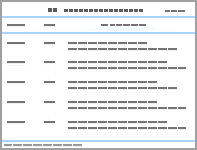
表1
抗体类型及分布[n(%)]
| 项目 | 例数(百分比)[n(%)] |
| 抗体类型 | |
| NMDAR | 49(24.1) |
| CASPR2 | 16(7.9) |
| DPPX | 14(6.9) |
| MOG | 12(5.9) |
| GFAP | 11(5.4) |
| GAD65 | 11(5.4) |
| SOX1 | 9(4.4) |
| GABABR | 8(3.9) |
| LGI1 | 8(3.9) |
| Titin | 6(3.0) |
| IgLON5 | 6(3.0) |
| Amphiphysin | 5(2.5) |
| Neurexin-3a | 5(2.5) |
| KLHL11 | 4(2.0) |
| Ri | 4(2.0) |
| GQ1b | 4(2.0) |
| mGluR5 | 4(2.0) |
| Tr(DNER) | 3(1.5) |
| Recoverin | 3(1.5) |
| AMPAR | 2(1.0) |
| GT1a | 2(1.0) |
| Ma2 | 2(1.0) |
| AK5 | 1(0.5) |
| D2R | 1(0.5) |
| CV2 | 1(0.5) |
| GD1b | 1(0.5) |
| GABAAR | 1(0.5) |
| GluK2 | 1(0.5) |
| Sulfatides | 1(0.5) |
| Hu | 1(0.5) |
| NF186 | 1(0.5) |
| GlyR1 | 1(0.5) |
| Yo | 1(0.5) |
| 抗体阴性 | 31(15.3) |
| 叠加抗体阳性 | 28(13.8) |
| MOG:髓鞘少突胶质细胞糖蛋白(myelin oligodendrocyte glycoprotein);GFAP:神经胶质细胞原纤维酸性蛋白(glial fibrillary acidic protein);KLHL11:Kelch样蛋白11(Kelch-like protein 11);GQ1b:神经节苷脂Q1b(ganglioside Q1b);GT1a:神经节苷脂T1a(ganglioside T1a); AK5:腺苷酸激酶5(adenylate kinase 5);CV2: 胶原反应介导蛋白5(collapsin response mediator protein 5);GD1b:神经节苷脂D1b(ganglioside D1b);GluK2:谷氨酸海藻酸受体2(glutamate kainate receptor subunit 2);NF186:神经束蛋白186(neurofascin-186) | |
| 抗体分布 | |
| 抗细胞表面抗原抗体 | 136(67.0) |
| 抗细胞内抗原抗体 | 63(31.0) |
表2
治疗启动时间及治疗效果[n(%)]
| 项目 | 例数(百分比)[n(%)] |
| 发病至启动治疗时间(d) | |
| ≤7 | 41(20.2) |
| >7~30 | 68(33.5) |
| >30~180 | 36(17.7) |
| >180 | 58(28.6) |
| 治疗效果(ΔCASE) | |
| 明显好转 | 23(11.3) |
| 部分好转 | 137(67.5) |
| 未好转 | 41(20.2) |
| 死亡 | 2(1.0) |
| [1] | Irani SR. Autoimmune encephalitis[J]. Continuum (Minneap Minn), 2024, 30(4): 995-1020. |
| [2] |
Dalmau J, Graus F. Diagnostic criteria for autoimmune encephalitis: utility and pitfalls for antibody-negative disease[J]. Lancet Neurol, 2023, 22(6): 529-540.
doi: 10.1016/S1474-4422(23)00083-2 |
| [3] |
Graus F, Titulaer MJ, Balu R, et al. A clinical approach to diagnosis of autoimmune encephalitis[J]. Lancet Neurol, 2016, 15(4): 391-404.
doi: 10.1016/S1474-4422(15)00401-9 |
| [4] |
Rosenfeld MR, Titulaer MJ, Dalmau J. Paraneoplastic syndromes and autoimmune encephalitis: five new things[J]. Neurol Clin Pract, 2012, 2(3): 215-223.
doi: 10.1212/CPJ.0b013e31826af23e |
| [5] |
Bost C, Chanson E, Picard G, et al. Malignant tumors in autoimmune encephalitis with anti-NMDA receptor antibodies[J]. J Neurol, 2018, 265(10): 2190-2200.
doi: 10.1007/s00415-018-8970-0 |
| [6] |
Nguyen L, Wang C. Anti-NMDA receptor autoimmune encephalitis: diagnosis and management strategies[J]. Int J Gen Med, 2023, 16: 7-21.
doi: 10.2147/IJGM.S397429 |
| [7] |
Gong S, Han Y, He E, et al. Coexistence of anti-SOX1 and anti-GABAB receptor antibodies with paraneoplastic limbic encephalitis presenting with seizures and memory impairment in small cell lung cancer: a case report[J]. Front Immunol, 2022, 13: 955170.
doi: 10.3389/fimmu.2022.955170 |
| [8] | 中华医学会神经病学分会神经感染性疾病与脑脊液细胞学学组. 中国自身免疫性脑炎诊治专家共识(2022年版)[J]. 中华神经科杂志, 2022, 55(9): 931-949. |
| Chinese Society of Neuroinfectious Diseases and Cerebrospinal Fluid Cytology. Chinese expert consensus on the diagnosis and management of autoimmune encephalitis (2022 edition)[J]. Chin J Neurol, 2022, 55(9): 931-949. | |
| [9] |
Kerstens J, Schreurs MWJ, de Vries JM, et al. Autoimmune encephalitis and paraneoplastic neurologic syndromes: a nationwide study on epidemiology and antibody testing performance[J]. Neurol Neuroimmunol Neuroinflamm, 2024, 11(6): e200318.
doi: 10.1212/NXI.0000000000200318 |
| [10] |
Nissen MS, Ryding M, Meyer M, et al. Autoimmune encephalitis: current knowledge on subtypes, disease mechanisms and treatment[J]. CNS Neurol Disord Drug Targets, 2020, 19(8): 584-598.
doi: 10.2174/1871527319666200708133103 |
| [11] | Dalmau J, Armangué T, Planagumà J, et al. An update on anti-NMDA receptor encephalitis for neurologists and psychiatrists: mechanisms and models[J]. Lancet Neurol, 2019, 18(11): 1045-1057. |
| [12] |
Rodriguez A, Klein CJ, Sechi E, et al. LGI1 antibody encephalitis: acute treatment comparisons and outcome[J]. J Neurol Neurosurg Psychiatry, 2022, 93(3): 309-315.
doi: 10.1136/jnnp-2021-327302 |
| [13] |
Dutra LA, Abrantes F, Toso FF, et al. Autoimmune encephalitis: a review of diagnosis and treatment[J]. Arq Neuropsiquiatr, 2018, 76(1): 41-49.
doi: 10.1590/0004-282x20170176 |
| [14] |
Platt MP, Agalliu D, Cutforth T. Hello from the other side: how autoantibodies circumvent the blood-brain barrier in autoimmune encephalitis[J]. Front Immunol, 2017, 8: 442.
doi: 10.3389/fimmu.2017.00442 |
| [15] |
Konopka A, Jaz K, Kapłon K, et al. Autoimmune encephalitis as a possible reason for psychiatric hospitalisation in the teenage population[J]. Psychiatr Pol, 2023, 57(4): 843-852.
doi: 10.12740/PP/151125 |
| [16] |
Hermetter C, Fazekas F, Hochmeister S. Systematic review: syndromes, early diagnosis, and treatment in autoimmune encephalitis[J]. Front Neurol, 2018, 9: 706.
doi: 10.3389/fneur.2018.00706 |
| [17] |
Lancaster E. The diagnosis and treatment of autoimmune encephalitis[J]. J Clin Neurol, 2016, 12(1): 1-13.
doi: 10.3988/jcn.2016.12.1.1 |
| [18] |
Wesselingh R, Broadley J, Buzzard K, et al. Prevalence, risk factors, and prognosis of drug-resistant epilepsy in autoimmune encephalitis[J]. Epilepsy Behav, 2022, 132: 108729.
doi: 10.1016/j.yebeh.2022.108729 |
| [19] |
Lee WJ, Lee HS, Kim DY, et al. Seronegative autoimmune encephalitis: clinical characteristics and factors associated with outcomes[J]. Brain, 2022, 145(10): 3509-3521.
doi: 10.1093/brain/awac166 |
| [20] |
Huang T, Liu F, Wang B, et al. Clinical characteristics and prognosis in patients with neuronal surface antibody-mediated autoimmune encephalitis: a single-center cohort study in China[J]. Front Immunol, 2023, 14: 1213532.
doi: 10.3389/fimmu.2023.1213532 |
| [21] |
Ghimire P, Khanal UP, Gajurel BP, et al. Anti-LGI1, anti-GABABR, and anti-CASPR2 encephalitides in Asia: a systematic review[J]. Brain Behav, 2020, 10(10): e01793.
doi: 10.1002/brb3.1793 |
| [22] |
Binks S, Uy C, Honnorat, et al. Paraneoplastic neurological syndromes: a practical approach to diagnosis and management[J]. Pract Neurol, 2022, 22(1): 19-31.
doi: 10.1136/practneurol-2021-003073 |
| [23] |
Macher S, Zimprich F, De Simoni D, et al. Management of autoimmune encephalitis: an observational monocentric study of 38 patients[J]. Front Immunol, 2018, 9: 2708.
doi: 10.3389/fimmu.2018.02708 |
| [1] | . 脑肿瘤切除术中的肿瘤移位预测和增强现实可视化[J]. J Shanghai Jiaotong Univ Sci, 2025, 30(4): 733-743. |
| [2] | 曹卫刚, 杨振林. 自体皮瓣重建乳腺癌术后胸壁缺损的临床经验[J]. 组织工程与重建外科杂志, 2025, 21(3): 225-. |
| [3] | 金佳敏, 赖柏翰, 顾婕妤, 等. 先天性巨痣自发消退患者的单细胞测序分析[J]. 组织工程与重建外科杂志, 2025, 21(2): 162-. |
| [4] | Sahaya Anselin Nisha1, NARMADHA R.1, AMIRTHALAKSHMI T. M.2, BALAMURUGAN V.1, VEDANARAYANAN V.1. LOBO优化的深度卷积神经网络用于脑肿瘤分类[J]. J Shanghai Jiaotong Univ Sci, 2025, 30(1): 107-114. |
| [5] | 张姚, 韩婷, 王宇, 王春艳, 肖秀英. 肿瘤免疫治疗相关外周神经病变的研究进展[J]. 内科理论与实践, 2025, 20(05): 388-392. |
| [6] | 徐琬倩, 周春华, 邹多武. 消化内镜在胰腺导管内乳头状黏液性肿瘤诊疗中的应用及进展[J]. 外科理论与实践, 2025, 30(05): 369-377. |
| [7] | 计蓓, 商正晔, 庹必光, 刘雪梅. 功能性胰腺神经内分泌肿瘤综合诊治策略(附3例报告)[J]. 外科理论与实践, 2025, 30(05): 438-443. |
| [8] | 陈嘉倩, 刘红枝, 孟令甜, 周伟平, 程张军, 楼健颖, 郑树国, 毕新宇, 王剑明, 郭伟, 李富宇, 王坚, 郑亚民, 李敬东, 程石, 黄尧, 曾永毅. 基于预后分析的肝内胆管癌肿瘤大小分型:一项回顾性多中心研究[J]. 外科理论与实践, 2025, 30(04): 332-338. |
| [9] | 李雅琪, 莫少波, 彭俊杰. 循环肿瘤DNA检测微小残留病灶在结肠直肠癌肝转移中的应用进展[J]. 外科理论与实践, 2025, 30(04): 351-357. |
| [10] | 杨越, 赵磊. 慢性肝病对结肠直肠癌肝转移的影响与研究进展[J]. 外科理论与实践, 2025, 30(04): 364-368. |
| [11] | 王祎宁, 陈楠楠, 程琳, 刘振华, 郑晓燕, 徐静, 潘晓霞, 陈永熙, 陈晓农. 抗肿瘤药物所致血栓性微血管病样肾损伤2例[J]. 内科理论与实践, 2025, 20(04): 322-327. |
| [12] | 计蓓, 苏薇, 庹必光, 刘雪梅. 《中国抗癌协会神经内分泌肿瘤诊治指南(2025年版)》更新精要:消化内镜诊疗解析[J]. 诊断学理论与实践, 2025, 24(04): 401-406. |
| [13] | 江南, 许亚聪, 刘佳瑶, 孙荣, 郑高歌, 徐菱遥, 闫春晓. 血清Hsp90α、eotaxin-2、TRAF6联合检测对早期结肠直肠癌的诊断及预测预后价值[J]. 诊断学理论与实践, 2025, 24(04): 423-430. |
| [14] | 于强, 杨玉龙. 环状胰腺合并十二指肠球部狭窄致上消化道梗阻(附1例报告)[J]. 外科理论与实践, 2025, 30(03): 264-267. |
| [15] | 覃雨, 李程, 华晴, 张慧婷, 贾宛儒, 董屹婕, 周建桥, 夏蜀珺. 超声黏弹性成像在乳腺肿瘤良恶性鉴别中的研究[J]. 诊断学理论与实践, 2025, 24(02): 194-203. |
| 阅读次数 | ||||||
|
全文 |
|
|||||
|
摘要 |
|
|||||
