

内科理论与实践 ›› 2025, Vol. 20 ›› Issue (05): 371-375.doi: 10.16138/j.1673-6087.2025.05.04
吴茜茜, 郭洁, 王依凡, 刘丽, 王锋( )
)
收稿日期:2024-11-06
出版日期:2025-12-10
发布日期:2025-12-26
通讯作者:
王锋
E-mail:zyzwq1030@163.com
基金资助:
WU Qianqian, GUO Jie, WANG Yifan, LIU Li, WANG Feng()
Received:2024-11-06
Online:2025-12-10
Published:2025-12-26
Contact:
WANG Feng
E-mail:zyzwq1030@163.com
摘要:
目的:观察钠-葡萄糖耦联转运体2(sodium-glucose linked transporter 2, SGLT-2)抑制剂达格列净对2型糖尿病(type 2 diabetes mellitus, T2DM)早期肾病伴高尿酸血症患者血尿酸(serum uric acid,SUA)水平的影响,探讨SGLT-2抑制剂对于高尿酸血症的治疗价值。方法:选取2020年6月至2023年6月于我院就诊的T2DM早期肾病伴高尿酸血症患者65例,在原降糖方案基础上加用达格列净。治疗4周后,采用配对样本t检验比较治疗前后SUA、糖化血红蛋白(glycated hemoglobin, HbA1c)、空腹血糖(fasting plasma glucose, FPG)、血肌酐(serum creatinine, SCr)、总胆固醇(total cholesterol, TC)、甘油三酯(triglycerides,TG)、尿微量白蛋白/肌酐比值(urine albumin-to-creatinine ratio, UACR)及体重等指标变化。采用线性回归分析治疗后SUA的变化与基线SUA水平的关系。结果:65例患者经达格列净治疗4周后,SUA[(436.07±39.53) μmol/L 比(392.18±32.18) μmol/L,P<0.001]、FPG[(7.66±2.23) mmol/L比(6.40±1.06) mmol/L,P<0.001] 、UACR[(211.31±73.21) mg/g比(177.83±88.28) mg/g,P=0.005]、体重[(63.08±9.74) kg比(62.68±9.29) kg,P=0.038]较前明显下降,差异均具有统计学意义。收缩压、舒张压、HbA1c、TC、TG、SCr、估算肾小球滤过率(estimated glomerular filtration rate, eGFR)等水平较前差异无统计学意义(P>0.05)。线性回归分析显示,治疗后SUA下降幅度与基线SUA水平呈正相关(β=0.634,R2=0.401,P<0.001)。结论:SGLT-2抑制剂不仅能有效控制T2DM早期肾病患者血糖,还可显著降低患者SUA和尿微量白蛋白水平,提示其具有潜在的长期肾脏保护作用。
中图分类号:
吴茜茜, 郭洁, 王依凡, 刘丽, 王锋. 钠-葡萄糖耦联转运体2抑制剂降低早期糖尿病肾病患者的尿酸水平[J]. 内科理论与实践, 2025, 20(05): 371-375.
WU Qianqian, GUO Jie, WANG Yifan, LIU Li, WANG Feng. Sodium-glucose linked transporter 2 inhibitors reduce serum uric acid in type 2 diabetic mellitus patients with early nephropathy[J]. Journal of Internal Medicine Concepts & Practice, 2025, 20(05): 371-375.
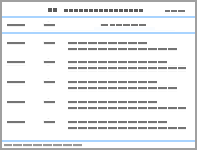
表1
达格列净治疗前后临床指标比较(n=65,$\bar x $±s)
| 项目 | 治疗前 | 治疗后 | ∆m | t/Z | P |
| ∆m=治疗后−治疗前均数; 1 mmHg=0.133 kPa。 | |||||
| 收缩压(mmHg) | 126.45±31.91 | 125.60±22.38 | −0.85±37.05 | 0.18 | 0.854 |
| 舒张压(mmHg) | 82.23±13.93 | 81.86±12.53 | −3.69±17.21 | 0.17 | 0.863 |
| 体重(kg) | 63.08±9.74 | 62.68±9.29 | −0.40±1.50 | 2.12 | 0.038 |
| SCr(μmol/L) | 80.97±13.97 | 79.06±14.54 | −1.91±17.13 | 0.90 | 0.373 |
| eGFR[mL/(min·1.73m2)] | 86.48±20.51 | 90.16±24.92 | 3.68±22.17 | −1.34 | 0.185 |
| 尿素氮(mmol/L) | 9.14±2.66 | 8.69±2.45 | −0.45±2.88 | 1.27 | 0.209 |
| SUA(μmol/L) | 436.07±39.53 | 392.18±32.18 | −43.89±15.04 | 23.53 | <0.001 |
| FBG(mmol/L) | 7.66±2.23 | 6.40±1.06 | −1.27±1.46 | 6.99 | <0.001 |
| HbA1c(%) | 7.51±1.22 | 7.34±0.91 | −0.17±0.97 | 1.39 | 0.170 |
| TC(mmol/L) | 4.61±1.32 | 4.43±1.21 | −0.19±1.91 | 0.79 | 0.433 |
| TG(mmol/L) | 1.68±1.01 | 1.81±1.10 | 0.13±1.54 | 0.68 | 0.491 |
| UACR(mg/g) | 211.31±73.21 | 177.83±88.28 | −33.48±92.33 | 2.92 | 0.005 |

图1
治疗前后SUA下降幅度与基线SUA水平的关系

| [1] | Concepción M, Quiroz J, Suarez J, et al. Novel biomarkers for the diagnosis of diabetic nephropathy[J]. Caspian J Intern Med, 2024, 15(3): 382-391. |
| [2] |
Sridhar VS, Cosentino F, Dagogo-Jack S, et al. Effects of ertugliflozin on uric acid and gout-related outcomes in persons with type 2 diabetes and cardiovascular disease: post hoc analyses from VERTIS CV[J]. Diabetes Obes Metab, 2024, 26(11): 5336-5346.
doi: 10.1111/dom.15895 |
| [3] |
Shaffner J, Chen B, Malhotra DK, et al. Therapeutic targeting of SGLT2: a new era in the treatment of diabetes and diabetic kidney disease[J]. Front Endocrinol (Lausanne), 2021, 12: 749010.
doi: 10.3389/fendo.2021.749010 |
| [4] |
Liu B, Wang Y, Zhang Y, et al. Mechanisms of protective effects of SGLT2 inhibitors in cardiovascular disease and renal dysfunction[J]. Curr Top Med Chem, 2019, 19(20): 1818-1849.
doi: 10.2174/1568026619666190828161409 |
| [5] |
O'Hara DV, Lam CSP, McMurray JJV, et al. Applications of SGLT2 inhibitors beyond glycaemic control[J]. Nat Rev Nephrol, 2024, 20(8): 513-529.
doi: 10.1038/s41581-024-00836-y |
| [6] | 中华医学会糖尿病学分会微血管并发症学组. 糖尿病肾病防治专家共识(2014年版)[J]. 中华糖尿病杂志, 2014, 6(11): 792-801. |
| Chinese Diabetes Society Microvascular Complications Group. Expert consensus on prevention and treatment of diabetic kidney disease (2014 edition)[J]. Chin J Diabetes, 2014, 6(11): 792-801. | |
| [7] | 中国医师协会肾脏内科医师分会. 中国肾脏疾病高尿酸血症诊治的实践指南(2017版)[J]. 中华医学杂志, 2017, 97(25): 1927-1936. |
| Chinese Nephrologist Association. Practice guideline for the diagnosis and treatment of hyperuricemia in kidney disease in China (2017 edition)[J]. Natl Med J China, 2017, 97(25): 1927-1936. | |
| [8] |
Doehner W, Anker SD, Butler J, et al. Uric acid and SGLT2 inhibition with empagliflozin in heart failure with preserved ejection fraction: the EMPEROR-preserved trial[J]. JACC Heart Fail, 2024, 12(12): 2057-2070.
doi: 10.1016/j.jchf.2024.08.020 |
| [9] |
McMurray JJV, Solomon SD, Inzucchi SE, et al. Dapagliflozin in patients with heart failure and reduced ejection fraction[J]. N Engl J Med, 2019, 381(21): 1995-2008.
doi: 10.1056/NEJMoa1911303 |
| [10] |
Suijk DLS, van Baar MJB, van Bommel EJM, et al. SGLT2 inhibition and uric acid excretion in patients with type 2 diabetes and normal kidney function[J]. Clin J Am Soc Nephrol, 2022, 17(5): 663-671.
doi: 10.2215/CJN.11480821 |
| [11] |
Vallon V, Verma S. Effects of SGLT2 inhibitors on kidney and cardiovascular function[J]. Annu Rev Physiol, 2021, 83: 503-528.
doi: 10.1146/annurev-physiol-031620-095920 |
| [12] |
Liu P, Chen Y, Wang B, et al. Allopurinol treatment improves renal function in patients with type 2 diabetes and asymptomatic hyperuricemia: 3-year randomized parallel-controlled study[J]. Clin Endocrinol (Oxf), 2015, 83(4): 475-482.
doi: 10.1111/cen.12673 |
| [13] |
Novikov A, Fu Y, Huang W, et al. SGLT2 inhibition and renal urate excretion: role of luminal glucose, GLUT9, and URAT1[J]. Am J Physiol Renal Physiol, 2019, 316(1): F173-F185.
doi: 10.1152/ajprenal.00462.2018 |
| [14] |
Toyama T, Neuen BL, Jun M, et al. Effect of SGLT2 inhibitors on cardiovascular, renal and safety outcomes in patients with type 2 diabetes mellitus and chronic kidney disease: a systematic review and meta-analysis[J]. Diabetes Obes Metab, 2019, 21(5): 1237-1250.
doi: 10.1111/dom.13648 |
| [15] |
Beal B, Schutte AE, Neuen BL. Blood pressure effects of SGLT2 inhibitors: mechanisms and clinical evidence in different populations[J]. Curr Hypertens Rep, 2023, 25(12): 429-435.
doi: 10.1007/s11906-023-01281-1 |
| [16] |
Kelly MS, Lewis J, Huntsberry AM, et al. Efficacy and renal outcomes of SGLT2 inhibitors in patients with type 2 diabetes and chronic kidney disease[J]. Postgrad Med, 2019, 131(1): 31-42.
doi: 10.1080/00325481.2019.1549459 |
| [17] |
Wiviott SD, Raz I, Bonaca MP, et al. Dapagliflozin and cardiovascular outcomes in type 2 diabetes[J]. N Engl J Med, 2019, 380(4): 347-357.
doi: 10.1056/NEJMoa1812389 |
| [18] |
Bailey CJ, Day C, Bellary S. Renal protection with SGLT2 inhibitors: effects in acute and chronic kidney disease[J]. Curr Diab Rep, 2022, 22(1): 39-52.
doi: 10.1007/s11892-021-01442-z |
| [19] |
Cheong AJY, Teo YN, Teo YH, et al. SGLT inhibitors on weight and body mass: a meta-analysis of 116 randomized-controlled trials[J]. Obesity (Silver Spring), 2022, 30(1): 117-128.
doi: 10.1002/oby.23331 |
| [20] |
Ravindran S, Munusamy S. Renoprotective mechanisms of sodium-glucose co-transporter 2 (SGLT2) inhibitors against the progression of diabetic kidney disease[J]. J Cell Physiol, 2022, 237(2): 1182-1205.
doi: 10.1002/jcp.30621 |
| [21] |
Lioudaki E, Joslin JR, Trachanatzi E, et al. The role of sodium-glucose co-transporter (SGLT)-2 inhibitors in heart failure management and implications for the kidneys[J]. Rev Cardiovasc Med, 2022, 23(3): 82.
doi: 10.31083/j.rcm2303082 |
| [1] | 郭娟, 杨志芳, 吉日. 超声在糖尿病肾病诊断中的应用进展[J]. 诊断学理论与实践, 2025, 24(03): 342-348. |
| [2] | 武梦梦, 杨福燕, 刘雨辰, 鲁旭柯, 高静歌, 叶紫灵. 维持性血液透析的2型糖尿病肾病患者并发肌少症的相关因素分析[J]. 内科理论与实践, 2024, 19(02): 102-106. |
| [3] | 张小月, 王伟铭. 盐皮质激素受体拮抗剂在糖尿病肾病治疗中的研究进展[J]. 内科理论与实践, 2023, 18(03): 206-210. |
| [4] | 毕礼明, 王朝晖. 糖尿病肾病发病机制研究进展[J]. 内科理论与实践, 2023, 18(03): 201-205. |
| [5] | 罗亚丹, 袁立英, 陆怡德, 王子秋, 王朝晖. 成人患者血尿酸水平调查及相关影响因素分析[J]. 内科理论与实践, 2023, 18(03): 141-145. |
| [6] | 缪雅, 杨玉琳, 朱怡洁, 盛长生, 田景琰. 糖化血红蛋白变异性与糖尿病微血管并发症关系的研究进展[J]. 内科理论与实践, 2021, 16(06): 427-430. |
| [7] | 孙艳, 代丹娇, 陈智伟, 张华清. 卡格列净对早期糖尿病肾病尿白蛋白/肌酐比值和尿足细胞相关蛋白裂隙素的影响[J]. 内科理论与实践, 2021, 16(06): 387-391. |
| [8] | 李淑雨, 沈琳辉,. 2型糖尿病患者参考范围甲状腺激素与糖尿病肾病的相关性分析[J]. 内科理论与实践, 2020, 15(01): 38-44. |
| [9] | 侯亚楠, 禤立平, 赵志云, 李勉, 陈宇红, 戴蒙, 徐敏, 毕宇芳, 王卫庆, 高金丽. 上海社区中老年人群血尿酸/肌酐比值与代谢综合征关联性的流行病学调查[J]. 诊断学理论与实践, 2019, 18(1): 44-50. |
| [10] | 邓琳, 丁怡, 汪萍, 卞炳贤, 沈立松. 尿中性粒细胞明胶酶相关脂质运载蛋白/肌酐比值在2型糖尿病肾损伤的早期诊断及病情评估中的临床应用[J]. 诊断学理论与实践, 2019, 18(1): 61-65. |
| [11] | 荣岚, 焦洁茹, 林青, 张永怡,. 胰岛素样生长因子1及半胱氨酸蛋白酶抑制剂C在老年2型糖尿病肾病患者中的变化[J]. 内科理论与实践, 2019, 14(02): 127-130. |
| [12] | 谭姣容, 田冬梅, 杨昕, 张立娟, 王芳, 苏玉霞. 维生素D缺乏与糖尿病患者糖尿病肾病发生率的关系研究:前瞻性3年随访研究[J]. 诊断学理论与实践, 2018, 17(02): 176-180. |
| [13] | 陈彦, 陈刚. 糖尿病肾病的诊断策略[J]. 诊断学理论与实践, 2018, 17(01): 11-18. |
| [14] | 徐丽梨, 王伟铭. 生活方式对糖尿病肾病发生发展的影响[J]. 诊断学理论与实践, 2017, 16(05): 553-556. |
| [15] | 李慧凛, 吴萍, 刘爽, 蒋更如. 可溶性Klotho蛋白抑制高糖诱导的STAT3磷酸化通路减轻肾纤维化[J]. 诊断学理论与实践, 2017, 16(04): 371-376. |
| 阅读次数 | ||||||
|
全文 |
|
|||||
|
摘要 |
|
|||||
