

内科理论与实践 ›› 2025, Vol. 20 ›› Issue (06): 435-439.doi: 10.16138/j.1673-6087.2025.06.02
陈梁国1( ), 邓可武1, 刘越2, 钟鹏3, 白英1,*()
收稿日期:2024-08-21
出版日期:2025-12-30
发布日期:2026-01-30
通讯作者:
白 英 E-mail:基金资助:
CHEN Liangguo1(), DENG Kewu1, LIU Yue2, ZHONG Peng3, BAI Ying1,*()
Received:2024-08-21
Online:2025-12-30
Published:2026-01-30
摘要:
目的:探索甘油三酯-葡萄糖(triglyceride-glucose, TyG)指数与心房颤动(atrial fibrillation, AF)患者发生急性心肌梗死(acute myocardial infarction, AMI)的关系。方法:纳入首都医科大学附属北京同仁医院和首都医科大学附属北京友谊医院4 277例住院的AF患者,根据是否因AMI入院分为未发生AMI组[AMI(−),3 725例]和发生AMI组[AMI(+), 552例]。采用Logistic回归评估TyG指数与AMI的关系,并根据基线是否存在糖尿病进行亚组分析。结果:在AF患者中,AMI(+)组的TyG指数显著高于AMI(−)组(8.83±0.73比8.56±0.66, P < 0.001),AMI(+)组患者年龄更大、合并症更多(均P < 0.05)。多因素Logistic回归结果显示,高TyG指数是AF患者发生AMI的独立危险因素[优势比(odds ratio, OR)=1.824, 95%CI 1.540~2.161, P < 0.001],TyG指数预测AMI的受试者操作特征(receiver operating characteristic, ROC)曲线下面积为0.614(95%CI 0.589~0.640, P < 0.001),截断值为8.79。在AF患者中,无论是否存在糖尿病,TyG指数均与AMI发生风险呈正相关。结论:TyG指数与AF患者发生AMI的风险呈正相关,且不受糖尿病状态的影响。
中图分类号:
陈梁国, 邓可武, 刘越, 钟鹏, 白英. 甘油三酯-葡萄糖指数与心房颤动患者发生急性心肌梗死风险的关系[J]. 内科理论与实践, 2025, 20(06): 435-439.
CHEN Liangguo, DENG Kewu, LIU Yue, ZHONG Peng, BAI Ying. Relationship between triglyceride-glucose index and risk of acute myocardial infarction in patients with atrial fibrillation[J]. Journal of Internal Medicine Concepts & Practice, 2025, 20(06): 435-439.
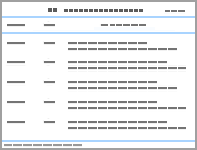
表1
合并AF患者中伴与不伴AMI者的基线特征比较[$\bar{x}±s$/n (%)]
| 项目 | AMI(−)组(n=3 725) | AMI(+)组(n=552) | t/χ2 | P |
| 年龄(岁) | 71.44±12.22 | 74.48±11.66 | −5.489 | < 0.001 |
| 男性[n (%)] | 2 054(55.1) | 344(62.3) | 10.056 | 0.002 |
| BMI(kg/m2) | 25.42±4.01 | 25.06±3.94 | 1.268 | 0.205 |
| 曾经或当前吸烟[n (%)] | 979(26.3) | 207(37.5) | 59.633 | < 0.001 |
| 合并症[n (%)] | ||||
| 高血压 | 2 486(66.7) | 415(75.2) | 15.704 | < 0.001 |
| 糖尿病 | 1 138(30.6) | 244(44.2) | 40.971 | < 0.001 |
| 心力衰竭 | 1 408(37.8) | 197(35.7) | 0.913 | 0.339 |
| 陈旧性心肌梗死 | 249(6.7) | 95(17.2) | 72.014 | < 0.001 |
| 既往PCI或CABG | 313(8.4) | 81(14.7) | 22.607 | < 0.001 |
| 外周血管疾病 | 205(5.5) | 57(10.3) | 19.445 | < 0.001 |
| TyG指数 | 8.56±0.66 | 8.83±0.73 | −8.444 | < 0.001 |
| 辅助检查 | ||||
| LVEF(%) | 61.33±10.37 | 53.86±12.69 | 11.144 | < 0.001 |
| TC(mmol/L) | 4.01±1.79 | 4.08±1.10 | −0.952 | 0.341 |
| LDL-C(mmol/L) | 2.42±0.87 | 2.42±0.90 | 0.047 | 0.963 |
| HDL-C(mmol/L) | 1.08±0.37 | 1.08±0.39 | −0.405 | 0.686 |
| TG(mmol/L) | 1.30±1.08 | 1.35±1.07 | −0.967 | 0.334 |
| 血糖(mmol/L) | 6.28±2.48 | 8.44±4.33 | −11.44 | < 0.001 |
表2
单因素Logistic回归分析
| 变量 | OR | 95%CI | P |
| TyG指数 | 1.795 | 1.578~2.042 | < 0.001 |
| 年龄 | 1.022 | 1.014~1.030 | < 0.001 |
| 性别(男性) | 0.743 | 0.618~0.893 | 0.002 |
| BMI | 0.977 | 0.944~1.012 | 0.205 |
| 曾经或当前吸烟 | 2.305 | 1.857~2.861 | < 0.001 |
| 高血压 | 1.510 | 1.230~1.853 | < 0.001 |
| 糖尿病 | 1.801 | 1.501~2.160 | < 0.001 |
| 心力衰竭 | 0.913 | 0.758~1.100 | 0.339 |
| 陈旧性心肌梗死 | 2.902 | 2.247~3.747 | < 0.001 |
| 既往PCI或CABG | 1.875 | 1.442~2.438 | < 0.001 |
| 外周血管疾病 | 1.977 | 1.453~2.691 | < 0.001 |
表3
多因素Logistic回归分析
| 变量 | OR | 95%CI | P |
| OR:优势比(odds ratio)。 | |||
| TyG指数 | 1.824 | 1.540~2.161 | < 0.001 |
| 年龄 | 1.028 | 1.017~1.039 | < 0.001 |
| 性别(男性) | 0.803 | 0.611~1.056 | 0.117 |
| 曾经或当前吸烟 | 2.226 | 1.716~2.886 | < 0.001 |
| 高血压 | 1.089 | 0.843~1.406 | 0.513 |
| 糖尿病 | 1.266 | 0.994~1.613 | 0.056 |
| 陈旧性心肌梗死 | 2.272 | 1.601~3.226 | < 0.001 |
| 既往PCI或CABG | 1.190 | 0.839~1.688 | 0.328 |
| 外周血管疾病 | 0.893 | 0.442~1.803 | 0.752 |

图1
ROC曲线

表4
AF糖尿病与非糖尿病的亚组分析
| 变量 | B | SE | Wald X2 | OR | 95%CI | P |
| 糖尿病 | ||||||
| TyG指数 | 0.540 | 0.189 | 8.128 | 1.716 | 1.184~2.488 | 0.004 |
| 曾经或当前吸烟 | 0.703 | 0.327 | 4.616 | 2.021 | 1.064~3.838 | 0.032 |
| 心力衰竭 | −0.784 | 0.314 | 6.225 | 0.457 | 0.247~0.845 | 0.013 |
| 陈旧性心肌梗死 | 0.967 | 0.467 | 4.296 | 2.631 | 1.054~6.567 | 0.038 |
| 非糖尿病 | ||||||
| TyG指数 | 0.596 | 0.185 | 10.331 | 1.814 | 1.262~2.609 | 0.001 |
| 年龄 | 0.028 | 0.010 | 7.200 | 1.028 | 1.007~1.049 | 0.007 |
| 性别(男性) | −0.860 | 0.303 | 8.058 | 0.423 | 0.234~0.766 | 0.005 |
| 曾经或当前吸烟 | 0.768 | 0.255 | 9.065 | 2.156 | 1.308~3.556 | 0.003 |
| 陈旧性心肌梗死 | 1.353 | 0.355 | 14.556 | 3.871 | 1.931~7.758 | < 0.001 |
| 既往PCI或CABG | 0.935 | 0.368 | 6.468 | 2.548 | 1.239~5.238 | 0.011 |
| [1] | January CT, Wann LS, Calkins H, et al. 2019 AHA/ACC/HRS focused update of the 2014 AHA/ACC/HRS guideline for the management of patients with atrial fibrillation: a report of the American College of Cardiology/American Heart Association Task Force on Clinical Practice Guidelines and the Heart Rhythm Society in collaboration with the Society of Thoracic Surgeons[J]. Circulation, 2019, 140(2):e125-e151. |
| [2] |
Baman JR, Passman RS. Atrial fibrillation[J]. JAMA, 2021, 325(21):2218.
doi: 10.1001/jama.2020.23700 |
| [3] |
Fontes JD, Lyass A, Massaro JM, et al. Insulin resistance and atrial fibrillation (from the Framingham Heart study)[J]. Am J Cardiol, 2012, 109(1):87-90.
doi: 10.1016/j.amjcard.2011.08.008 |
| [4] |
Park GM, Cho YR, Won KB, et al. Triglyceride glucose index is a useful marker for predicting subclinical coronary artery disease in the absence of traditional risk factors[J]. Lipids Health Dis, 2020, 19(1):7.
doi: 10.1186/s12944-020-1187-0 |
| [5] |
Tao LC, Xu JN, Wang TT, et al. Triglyceride-glucose index as a marker in cardiovascular diseases: landscape and limitations[J]. Cardiovasc Diabetol, 2022, 21(1):68.
doi: 10.1186/s12933-022-01511-x |
| [6] |
Choe WS, Choi EK, Han KD, et al. Association of metabolic syndrome and chronic kidney disease with atrial fibrillation: a nationwide population-based study in Korea[J]. Diabetes Res Clin Pract, 2019, 148: 14-22.
doi: 10.1016/j.diabres.2018.12.004 |
| [7] |
Zheng D, Cao L. Association between myocardial infarction and triglyceride-glucose index: a study based on NHANES database[J]. Glob Heart, 2024, 19(1):23.
doi: 10.5334/gh.1303 |
| [8] |
Bai Y, Liu XY, Liu Y, et al. Prevalence of recommended anticoagulation by guidelines preadmission and its impact on the incidence of acute myocardial infarction (AMI) and in-hospital outcomes after AMI in atrial fibrillation patients[J]. J Thromb Thrombolysis, 2022, 54(1):91-96.
doi: 10.1007/s11239-021-02622-0 |
| [9] |
Levine GN, Bates ER, Bittl JA, et al. 2016 ACC/AHA guideline focused update on duration of dual antiplatelet therapy in patients with coronary artery disease: a report of the American College of Cardiology/American Heart Association Task Force on Clinical Practice Guidelines[J]. J Thorac Cardiovasc Surg, 2016, 152(5):1243-1275.
doi: 10.1016/j.jtcvs.2016.07.044 |
| [10] |
Chen S, Mei Q, Guo L, et al. Association between triglyceride-glucose index and atrial fibrillation: a retrospective observational study[J]. Front Endocrinol (Lausanne), 2022, 13: 1047927.
doi: 10.3389/fendo.2022.1047927 |
| [11] |
Lee Y, Cha SJ, Park JH, et al. Association between insulin resistance and risk of atrial fibrillation in non-diabetics[J]. Eur J Prev Cardiol, 2020, 27(18):1934-1941.
doi: 10.1177/2047487320908706 |
| [12] |
Harati H, Zanetti D, Rao A, et al. No evidence of a causal association of type 2 diabetes and glucose metabolism with atrial fibrillation[J]. Diabetologia, 2019, 62(5):800-804.
doi: 10.1007/s00125-019-4836-y |
| [13] |
Zhang Y, Ding X, Hua B, et al. High triglyceride-glucose index is associated with poor cardiovascular outcomes in nondiabetic patients with ACS with LDL-C below 1.8 mmol/L[J]. J Atheroscler Thromb, 2022, 29(2):268-281.
doi: 10.5551/jat.61119 |
| [14] |
Wang L, Cong HL, Zhang JX, et al. Triglyceride-glucose index predicts adverse cardiovascular events in patients with diabetes and acute coronary syndrome[J]. Cardiovasc Diabetol, 2020, 19(1):80.
doi: 10.1186/s12933-020-01054-z |
| [15] |
Guo W, Zhao L, Mo F, et al. The prognostic value of the triglyceride glucose index in patients with chronic heart failure and type 2 diabetes: a retrospective cohort study[J]. Diabetes Res Clin Pract, 2021, 177: 108786.
doi: 10.1016/j.diabres.2021.108786 |
| [16] |
Zhu Y, Liu K, Chen M, et al. Triglyceride-glucose index is associated with in-stent restenosis in patients with acute coronary syndrome after percutaneous coronary intervention with drug-eluting stents[J]. Cardiovasc Diabetol, 2021, 20(1):137.
doi: 10.1186/s12933-021-01332-4 |
| [1] | 颜铭萱1,苗雨桐2,3,盛淑茜1,甘小莺1,何 奔2,沈 兰2,3. 基于集成学习的急性心肌梗死死亡预测[J]. J Shanghai Jiaotong Univ Sci, 2025, 30(1): 153-165. |
| [2] | 靳正逸, 刘齐龙, 胡佳琪, 徐霞, 高洁. 高尿酸血症与心血管疾病关系的研究进展[J]. 内科理论与实践, 2025, 20(04): 334-339. |
| [3] | 方春梅, 李峰, 沈童童, 周扬. 麝香保心丸联合沙库巴曲缬沙坦钠治疗急性心肌梗死PCI术后的临床效果[J]. 内科理论与实践, 2024, 19(05): 310-313. |
| [4] | 罗晓颖, 章安迪, 许燕, 吴立群, 戚文航. 缺血性心力衰竭患者N端脑钠肽前体与新发房颤的相关性研究[J]. 诊断学理论与实践, 2024, 23(03): 313-317. |
| [5] | 孙以亚, 罗庆志, 金奇, 吴立群. 导管消融治疗心房颤动合并射血分数保留型心力衰竭患者的临床进展[J]. 内科理论与实践, 2024, 19(03): 188-192. |
| [6] | 李晴, 郑朝霞, 罗静慧, 李莉, 牛福英. 残粒胆固醇、同型半胱氨酸预测老年急性心肌梗死患者新发心房颤动的价值[J]. 内科理论与实践, 2024, 19(01): 68-71. |
| [7] | 张芝, 汤学超, 黄新苗, 秦永文. 脉冲电场消融在心房颤动中的应用[J]. 内科理论与实践, 2022, 17(05): 400-404. |
| [8] | 费镇涛, 陈牧, 李毅刚. 心房颤动导管消融后复发机制的研究进展[J]. 内科理论与实践, 2022, 17(05): 396-399. |
| [9] | 尹翔, 郑良荣. 经皮左心耳封堵预防心房颤动卒中的研究进展[J]. 内科理论与实践, 2022, 17(05): 392-395. |
| [10] | 陆林, 代杨, 王晓群, 吴立群, 张瑞岩, 沈卫峰. 心血管转化研究的若干进展[J]. 内科理论与实践, 2022, 17(05): 369-372. |
| [11] | 吴立群. 大道至简——肺静脉隔离新技术[J]. 内科理论与实践, 2022, 17(05): 357-359. |
| [12] | 周慈航, 涂丁元, 白元. 超速起搏救治急性心肌梗死合并电风暴1例[J]. 内科理论与实践, 2022, 17(04): 337-338. |
| [13] | 徐敏, 张京岚. 非心脏手术后新发心房颤动患者的相关临床分析[J]. 内科理论与实践, 2022, 17(04): 334-336. |
| [14] | 席锐, 范骎, 王芳, 陶蓉, 顾刚. D-二聚体联合半胱氨酸蛋白酶抑制剂C预测急性心肌梗死患者PCI术后的主要不良心血管事件[J]. 内科理论与实践, 2022, 17(03): 227-232. |
| [15] | 白英, 刘心遥, 张溪林, 高兆芳, 史旭波, 邓可武. 规范抗凝对心房颤动住院患者预后的影响[J]. 内科理论与实践, 2021, 16(06): 409-412. |
| 阅读次数 | ||||||
|
全文 |
|
|||||
|
摘要 |
|
|||||
