

Contemporary Foreign Languages Studies ›› 2025, Vol. 25 ›› Issue (6): 160-174.doi: 10.3969/j.issn
Previous Articles Next Articles
YU Cuihong( ), HAN Xiaoxi, CHEN Zhixin
Online:2025-12-28
Published:2026-01-28
CLC Number:
YU Cuihong, HAN Xiaoxi, CHEN Zhixin. Progress and Prospects in the Research on Motion Events at Home and Abroad[J]. Contemporary Foreign Languages Studies, 2025, 25(6): 160-174.
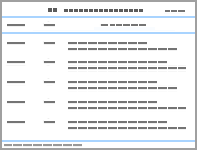
| 来源 | 时间节点 | 检索数 | 选取数 | 关键词 | ||||
|---|---|---|---|---|---|---|---|---|
| CNKI | 2001—2011 | 4532 | 141 | 空间(关系/构式)、运动/动态(事件)、位移(表达/事件)、致使(事件) | ||||
| 2012—2022 | 5254 | 324 | ||||||
| WOS | 2001—2011 | 932357 | 116 | Spatial (relation/construction), motion/dynamic (event), locational expression/event, caused (event) | ||||
| 2012—2022 | 2487272 | 344 | ||||||


| [1] |
Brown, A. & M. Gullberg. 2011. Bidirectional cross-linguistic influence in event conceptualization? Expressions of Path among Japanese learners of English[J]. Bilingualism: Language and Cognition 14(1): 79-94.
doi: 10.1017/S1366728910000064 URL |
| [2] | Bunger, A., D. Skordos, J. Trueswell, et al. 2021. How children attend to events before speaking: Crosslinguistic evidence from the motion domain[J]. Glossa: A Journal of General Linguistics 6(1): 1-22. |
| [3] | Cacciari, C., N. Bolognini, I. Senna, et al. 2011. Literal, fictive and metaphorical motion sentences preserve the motion component of the verb: A TMS study[J]. Brain & Language 119(3): 149-157. |
| [4] | Cadierno, T. & K. Lund. eds.). 2004. Cognitive linguistics and second language acquisition: Motion events in a typological framework[A]. In B. VanPatten, J. Williams, S. Rott, et al. (eds.). Form-meaning Connections in Second Language Acquisition[C]. Mahwah: Lawrence Erlbaum. 139-154. |
| [5] |
Chen, L. & J. Guo. 2009. Motion events in Chinese novels: Evidence for an equipollently-framed language[J]. Journal of Pragmatics 41(9): 1749-1766.
doi: 10.1016/j.pragma.2008.10.015 URL |
| [6] |
Choi, S. & M. Bowerman. 1991. Learning to express motion events in English and Korean: The influence of language-specific lexicalization patterns[J]. Cognition 41(1-3): 83-121.
pmid: 1790656 |
| [7] |
Deng, Y. & H. Zhu. 2020. To move or not to move: An ERP study on the processing of fictive and literal motion expressions[J]. Lingua 244: 102908.
doi: 10.1016/j.lingua.2020.102908 URL |
| [8] | Egorova, E., T. Tenbrink & R. S. Purves. 2018. Fictive motion in the context of mountaineering[J]. Spatial Cognition & Computation 18(4): 259-284. |
| [9] |
Fernandez, R., A. Monacelli & C. J. Duffy. 2013. Visual motion event related potentials distinguish aging and Alzheimer’s disease[J]. Journal of Alzheimer’s Disease 36(1): 177-83.
doi: 10.3233/JAD-122053 URL |
| [10] |
Flecken, M., M. Carroll, K. Weimar, et al. 2015. Driving along the road or heading for the village? Conceptual differences underlying motion event encoding in French, German, and French—German L2 users[J]. The Modern Language Journal 99(S1): 100-122.
doi: 10.1111/mono.v99.s1 URL |
| [11] | Göksun, T., M. Lehet, K. Malykhina, et al. 2015. Spontaneous gesture and spatial language: Evidence from focal brain injury[J]. Brain & Language 150: 1-13. |
| [12] |
Ji, Y., & J. Hohenstein. 2018. English and Chinese children’s motion event similarity judgments[J]. Cognitive Linguistics 29(1): 45-76.
doi: 10.1515/cog-2016-0151 URL |
| [13] | Kamenetski, A., V. T. Lai & M. Flecken. 2022. Minding the manner: Attention to motion events in Turkish-Dutch early bilinguals[J]. Language and Cognition 14 (3): 456-478. |
| [14] | Kısa, Y. D., S. Goldin-Meadow & D. Casasanto. 2022. Do gestures really facilitate speech production?[J]. Journal of Experimental Psychology: General 151(6): 1252-1271. |
| [15] |
Lewandowski, W. & Özçalìʂkan. 2021. How language type influences patterns of motion expression in bilingual speakers[J]. Second Language Research 37(1): 27-50.
doi: 10.1177/0267658319877214 URL |
| [16] |
Lewandowski, W. 2020. Bilingual patterns of path encoding: A study of Polish L1-German L2 and Polish L1-Spanish L2 speakers[J]. IRAL-International Review of Applied Linguistics in Language Teaching 60(3): 679-698.
doi: 10.1515/iral-2019-0127 URL |
| [17] | Lin, N., Y. Bi Y. Zhao, et al. 2015. The theory-of-mind network in support of action verb comprehension: Evidence from an fMRI study[J]. Brain & Language 141: 1-10. |
| [18] | Slobin, D. I. 1996. Two ways to travel: Verbs of motion in English and Spanish[A]. In M.Shibatani & S. A.Thompson (eds.) Grammatical Constructions: Their Form and Meaning[C]. Oxford: Clarendon Press. 195-219. |
| [19] | Slobin, D. I. 2000. Verbalized events: A dynamic approach to linguistic relativity and determinism[A]. In S.Neimeier & R.Dirven (eds.). Evidence for Linguistic Relativity[C]. Amsterdam/Philadelphia: John Benjamins. 107-138. |
| [20] | Slobin, D. I. 2004. The many ways to search for a frog:Linguistic typology and the expression of motion events[A]. In S.Strömqvist & L.Verhoeven (eds.). Relating Events in Narrative. Typological and Contextual Perspectives[C]. Mahwah, NJ: Lawrence Erlbaum. 219-257. |
| [21] | Talmy, L. 1985. Lexicalization pattern: Semantic structure in lexical forms[A]. In T.Shopen(ed.). Language Typology and Syntactic Description: Grammatical Categories and the Lexicon (Vol. 3)[C]. Cambridge: Cambridge University Press. 36-149. |
| [22] | Talmy, L. 2000a. Toward a Cognitive Semantics. Vol. I: Concept Structuring Systems[M]. Cambridge, MA: MIT Press. |
| [23] | Talmy, L. 2000b. Toward a Cognitive Semantics (Vol. II): Typology and Process in Concept Structuring[M]. Cambridge, MA: MIT Press. |
| [24] |
Treffers-Daller, J. & F. Aveledo. 2023. Approaching motion in a second language: how bilinguals restructure motion event expressions inside and outside the classroom[J]. International Review of Applied Linguistics in Language Teaching 61(1): 1-12.
doi: 10.1515/iral-2023-0006 URL |
| [25] |
Villwock, A., D. Bottari & B. Röder. 2022. Event-related potential correlates of visuo-tactile motion processing in congenitally deaf humans[J]. Neuropsychologia 170(10): 108209.
doi: 10.1016/j.neuropsychologia.2022.108209 URL |
| [26] |
Zhang, Y., R. Lemarchand, A. Asyraff, et al. 2022. Representation of motion concepts in occipitotemporal cortex: fMRI activation, decoding and connectivity analyses[J]. NeuroImage 259(10): 119450.
doi: 10.1016/j.neuroimage.2022.119450 URL |
| [27] | 谷峪、 林正军. 2020. 中国英语学习者运动事件编码的修辞风格研究[J]. 解放军外国语学院学报(2): 93-101,160. |
| [28] | 郝美玲、 王芬. 2015. 来自不同语言类型的学习者叙述汉语运动事件的实验研究[J]. 世界汉语教学(1): 83-94. |
| [29] | 纪瑛琳. 2020. 英汉二语习得者的空间运动事件认知——来自行为实验的证据[J]. 现代外语(5): 654-666. |
| [30] | 李恒、 曹宇. 2015. 中国高水平英语学习者指示性手势研究[J]. 解放军外国语学院学报(4): 51-58, 160. |
| [31] | 李杰、 陈超美. 2016. CiteSpace: 科技文本挖掘及可视化[M]. 北京: 首都经济贸易大学出版社. |
| [32] | 李天宇. 2020. 汉语运动事件词化类型研究中的几个问题[J]. 当代语言学(3): 395-410. |
| [33] | 刘雪卉、 陈亚平. 2021. 中国英语学习者运动事件的双向概念迁移研究[J]. 外语教学与研究(3): 387-399,479. |
| [34] |
彭宣维、 高继华. 2023. 论量子化的事件运动轨迹[J]. 当代外语研究(5): 43-65.
doi: 10.3969/j.issn.1674-8921.2023.05.005 |
| [35] | 沈家煊. 2003. 现代汉语“动补结构”的类型学考察[J]. 世界汉语教学(3): 17-23,2. |
| [36] | 史文磊. 2012. 汉语运动事件词化类型研究综观[J]. 当代语言学(1): 49-65,110. |
| [37] | 吴建伟、 潘艳艳. 2017. 英、汉、日运动事件动词的句法——语义比较研究[J]. 外语研究(2): 57-62. |
| [38] | 徐萌敏、 李福印. 2022. 基于汉语动补结构的事件融合研究——以“V回”结构表征宏事件为例[J]. 浙江外国语学院学报(2): 49-58. |
| [39] | 于翠红、 张拥政. 2017. 中国学习者在线加工英语运动事件表达中的启动效应与认知机制研究[J]. 外语教学与研究(3): 416-427,481. |
| [40] | 于翠红、 张拥政. 2020. 中国学习者英语位移事件加工中的动词与结构效应[J]. 现代外语(6): 818-829. |
| [41] | 曾永红、 白解红. 2013. 中国学生英语运动事件表达习得研究[J]. 外语与外语教学(6): 44-48. |
| [42] | 张拥政、 于翠红. 2017. 自发运动事件在线加工中的跨语言差异[J]. 现代外语(6): 778-789,873. |
| [43] | 赵晨、 林琳、 郑琴. 2023. 英语二语产出中言语计划的生成及其向句子结构的投射[J]. 解放军外国语学院学报(2): 11-19,160. |
| [1] | WEI Zaijiang. The Constructional Path of Sinicization for Chinese Loanwords [J]. Contemporary Foreign Languages Studies, 2025, 25(6): 150-159. |
| [2] | QIN Jianghua, CHEN Zhaorui. New Developments in Building China's Independent Knowledge System for Translation Studies: A Report from the 3rd Conference on Transknowletology [J]. Contemporary Foreign Languages Studies, 2025, 25(6): 223-230. |
| [3] | LIU Chunjie, WANG Jinjun. The Fractal Construction Models of Personification Metaphors: An Interdisciplinary Perspective [J]. Contemporary Foreign Languages Studies, 2025, 25(5): 186-195. |
| [4] | GUO Cong, XIN Jing. Construction and Exploration of a Digital-Intelligent English Teaching Model in Higher Education [J]. Contemporary Foreign Languages Studies, 2025, 25(5): 97-105. |
| [5] | WANG Hua. A New Dimension in Corpus-Assisted Foreign Language Teaching Research [J]. Contemporary Foreign Languages Studies, 2025, 25(5): 143-155. |
| [6] | YE Huijun, ZHANG Zhaoyang. Language Security and Cultural Security in the Context of Cultural Communication [J]. Contemporary Foreign Languages Studies, 2025, 25(5): 196-204. |
| [7] | ZHANG Jing, PENG Sirui. An Empirical Study on AI-Driven Evaluation of Student Translations Using Large Language Models [J]. Contemporary Foreign Languages Studies, 2025, 25(5): 85-96. |
| [8] | LIN Ling, LIU Ming. Towards a Part-of-Speech (PoS) Gram Approach to Corpus-based Phraseology [J]. Contemporary Foreign Languages Studies, 2025, 25(4): 15-27. |
| [9] | ZHAO Tao, DONG Xiaobo. Research on the Application of Parallel Corpus in the Translation of Civil Code Terminology from the Perspective of Transknowletology [J]. Contemporary Foreign Languages Studies, 2025, 25(4): 157-172. |
| [10] | CHENG Shuang, ZHANG Yushuang. Post-Editing Teaching and Post-Editing Competence Development: Practices, Findings and Implications [J]. Contemporary Foreign Languages Studies, 2025, 25(4): 182-195. |
| [11] | REN Ran, CHENG Xia, WU Xiaochun. An Evaluative Analysis of Climate-related Information Disclosure of Chinese NEV Companies [J]. Contemporary Foreign Languages Studies, 2025, 25(4): 28-39. |
| [12] | ZHEN Fengchao. Exploring New Paths in Corpus Stylistics: How does Kazuo Ishiguro Construct the Meaning of Hailsham in Never Let Me Go? [J]. Contemporary Foreign Languages Studies, 2025, 25(4): 3-14. |
| [13] | ZHANG Yujia, YUE Ming. Usage of Please in Spoken BNC2014: Regularities and Pedagogical Implications [J]. Contemporary Foreign Languages Studies, 2025, 25(4): 54-67. |
| [14] | LI Jincai. New Horizons in the Philosophy of Language through Cross-disciplinary Dialogue [J]. Contemporary Foreign Languages Studies, 2025, 25(3): 198-204. |
| [15] | HOU Guojin. What Is Pragma-rhetorical Competence vs Pragma-rhetorical Failure? [J]. Contemporary Foreign Languages Studies, 2025, 25(2): 65-76. |
| Viewed | ||||||
|
Full text |
|
|||||
|
Abstract |
|
|||||
