

诊断学理论与实践 ›› 2026, Vol. 25 ›› Issue (01): 37-43.doi: 10.16150/j.1671-2870.2026.01.006
蔡姣迪, 陈国群, 张文琴( )
)
收稿日期:2025-07-11
修回日期:2025-11-15
接受日期:2025-11-19
出版日期:2026-02-25
发布日期:2026-02-25
通讯作者:
张文琴 E-mail: zwq2020095@126.com基金资助:
CAI Jiaodi, CHEN Guoqun, ZHANG Wenqin()
Received:2025-07-11
Revised:2025-11-15
Accepted:2025-11-19
Published:2026-02-25
Online:2026-02-25
摘要:
2022年,全球肺癌新发病例约250万,死亡病例180万,中国新发肺癌病例约106.06万,死亡病例73.33万,肺癌在中国及全球的发病率和死亡率均居恶性肿瘤首位。非小细胞肺癌(non-small cell lung cancer,NSCLC)占肺癌约85%,生物标志物检测对其治疗选择至关重要。2024年12月至2025年1月,美国国立综合癌症网络(National Comprehensive Cancer Network,NCCN)连续发布了NSCLC临床实践指南的2025年第一版(V1)、第二版(V2)和第三版(V3),部分内容更新在肺癌诊疗领域具有重要意义。V1指南主要更新内容包括初始治疗评估、生物标志物检测、优化特定基因突变治疗路径及新增新兴靶点治疗药物等,主要新增药物有厄达替尼针对成纤维细胞生长因子受体(fibroblast growth factor receptor, FGFR)基因、泽妥珠单抗针对神经调节蛋白1(neuroregulatory protein 1,NRG1)基因融合及德曲妥珠单抗针对人类表皮生长因子受体2(human epidermal growth factor receptor 2,HER2)过表达等,为患者提供更多治疗选择。V2指南新增恩沙替尼作为间变性淋巴瘤激酶(anaplastic lymphoma kinase, ALK)重排的NSCLC一线优选方案。V3指南推荐纳武利尤单抗皮下注射替代静脉输注,用于新辅助系统治疗。尽管肺癌治疗的新靶点和新疗法不断涌现,但如何实现精准、可及且规范化的检测与治疗,仍是未来临床实践面临的核心挑战与优化方向。
中图分类号:
蔡姣迪, 陈国群, 张文琴. 2025年NCCN非小细胞肺癌临床实践(V1-V3)指南解读[J]. 诊断学理论与实践, 2026, 25(01): 37-43.
CAI Jiaodi, CHEN Guoqun, ZHANG Wenqin. Interpretation of the 2025 NCCN clinical practice guidelines for non-small cell lung cancer (V1-V3)[J]. Journal of Diagnostics Concepts & Practice, 2026, 25(01): 37-43.
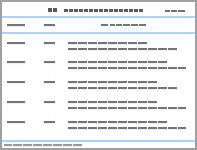
表1
晚期或转移性NSCLC推荐检测的生物标志物
| 检测项目 | 内容 | 更新 |
|---|---|---|
| 基因检测 | 1类:EGFR、ALK、RET基因检测;2类:KRAS、ROS1、BRAF、NTRK1/2/3、 MET ex14、ERBB2(HER2)、NRG1基因检测 | ① RET是此次新增的1类推荐; ② NRG1为此次新增 |
| IHC检测 | 1类:PD-L1;2类:HER2 | HER2 IHC为此次新增 |
表2
NSCLC中HER2 IHC评分标准
| IHC表达结果 | 染色特征 | 评分 |
|---|---|---|
| 阴性 | 无染色或≤10%的癌细胞显示不完整和弱的细胞膜染色 | 0 |
| 阴性或低表达 | >10%的癌细胞显示不完整和弱的细胞膜染色 | 1+ |
| 阳性 | >10%的癌细胞显示弱至中等强度,完整的细胞膜染色,或≤10%的癌细胞显示强且完整的细胞膜染色 | 2+ |
| 阳性 | >10%的癌细胞显示强、完整且均匀的细胞膜染色。 | 3+ |
表3
纳武利尤单抗皮下注射和静脉注射疗效比较
| 参数 | 皮下注射纳武利尤单抗 | 静脉输注纳武利尤单抗 |
|---|---|---|
| 药代动力学非劣效性 | 是 | 无数据 |
| 客观缓解率 | 24.2%(95%CI为19.0%~30.0%) | 18.2%(95%CI为13.6%~23.6%) |
| 给药时间 | 3~5 min | 30 min |
| [1] | 范伯男, 李岩. 全球主要疾病负担及健康状况趋势分析——1990年至2021年全球疾病和伤害负担报告解读[J]. 诊断学理论与实践, 2024, 23(5):474-483. |
| FAN B N, LI Y. Trends in global major disease burden and health conditions---interpretation of the Global Burden of Disease Study 1990-2021[J]. J Diagn Concepts Pract, 2024, 23(5):474-483. | |
| [2] | HAN B, ZHENG R, ZENG H, et al. Cancer incidence and mortality in China, 2022[J]. J Natl Cancer Cent, 2024, 4(1):47-53. |
| [3] | BRAY F, LAVERSANNE M, SUNG H, et al. Global cancer statistics 2022: GLOBOCAN estimates of incidence and mortality worldwide for 36 cancers in 185 countries[J]. CA A Cancer J Clinicians, 2024, 74(3):229-263. |
| [4] | SIEGEL R L, MILLER K D, FUCHS H E, et al. Cancer statistics, 2021[J]. CA A Cancer J Clin, 2021, 71(1):7-33. |
| [5] |
RECK M, RODRÍGUEZ-ABREU D, ROBINSON A G, et al. Updated analysis of KEYNOTE-024: Pembrolizumab versus platinum-based chemotherapy for advanced non-small-cell lung cancer with PD-L1 tumor proportion score of 50% or greater[J]. J Clin Oncol, 2019, 37(7):537-546.
doi: 10.1200/JCO.18.00149 pmid: 30620668 |
| [6] |
HERBST R S, GARON E B, KIM D W, et al. Five year survival update from KEYNOTE-010: Pembrolizumab versus docetaxel for previously treated, programmed death-ligand 1-positive advanced NSCLC[J]. J Thorac Oncol, 2021, 16(10):1718-1732.
doi: 10.1016/j.jtho.2021.05.001 URL |
| [7] |
MOK T, CAMIDGE D R, GADGEEL S M, et al. Updated overall survival and final progression-free survival data for patients with treatment-naive advanced ALK-positive non-small-cell lung cancer in the ALEX study[J]. Ann Oncol, 2020, 31(8):1056-1064.
doi: S0923-7534(20)39796-9 pmid: 32418886 |
| [8] |
LUO G, ZHANG Y, RUMGAY H, et al. Estimated worldwide variation and trends in incidence of lung cancer by histological subtype in 2022 and over time: A population-based study[J]. Lancet Respir Med, 2025, 13(4):348-363.
doi: 10.1016/S2213-2600(24)00428-4 pmid: 39914442 |
| [9] |
CHANG J Y, MEHRAN R J, FENG L, et al. Stereotactic ablative radiotherapy for operable stage I non-small-cell lung cancer (revised STARS): Long-term results of a single-arm, prospective trial with prespecified comparison to surgery[J]. Lancet Oncol, 2021, 22(10):1448-1457.
doi: 10.1016/S1470-2045(21)00401-0 pmid: 34529930 |
| [10] |
OVERBECK T R, CRON D A, SCHMITZ K, et al. Top-level MET gene copy number gain defines a subtype of poorly differentiated pulmonary adenocarcinomas with poor prognosis[J]. Transl Lung Cancer Res, 2020, 9(3):603-616.
doi: 10.21037/tlcr URL |
| [11] |
RODÓN J, DAMIAN S, FURQAN M, et al. Pemigatinib in previously treated solid tumors with activating FGFR1-FGFR3 alterations: Phase 2 FIGHT-207 basket trial[J]. Nat Med, 2024, 30(6):1645-1654.
doi: 10.1038/s41591-024-02934-7 |
| [12] |
ZHOU Z, LIU Z, OU Q, et al. Targeting FGFR in non-small cell lung cancer: Implications from the landscape of clinically actionable aberrations of FGFR kinases[J]. Cancer Biol Med, 2021, 18(2):490-501.
doi: 10.20892/j.issn.2095-3941.2020.0120 URL |
| [13] |
ZHANG P, YUE L, LENG Q, et al. Targeting FGFR for cancer therapy[J]. J Hematol Oncol, 2024, 17(1):39.
doi: 10.1186/s13045-024-01558-1 |
| [14] |
PARK J O, FENG Y H, SU W C, et al. Erdafitinib in Asian patients with advanced solid tumors: An open-label, single-arm, phase Ⅱa trial[J]. BMC Cancer, 2024, 24(1):1006.
doi: 10.1186/s12885-024-12584-0 |
| [15] |
JONNA S, FELDMAN R A, SWENSEN J, et al. Detection of NRG1 gene fusions in solid tumors[J]. Clin Cancer Res, 2019, 25(16):4966-4972.
doi: 10.1158/1078-0432.CCR-19-0160 URL |
| [16] |
SCHRAM A M, GOTO K, KIM D W, et al. Efficacy of zenocutuzumab in NRG1 fusion-positive cancer[J]. N Engl J Med, 2025, 392(6):566-576.
doi: 10.1056/NEJMoa2405008 URL |
| [17] | SCHRAM A M, GOTO K, KIM D W, et al. Efficacy and safety of zenocutuzumab, a HER2 x HER3 bispecific antibody, across advanced NRG1 fusion (NRG1+) cancers[J]. J Clin Oncol, 2022, 40(16_suppl):105. |
| [18] |
ZHANG S, WANG W, XU C, et al. Chinese expert consensus on the diagnosis and treatment of HER2-altered non-small cell lung cancer[J]. Thorac Cancer, 2023, 14(1):91-104.
doi: 10.1111/tca.v14.1 URL |
| [19] |
REN S, WANG J, YING J, et al. Consensus for HER2 alterations testing in non-small-cell lung cancer[J]. ESMO Open, 2022, 7(1):100395.
doi: 10.1016/j.esmoop.2022.100395 URL |
| [20] |
RIUDAVETS M, SULLIVAN I, ABDAYEM P, et al. Targeting HER2 in non-small-cell lung cancer (NSCLC): A glimpse of hope? An updated review on therapeutic strategies in NSCLC harbouring HER2 alterations[J]. ESMO Open, 2021, 6(5):100260.
doi: 10.1016/j.esmoop.2021.100260 URL |
| [21] |
SMIT E F, FELIP E, UPRETY D, et al. Trastuzumab deruxtecan in patients with metastatic non-small-cell lung cancer (DESTINY-Lung01): Primary results of the HER2-overexpressing cohorts from a single-arm, phase 2 trial[J]. Lancet Oncol, 2024, 25(4):439-454.
doi: 10.1016/S1470-2045(24)00064-0 pmid: 38547891 |
| [22] |
HORN L, WANG Z, WU G, et al. Ensartinib vs crizotinib for patients with anaplastic lymphoma kinase-positive non-small cell lung cancer: A randomized clinical trial[J]. JAMA Oncol, 2021, 7(11):1617-1625.
doi: 10.1001/jamaoncol.2021.3523 URL |
| [23] | GEORGE S, BOURLON M T, CHACON M R, et al. Subcutaneous nivolumab (nivo Sc) vs intravenous nivolumab (nivo iv) in patients with previously treated advanced or metastatic clear cell renal cell carcinoma (ccRCC): Pharmacokinetics (pk), efficacy, and safety results from CheckMate 67t[J]. J Clin Oncol, 2024, 42(4_suppl):LBA360. |
| [24] | U.S Food & Drug Administration. FDA approves nivo-lumab and hyaluronidase-nvhy for subcutaneous injection[EB/OL]. 2024. https://www.fda.gov/drugs/resources-information-approved-drugs/fda-approves-nivolumab-and-hyaluronidase-nvhy-subcutaneous-injection. |
| [25] | 王文卿, 王秀娟, 韩荣波, 等. 非小细胞肺癌脑转移患者T淋巴细胞亚群与免疫治疗联合化疗及立体定向放疗的疗效关系[J]. 中国临床研究, 2025, 38(3):375-378. |
| WANG W Q, WANG X J, HAN R B, et al. Relationship between T lymphocyte subsets and the efficacy of immunotherapy combined with chemotherapy and stereotactic body radiotherapy in non-small cell lung cancer patients with brain metastases[J]. Chin J Clin Res, 2025, 38(3):375-378. | |
| [26] | 康承欣, 付彬洁, 吕发金, 等. 肺癌筛查低剂量CT检查技术规范: 专家共识[J]. 重庆医科大学学报, 2024, 49(10):1025-1030. |
| KANG C X, FU B J, LV F J, et al. Technical specifications for low-dose computed tomography for lung cancer screening:expert consensus[J]. J Chongqing Med University, 2024, 49(10):1025-1030. |
| [1] | 陶怡, 糜坚青. 2026年美国国立综合癌症网络《多发性骨髓瘤指南》(第3版)更新解读[J]. 诊断学理论与实践, 2026, 25(01): 30-36. |
| [2] | 刘晶, 李勇, 向恩菲, 方旭前. 肺大细胞神经内分泌癌患者临床组织特征和可靶向分子亚型分布及意义[J]. 诊断学理论与实践, 2026, 25(01): 53-62. |
| [3] | 黄曼, 丁朔. 脓毒症的诊治现状及挑战[J]. 诊断学理论与实践, 2025, 24(06): 583-592. |
| [4] | 李雨航, 肖世富, 岳玲. 轻度行为损害与阿尔茨海默病相关研究的进展[J]. 诊断学理论与实践, 2025, 24(05): 548-554. |
| [5] | 白娅娅, 周春华, 邹多武. 2025年美国胃肠内镜学会《消化内镜在慢性胰腺炎管理中的作用指南:方法学及证据回顾》解读[J]. 诊断学理论与实践, 2025, 24(04): 407-414. |
| [6] | 刘敬浩, 郭海艳, 甘桂芳, 陈福祥. miR-2355-3p、miR-337-3p和miR-99a-5p检测在头颈部鳞状细胞癌早期筛查中的价值[J]. 诊断学理论与实践, 2025, 24(02): 204-211. |
| [7] | 王一阳, 吕良敬. 系统性红斑狼疮CAR T细胞治疗疗效预测及安全性评估的潜在生物标志物[J]. 诊断学理论与实践, 2024, 23(03): 263-269. |
| [8] | 刘洪江, 谢其冰. 免疫介导坏死性肌病诊治进展[J]. 诊断学理论与实践, 2024, 23(03): 270-277. |
| [9] | 秦晓丹, 孙慧玲, 潘蓓, 潘玉琴, 王书奎. miR-1229-3p抑制结直肠癌疾病进展及作为潜在生物标志物的研究[J]. 诊断学理论与实践, 2023, 22(05): 429-440. |
| [10] | 范臻佳, 赵珺涛, 周嘉宽, 李占权, 万颖蕾. ST2联合CEA、CYFRA211在早期非小细胞肺癌辅助诊断中的应用价值[J]. 诊断学理论与实践, 2023, 22(05): 441-447. |
| [11] | 李一林, 陈杨, 李艳艳, 冯旭娇, 章程, 李健, 沈琳. 循环肿瘤细胞检测在常见恶性肿瘤精准医学中的应用和展望[J]. 诊断学理论与实践, 2023, 22(04): 332-340. |
| [12] | 陶怡, 糜坚青. 2023年美国国立综合癌症网络(NCCN)《多发性骨髓瘤指南》(第2版)更新解读[J]. 诊断学理论与实践, 2023, 22(02): 121-126. |
| [13] | 常宇宸, 李京波. 心肌梗死中铁死亡标志物研究进展[J]. 诊断学理论与实践, 2023, 22(02): 197-202. |
| [14] | 陈国群, 蔡姣迪. 2022年美国国立综合癌症网络(NCCN)《非小细胞肺癌临床诊疗指南》(第4版及第5版)解读[J]. 诊断学理论与实践, 2023, 22(01): 8-13. |
| [15] | 武冬冬, 陈玉辉, 刘芳, 刘银红, 蒋景文. 脑小血管疾病合并中枢神经系统退行性疾病机制的研究进展[J]. 诊断学理论与实践, 2022, 21(05): 644-649. |
| 阅读次数 | ||||||
|
全文 |
|
|||||
|
摘要 |
|
|||||
