

诊断学理论与实践 ›› 2026, Vol. 25 ›› Issue (01): 44-52.doi: 10.16150/j.1671-2870.2026.01.007
李妙慧1, 顾峻豪2, 黄婷1, 乔宇2, 陈冰1( )
)
收稿日期:2025-09-15
修回日期:2026-01-06
接受日期:2026-01-07
出版日期:2026-02-25
发布日期:2026-02-25
通讯作者:
陈冰 E-mail:chenbing_rjh@163.com基金资助:
LI Miaohui1, GU Junhao2, HUANG Ting1, QIAO Yu2, CHEN Bing1()
Received:2025-09-15
Revised:2026-01-06
Accepted:2026-01-07
Published:2026-02-25
Online:2026-02-25
摘要:
目的:构建医学知识嵌入的因果人工智能(artificial intelligence,AI)框架模型,基于医学诊断逻辑进行急性白血病骨髓形态学AI辅助诊断。方法:本研究构建了医学知识嵌入的、分段式因果AI诊断框架模型。基于上海瑞金医院2020年至2023年间收治的93例病例(69例骨髓及外周血正常的其他疾病患者;24例血液疾病患者,其中14例急性白血病)骨髓及外周血涂片的20 089张显微图像数据集,以7∶3的比例训练和测试骨髓增生状态评估模块(模块1)、骨髓细胞种类识别模块(模块2)、外周血 AKP 组织化学染色积分评估模块(模块3)、POX 组织化学染色(模块4)及 CE组织化学染色(模块5)特征提取模块,用以提取多种关键骨髓形态学特征,包括骨髓增生状态、骨髓细胞种类识别、骨髓及外周血不同细胞组织化学染色程度等,并在2023年另10例真实病例的2 750张图中进行全流程验证。立足于血液系统疾病骨髓外周血形态诊断实践,对上述特定AI识别模块,根据医学诊断逻辑分步组合,整合多维度骨髓细胞形态学特征,进行两阶段序贯诊断预测(第一阶段:整合模块1、2、3;第二阶段:整合模块4、5)。第一阶段为正常、异常骨髓象病例鉴别,并同步识别慢性粒细胞白血病;第二阶段为急性白血病诊断及类型鉴别。同时建立端到端AI诊断框架模型作为对照,在真实病例中验证医学知识嵌入的因果AI诊断框架模型效能。结果:医学知识嵌入的因果AI诊断框架模型,在真实病例诊断测试中,准确率均高于端对端AI框架诊断模型(第一阶段准确率90.00%比70.00%,第二阶段准确率83.33%比66.67%)。结论:医学专业知识与诊断逻辑在血液系统疾病骨髓细胞形态学AI辅助诊断中发挥关键作用,应用医学知识嵌入的因果AI诊断框架模型,提升了AI辅助诊断急性白血病的准确率与可解释性,为血液系统疾病智能诊断提供了可推广的新范式。
中图分类号:
李妙慧, 顾峻豪, 黄婷, 乔宇, 陈冰. 医学知识嵌入的因果框架在急性白血病骨髓形态学AI辅助诊断中发挥关键作用[J]. 诊断学理论与实践, 2026, 25(01): 44-52.
LI Miaohui, GU Junhao, HUANG Ting, QIAO Yu, CHEN Bing. Key role of causal framework embedded with medical knowledge in AI-assisted diagnosis of bone marrow morphology for acute leukemia[J]. Journal of Diagnostics Concepts & Practice, 2026, 25(01): 44-52.

图1
医学知识嵌入的因果AI诊断框架

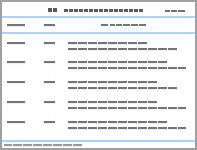
表1
各AI识别模块构建所用图像数据集
| Modules | Training set(images) | Testing set(images) | Total (images) |
|---|---|---|---|
| Bone Marrow Hyperplasia Assessment Module | 140 | 84a | 224 |
| Bone Marrow Cell Classification Module | 9 881 | 4 234 | 14 115 |
| AKP Score Calculation Module | 1 409 | 1 251b | 2 660 |
| POX-stained Leukaemic Cell Feature Extraction Module | 1 480 | 634 | 2 114 |
| CE-stained Leukaemic Cell Feature Extraction Module | 683 | 293 | 976 |
表2
各AI识别模块训练测试结果
| Modules | Recall | Precision |
|---|---|---|
| Bone marrow cell classification module | 84.36% | 88.52% |
| POX-stained leukaemic cell feature extraction module | 86.48% | 90.89% |
| CE-stained leukaemic cell feature extraction module | 85.48% | 84.86% |
表3
真实病例测试数据集构成
| Items | Image counts of Wright’s- stainedbone marrow (40×Magnification) | Image counts of Wright’ s-stained bone marrow (100× Magnification) | Image counts of AKP- stained peripheral blood | Image counts of POX-stained bone marrow | Image counts of CE-stained bone marrow |
|---|---|---|---|---|---|
| Normal (n=2) | 14 | 250 | 210 | / | / |
| CML-CP (n=2) | 14 | 209 | 206 | / | / |
| ALL (n=2) | 14 | 220 | 154 | 136 | 135 |
| APL (n=2) | 14 | 190 | 188 | 108 | 110 |
| AML (n=2) | 14 | 260 | 46 | 128 | 130 |
| Total | 70 | 1129 | 804 | 372 | 375 |
表4
2种AI诊断框架模型鉴别正常和异常病例准确率比较
| Diagnostic framework | Training accuracy | Testing accuracy |
|---|---|---|
| Causal diagnostic framework | 97.16% | 90.00% |
| End-to-End diagnostic framework | 93.48% | 70.00% |
表5
2种AI诊断框架模型鉴别急性白血病类型准确率比较
| Diagnostic framework | Training accuracy | Testing accuracy |
|---|---|---|
| Causal diagnostic framework | 95.20% | 83.33% |
| End-to-End diagnostic framework | 100.00% | 66.67% |
| [1] | 沈悌, 赵永强. 血液病诊断及疗效标准(第4版)[M]. 北京: 科学出版社,2018:87-113. |
| SHEN T, ZHAO Y Q. Criteria for diagnosis and efficacy of hematological diseases (4th ed)[M]. Beijing: Science Press,2018:87-113. | |
| [2] | 熊树民, 余润泉. 临床血液细胞学图谱与应用[M]. 上海: 上海交通大学出版社,2009:15-19. |
| XIONG S M, YU R Q. Atlas and application of clinical hematology[M]. Shanghai: Shanghai Jiao Tong University Press,2009:15-19. | |
| [3] |
CAO K, XIA Y, YAO J, et al. Large-scale pancreatic cancer detection via non-contrast CT and deep learning[J]. Nat Med, 2023, 29(12):3033-3043.
doi: 10.1038/s41591-023-02640-w |
| [4] | AHN B, MOON D, KIM H S, et al. Histopathologic image-based deep learning classifier for predicting platinum-based treatment responses in high-grade serous ovarian cancer[J]. Nat Commun, 2024,15:4253. |
| [5] | ZHU L, SHI H, WEI H, et al. An accurate prediction of the origin for bone metastatic cancer using deep learning on digital pathological images[J]. eBioMedicine, 2023,87:104426. |
| [6] |
CHANDRADEVAN R, ALJUDI A A, DRUMHELLER B R, et al. Machine-based detection and classification for bone marrow aspirate differential counts: Initial development focusing on nonneoplastic cells[J]. Lab Investig, 2020, 100(1):98-109.
doi: 10.1038/s41374-019-0325-7 URL |
| [7] |
YU T C, CHOU W C, YEH C Y, et al. Automatic bone marrow cell identification and classification by deep neural network[J]. Blood, 2019, 134(Suppl 1):2084.
doi: 10.1182/blood-2019-125322 URL |
| [8] |
MATEK C, KRAPPE S, MÜNZENMAYER C, et al. Highly accurate differentiation of bone marrow cell morphologies using deep neural networks on a large image data set[J]. Blood, 2021, 138(20):1917-1927.
doi: 10.1182/blood.2020010568 pmid: 34792573 |
| [9] | WANG C W, HUANG S C, LEE Y C, et al. Deep learning for bone marrow cell detection and classification on whole-slide images[J]. Med Image Anal, 2022,75:102270. |
| [10] | WANG W, LUO M, GUO P, et al. Artificial intelligence-assisted diagnosis of hematologic diseases based on bone marrow smears using deep neural networks[J]. Comput Meth Programs Biomed, 2023,231:107343. |
| [11] | WANG C, WEI X L, LI C X, et al. Efficient and highly accurate diagnosis of malignant hematological diseases based on whole-slide images using deep learning[J]. Front Oncol, 2022,12:879308. |
| [12] | ABHISHEK A, JHA R K, SINHA R, et al. Automated detection and classification of leukemia on a subject-independent test dataset using deep transfer learning supported by Grad-CAM visualization[J]. Biomed Signal Process Control, 2023,83:104722. |
| [13] | LITJENS G, KOOI T, BEJNORDI B E, et al. A survey on deep learning in medical image analysis[J]. Med Image Anal, 2017,42:60-88. |
| [14] | LIU M, LEE C W, SUN X, et al. Learning Causal Alignment for Reliable Disease Diagnosis[C]. arXiv, 2025. |
| [15] | YALCIN C, ABRAMOVA V, TERCEÑO M, et al. Hematoma expansion prediction in intracerebral hemorrhage patients by using synthesized CT images in an end-to-end deep learning framework[J]. Comput Med Imag Graph, 2024,117:102430. |
| [16] |
ESTEVA A, KUPREL B, NOVOA R A, et al. Dermatologist-level classification of skin cancer with deep neural networks[J]. Nature, 2017, 542(7639):115-118.
doi: 10.1038/nature21056 |
| [17] | RICHENS J G, LEE C M, JOHRI S. Improving the accuracy of medical diagnosis with causal machine learning[J]. Nat Commun, 2020,11:3923. |
| [18] | PATIL R S, SZOLOVITS P, SCHWARTZ W B. Causal understanding of patient illness in medical diagnosis[M]. New York,Springer New York,1985:272-292. |
| [19] |
SEVER C, ABBOTT C L, DE BACA M E, et al. Bone marrow synoptic reporting for hematologic neoplasms: Guideline from the college of American pathologists pathology and laboratory quality center[J]. Arch Pathol Lab Med, 2016, 140(9):932-949.
doi: 10.5858/arpa.2015-0450-SA pmid: 26905483 |
| [20] | SWERDLOW S H, CAMPO E, Harris N L, et al. WHO classification of tumours of haematopoietic and lymphoid tissues[M]. France: International Agency for Research on Cancer (IARC),2017:156-161. |
| [21] |
LI N, FAN L, XU H, et al. An AI-aided diagnostic framework for hematologic neoplasms based on morphologic features and medical expertisep[J]. Lab Invest, 2023, 103(4):100055.
doi: 10.1016/j.labinv.2022.100055 URL |
| [22] |
CAI Z, VASCONCELOS N. Cascade R-CNN: High quality object detection and instance segmentation[J]. IEEE Trans Pattern Anal Mach Intell, 2021, 43(5):1483-1498.
doi: 10.1109/TPAMI.2019.2956516 URL |
| [23] | LIU Z, LIN Y, CAO Y, et al. Swin transformer: Hierarchical vision transformer using shifted windows[C]. 2021 IEEE/CVF International Conference on Computer Vision (ICCV),2021:9992-10002. |
| [24] | 王霄霞, 夏薇, 龚道元. 临床骨髓细胞检验形态学[M]. 北京: 人民卫生出版社,2019:3-90. |
| WANG X X, XIA W, GONG D Y. Clinical bone marrow cell morphology[M]. Beijing: People's Medical Publishing House,2019:3-90. | |
| [25] | SIDHOM J W, SIDDARTHAN I J, LAI B S, et al. Deep learning for diagnosis of acute promyelocytic leukemia via recognition of genomically imprinted morphologic features[J]. NPJ Precis Onc, 2021,5:38. |
| [26] | PAESSLER M E, HELFRICH M, WERTHEIM G B W. Cytochemical staining[M]. New York: Springer New York,2017:19-32. |
| [27] | KENNETH K, MARSHALL A L, JOSEF T P, et al. Williams hematology[M]. 9th ed. New York: McGraw-Hill Education, 2017. |
| [1] | 孔德艳, 高祎阳, 张曹阳, 董海鹏, 严福华, 原子扬, 代建琨, 刘方韬. 基于深度学习的快速MRCP成像在屏气困难患者检查中的应用价值[J]. 诊断学理论与实践, 2025, 24(06): 628-633. |
| [2] | 郭语清, 王长燕, 刘迎春, 庞芸, 朱霞, 葛睿, 李蔚萍, 张麒, 陈林. 基于三维超声视频的深度学习模型辅助不同年资医师鉴别乳腺肿块良恶性的应用价值[J]. 诊断学理论与实践, 2025, 24(03): 312-319. |
| [3] | 张慧慧, 方姝, 吴梦雄, 刘方韬, 贺娜英, 董海鹏, 严福华. 深度学习重建技术在改善磁共振冠状位T1WI显示垂体神经内分泌肿瘤图像质量中的研究[J]. 诊断学理论与实践, 2024, 23(06): 594-601. |
| [4] | 吕晓宇, 冯威铭, 周慧赟, 李纪强, 董海鹏, 黄娟. 基于磁共振深度学习重建算法缩短扫描时间的可行性分析:水模研究[J]. 诊断学理论与实践, 2024, 23(02): 131-138. |
| [5] | 查云飞, 武夏夏. MRI深度学习图像重建技术在肌骨系统疾病诊断的应用进展[J]. 诊断学理论与实践, 2024, 23(02): 114-118. |
| [6] | 钱佳乐, 范婧, 朱宏, 王落桐, 孔德艳. 深度学习图像重建在虚拟平扫CT尿路成像中的应用价值[J]. 诊断学理论与实践, 2024, 23(02): 139-145. |
| [7] | 颜凌, 王凌云, 陈勇, 杜联军. 双能CT图像深度学习重建算法在胃癌术前T分期中的应用[J]. 诊断学理论与实践, 2023, 22(02): 154-159. |
| [8] | 范婧, 杨文洁, 王梦真, 陆伟, 石骁萌, 朱宏. 深度学习重建算法在低管电压冠状动脉CT血管成像中的应用[J]. 诊断学理论与实践, 2022, 21(03): 374-379. |
| [9] | 王建中. 流式细胞术诊断急性白血病微小残留病:当前主要的技术问题和对策[J]. 诊断学理论与实践, 2017, 16(01): 7-11. |
| [10] | 赵佳强, 王思敏, 余文俊, 邱进锋, 张泽文, 尹俊,. 成人急性白血病患者白细胞和血小板中活性氧簇的监测研究[J]. 诊断学理论与实践, 2015, 14(02): 136-141. |
| [11] | 宋陆茜, 吴凌云, 常春康, 李晓,. 急性白血病诱导缓解后并发走马疳一例报告及文献复习[J]. 诊断学理论与实践, 2010, 9(01): 79-81. |
| [12] | 林志谦, 陈克敏, 管永靖,. 成人急性白血病的骨髓MRI表现与定量分析研究[J]. 诊断学理论与实践, 2009, 8(01): 43-49. |
| [13] | 林志谦, 陈克敏, 管永靖,. 磁共振成像在急性白血病骨髓研究中的应用[J]. 诊断学理论与实践, 2008, 7(01): 99-102. |
| [14] | 陈瑜,邬维礼,吴文,孙关林,沈志祥. 急性白血病患者血清对正常红系造血抑制活性的研究[J]. 诊断学理论与实践, 2004, 3(03): 64-67. |
| [15] | 王晨,朱建善,陈芳源,郑璐滢,韩洁英,欧阳仁荣. 成人急性白血病患者骨髓中血管生成的病理观察[J]. 诊断学理论与实践, 2004, 3(01): 21-25. |
| 阅读次数 | ||||||
|
全文 |
|
|||||
|
摘要 |
|
|||||
