

Journal of Diagnostics Concepts & Practice ›› 2026, Vol. 25 ›› Issue (02): 225-231.doi: 10.16150/j.1671-2870.2026.02.014
• Case reports • Previous Articles Next Articles
XU Chenhaoyi1, LIU Jingwen2, FANG Min1( )
)
Received:2026-01-05
Revised:2026-02-06
Accepted:2026-02-09
Online:2026-04-25
Published:2026-04-25
Contact:
FANG Min
E-mail:fangmin_dr@126.com
CLC Number:
XU Chenhaoyi, LIU Jingwen, FANG Min. Case report and risk factor analysis of amyloid-related imaging abnormalities induced by lecanemab in Alzheimer's disease[J]. Journal of Diagnostics Concepts & Practice, 2026, 25(02): 225-231.

Figure 1
Images of Aβ-PET-CT


Figure 2
Images of tau-PET-CT


Figure 3
Baseline images of brain MRI


Figure 4
Follow-up images of brain MRI A: Before the 5th treatment with lecanemab; B: Before the 7th treatment with lecanemab; C: Before the 14th treatment with lecanemab; D: After 1 month treatment with prednisone.


Figure 5
Follow-up images of brain SWI A: Before the 5th treatment with lecanemab; B: Before the 7th treatment with lecanemab; C: Before the 14th treatment with lecanemab; D: After 1 month treatment with prednisone.

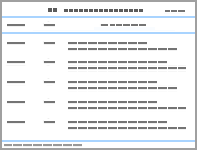
Table 1
7 cases of amyloid-related imaging abnormalities caused by lecanemab
| 病例 | 文献 | 发表 年份 | 年龄(岁) | 性别 | ApoE 基因型 | 发生ARIA时间 | ARIA程度 | 临床症状 | 治疗 方案 | 后续是否仑卡奈单抗治疗 | 参考文献 |
|---|---|---|---|---|---|---|---|---|---|---|---|
| 1 | 本文 | - | 77 | 男 | ε3/ε4 | 第14次前 | 轻度ARIA-E、轻度ARIA-H | 稳定 | 激素 | 是 | - |
| 2 | Wang等 | 2025 | 70 | 男 | ε2/ε3 | 第5次前 | 轻度ARIA-E、中度ARIA-H | 认知功能减退 | 停药 | 否 | |
| 3 | Wang等 | 2025 | 75 | 女 | ε3/ε4 | 第7次前 | 轻度ARIA-H | 稳定 | 停药 | 是 | |
| 4 | Ji等 | 2024 | 73 | 男 | ε2/ε3 | 第14次前 | 轻度ARIA-H | 外伤后脑出血 | 停药 | 否 | |
| 5 | Yamazaki等 | 2025 | 57 | 女 | 未报道 | 第5次前 | 重度ARIA- E、重度ARIA-H | 偏瘫、尿失禁、认知功能减退 | 激素 | 否 | |
| 6 | Gibson等 | 2024 | 71 | 男 | ε3/ε4 | 第4次前 | 重度ARIA-E、轻度ARIA-H | 头痛、癫痫 | 激素 | 否 | |
| 7 | Bitar等 | 2025 | 60 | 女 | 未报道 | 第7次前 | 中度ARIA-E | 稳定 | 停药 | 否 | |
| 8 | Alammar等 | 2025 | 76 | 女 | ε2/ε3 | 第5次前 第7次前 | 轻度ARIA-E、轻度ARIA-H | 新发脑梗 | 停药 | 否 |

Figure 6
Baseline DTI-ALPS values before treatment with lecanemab Note: Red data point refers to the patient of this case.


Figure 7
Infusion process of lecanemab in the department of neurology in Shanghai Tongren Hospital

| [1] | 王刚, 齐金蕾, 刘馨雅, 等. 中国阿尔茨海默病报告2024[J]. 诊断学理论与实践, 2024, 23(3):219-256. |
| WANG G, QI J L, LIU X Y, et al. China Alzheimer report 2024[J]. J Diagn Concepts Pract, 2024, 23(3):219-256. | |
| [2] |
JI Q, CHEN J, LI Y, et al. Incidence and prevalence of Alzheimer’s disease in China: A systematic review and meta-analysis[J]. Eur J Epidemiol, 2024, 39(7):701-714.
doi: 10.1007/s10654-024-01144-2 |
| [3] | 支楠, 肖金雯, 任汝静, 等. 抗Aβ单克隆抗体临床应用建议(2025版)[J]. 重庆医科大学学报, 2025, 50(9):1133-1140. |
| ZHI N, XIAO J W, REN R J, et al. Recommendations for the clinical use of anti-amyloid-β monoclonal antibody for Alzheimer's disease(2025)[J]. J Chongqing Med University, 2025, 50(9):1133-1140. | |
| [4] | 杨曦玥, 李婉婷, 杨兴隆, 等. 阿尔茨海默病淀粉样蛋白相关影像学异常的影像识别与评估[J]. 四川大学学报(医学版), 2024, 55(6):1364-1370. |
| YANG X Y, LI W T, YANG X L, et al. Radiological Identification and evaluation of amyloid-related imaging abnormalities in Alzheimer's disease[J]. J Sichuan Univ (Med Sci), 2024, 55(6):1364-1370. | |
| [5] | 马瑾瑾, 肖卫忠. 阿尔茨海默病早期诊断方法[J]. 中国临床研究, 2024, 37(7):1113-1119. |
| MA J J, XIAO W Z. Early diagnosis of Alzheimer's di-sease[J]. Chin J Clin Res, 2024, 37(7):1113-1119. | |
| [6] | JACK C R JR, ANDREWS J S, BEACH T G, et al. Revised criteria for diagnosis and staging of Alzheimer's disease: Alzheimer’s Association Workgroup[J]. Alzhei-mers Dement, 2024, 20(8):5143-5169. |
| [7] | 岳玲, 江叶昊. 阿尔茨海默病诊断和分期新标准:生物标志物引领的精准医疗时代[J]. 神经病学与神经康复学杂志, 2025, 21(1):1-5. |
| YUE L, JIANG Y H. New diagnostic and staging criteria for Alzheimer's disease:the era of precision medicine led by biomarkers[J]. J Neurol Neurorehabil, 2025, 21(1):1-5. | |
| [8] |
CUMMINGS J, APOSTOLOVA L, RABINOVICI G D, et al. Lecanemab: Appropriate use recommendations[J]. J Prev Alzheimers Dis, 2023, 10(3):362-377.
doi: 10.14283/jpad.2023.30 pmid: 37357276 |
| [9] |
WANG Y, YU Q, CHEN B, et al. Two cases of Amyloid-Related Imaging Abnormalities (ARIA) following lecanemab treatment for Alzheimer’s disease and a literature review[J]. BMC Neurol, 2025, 25(1):281.
doi: 10.1186/s12883-025-04302-5 |
| [10] |
JI S, ROSENBLOOM M. Intracerebral hemorrhage following mild ARIA-H in an APOE ε2 carrier receiving lecanemab[J]. Alzheimers Res Ther, 2024, 16(1):265.
doi: 10.1186/s13195-024-01640-3 pmid: 39702440 |
| [11] | YAMAZAKI A, SEKINE T, TAKAHASHI S, et al. A case of severe ARIA with multiple infarctions and extensive microbleeds following lecanemab administration[J]. Psychogeriatrics, 2025,25:e13231. |
| [12] |
GIBSON A W, ELSER H, ROSSO M, et al. Ischemic stroke associated with amyloid-related imaging abnormalities in a patient treated with lecanemab[J]. Alzheimers Dement, 2024, 20(11):8192-8197.
doi: 10.1002/alz.14223 pmid: 39215494 |
| [13] | BITAR I, ALABDALRAZZAK M, ZAMZAM M, et al. Clinically silent amyloid-related imaging abnormality with edema following lecanemab therapy: A case report[J]. Cureus,2025:e91230. |
| [14] |
ALAMMAR H, DIALLO M, LLANO D A. Multiple ische-mic strokes in a patient treated with Lecanemab: A case report[J]. Neurocase, 2025, 31(6):295-300.
doi: 10.1080/13554794.2025.2566151 URL |
| [15] |
HAMPEL H, ELHAGE A, CHO M, et al. Amyloid-related imaging abnormalities (ARIA): Radiological, biological and clinical characteristics[J]. Brain, 2023, 146(11):4414-4424.
doi: 10.1093/brain/awad188 pmid: 37280110 |
| [16] |
GREENBERG S M, BAX F, VAN VELUW S J. Amyloid-related imaging abnormalities: Manifestations, metrics and mechanisms[J]. Nat Rev Neurol, 2025, 21(4):193-203.
doi: 10.1038/s41582-024-01053-8 pmid: 39794509 |
| [17] |
HONIG L S, SABBAGH M N, VAN DYCK C H, et al. Updated safety results from phase 3 lecanemab study in early Alzheimer's disease[J]. Alzheimers Res Ther, 2024, 16(1):105.
doi: 10.1186/s13195-024-01441-8 pmid: 38730496 |
| [18] | DORAN S J, SAWYER R P. Risk factors in developing amyloid related imaging abnormalities (ARIA) and clinical implications[J]. Front Neurosci, 2024,18:1326784. |
| [19] |
TAOKA T, MASUTANI Y, KAWAI H, et al. Evaluation of glymphatic system activity with the diffusion MR technique: Diffusion tensor image analysis along the perivascular space (DTI-ALPS) in Alzheimer's disease cases[J]. Jpn J Radiol, 2017, 35(4):172-178.
doi: 10.1007/s11604-017-0617-z pmid: 28197821 |
| [20] | HUANG S Y. Glymphatic system dysfunction predicts amyloid deposition, neurodegeneration, and clinical progression in Alzheimer’s disease[J]. Alzheimers Dement, 2024, 20(S1):e084295. |
| [21] | AHMAD F, KARAN A, SHARMA R, et al. Evolving therapeutic interventions for the management and treatment of Alzheimer’s disease[J]. Ageing Res Rev, 2024,95:102229. |
| [22] |
KIM S, CHUN H, KIM Y, et al. Astrocytic autophagy plasticity modulates Aβ clearance and cognitive function in Alzheimer’s disease[J]. Mol Neurodegener, 2024, 19(1):55.
doi: 10.1186/s13024-024-00740-w |
| [23] |
LIMBERGER C, ZIMMER E R. Blood GFAP reflects astrocyte reactivity to Alzheimer's pathology in post-mortem brain tissue[J]. Brain, 2024, 147(5):1598-1600.
doi: 10.1093/brain/awae104 URL |
| [24] |
PEREIRA J B, JANELIDZE S, SMITH R, et al. Plasma GFAP is an early marker of amyloid-β but not tau pathology in Alzheimer’s disease[J]. Brain, 2021, 144(11):3505-3516.
doi: 10.1093/brain/awab223 URL |
| [25] |
COGSWELL P M, ANDREWS T J, BARAKOS J A, et al. Alzheimer disease anti-amyloid immunotherapies: Ima-ging recommendations and practice considerations for monitoring of amyloid-related imaging abnormalities[J]. AJNR Am J Neuroradiol, 2025, 46(1):24-32.
doi: 10.3174/ajnr.A8469 URL |
| [26] | 常燕. 重视β-淀粉样蛋白PET在新时代阿尔茨海默病诊疗中的价值[J]. 神经病学与神经康复学杂志, 2025, 21(1):12-16., |
| CHANG Y. Attach importance to the value of β-amyloid-PET in the diagnosis and treatment of Alzheimer's di-sease in the new era[J]. J Neurol Neurorehabil, 2025, 21(1):12-16. | |
| [27] |
BARAKOS J, PURCELL D, SUHY J, et al. Detection and management of amyloid-related imaging abnormalities in patients with Alzheimer's disease treated with anti-amyloid beta therapy[J]. J Prev Alzheimers Dis, 2022, 9(2):211-220.
doi: 10.14283/jpad.2022.21 pmid: 35542992 |
| [1] | ZHANG Nan, LU Qingzheng. Diagnosis of atypical Alzheimer′s disease [J]. Journal of Diagnostics Concepts & Practice, 2026, 25(02): 121-130. |
| [2] | LIU Xiaocao, ZENG Qingze, LI Yixia, LI Kaicheng, LUO Xiao, YAN Shaozhen, LU Jie. The effect of KL-VS gene on medial temporal lobe volume in patients with mild cognitive impairment: A study based on MRI [J]. Journal of Diagnostics Concepts & Practice, 2026, 25(02): 174-182. |
| [3] | LI Xiang, HUANG Xinyun, GUO Rui, LI Biao, ZHOU Yilei. Value of 68Ga-DOTATATE PET/CT in differentiating pancreatic neuroendocrine tumors from uncinate process of pancreas [J]. Journal of Diagnostics Concepts & Practice, 2026, 25(02): 193-199. |
| [4] | WEN Bin, ZHU Hong, LIU Shi, QIN Feixue, HE Juankun, GUI Li. PD-1 inhibitor-induced fulminant type 1 diabetic ketoacidosis:a case report and literature review [J]. Journal of Diagnostics Concepts & Practice, 2026, 25(02): 232-238. |
| [5] | XIE Xiangmei, HAN Ying, SU Juan, HENG Wei. A case report of seminal vesicle metastasis from lung cancer [J]. Journal of Diagnostics Concepts & Practice, 2026, 25(01): 96-99. |
| [6] | WANG Yan, FAN Lei. Application progress of artificial intelligence in morphological diagnosis of blood diseases [J]. Journal of Diagnostics Concepts & Practice, 2026, 25(01): 15-20. |
| [7] | LIU Dandan, NIU Yantao, KANG Tianliang, LIU Yunfu, GUO Senlin, HAN Wenjing, ZHANG Yongxian. Application of virtual simulation combined with problem-oriented project-driven teaching in the teaching reform of radiation physics and protection course [J]. Journal of Diagnostics Concepts & Practice, 2026, 25(01): 105-111. |
| [8] | YANG Ruixin, YU Yingyan. Application of artificial intelligence in medical image data processing for digestive tract tumors [J]. Journal of Diagnostics Concepts & Practice, 2025, 24(06): 605-612. |
| [9] | KONG Deyan, GAO Yiyang, Zhang Caoyang, DONG Haipeng, YAN Fuhua, YUAN Ziyang, DAI Jiankun, LIU Fangtao. Application value of deep learning-based rapid MRCP imaging in examination of patients with breath holding difficulties [J]. Journal of Diagnostics Concepts & Practice, 2025, 24(06): 628-633. |
| [10] | GAO Yihui, ZHANG Huiping, ZHOU Yuqing. Analysis of ultrasonic two-step assessment of postpartum diastasis recti abdominis and related risk factors in parturients at 42-day postpartum [J]. Journal of Diagnostics Concepts & Practice, 2025, 24(06): 641-647. |
| [11] | ZENG Beibei, HUANG Yi, ZHANG Buteng, HUANG Ronghe, QIN Lihua, ZHOU Qiting. Predictive value of serum IGF-1 combined with TPOAb for the occurrence of hypothyroidism after 131I treatment in patients with hyperthyroidism [J]. Journal of Diagnostics Concepts & Practice, 2025, 24(05): 505-511. |
| [12] | WANG Yang, WANG Chao, FU Fan, ZHANG Min, LI Biao, WANG Jin. Correlation between diffuse hepatic ¹³¹I uptake and functional status of ¹³¹I uptake in lung metastases during post-operative ablation therapy for papillary thyroid carcinom [J]. Journal of Diagnostics Concepts & Practice, 2025, 24(05): 512-517. |
| [13] | XU Shen, SUN Ruizhuang, YU Qin, LIU Qukai, DING Ning. Analysis of correlation between thrombelastography and severity of coronary artery lesions in patients with acute coronary syndrome [J]. Journal of Diagnostics Concepts & Practice, 2025, 24(05): 534-541. |
| [14] | ZHENG Xiangyu, CHEN Jinxiang, LIU Guorong, YANG Yaoxiang, CAI Shaoting, YANG Jing. Clinicopathological analysis and literature review of SMARCB1-deficient sinonasal carcinoma [J]. Journal of Diagnostics Concepts & Practice, 2025, 24(05): 555-561. |
| [15] | YANG Cuiping, CHEN Ping. Analysis of global trends and current status of diagnosis and treatment of inflammatory bowel diseas [J]. Journal of Diagnostics Concepts & Practice, 2025, 24(04): 373-382. |
| Viewed | ||||||
|
Full text |
|
|||||
|
Abstract |
|
|||||
