

Journal of Diagnostics Concepts & Practice ›› 2025, Vol. 24 ›› Issue (06): 634-640.doi: 10.16150/j.1671-2870.2025.06.009
• Original articles • Previous Articles Next Articles
LU Hongyu1, XU Youhai2, XU Hao2, LIU Dan3, SONG Luxi4( )
)
Received:2025-03-17
Revised:2025-08-27
Online:2025-12-25
Published:2025-12-25
Contact:
SONG Luxi
E-mail:songluxi@139.com
CLC Number:
LU Hongyu, XU Youhai, XU Hao, LIU Dan, SONG Luxi. Analysis of diagnosis and treatment of 9 cases of primary thyroid lymphoma[J]. Journal of Diagnostics Concepts & Practice, 2025, 24(06): 634-640.
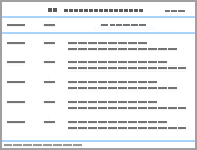
Table 1
Clinical characteristics of patients with primary thyroid lymphoma
| No. | Age(Year)/Gender | Clinical symptoms | Antibody | US type | Lymph node | Diagnostic method | Lugano stage | IPI group | Treatment | Response | Fllow-up (month) and status |
|---|---|---|---|---|---|---|---|---|---|---|---|
| 1 | 81/M | mass, choking | + | Mixed type | 3 | FNA/CNB | IIEX | High-int | R-miniCHOP+ISRT | PR | 36 m,alive |
| 2 | 82/F | mass, choking | + | Diffuse type | 5 | CNB/Surgery | IIIEX | High | PolaR-miniCHP,ISRT,Surgery | PD | 11 m, eath |
| 3 | 76/F | mass | + | Nodular type | 3 | FNA/CNB | IIE | High-int | R-CHOP | CR | 20 m,alive |
| 4 | 88/F | mass, choking | + | Nodular type | 4 | FNA/CNB | IIE | High | R-miniCHOP | ND | withdraw |
| 5 | 83/F | mass, choking | + | Nodular type | 4 | Surgery | IIE | High | Surgery+PolaR- miniCHP-Glofit | CR | 11 m,alive |
| 6 | 61/F | mass,choking | + | Nodular type | 1 | Surgery | IIE | Low | Surgery+R-CHOP | CR | 10 m,alive |
| 7 | 39/F | mass | - | Nodular type | 1 | FNA/CNB | IIE | Low | R-CHOP | CR | 9 m,alive |
| 8 | 57/F | mass, choking | + | Diffuse type | 5 | CNB | IIIEX | Low-int | R-CHOP+ISRT | PR | 9 m,alive |
| 9 | 70/M | mass | + | Mixed type | 3 | FNA/CNB | IIEX | Low | R-CHOP | Ongoing | Ongoing, alive |

Figure 1
Ultrasonography (US) patterns of primary thyroid lymphoma A:Diffuse type (Case 9), ultrasonography (US) shows diffuse thyroid enlargement with hypoechoic parenchyma, internal linear echoes, and posterior acoustic enhancement. B:Nodular type (Case 3), US of the right thyroid lobe shows a well-circumscribed 3.6 cm hypoechoic nodule. C: Mixed type (Case 4), US shows diffuse enlargement of the right thyroid lobe with focal multiple well-defined hypoechoic nodular lesions and partial "cloud-like" hyperechoic areas, accompanied by posterior acoustic enhancement.


Figure 2
Pathological findings of primary thyroid lymphoma A: Diffuse infiltration of large lymphocytes around residual thyroid follicular structures (indicated by arrows) (HE stain, ×100). B: Diffusely positive expression of CD20 (immunohistochemistry, ×400).

| [1] |
JIN S, XIE L, YOU Y, et al. Development and validation of a nomogram to predict B-cell primary thyroid malignant lymphoma-specific survival: A population-based analysis[J]. Front Endocrinol (Lausanne), 2022, 13:965448.
doi: 10.3389/fendo.2022.965448 URL |
| [2] |
OTA H, ITO Y, MATSUZUKA F, et al. Usefulness of ultrasonography for diagnosis of malignant lymphoma of the thyroid[J]. Thyroid, 2006, 16(10):983-987.
doi: 10.1089/thy.2006.16.983 pmid: 17042683 |
| [3] |
SWERDLOW S H, CAMPO E, PILERI S A, et al. The 2016 revision of the World Health Organization classification of lymphoid neoplasms[J]. Blood, 2016, 127(20):2375-2390.
doi: 10.1182/blood-2016-01-643569 pmid: 26980727 |
| [4] |
CHESON B D, FISHER R I, BARRINGTON S F, et al. Recommendations for initial evaluation, staging, and response assessment of Hodgkin and non-Hodgkin lymphoma: the Lugano classification[J]. J Clin Oncol, 2014, 32(27):3059-3068.
pmid: 25113753 |
| [5] |
ZIEPERT M, HASENCLEVER D, KUHNT E, et al. Standard International prognostic index remains a valid predictor of outcome for patients with aggressive CD20+ B-cell lymphoma in the rituximab era[J]. J Clin Oncol, 2010, 28(14):2373-2380.
doi: 10.1200/JCO.2009.26.2493 pmid: 20385988 |
| [6] | 中国临床肿瘤学会指南工作委员会. 中国临床肿瘤学会(CSCO)淋巴瘤诊疗指南2023[M]. 北京, 人民卫生出版社,2023:4. |
| Guideline Working Committee of Chinese society of clinical oncology. Guidelines of Chinese society of Clinical Oncology (CSCO) lymphoid malignancies 2023[M]. Beijing: People's Medical Publishing House,2023:4. | |
| [7] |
ZHU Y, YANG S, HE X. Prognostic evaluation models for primary thyroid lymphoma, based on the SEER database and an external validation cohort[J]. J Endocrinol Invest, 2022, 45(4):815-824.
doi: 10.1007/s40618-021-01712-3 |
| [8] |
WATANABE N, NOH J Y, NARIMATSU H, et al. Clinicopathological features of 171 cases of primary thyroid lymphoma: a long-term study involving 24553 patients with Hashimoto's disease[J]. Br J Haematol, 2011, 153(2):236-243.
doi: 10.1111/bjh.2011.153.issue-2 URL |
| [9] | LIU L, YU Y, CHEN L, et al. Clinical differences between IgG4 Hashimoto's thyroiditis and primary thyroid lymphoma[J]. Eur Thyroid J, 2022, 11(3):e210144. |
| [10] |
VANDER POORTEN V, GOEDSEELS N, TRIANTAFYLLOU A, et al. Effectiveness of core needle biopsy in the diagnosis of thyroid lymphoma and anaplastic thyroid carcinoma: A systematic review and meta-analysis[J]. Front Endocrinol (Lausanne), 2022, 13:971249.
doi: 10.3389/fendo.2022.971249 URL |
| [11] |
ALEXANDER L F, PATEL N J, CASERTA M P, et al. Thyroid ultrasound: diffuse and nodular disease[J]. Radiol Clin North Am, 2020, 58(6):1041-1057.
doi: 10.1016/j.rcl.2020.07.003 URL |
| [12] |
PENG C, YI D, ZHOU Y, et al. Differential diagnosis of non-diffuse primary thyroid lymphoma and papillary thyroid carcinoma by ultrasound combined with computed tomography[J]. BMC Cancer, 2022, 22(1):938.
doi: 10.1186/s12885-022-10035-2 pmid: 36042430 |
| [13] |
GU L S, CUI N Y, WANG Y, et al. Comparison of sonographic characteristics of primary thyroid lymphoma and anaplastic thyroid carcinoma[J]. J Thorac Dis, 2017, 9(11):4774-4784.
doi: 10.21037/jtd URL |
| [14] | 杨盼, 孙映荷, 马步云, 等. 原发性甲状腺非霍奇金淋巴瘤的超声征象分析[J]. 中国普外基础与临床杂志, 2014, 21(9):1092-1096. |
| YANG P, SUN Y H, MA B Y, et al. Ultrasonography features of primary thyroid non-Hodgkin lymphoma[J]. Chin J Bases Clin General Surg, 2014, 21(9):1092-1096. | |
| [15] |
MATSUZUKA F, MIYAUCHI A, KATAYAMA S, et al. Clinical aspects of primary thyroid lymphoma: diagnosis and treatment based on our experience of 119 cases[J]. Thyroid, 1993, 3(2):93-99.
doi: 10.1089/thy.1993.3.93 pmid: 8369658 |
| [16] |
LEE J S, SHIN S J, YUN H J, et al. Primary thyroid lymphoma: A single-center experience[J]. Front Endocrinol (Lausanne), 2023, 14:1064050.
doi: 10.3389/fendo.2023.1064050 URL |
| [17] |
WATANABE N, NARIMATSU H, NOH J Y, et al. Long-term outcomes of 107 cases of primary thyroid mucosa-associated lymphoid tissue lymphoma at a single medical institution in Japan[J]. J Clin Endocrinol Metab, 2018, 103(2):732-739.
doi: 10.1210/jc.2017-01478 pmid: 29165612 |
| [18] | 中华医学会内分泌学分会, 中华医学会外科学分会甲状腺及代谢外科学组, 中国抗癌协会头颈肿瘤专业委员会, 等. 甲状腺结节和分化型甲状腺癌诊治指南(第二版)[J]. 中华内分泌代谢杂志, 2023, 39(3):181-226. |
| Chinese Society of Endocrinology, Thyroid and Metabolism Surgery Group of the Chinese Society of Surgery, China Anti-Cancer Association, et al. Guidelines for the diagnosis and management of thyroid nodules and differentiated thyroid cancer (Second edition)[J]. Chin J Endocrinol Metab, 2023, 39(3):181-226. |
| [1] | GAO Yihui, ZHANG Huiping, ZHOU Yuqing. Analysis of ultrasonic two-step assessment of postpartum diastasis recti abdominis and related risk factors in parturients at 42-day postpartum [J]. Journal of Diagnostics Concepts & Practice, 2025, 24(06): 641-647. |
| [2] | HUANG Man, DING Shuo. Current status and challenges in sepsis diagnosis and treatment [J]. Journal of Diagnostics Concepts & Practice, 2025, 24(06): 583-592. |
| [3] | MA Zhiqiang, LIN Zixin, WU Hao, WANG Zaijia, ZHANG Xiangtao, DONG Yifei. Prevalence, diagnosis, and treatment progress of resistant hypertension [J]. Journal of Diagnostics Concepts & Practice, 2025, 24(05): 471-484. |
| [4] | ZHENG Xiangyu, CHEN Jinxiang, LIU Guorong, YANG Yaoxiang, CAI Shaoting, YANG Jing. Clinicopathological analysis and literature review of SMARCB1-deficient sinonasal carcinoma [J]. Journal of Diagnostics Concepts & Practice, 2025, 24(05): 555-561. |
| [5] | SHEN Xiaonan, ZHOU Chunhua, ZHANG Benyan, GAO Lili, ZHANG Ling, HE Xiangyi, LIU Chenxiao, ZHANG Xianda, ZHANG Yao, WU Wei, GONG Tingting, ZHANG Tianyu, LIU Lei, ZOU Duowu, ZHANG Minmin. Comparative study on diagnostic performance of Acquire fine-needle biopsy and fine-needle aspiration in endoscopic ultrasonography-guided tissue acquisition for type 1 autoimmune pancreatitis [J]. Journal of Diagnostics Concepts & Practice, 2025, 24(05): 498-504. |
| [6] | CHENG Guilian, SHI Tianze, HU Duanmin. Research progress on endoscopic ultrasonography in vascular interventional diagnosis and therapy [J]. Journal of Diagnostics Concepts & Practice, 2025, 24(04): 365-372. |
| [7] | YANG Cuiping, CHEN Ping. Analysis of global trends and current status of diagnosis and treatment of inflammatory bowel diseas [J]. Journal of Diagnostics Concepts & Practice, 2025, 24(04): 373-382. |
| [8] | ZHANG Pingxin, YANG Jie, WANG Yangdi, CHEN Minhu, LI Xuehua, MAO Ren. Research progress on noninvasive quantitative diagnosis of intestinal fibrosis in Crohn's disease [J]. Journal of Diagnostics Concepts & Practice, 2025, 24(04): 383-392. |
| [9] | JI Bei, SU Wei, TUO Biguang, LIU Xuemei. Key updates of China Anti-Cancer Association Guidelines for Diagnosis and Treatment of Neuroendocrine Neoplasms (2025 Edition): Analysis of gastrointestinal endoscopic diagnosis and treatment [J]. Journal of Diagnostics Concepts & Practice, 2025, 24(04): 401-406. |
| [10] | ZHOU Yan, ZHANG Min. Interpretation of Chinese Guidelines for the Prevention and Management of Bronchial Asthma (2024 Edition) [J]. Journal of Diagnostics Concepts & Practice, 2025, 24(04): 415-422. |
| [11] | JIANG Nan, XU Yacong, LIU Jiayao, SUN Rong, ZHENG Gaoge, XU Lingyao, YAN Chunxiao. Diagnostic and prognostic value of combined detection of serum Hsp90α, eotaxin-2, and TRAF6 in early colorectal cancer [J]. Journal of Diagnostics Concepts & Practice, 2025, 24(04): 423-430. |
| [12] | ZHANG Ling, YAO Weiyan, ZOU Duowu. Application strategies of examination methods in clinical diagnosis of gastroesophageal reflux disease [J]. Journal of Diagnostics Concepts & Practice, 2025, 24(04): 359-364. |
| [13] | SHEN Qian. Current status and prospects of diagnosis and treatment of genetic kidney diseases in Chinese children [J]. Journal of Diagnostics Concepts & Practice, 2025, 24(03): 241-248. |
| [14] | HU Xiaofan, XU Jing. Recent advances in diagnosis and treatment of primary membranous nephropathy [J]. Journal of Diagnostics Concepts & Practice, 2025, 24(03): 249-254. |
| [15] | HONG Yena, ZHANG Yü, SHI Kuangyu, LI Biao, GUO Rui. Issues and solutions in integrated radionuclide diagnosis and treatment [J]. Journal of Diagnostics Concepts & Practice, 2025, 24(03): 263-267. |
| Viewed | ||||||
|
Full text |
|
|||||
|
Abstract |
|
|||||
