

Journal of Internal Medicine Concepts & Practice ›› 2026, Vol. 21 ›› Issue (01): 39-45.doi: 10.16138/j.1673-6087.2026.01.05
Previous Articles Next Articles
CHEN Lijuan( ), LUO Canwei, LIU Linshan, LI Jiajia, HUANG Shaolan, LI Linghua, LIU Cong*()
Received:2025-12-08
Revised:2026-02-03
Accepted:2026-02-05
Online:2026-02-25
Published:2026-04-08
Contact:
LIU Cong, Email: CLC Number:
CHEN Lijuan, LUO Canwei, LIU Linshan, LI Jiajia, HUANG Shaolan, LI Linghua, LIU Cong. Status and influencing factors of optimism among reproductive-aged women with HIV[J]. Journal of Internal Medicine Concepts & Practice, 2026, 21(01): 39-45.
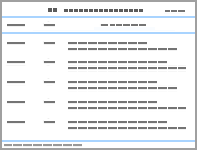
Table 1
Analysis of factors influencing optimism levels among women of reproductive age living with HIV [n=185,n(%)/ M (Q1,Q3)]
| 项目 | 例数(百分比) | 乐观水平得分 | U/H | P |
| 年龄(岁) | 0.249 | 0.883 | ||
| 19~27 | 16(8.6) | 22.00(18.25,23.50) | ||
| 28~35 | 53(28.6) | 22.00(18.50,25.50) | ||
| 36~49 | 116(62.7) | 21.50(19.00,25.00) | ||
| 婚姻状况 | −2.257 | 0.024 | ||
| 未婚/离异/丧偶 | 61(33.0) | 21.00(18.00,24.00) | ||
| 已婚 | 124(67.0) | 22.00(19.25,25.00) | ||
| 居住地 | −2.678 | 0.007 | ||
| 城市 | 98(53.0) | 23.00(20.00,26.00) | ||
| 农村 | 87(47.0) | 21.00(18.00,23.00) | ||
| 独生女 | 1.705 | 0.088 | ||
| 是 | 17(9.2) | 21.00(18.00,22.50) | ||
| 否 | 168(90.8) | 22.00(19.00,25.00) | ||
| 文化程度 | 3.484 | 0.175 | ||
| 初中及以下 | 96(51.9) | 21.00(18.25,24.00) | ||
| 高中/中专 | 57(30.8) | 22.00(18.50,26.00) | ||
| 大专及以上 | 32(17.3) | 22.50(19.25,26.00) | ||
| 每月可支配收入(元) | 5.854 | 0.054 | ||
| 无收入 | 29(15.7) | 21.00(18.00,23.50) | ||
| < 5 000 | 104(56.2) | 21.00(19.00,24.75) | ||
| ≥ 5 000 | 52(28.1) | 23.00(20.00,26.00) | ||
| 医疗费用支付方式 | 2.479 | 0.479 | ||
| 城镇居民医保 | 32(17.3) | 20.00(18.00,24.75) | ||
| 新农合 | 7(3.8) | 22.00(18.00,26.00) | ||
| 职工医保 | 39(21.1) | 22.00(20.00,25.00) | ||
| 自费或其他 | 107(57.8) | 22.00(19.00,25.00) | ||
| 感染途径 | −1.494 | 0.135 | ||
| 性传播 | 170(91.9) | 22.00(19.00,25.00) | ||
| 非性传播 | 15(8.1) | 20.00(18.00,23.00) | ||
| 抗病毒治疗时长 | −0.101 | 0.919 | ||
| < 1年 | 6(3.2) | 21.00(18.75,24.75) | ||
| ≥ 1年 | 179(96.8) | 22.00(19.00,25.00) | ||
| 服药依从性 | −0.282 | 0.778 | ||
| 从未漏服 | 100(54.1) | 22.00(18.50,26.00) | ||
| 有漏服 | 85(45.9) | 22.00(19.00,24.75) | ||
| 药物不良反应 | 0.220 | 0.974 | ||
| 严重 | 3(1.6) | 20.00(18.50,24.00) | ||
| 一般 | 24(13.0) | 21.00(19.00,25.50) | ||
| 轻微 | 58(31.4) | 22.00(19.00,25.00) | ||
| 无感觉 | 100(54.1) | 22.00(18.00,25.00) | ||
| 耐药性 | −1.017 | 0.309 | ||
| 是 | 5(2.7) | 22.00(17.00,24.00) | ||
| 否 | 180(97.3) | 22.00(19.00,25.00) | ||
| CD4+T淋巴细胞(个/µL) | 1.914 | 0.590 | ||
| < 200 | 2(1.1) | 23.50(20.00,27.00) | ||
| 200~350 | 15(8.1) | 21.00(19.00,26.00) | ||
| 351~500 | 36(19.5) | 22.00(20.00,25.00) | ||
| > 500 | 132(71.4) | 21.50(18.00,24.00) | ||
| 病毒载量(拷贝/mL) | −0.153 | 0.878 | ||
| ≤ 50 | 180(97.3) | 22.00(19.00,25.00) | ||
| > 50 | 5(2.7) | 21.00(18.50,26.00) | ||
| 目前身体状况 | −1.749 | 0.080 | ||
| 好 | 104(56.2) | 22.00(18.25,26.00) | ||
| 一般 | 81(43.8) | 21.00(19.00,24.00) | ||
| 生育史 | 2.269 | 0.023 | ||
| 是 | 124(67.0) | 22.00(20.00,25.00) | ||
| 否 | 61(33.0) | 21.00(18.00,24.00) | ||
| 未来生育意愿 | 0.478 | 0.633 | ||
| 是 | 38(20.5) | 22.00(18.00,25.00) | ||
| 否 | 147(79.5) | 22.00(19.75,25.00) | ||
| 因HIV改变生育意愿 | 1.852 | 0.064 | ||
| 是 | 99(53.5) | 21.00(18.00,24.00) | ||
| 否 | 86(46.5) | 22.00(20.00,26.00) | ||
| 医学应对问卷 | 0.958 | 0.620 | ||
| 面对 | 96(51.9) | 21.50(19.00,25.00) | ||
| 回避 | 85(45.9) | 22.00(19.00,25.50) | ||
| 屈服 | 4(2.2) | 21.00(17.25,21.75) |
Table 2
Assignment of variables for the multiple linear regression analysis
| 变量 | 赋值与定义 |
| 每月可支配收入(元) | 0= “无收入”,1=“5 000以下”, 2=“5 000以上” |
| 居住地 | 0=“农村”,1=“城市” |
| 婚姻状况 | 0=“未婚/离异/丧偶”,1=“已婚” |
| 身体状况 | 0=“一般”,1=“好” |
| 独生女 | 0=“否”,1=“是” |
| 生育史 | 0=“否”,1=“是” |
| 因HIV改变生育意愿 | 0=“否”,1=“是” |
Table 3
Results of multiple linear regression analysis on factors influencing optimism levels among women with HIV
| 变量 | B | SE | β | t | P | 95% CI |
| 常数项 | 20.271 | 0.710 | - | 28.556 | 0.000 | 18.870~21.672 |
| 每月可支配收入 | 0.757 | 0.420 | 0.134 | 1.802 | 0.073 | −0.072~1.586 |
| 居住地(城市) | 1.209 | 0.549 | 0.165 | 2.202 | 0.029 | 0.126~2.292 |
| 独生女(是) | −1.914 | 0.895 | −0.151 | −2.138 | 0.034 | −3.680~−0.147 |
| 因HIV改变生育意愿(是) | −1.038 | 0.516 | −0.141 | −2.011 | 0.046 | −2.057~−0.019 |
| 生育史(是) | 1.332 | 0.548 | 0.171 | 2.430 | 0.016 | 0.251~2.414 |
| [1] | World Health Organization. HIV statistics, globally and by WHO region, 2025 [EB/OL]. (2025-07-21)[2025-11-06]. https://cdn.who.int/media/docs/default-source/hq-hiv-hepatitis-and-stis-library/who-ias-hiv-statistics_2025-new.pdf?sfvrsn=5023deae_15. |
| [2] | 冯颖, 李月飞, 何倩, 等. 育龄期女性HIV感染者心理韧性、歧视感知、社会资本影响因素分析[J]. 中国优生与遗传杂志, 2023, 31(5):901-907. |
| Feng Y, Li YF, He Q, et al. Influencing factors of psychological resilience, perceived discrimination and social capital among women infected with HIV in reproductive age[J]. Chinese Journal of Birth Health & Heredity, 2023, 31(5):901-907. | |
| [3] |
段甜, 王哲, 殷爱娣. 积极心理学的团体心理辅导对冠心病患者经皮冠状动脉介入治疗术后运动恐惧、创伤后成长和生活质量的影响[J]. 中国健康心理学杂志, 2025, 33(6):865-870.
doi: 10.13342/j.cnki.cjhp.2025.06.013 |
|
Duan T, Wang Z, Yin AD. Effect of group psychological counseling based on positive psychology on exercise fear, post-traumatic growth and quality of life in patients with coronary heart disease after PCI[J]. China Journal of Health Psychology, 2025, 33(6):865-870.
doi: 10.13342/j.cnki.cjhp.2025.06.013 |
|
| [4] |
Basten-Günther J, Peters M, Lautenbacher S. Optimism and the experience of pain: a systematic review[J]. Behav Med, 2019, 45(4):323-339.
doi: 10.1080/08964289.2018.1517242 |
| [5] | Kubzansky LD, Huffman JC, Boehm JK, et al. Positive psychological well-being and cardiovascular disease: JACC health promotion series[J]. J Am Coll Cardiol, 2018, 72(12):1382-1396. |
| [6] |
Wong WS, Fielding R. Quality of life and pain in Chinese lung cancer patients: is optimism a moderator or mediator?[J]. Qual Life Res, 2007, 16(1):53-63.
doi: 10.1007/s11136-006-9106-z |
| [7] |
Liu Y, Jiang TT, Shi TY. The relationship among rumination, coping strategies, and subjective well-being in Chinese patients with breast cancer: a cross-sectional study[J]. Asian Nurs Res (Korean Soc Nurs Sci), 2020, 14(4):206-211.
doi: 10.1016/j.anr.2020.07.005 |
| [8] |
高玉琴, 原露露, 张序杰, 等. 口腔肿瘤患者积极心理品质与生活质量的相关性研究[J]. 中华护理教育, 2019, 16(2):101-104.
doi: 10.3761/j.issn.1672-9234.2019.02.005 |
|
Gao YQ, Yuan LL, Zhang XJ, et al. The correlation between positive psychological quality and the quality of life among oral cancer patients[J]. Chin J Nurs Educ, 2019, 16(2):101-104.
doi: 10.3761/j.issn.1672-9234.2019.02.005 |
|
| [9] | 赵阳. 慢性阻塞性肺疾病患者社会支持和生存质量的关系及积极心理资源的中介作用研究[D].沈阳: 沈阳医学院, 2023. |
| Zhao Y. Study on the relationship between social support and quality of survival in patients with chronic obstructive pulmonary disease and the mediating role of positive psychological resources[D].Shenyang: Shenyang Medical College, 2023. | |
| [10] |
吴兰花, 薛将, 许倩. 城市社区3类老人心理弹性与社会支持、气质性乐观、自我效能的关系[J]. 中国健康心理学杂志, 2021, 29(12):1796-1799.
doi: 10.13342/j.cnki.cjhp.2021.12.009 |
|
Wu LH, Xue J, Xu Q. Associations of resilience, social support, dispositional optimism and self-efficacy in three groups of elderly people in urban community[J]. China Journal of Health Psychology, 2021, 29(12):1796-1799.
doi: 10.13342/j.cnki.cjhp.2021.12.009 |
|
| [11] |
Benoit V, Gabola P. Effects of positive psychology interventions on the well-being of young children: a systematic literature review[J]. Int J Environ Res Public Health, 2021, 18(22):12065.
doi: 10.3390/ijerph182212065 |
| [12] |
Rogers ME, Hansen NB, Levy BR, et al. Optimism and coping with loss in bereaved HIV-infected men and women[J]. J Soc Clin Psychol, 2005, 24(3):341-360.
doi: 10.1521/jscp.24.3.341.65619 |
| [13] |
Pan L, Yeung NCY. Positive psychology interventions for improving self-management behaviors in patients with type 1 and type 2 diabetes: a narrative review of current evidence[J]. Curr Diab Rep, 2023, 23(11):329-345.
doi: 10.1007/s11892-023-01525-z |
| [14] |
郭玉华, 熊良圣. 2018年—2021年宜春市女性流动人口艾滋病、梅毒感染现状及影响因素分析[J]. 中国性科学, 2022, 31(6):141-144.
doi: 10.3969/j.issn.1672-1993.2022.06.037 |
|
Guo YH, Xiong LS. Situation and influencing factors of HIV/syphilis infection among female floating population in Yichun from 2018 to 2021[J]. Chinese Journal of Human Sexuality, 2022, 31(6):141-144.
doi: 10.3969/j.issn.1672-1993.2022.06.037 |
|
| [15] | 谢鹏. 育龄期HIV感染者生育忧虑量表的研制及信效度检验[D].成都: 成都中医药大学, 2024. |
| Xie P. Development and reliability test of the reproductive concerns scale for HIV-infected persons of reproductive age[D].Chengdu: Chengdu University of TCM, 2024. | |
| [16] |
江欣悦, 刘拽花, 徐钟庚. 艾滋病与艾滋病家庭研究进展[J]. 中国艾滋病性病, 2017, 23(7):674-676.
doi: 10.13419/j.cnki.aids.2017.07.28 |
|
Jiang XY, Liu ZH, Xu ZG. Research progress of people living with HIV/AIDS and their families[J]. Chin J AIDS STD, 2017, 23(7):674-676.
doi: 10.13419/j.cnki.aids.2017.07.28 |
|
| [17] |
Shah MS, Letourneau JM, Niemasik EE, et al. The role of in-depth reproductive health counseling in addressing reproductive health concerns in female survivors of nongynecologic cancers[J]. J Psychosoc Oncol, 2016, 34(4):305-317.
doi: 10.1080/07347332.2016.1182958 |
| [18] |
谢鹏, 万彬, 曾艳, 等. 基于ABC-X模型的育龄期HIV/AIDS患者生育忧虑的质性研究[J]. 中国艾滋病性病, 2024, 30(4):382-386.
doi: 10.13419/j.cnki.aids.2024.04.09 |
|
Xie P, Wan B, Zeng Y, et al. Qualitative research on reproductive concerns among patients with HIV/AIDS of childbearing age: insights from the ABC-X model[J]. Chin J AIDS STD, 2024, 30(4):382-386.
doi: 10.13419/j.cnki.aids.2024.04.09 |
|
| [19] | 岳岑, 张刚, 刘伟信, 等. 2013—2021年四川省艾滋病合并梅毒感染孕产妇流行病学特征及干预服务情况分析[J]. 预防医学情报杂志, 2024, 40(1):11-17. |
| Yue C, Zhang G, Liu WX, et al. Epidemiological characteristics and intervention services of pregnant women infected with AIDS and syphilis in Sichuan province[J]. J Prev Med Inf, 2024, 40(1):11-17. |
| [1] | WANG Yao, WEI Lanlan, CHU Ming, WANG Fuxiang. Mechanisms and research progress of neurological damage caused by HIV and CMV from the perspective of co-infection [J]. Journal of Internal Medicine Concepts & Practice, 2026, 21(01): 62-67. |
| [2] | WANG Minhui, KANG Lei. Analysis of the status and influencing factors of patient dignity in the intensive care unit [J]. Journal of Internal Medicine Concepts & Practice, 2026, 21(01): 46-52. |
| [3] | QI Qingsong, TIAN Meina, YU Yao. Research progress on immunological non-response in acquired immunodeficiency syndrome patients [J]. Journal of Internal Medicine Concepts & Practice, 2026, 21(01): 3-11. |
| [4] | WANG Yanli, HOU Mingjie, YUAN Haizhen, XIN Ningbo, ZHANG Yuwei, HAN Lei, ZHANG Yifan, MA Yuqing, ZHAO Qingxia. Analysis on etiological characteristics of 322 patients with human immunodeficiency virus infection / acquired immunodeficiency syndrome complicated with pulmonary infection in Henan province [J]. Journal of Internal Medicine Concepts & Practice, 2026, 21(01): 21-27. |
| [5] | HE Yuanhong, LIU Lin, LIU Huanxia, YANG Tongtong. Effects of rapid initiation of antiretroviral therapy on viral suppression and immune recovery in treatment-naïve HIV-1-infected patients in Sichuan province [J]. Journal of Internal Medicine Concepts & Practice, 2026, 21(01): 12-20. |
| [6] | WANG Guojun, WANG Liye, WANG Lifang, LIAO Chenglin. Electric Vehicle Charging Load Modeling Based on Influence Factor Analysis [J]. J Shanghai Jiaotong Univ Sci, 2025, 30(6): 1232-1241. |
| [7] | Tang Yuzhen, Du Jiang, Zhang Dapeng, Wu Xiaojun, Long Yan, Zhang Lei, Chen Tianzhen. Exploring Functions of a Smartphone-Based Digital Alcohol Consumption Intervention Mini-Program to Address Difficulties of Abstinence for Native Drinkers in China: A Mixed Methods Approach [J]. J Shanghai Jiaotong Univ Sci, 2025, 30(4): 751-758. |
| [8] | TANG Yuhang, YU Kun, ZENG Xiangjun, NI Yanru, CHENG Xinxiang, HAN Wei. Calculation Method for Underground Metal Corrosion Due to Stray Current Based on Ground Potential Distribution [J]. Journal of Shanghai Jiao Tong University, 2025, 59(3): 424-434. |
| [9] | LIU Xinyi, ZHOU Yanchun, ZHANG Yili, et al . The status and influencing factors of anxiety and depression in patients with congenital microtia [J]. Journal of Tissue Engineering and Reconstructive Surgery, 2025, 21(1): 68-. |
| [10] | WANG Tian, YANG Minli. Influencing factors and prediction model construction of preoperative respiratory tract infection and postoperative prognosis of cleft lip and palate#br# [J]. Journal of Tissue Engineering and Reconstructive Surgery, 2025, 21(1): 40-. |
| [11] | CAI Hui, LI Yousheng, HUANG Yuhua, XU Jingjing, LIU Qingfen, GU Fen. Analysis of current status and influencing factors of opportunistic infections in Crohn disease [J]. Journal of Internal Medicine Concepts & Practice, 2025, 20(06): 440-448. |
| [12] | SUN Xin, WANG Simin, XIE Jingdong, JIANG Hailin, WANG Sen. Improved Transformer-PSO Short-Term Electricity Price Prediction Method Considering Multidimensional Influencing Factors [J]. Journal of Shanghai Jiao Tong University, 2024, 58(9): 1420-1431. |
| [13] |
JIANG Yan, Ran Xuehui, LIN Xiaoxi, et al.
Status and influencing factors of stigma in patients with port wine stains in the head and neck [J]. Journal of Tissue Engineering and Reconstructive Surgery, 2024, 20(3): 335-. |
| [14] | Gong Tingting, Qian Aihua, Chen Xi. Construction of a Nomogram model for personalized prediction of the risk of delayed postoperative bleeding after endoscopic submucosal dissection for early gastric cancer [J]. Journal of Surgery Concepts & Practice, 2024, 29(03): 236-242. |
| [15] | SONG Jiani, ZHU Ying, HUANG Jia, TANG Yuming, YAO Weiyan. Mental health status of patients with esophageal symptoms and esophageal motility disorders during coronavirus pandemic [J]. Journal of Internal Medicine Concepts & Practice, 2023, 18(05): 309-315. |
| Viewed | ||||||
|
Full text |
|
|||||
|
Abstract |
|
|||||
