

Contemporary Foreign Languages Studies ›› 2025, Vol. 25 ›› Issue (6): 142-149.doi: 10.3969/j.issn.1674-8921.2025.06.016
Previous Articles Next Articles
CHEN Ying1( ), PENG Jian’e2(), LIU Yi1()
Online:2025-12-28
Published:2026-01-28
CLC Number:
CHEN Ying, PENG Jian’e, LIU Yi. Investigating the Correlation Between Teachers’ Teaching for Creativity and Foreign Language Teaching Enjoyment[J]. Contemporary Foreign Languages Studies, 2025, 25(6): 142-149.
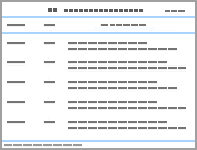
| 变量 | 得分区间 | 最小值 | 最大值 | 单项平均值 | 标准差 |
|---|---|---|---|---|---|
| 教师创造力教学 | 36-216 | 114 | 216 | 4.51 | 0.54 |
| 教师自我效能 | 13-78 | 37 | 78 | 4.44 | 0.61 |
| 环境鼓励 | 7-42 | 15 | 42 | 4.33 | 0.80 |
| 社会价值 | 10-60 | 30 | 60 | 4.91 | 0.63 |
| 学生潜力 | 6-36 | 13 | 36 | 4.21 | 0.70 |
| 外语教学愉悦 | 9-54 | 27 | 54 | 4.70 | 0.70 |
| 个人外语教学愉悦 | 3-18 | 9 | 18 | 4.78 | 0.75 |
| 学生相关型外语教学愉悦 | 3-18 | 9 | 18 | 4.67 | 0.75 |
| 社交型外语教学愉悦 | 3-18 | 9 | 18 | 4.66 | 0.74 |
| 外语教学愉悦 | ||
|---|---|---|
| 教师创造力教学 | 皮尔逊相关性 | .785*** |
| 教师自我效能 | 皮尔逊相关性 | .753*** |
| 环境鼓励 | 皮尔逊相关性 | .391*** |
| 社会价值 | 皮尔逊相关性 | .712*** |
| 学生潜力 | 皮尔逊相关性 | .622*** |
| 回归模型 | 拟合指数 | 系数 | 共线性诊断 | |||||||||||
|---|---|---|---|---|---|---|---|---|---|---|---|---|---|---|
| 预测变量 | 结果变量 | R | R2 | F | β | t | p | 容忍度 | 方差 膨胀系数 | |||||
| 常量 | - | .405 | .686 | - | - | |||||||||
| 教师自我 效能 | 外语教学 愉悦 | .435 | 12.858 | .000 | .433 | 2.309 | ||||||||
| 环境鼓励 | .81 | .656 | 330.644*** | .017 | .660 | .509 | .780 | 1.282 | ||||||
| 社会价值 | .334 | 10.593 | .000 | .499 | 2.005 | |||||||||
| 学生潜力 | .134 | 4.379 | .000 | .528 | 1.895 | |||||||||
| [1] |
Amabile, T. M., S. G. Barsade, J. S. Mueller, et al. 2005. Affect and creativity at work[J]. Administrative Science Quarterly 50(3): 367-403.
doi: 10.2189/asqu.2005.50.3.367 URL |
| [2] | Benesch, S. 2017. Emotions and English Language Teaching: Exploring Teachers’ Emotion Labor[M]. New York: Routledge. |
| [3] |
Davis, M. A. 2009. Understanding the relationship between mood and creativity: A meta-analysis[J]. Organizational Behavior and Human Decision Processes 108(1):25-38.
doi: 10.1016/j.obhdp.2008.04.001 URL |
| [4] | Dewaele, J.-M. & P. D. MacIntyre. 2016. Foreign language enjoyment and foreign language classroom anxiety: The right and left feet of the language learner[A]. In P. D.MacIntyre, T.Gregersen & S.Mercer (eds.). Positive Psychology in SLA[C]. Bristol: Multilingual Matters. 215-236. |
| [5] | Dobbins, K. 2009. Teacher creativity within the current education system: A case study of the perceptions of primary teachers[J]. Education3-13 37 (2): 95-104. |
| [6] | Eason, R., D. M. Giannangelo, L. A. Franceschini. 2009. A look at creativity in public and private schools[J]. Thinking Skills and Creativity (4):130-137. |
| [7] |
Frenzel, A. C., T. Goetz, O. Lüdtke, et al. 2009. Emotional transmission in the classroom: Exploring the relationship between teacher and student enjoyment[J]. Journal of Educational Psychology 101(3):705-716.
doi: 10.1037/a0014695 URL |
| [8] |
Lee, H.-H. & T.-T. Yang. 2015. Employee goal orientation, work unit goal orientation and employee creativity[J]. Creativity and Innovation Management 24(4): 659-674.
doi: 10.1111/caim.v24.4 URL |
| [9] |
Meihami, H. 2022. An exploratory investigation into EFL teacher educators’ approaches to develop EFL teachers’ ability to teach for creativity[J]. Thinking Skills and Creativity 43:101006.
doi: 10.1016/j.tsc.2022.101006 URL |
| [10] | Mierzwa, E. 2019. Foreign language learning and teaching enjoyment: Teachers’ perspectives[J]. Journal of Education, Culture and Society 10(2): 170-188. |
| [11] |
Oxford, R. L. & J. A. Burry-Stock. 1995. Assessing the use of language learning strategies worldwide with the ESL/EFL version of the Strategy Inventory for Language Learning (SILL)[J]. System 23(1): 1-23.
doi: 10.1016/0346-251X(94)00047-A URL |
| [12] |
Proietti Ergün, A. L. & J. -M. Dewaele. 2021. Do well-being and resilience predict the foreign language teaching enjoyment of teachers of Italian?[J]. System 99: 102506.
doi: 10.1016/j.system.2021.102506 URL |
| [13] |
Rubenstein, L. D., D. B. McCoach & D. Siegle. 2013. Teaching for creativity scales: An instrument to examine teachers’ perceptions of factors that allow for the teaching of creativity[J]. Creativity Research Journal 25(3):324-334.
doi: 10.1080/10400419.2013.813807 URL |
| [14] |
Yuan, F. & R. W. Woodman. 2010. Innovative behavior in the workplace: The role of performance and image outcome expectations[J]. Academy of Management Journal 53(2):323-342.
doi: 10.5465/amj.2010.49388995 URL |
| [15] | 雷蕾. 2020. 应用语言学研究——设计与统计[M]. 武汉: 华中科技大学出版社. |
| [16] | 王振宏、 王克静、 游旭群, 等. 2010. 教师效能、工作动机与心境对教学创新的影响[J]. 心理科学 33(5):1254-1257. |
| [17] | 夏纪梅、 卢莉. 2003. 教案设计:外语教师创新能力的表现[J]. 外语界(1):54-59. |
| [18] | 中共中央国务院. 2018. 关于全面深化新时代教师队伍建设改革的意见[EB/OL].[2024-09-20]. https://www.gov.cn/zhengce/2018-01/31/content_5262659.htm. |
| [19] | 中华人民共和国教育部. 2022. 义务教育英语课程标准(2022年版)[M]. 北京: 北京师范大学出版社. |
| Viewed | ||||||
|
Full text |
|
|||||
|
Abstract |
|
|||||
