

诊断学理论与实践 ›› 2025, Vol. 24 ›› Issue (05): 518-528.doi: 10.16150/j.1671-2870.2025.05.007
徐图1a, 史春桃1a, 韩玮2a, 姚丽倩2b, 陈超波1a, 房灵1b, 顾婷婷2b( )
)
收稿日期:2025-04-21
修回日期:2025-05-29
接受日期:2025-06-21
出版日期:2025-10-25
发布日期:2025-10-23
通讯作者:
顾婷婷 E-mail:15152883536@163.com基金资助:
XU Tu1a, SHI Chuntao1a, HAN Wei2a, YAO Liqian2b, CHEN Chaobo1a, FANG Ling1b, GU Tingting2b()
Received:2025-04-21
Revised:2025-05-29
Accepted:2025-06-21
Published:2025-10-25
Online:2025-10-23
摘要:
目的: 检测分析乳腺癌中生存素(survivin/BIRC5)表达及相关基因,并分析其在临床病理诊断及预测预后的价值。方法: 采用基于基因表达水平值的交互式分析平台(Gene Expression Profiling Interactive Analysis,GEPIA)数据库分析生存素在乳腺癌与正常乳腺组织中间的表达差异,及与其表达相关性最强基因,并分析生存素及相关基因产物与乳腺癌分期之间的关系。通过Kaplan-Meier plotter数据库数据,分析生存素及相关基因表达与乳腺癌患者预后间的关系。2016年1月至2019年3月间收集96例乳腺癌患者的术后组织标本中进行验证。采用免疫组织化学法检测标本中生存素及相关基因产物的表达情况,分析相关性,并评估其对临床病理和预后(5年总体生存率和5年无病生存)的评估价值。结果: GEPIA数据库生物信息分析显示,生存素在乳腺癌组织中表达异常升高;与其表达相关性最强的基因为胸苷激酶1(thymidine kinase 1,TK1),且TK1同时在乳腺癌组织中同样高表达。生存素与TK1在乳腺癌组织中的表达水平具有协同性,均呈现随着乳腺癌分期的升高而上升趋势(P<0.05),两者均与乳腺癌患者无复发生存期呈负相关(P<0.001)。术后组织标本免疫组化检测结果证实,生存素与TK1表达呈较强的正相关。生存素表达与淋巴结转移、TNM分期呈正相关(P<0.01);TK1表达与组织学分级、淋巴结转移、TNM分期呈正相关(P<0.05)。生存素与TK1共阳性共28例(29.17%),与乳腺癌组织学分级高、淋巴结转移及TNM分期晚相关(P<0.05)。在预后分析中,96例患者的5年总体生存率为61.5%,5年无病生存率为47.9%;生存素与TK1阳性分别是乳腺癌患者5年总体生存率(生存素阳性HR=2.225,95%CI为1.160~4.271,P=0.016;TK1阳性HR=3.176,95%CI为1.658~6.083,P<0.001)和5年无病生存率(生存素阳性HR=3.594,95%CI为2.018~6.401,P<0.001;TK1阳性HR=3.609,95%CI为2.057~6.330,P<0.001)的不良预后因素,且两者共阳性具有更高的风险比(5年总体生存率HR=4.486,95%CI为2.335~8.617,P<0.001;5年无病生存率HR=4.469,95%CI为2.515~7.942,P<0.001)。结论: 生存素与TK1在乳腺癌组织中的表达具有较强协同性,两者共阳性提示着高级别、淋巴结转移、中晚期,预后不佳。联合检测生存素和TK1对评估乳腺癌临床病理与预后具重要意义。
中图分类号:
徐图, 史春桃, 韩玮, 姚丽倩, 陈超波, 房灵, 顾婷婷. 乳腺癌组织中Survivin与TK1的协同表达现象及临床意义[J]. 诊断学理论与实践, 2025, 24(05): 518-528.
XU Tu, SHI Chuntao, HAN Wei, YAO Liqian, CHEN Chaobo, FANG Ling, GU Tingting. Synergistic expression of survivin and TK1 in breast cancer tissues and its clinical significance[J]. Journal of Diagnostics Concepts & Practice, 2025, 24(05): 518-528.
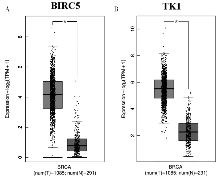
图1
GEPIA数据库分析BIRC5与TK1相关性 A:BIRC5在乳腺癌与正常组织中的表达差异;B:TK1在乳腺癌与正常组织中的表达差异。TPM:Transcripts Per Million,每百万转录本;*:P<0.05。
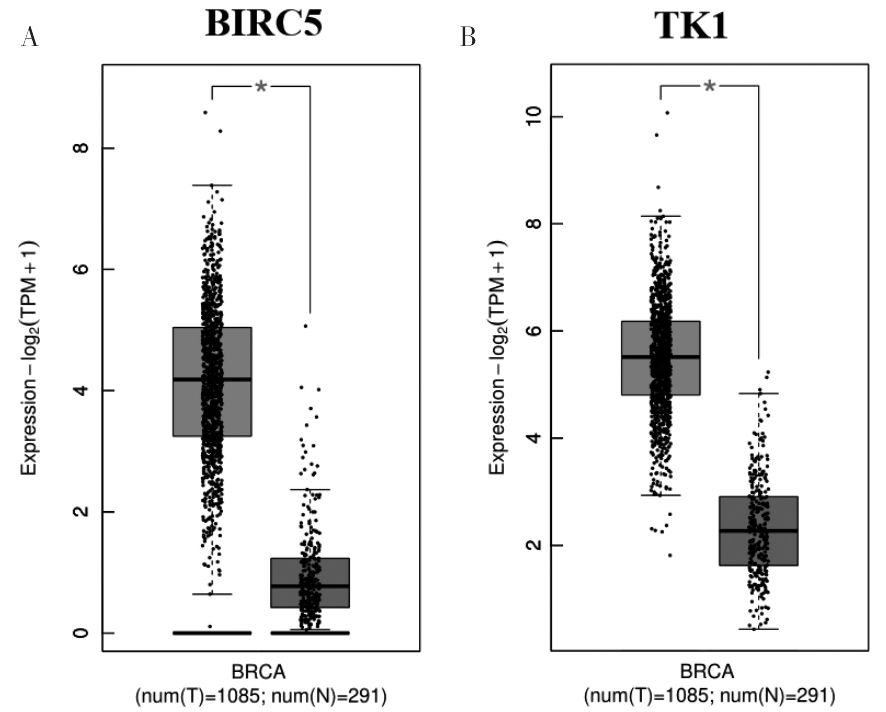
表1
乳腺癌组织中与BIRC5表达最相关的前十个基因
| Gene symbol | Genc ID | R |
|---|---|---|
| TK1 | ENSG00000167900.11 | 0.82 |
| ALYREF | ENSG00000183684.7 | 0.70 |
| KIF2C | ENSG00000142945.12 | 0.64 |
| NCAPH | ENSG00000121152.9 | 0.64 |
| PLK1 | ENSGU000166851.14 | 0.64 |
| KIF4A | ENSG00000N9088911 | 0.63 |
| AURKB | ENSG00000178999.12 | 0.63 |
| TROAP | ENSG00000135451.12 | 0.63 |
| CCNB2 | ENSG00000157456.7 | 0.63 |
| IPX2 | ENSGU0000D88325.15 | 0.63 |

图2
BIRC5与TK1表达相关性分析点状图


图3
GEPIA分析BIRC5、TK1与乳腺癌分期的关系
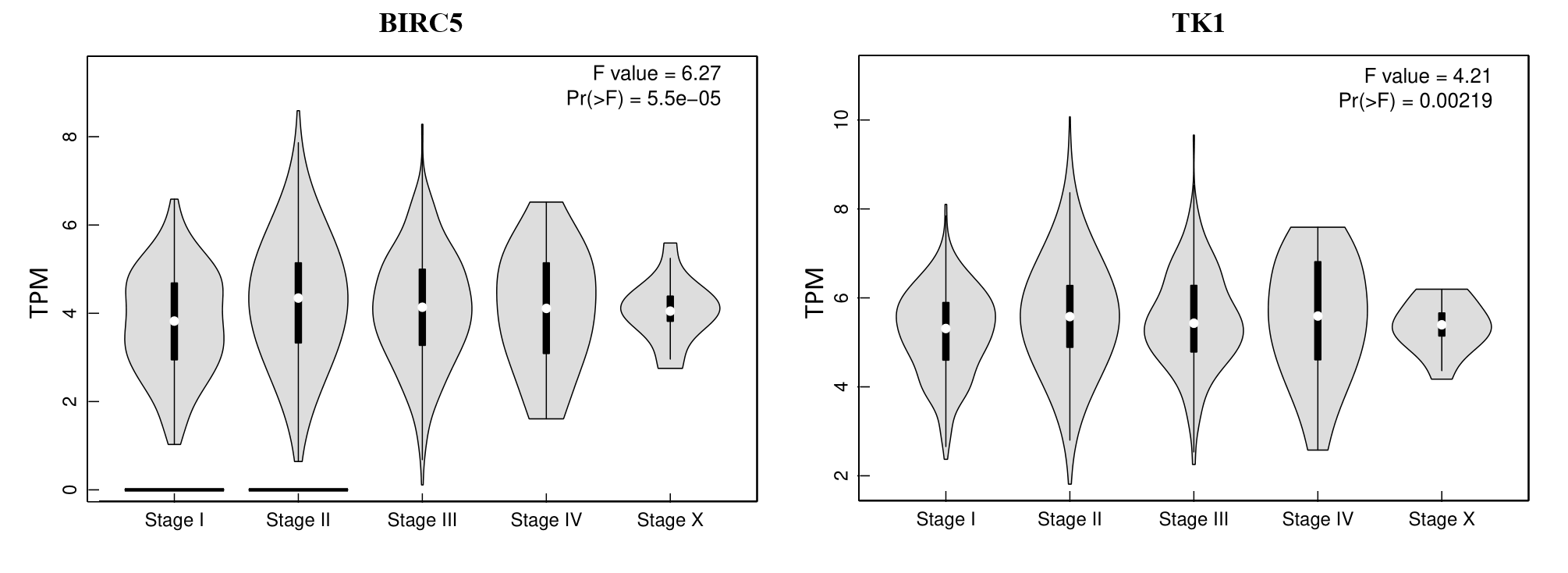

图4
Kaplan-Meier plotter分析BIRC5、TK1与乳腺癌患者预后间的关系 A:BIRC5、TK1表达高低的总体生存曲线;B:BIRC5、TK1表达高低的无复发生存曲线。

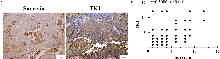
图5
免疫组化验证生存素与TK1在乳腺癌组织中的表达相关性 A:镜下观察生存素与TK1在乳腺癌组织中的阳性表达情况和阴性对照(×100);B:生存素与TK1的表达相关性分析点状图。

表2
生存素与TK1在乳腺癌中的表达与临床病理参数间的关系
| Clinicopathological features | n | Survivin expression | TK1 expression | ||||||
|---|---|---|---|---|---|---|---|---|---|
| Positive | Negative | χ2 | P | Positive | Negative | χ2 | P | ||
| Total | 96 | 42 | 54 | 34 | 62 | ||||
| Age | |||||||||
| <56 year | 50 | 20 | 30 | 0.596 | >0.05 | 19 | 31 | 0.304 | >0.05 |
| ≥56 year | 46 | 22 | 24 | 15 | 31 | ||||
| Tumor size | |||||||||
| ≤2 cm | 32 | 13 | 19 | 0.280 | >0.05 | 8 | 24 | 2.287 | >0.05 |
| 2-5 cm | 34 | 16 | 18 | 14 | 20 | ||||
| >5 cm | 30 | 13 | 17 | 12 | 18 | ||||
| Histological differentiation | |||||||||
| 1 | 27 | 10 | 17 | 1.732 | >0.05 | 6 | 21 | 6.634 | 0.036 |
| 2 | 39 | 16 | 23 | 12 | 27 | ||||
| 3 | 30 | 16 | 14 | 16 | 14 | ||||
| Lymph node metastasis | |||||||||
| No | 27 | 5 | 22 | 9.718 | 0.002 | 3 | 24 | 9.702 | 0.002 |
| Yes | 69 | 37 | 32 | 31 | 38 | ||||
| TNM stage | |||||||||
| Ⅰ-Ⅱ | 60 | 18 | 42 | 12.292 | <0.001 | 12 | 48 | 16.625 | <0.001 |
| Ⅲ-Ⅳ | 36 | 24 | 12 | 22 | 14 | ||||
表3
生存素与TK1在乳腺癌中共表达
| TK1 | Survivin expression | Summation | |
|---|---|---|---|
| expression | Positive | Negative | |
| Positive | 28 | 6 | 34 |
| Negative | 14 | 48 | 62 |
| Summation | 42 | 54 | 96 |
表4
生存素、TK1表达的共阳性、非共阳性与乳腺癌患者的临床病理参数的关系
| Clinicopathological features | n | Co-positive expression of Survivin and TK1 | χ2 | P | |
|---|---|---|---|---|---|
| Yes | No | ||||
| Total | 96 | 28 | 68 | ||
| Age | |||||
| <56 year | 50 | 17 | 33 | 1.180 | >0.05 |
| ≥56 year | 46 | 11 | 35 | ||
| Tumor size | |||||
| ≤2 cm | 32 | 5 | 27 | 4.275 | >0.05 |
| 2-5 cm | 34 | 12 | 22 | ||
| >5 cm | 30 | 11 | 19 | ||
| Histological diffe rentiation | |||||
| 1 | 27 | 4 | 23 | 7.374 | 0.025 |
| 2 | 39 | 10 | 29 | ||
| 3 | 30 | 14 | 16 | ||
| Lymph node metastasis | |||||
| No | 27 | 1 | 26 | 11.789 | 0.001 |
| Yes | 69 | 27 | 42 | ||
| TNM stage | |||||
| Ⅰ~Ⅱ | 60 | 8 | 52 | 19.415 | <0.001 |
| Ⅲ~Ⅳ | 36 | 20 | 16 | ||

图6
总体生存的Kaplan-Meier生存曲线 A:生存素表达高低的生存曲线(月);B:TK1表达高低的生存曲线(月)。
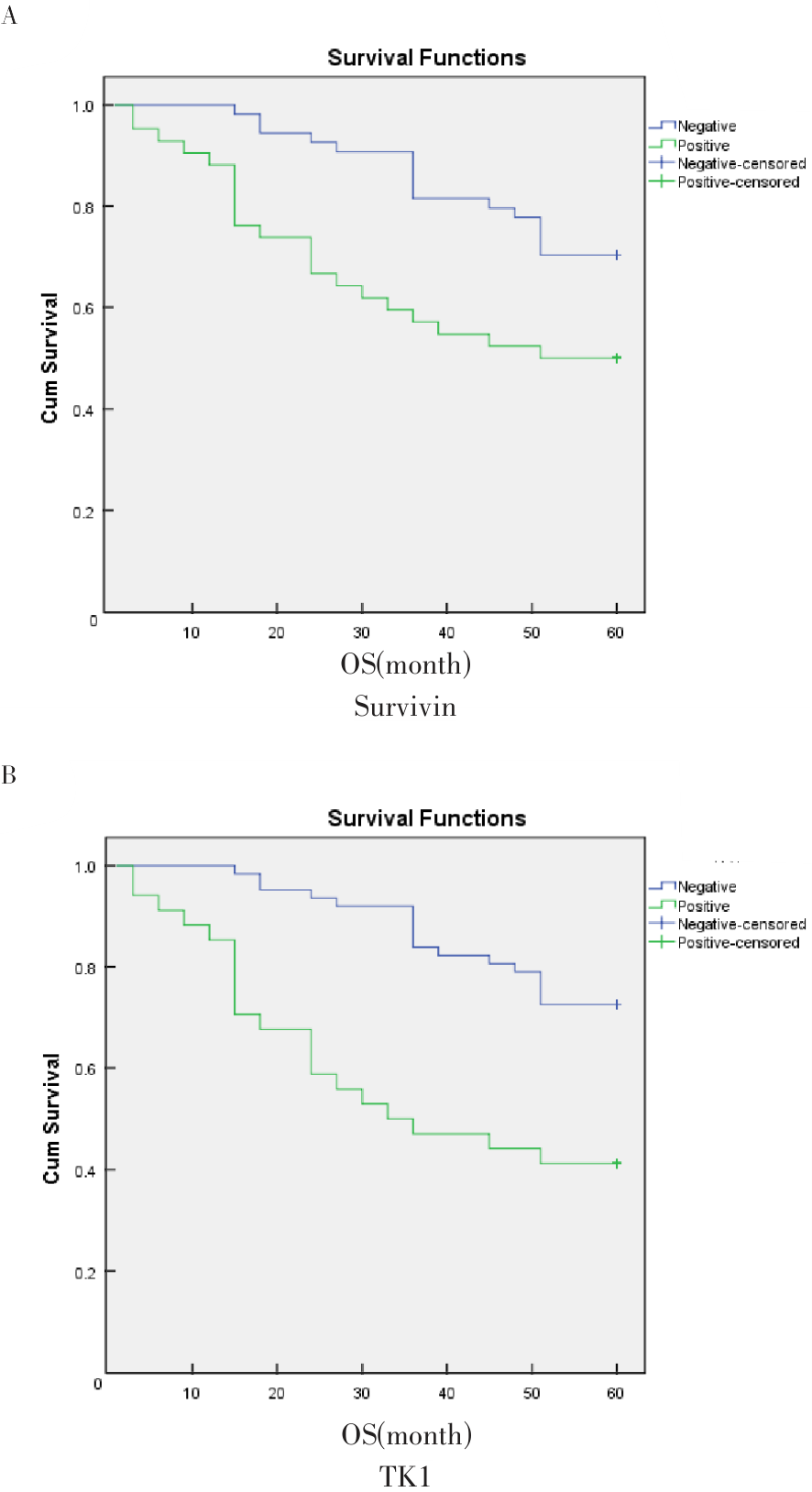

图7
无病生存的Kaplan-Meier生存曲线. A:生存素表达高低的生存曲线(月);B:TK1表达高低的生存曲线(月)。
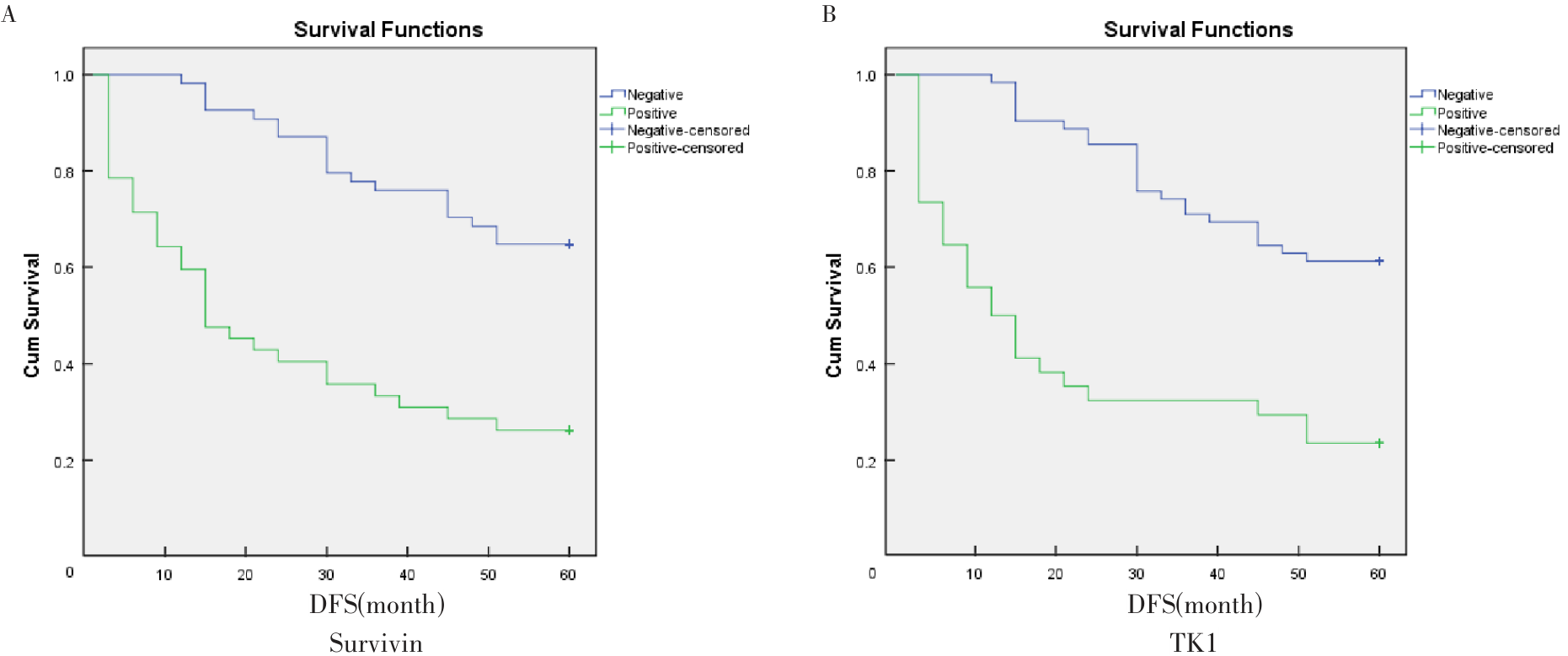
表5
总体生存率与无病生存率的Cox回归分析
| Items | Univariate analysis | Multivariate analysis | ||||
|---|---|---|---|---|---|---|
| HR | 95%CI | P | HR | 95%CI | P | |
| Overall survival | ||||||
| Survivin: Positive vs Negative | 2.225 | 1.160-4.271 | 0.016 | 1.130 | 0.522-2.446 | 0.756 |
| TK1: Positive vs Negative | 3.176 | 1.658-6.083 | <0.001 | 1.928 | 0.907-4.100 | 0.088 |
| Age: ≥56 y vs <56 y | 0.992 | 0.520-1.890 | 0.980 | 1.427 | 0.723-2.817 | 0.306 |
| Tumor size: >5 cm vs ≤5 cm | 1.988 | 1.037-3.812 | 0.039 | 1.327 | 0.667-2.643 | 0.421 |
| Histological differentiation: 3 vs 1-2 | 2.203 | 1.153-4.208 | 0.017 | 1.241 | 0.623-2.474 | 0.539 |
| Lymph node metastasis: Yes vs No | 4.064 | 1.439-11.479 | 0.008 | 0.929 | 0.251-3.443 | 0.913 |
| TNM stage: Ⅲ and Ⅳ vsⅠ and Ⅱ | 7.089 | 3.412-14.728 | <0.001 | 5.705 | 2.218-14.671 | <0.001 |
| Disease-free survival | ||||||
| Survivin: Positive vs Negative | 3.594 | 2.018-6.401 | <0.001 | 2.448 | 1.201-4.989 | 0.014 |
| TK1: Positive vs Negative | 3.609 | 2.057-6.330 | <0.001 | 1.997 | 1.035-3.854 | 0.039 |
| Age: ≥56 y vs <56 y | 0.845 | 0.484-1.474 | 0.553 | 0.829 | 0.446-1.543 | 0.555 |
| Tumor size: >5 cm vs ≤5 cm | 1.381 | 0.774-2.461 | 0.274 | 1.101 | 0.578-2.097 | 0.769 |
| Histological differentiation: 3 vs 1-2 | 1.344 | 0.748-2.414 | 0.322 | 0.694 | 0.363-1.325 | 0.268 |
| Lymph node metastasis: Yes vs No | 2.398 | 1.164-4.940 | 0.018 | 0.805 | 0.316-2.054 | 0.650 |
| TNM stage: Ⅲ and Ⅳ vs Ⅰ and Ⅱ | 5.015 | 2.802-8.976 | <0.001 | 4.225 | 1.904-9.376 | <0.001 |

图8
生存素与TK1联合检测的Kaplan-Meier生存曲线 A:总体生存(月);B:无病生存(月)。

表6
生存素与TK1共阳性的Cox回归分析
| Items | Univariate analysis | Multivariate analysis | ||||
|---|---|---|---|---|---|---|
| HR | 95%CI | P | HR | 95%CI | P | |
| Overall survival | ||||||
| Survivin+TK1+: Yes vs No | 4.486 | 2.335-8.617 | <0.001 | 2.951 | 1.455-5.983 | 0.003 |
| Age: ≥56 y vs <56 y | 1.542 | 0.778-3.055 | 0.215 | |||
| Tumor size: >5 cm vs ≤5 cm | 1.285 | 0.646-2.558 | 0.475 | |||
| Histological differentiation: 3 vs 1-2 | 1.064 | 0.525-2.158 | 0.863 | |||
| Lymph node metastasis: Yes vs No | 0.887 | 0.242-3.255 | 0.857 | |||
| TNM stage: Ⅲ and Ⅳ vs Ⅰ and Ⅱ | 5.806 | 2.249-14.989 | <0.001 | |||
| Disease-free survival | ||||||
| Survivin+TK1+: Yes vs No | 4.469 | 2.515-7.942 | <0.001 | 3.575 | 1.875-6.815 | <0.001 |
| Age: ≥56 y vs <56 y | 0.988 | 0.547-1.783 | 0.967 | |||
| Tumor size: >5 cm vs ≤5 cm | 0.945 | 0.505-1.769 | 0.860 | |||
| Histological differentiation: 3 vs 1-2 | 0.608 | 0.313-1.181 | 0.142 | |||
| Lymph node metastasis: Yes vs No | 0.879 | 0.347-2.225 | 0.786 | |||
| TNM stage: Ⅲ and Ⅳ vs Ⅰ and Ⅱ | 4.910 | 2.231-10.805 | <0.001 | |||
| [1] | 章新, 郑莹. 2005—2020年中国国家及分省疾病监测点的肿瘤死亡疾病负担数据解读[J]. 诊断学理论与实践, 2024, 23 (4): 371-377. |
| ZHANG X, ZHENG Y. Interpretation of cancer mortality burden data from national and provincial disease surveillance points in China from 2005 to 2020[J]. J Diagn Concepts Pract, 2024, 23 (4):371-377. | |
| [2] | 杨隽. 基于差异共表达分析的三阴性乳腺癌基因标志物及分型研究[D]. 西北民族大学, 2023. |
| YANG J. Research on gene markers and classification of triple-negative breast cancer based on differential co-expression analysis[D]. Northwest Minzu University, 2023. | |
| [3] | 苏芃, 毛晓韵, 关舒. 三阴性乳腺癌肿瘤微环境特征免疫相关生物学标志物筛选及功能预测分析[J]. 中国肿瘤外科杂志, 2020, 12(4):348-355. |
| SU P, MAO X, GUAN S, et al. Screening and functional prediction analysis of immune-related biomarkers in the tumor microenvironment of triple-negative breast cancer[J]. Chin J Surg Oncol, 2020, 12 (4):348-355. | |
| [4] | SHI C, MA J, SHI QF, et al. High survivin and low zinc finger of the cerebellum 1 expression indicates poor prognosis in triple-negative breast carcinoma[J]. J Breast Cancer, 2019, 22(2):248-259. |
| [5] | 林红霞, 韩鹭, 刘效伊. Survivin和Ezrin蛋白在乳腺癌组织中表达及病理意义[J]. 中国老年学杂志, 2021, 41 (23): 5387-5389. |
| LIN H, HAN L, LIU X. Expression and pathological significance of survivin and ezrin proteins in breast cancer tissues[J]. CJOG, 2021, 41 (23):5387-5389. | |
| [6] | 李科威. TK1通过TFDP1调控Wnt/β-catenin信号通路促进膀胱癌细胞增殖的研究[D]. 山东大学, 2021. |
| LI K. Research on the promotion of bladder cancer cell proliferation by TK1 through TFDP1 regulation of the Wnt/β-catenin signaling pathway[D]. Shandong University, 2021. | |
| [7] | 周家田, 梁卫东, 吴鹏, 等. 胸苷激酶1在恶性肿瘤中的作用[J]. 生命的化学, 2019, 39(3):498-503. |
| ZHOU J, LIANG W, WU P, et al. The role of thymidine kinase 1 in malignant tumors[J]. Chem Life, 2019, 39(3):498-503. | |
| [8] | SOOA A, MISHRA D, KHARBANDA O, et al. Role of S100 A7 as a diagnostic biomarker in oral potentially malignant disorders and oral cancer[J]. J Oral Maxillofac Pathol, 2022, 26(2):166-172. |
| [9] | LAZOW M, FULLER C, TROUT A, et al. Immunohistochemical assessment and clinical, histopathologic, and molecular correlates of membranous somatostatin type-2A receptor expression in high-risk pediatric central nervous system tumors[J]. Front Oncol, 2022, 12:996489. |
| [10] | 张亮杰, 王显斌, 刘俊. 乳腺癌血清TPS、TK1表达与病理特点的关系[J]. 解放军医药杂志, 2020, 32(2):32-35,47. |
| ZHANG L, WANG X, LIU J. Relationship between serum TPS and TK1 expression and pathological characteristics in breast cancer[J]. Med & Pharm J Chin PLA, 2020, 32(2):32-35,47. | |
| [11] | 朱娟, 陈鑫苹, 胡俊杰, 等. Survivin调控信号通路PTEN/PI3K/AKT对CNE-2细胞增殖和凋亡机制研究[J]. 广东医学, 2019, 40 (9):1231-1237. |
| ZHU J, CHEN X, HU J, et al. Study on the mechanism of survivin regulating the PTEN/PI3K/AKT signal pathway on the proliferation and apoptosis of CNE-2 cells[J]. Guangdong Med J, 2019, 40 (9):1231-1237. | |
| [12] | ZHANG Y, GAO H, ZHANG L, et al. Novel germline KIT variants in families with severe piebaldism: case series and literature review[J]. J Clin Lab Anal, 2024, 38(11-12):e25073. |
| [13] | PATRICIA Q, RICARDO Q, MOREIRA M, et al. Survivin expression as a prognostic marker for breast cancer.[J]. Rev Assoc Med Bras (1992), 2023, 69 (9):e20230167-e20230167. |
| [14] | 张富亮. TK1、HER2及Ki-67的表达与乳腺癌腋窝淋巴结转移的相关性研究[D]. 承德医学院, 2022. |
| Zhang Fuliang. Correlation study of TK1, HER2 and Ki-67 expression with axillary lymph node metastasis in breast cancer[D]. Chengde Medical University, 2022. | |
| [15] | 唐利娟, 程智勇, 门晓彦, 等. 血清TK1结合肿瘤标记物评估乳腺癌新辅助化疗疗效的价值观察[J]. 川北医学院学报, 2022, 37 (7):894-897. |
| TANG L, CHENG Z, MEN X, et al. Value of serum TK1 combined with tumor markers in evaluating the efficacy of neoadjuvant chemotherapy for breast cancer[J]. J North Sichuan Med College, 2022, 37 (7):894-897. | |
| [16] | 徐亮, 熊秋云. Survivin在乳腺癌中作用的研究进展[J]. 中华乳腺病杂志(电子版), 2012, 6 (04): 429-435. |
| XU L, XIONG Q. Research progress on the role of survivin in breast cancer[J]. Chin J Breast Dis (El Ed), 2012, 6 (4):429-435. | |
| [17] | 梅思思, 田世维, 段彦林, 等. SIRT2、P65和Survivin在乳腺癌中的表达及其与临床病理特征的关系[J]. 贵州医科大学学报, 2024, 49 (6):819-825. |
| MEI S, TIAN S, DUAN Y, et al. Expression of SIRT2, P65 and survivin in breast cancer and their relationship with clinical pathological characteristics[J]. J Guizhou Med Univ, 2024, 49 (6):819-825. | |
| [18] | 李伟清, 林永平, 黄玉林. 血清miR-21、sICAM-1、CA153联合检测诊断乳腺癌的价值[J]. 深圳中西医结合杂志, 2022, 32(9):71-73. |
| LI W, LIN Y, HUANG Y. Value of combined detection of serum miR-21, sICAM-1 and CA153 in the diagnosis of breast cancer[J]. Shenzhen J Integr Tradit Chin West Med, 2022, 32(9):71-73. | |
| [19] | KUCUKZEYBEK B, KUCUKZEYBEK Y, BASBINAR Y, et al. The prognostic role of survivin expression in breast cancer: A systematic review and meta-analysis[J]. Medicine, 2024, 103 (40):e40013. |
| [20] | 张佳佳. 长春、 上海两地乳腺癌疾病构成比及临床相关因素初步比较分析[D]. 吉林大学, 2005. |
| ZHANG J. A Preliminary comparative analysis of the composition ratio of breast cancer diseases and clinical related factors in Changchun and Shanghai[D]. Jilin University, 2005. | |
| [21] |
吴春晓, 庞怡, 顾凯, 等. 2002—2017年上海市女性乳腺癌生存分析[J]. 中国癌症杂志, 2025, 35(3):291-297.
doi: 10.19401/j.cnki.1007-3639.2025.03.005 |
| WU C, PANG Y, GU K, et al. Survival analysis of female breast cancer in Shanghai from 2002 to 2017[J]. China Oncol, 2025, 35 (3):291-297. | |
| [22] | 龙欣甜, 文洪梅, 李云飞, 等. 云南省23354例乳腺癌患者生存状况分析[J]. 实用肿瘤杂志, 2025, 40 (1):6-13. |
| LONG X, WEN H, LI Y, et al. Analysis of the survival status of 23,354 breast cancer patients in Yunnan province[J]. J Pract Oncol, 2025, 40 (1):6-13. |
| [1] | 杨梅, 廖啟安, 谭全会, 李婷婷, 张毅, 陈洁, 汤正好. 医院获得性细菌性脑膜炎患者预后不良的危险因素分析及列线图预测模型的构建[J]. 诊断学理论与实践, 2025, 24(04): 441-448. |
| [2] | 吴双成, 郁胜强. 2025版KDIGO常染色体显性多囊肾病评估、管理和治疗临床实践指南要点解读[J]. 诊断学理论与实践, 2025, 24(03): 255-262. |
| [3] | 周晓蝶, 戚荣鑫, 王璇, 余波, 王建军, 石群立, 饶秋, 鲍炜. 尿路上皮癌PD-L1、AR及P53表达及其与临床预后相关性[J]. 诊断学理论与实践, 2025, 24(03): 286-292. |
| [4] | 郭语清, 王长燕, 刘迎春, 庞芸, 朱霞, 葛睿, 李蔚萍, 张麒, 陈林. 基于三维超声视频的深度学习模型辅助不同年资医师鉴别乳腺肿块良恶性的应用价值[J]. 诊断学理论与实践, 2025, 24(03): 312-319. |
| [5] | 曾东, 宋曙, 杨月香, 许晶晶, 郭文娟, 郑叶, 石雨涵, 冯艳玲. AIDS合并CMV感染的临床病理特征及其鉴别诊断[J]. 诊断学理论与实践, 2025, 24(03): 320-327. |
| [6] | 魏静静, 银浩强, 王延文, 张晓云. 以微囊状形态为主的乳腺分泌性癌2例报告及文献复习[J]. 诊断学理论与实践, 2025, 24(03): 349-354. |
| [7] | 李卓含, 黄新韵, 郭睿, 易红梅, 许彭鹏, 武志芳, 李彪. 滤泡合并弥漫大B细胞淋巴瘤的PET/CT特征及其联合IPI在预后评估中的价值[J]. 诊断学理论与实践, 2025, 24(02): 178-186. |
| [8] | 龚静青, 曹端荣, 庄义欣, 邱立, 李晓鸣. 双表型鼻腔鼻窦肉瘤1例临床病理分析[J]. 诊断学理论与实践, 2025, 24(01): 100-105. |
| [9] | 张俊花, 李一林, 谢静远, 张春丽, 徐静. C3肾病临床预后相关病理特征分析[J]. 诊断学理论与实践, 2024, 23(06): 587-593. |
| [10] | 阮淼, 笪倩, 许海敏, 董磊, 费晓春. HER2低表达乳腺癌临床病理学特征及预后研究[J]. 诊断学理论与实践, 2024, 23(05): 500-508. |
| [11] | 王玉蓉, 汪元元, 翁海燕. 胃肠道平滑肌肉瘤临床病理分析3例报告[J]. 诊断学理论与实践, 2024, 23(05): 537-541. |
| [12] | 李卓含, 黄新韵, 郭睿, 李彪. 18F-FDG PET/CT在滤泡性淋巴瘤诊断和预后评估中的研究进展[J]. 诊断学理论与实践, 2024, 23(04): 439-444. |
| [13] | 朱维维, 李倩, 吴凡, 翟志敏. 100例骨髓增生异常性肿瘤患者基因突变及其与临床特征间的关系[J]. 诊断学理论与实践, 2024, 23(03): 305-312. |
| [14] | 倪亚平, 陈一峰, 杨晓群, 陈晓炎. 原发性肺腺癌伴肠母细胞分化2例临床病理及预后分析[J]. 诊断学理论与实践, 2024, 23(03): 324-329. |
| [15] | 刘娟, 殷丽娟, 范德生. AR、SKP2、SOX10、PD-L1及TIL表达在三阴性乳腺癌中的意义[J]. 诊断学理论与实践, 2024, 23(02): 162-172. |
| 阅读次数 | ||||||
|
全文 |
|
|||||
|
摘要 |
|
|||||
