

Journal of Diagnostics Concepts & Practice ›› 2026, Vol. 25 ›› Issue (02): 174-182.doi: 10.16150/j.1671-2870.2026.02.008
• Original articles • Previous Articles Next Articles
LIU Xiaocao1,2,3, ZENG Qingze4, LI Yixia1,2,3, LI Kaicheng4, LUO Xiao4, YAN Shaozhen1,2,3, LU Jie1,2,3( )
)
Received:2025-10-27
Revised:2026-01-04
Accepted:2026-01-05
Online:2026-04-25
Published:2026-04-25
Contact:
LU Jie
E-mail:imaginglu@hotmail.com
CLC Number:
LIU Xiaocao, ZENG Qingze, LI Yixia, LI Kaicheng, LUO Xiao, YAN Shaozhen, LU Jie. The effect of KL-VS gene on medial temporal lobe volume in patients with mild cognitive impairment: A study based on MRI[J]. Journal of Diagnostics Concepts & Practice, 2026, 25(02): 174-182.

Figure 1
Schematic diagram of automated segmentation of medial temporal lobe subregions and hippocampal subfields in different groups

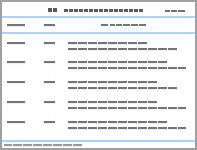
Table 1
Background characteristics of the total sample and by KL-VS status ($\bar{x}±s$)
| Item | KL-VShet-CN | KL-VShet-MCI | KL-VShet+CN | KL-VShet+MCI | F(χ2) | P |
|---|---|---|---|---|---|---|
| Number | 16 | 16 | 8 | 8 | / | / |
| Age(years) | 76.36±3.99 | 74.44±7.49 | 76.05±5.17 | 78.36±6.40 | 0.775 | 0.514 |
| Female [N (%)] | 2(12.5) | 9(56.25) | 4(50) | 1(12.5) | / | 0.024 |
| APOE ε4 carrier [N (%)] | 6(60) | 8(50) | 4(50) | 3(37.5) | / | 0.536 |
| Education(years) | 17.88±2.09 | 16.94±2.32 | 17.63±2.13 | 17.29±2.20 | 0.913 | 0.443 |
| MMSE (total) | 28.94±1.12 | 26.25±4.48 | 29.63±1.06 | 27.13±2.23 | 3.611 | 0.02a,d |
| MoCA (total) | 25.19±2.81 | 21.94±3.80 | 24.63±2.88 | 22.88±2.99 | 3.123 | 0.035a |
| Memory function (z-score) | 0.49±0.33 | 0.03±0.56 | 0.73±0.57 | 0.29±0.35 | 5.035 | 0.001a,c,d,f |
| Executive function (z-score) | 0.70±0.37 | 0.34±0.75 | 0.75±0.45 | 0.45±0.55 | 1.554 | 0.214 |
| Language function (z-score) | 0.45±0.33 | 0.34±0.65 | 0.76±0.41 | 0.20±0.48 | 1.956 | 0.135f |
| Aβ PET centiloid unit | 27.85±28.43(16) | 70.90±54.53(15) | 42.59±44.49(7) | 41.05±66.23(7) | 2.200 | 0.103a |
| tau Braak Ⅰ-Ⅱ SUVR(N) | 1.18±0.21(14) | 1.45±0.27(15) | 1.13±0.08(6) | 1.15±0.13(7) | 5.946 | 0.002a,d,e |
| tau Braak Ⅲ-Ⅳ SUVR(N) | 1.17±0.17(14) | 1.31±0.27(15) | 1.13±0.03(6) | 1.12±0.16(6) | 2.096 | 0.117 |
| tau Braak Ⅴ-Ⅵ SUVR(N) | 1.05±0.10(14) | 1.17±0.20(15) | 1.05±0.06(6) | 1.01±0.15(6) | 2.63 | 0.64a,e |
| tau META TEMporal SUVR(N) | 1.22±0.24(14) | 1.42±0.35(15) | 1.18±0.02(6) | 1.19±0.18(6) | 2.106 | 0.116 |
Table 2
Comparison of medial temporal lobe subregional volumes between KL-VShet⁺ and KL-VShet⁻ groups ($\bar{x}±s$)
| Item | KL-VShet-CN | KL-VShet-MCI | KL-VShet+CN | KL-VShet+MCI | F(χ2) | P |
|---|---|---|---|---|---|---|
| L_CA1 | 1287.70±114.45 | 1191.64±211.91 | 1324.33±200.95 | 1118.70±208.09 | 2.303 | 0.091c,f |
| L_CA2 | 1.57±1.26 | 1.11±0.61 | 1.53±1.21 | 0.74±0.46 | 1.275 | 0.300 |
| L_CA3 | 56.37±16.37 | 52.46±15.53 | 56.88±20.81 | 72.80±29.75 | 1.799 | 0.162e |
| L_DG | 782.93±68.93 | 710.09±146.09 | 797.66±98.31 | 755.19±186.68 | 1.234 | 0.309c,e |
| L_SUB | 447.20±83.46 | 403.47±52.35 | 447.50±87.31 | 382.98±69.07 | 1.959 | 0.135 |
| L_ERC | 456.30±66.04 | 369.30±79.03 | 398.13±101.39 | 387.99±128.81 | 2.671 | 0.060 |
| L_BA35 | 531.47±89.16 | 472.24±92.27 | 496.34±117.24 | 452.86±90.28 | 1.475 | 0.235 |
| L_BA36 | 1824.36±305.82 | 1605.57±266.88 | 1655.54±295.64 | 1599.68±448.21 | 1.502 | 0.228 |
| L_PHC | 757.33±165.20 | 722.16±164.32 | 713.10±140.74 | 693.08±143.82 | 0.317 | 0.813 |
| L_CA | 1346.21±123.47 | 1245.00±220.02 | 1382.17±192.91 | 1148.32±244.44 | 2.717 | 0.056c,f |
| L_HIPP | 2129.15±150.98 | 1955.09±358.11 | 2179.83±261.27 | 1859.12±441.02 | 2.283 | 0.093f |
| R_CA1 | 1173.77±119.59 | 1158.21±230.51 | 1266.84±162.16 | 1118.00±267.69 | 0.823 | 0.489 |
| R_CA2 | 7.84±3.27 | 8.19±4.12 | 9.38±2.72 | 6.68±1.04 | 0.778 | 0.513 |
| R_CA3 | 62.04±27.89 | 56.02±16.18 | 65.20±26.54 | 72.71±38.17 | 0.716 | 0.548 |
| R_DG | 792.12±99.14 | 788.20±165.25 | 852.15±73.66 | 751.24±140.99 | 0.803 | 0.499 |
| R_SUB | 443.26±85.09 | 434.48±75.11 | 477.25±80.70 | 387.62±48.23 | 1.750 | 0.171f |
| R_ERC | 491.23±102.61 | 415.65±98.74 | 433.40±101.50 | 464.73±167.08 | 1.262 | 0.300 |
| R_BA35 | 512.29±101.25 | 487.86±87.79 | 483.05±65.29 | 437.77±152.33 | 0.873 | 0.463 |
| R_BA36 | 1805.15±450.28 | 1574.03±250.67 | 1752.69±267.92 | 1591.25±510.68 | 1.225 | 0.313 |
| R_PHC | 774.14±126.18 | 787.02±125.03 | 759.42±110.75 | 764.08±283.94 | 0.069 | 0.976 |
| R_CA | 1243.64±136.95 | 1222.42±242.02 | 1341.42±154.19 | 1157.59±296.30 | 1.065 | 0.378 |
| R_HIPP | 2035.76±204.99 | 2010.62±400.06 | 2193.57±213.55 | 1882.69±430.93 | 1.225 | 0.312 |

Figure 2
Comparison of medial temporal lobe subregional volumes


Figure 3
Correlation analyses among imaging metrics, cognitive performance, and pathological markers


Figure 4
Illustration of interactive moderating effect

Table 3
Interactive moderating effects
| Subre- gions | Independent variable | Dependent variable | β(subregions× pathology× KL-VS) | SE | t | P | LLCI | ULCI | ∆R2 | KL-VShet- | KL-VShet+ | ||
|---|---|---|---|---|---|---|---|---|---|---|---|---|---|
| β | P | β | P | ||||||||||
| L_CA3 | Aβ-CL | MEM | 0.0005 | 0.000 2 | 2.710 0 | 0.010 3 | 0.000 1 | 0.000 8 | 0.112 9 | -0.000 1 | 0.702 3 | 0.000 4 | 0.001 0 |
| L_CA3 | Aβ-CL | MoCA | 0.002 5 | 0.001 2 | 2.033 1 | 0.049 7 | 0.000 0 | 0.005 0 | 0.076 0 | -0.001 0 | 0.272 1 | 0.001 5 | 0.082 0 |
| L_DG | tau Braak Ⅲ-Ⅳ SUVR | MEM | 0.028 1 | 0.009 5 | 2.974 6 | 0.005 5 | 0.008 9 | 0.047 4 | 0.120 4 | -0.004 9 | 0.179 7 | 0.023 3 | 0.012 3 |
| L_ERC | tau Braak Ⅲ-Ⅳ SUVR | MEM | 0.026 5 | 0.012 4 | 2.142 7 | 0.039 8 | 0.001 3 | 0.051 7 | 0.056 1 | -0.004 5 | 0.276 3 | 0.022 0 | 0.068 8 |
| L_PHC | tau Braak Ⅲ-Ⅳ SUVR | MEM | 0.034 1 | 0.017 7 | 1.923 5 | 0.063 3 | -0.002 0 | 0.070 2 | 0.062 5 | -0.000 8 | 0.080 4 | 0.033 3 | 0.065 4 |
| R_CA1 | tau Braak Ⅲ-Ⅳ SUVR | MEM | 0.019 1 | 0.008 4 | 2.260 5 | 0.030 7 | 0.001 9 | 0.036 3 | 0.082 9 | -0.003 3 | 0.168 6 | 0.015 8 | 0.060 6 |
| R_DG | tau Braak Ⅲ-Ⅳ SUVR | MEM | 0.038 5 | 0.014 9 | 2.587 5 | 0.014 4 | 0.008 2 | 0.068 8 | 0.099 9 | -0.005 6 | 0.039 6 | 0.032 9 | 0.031 9 |
| R_SUB | tau Braak Ⅲ-Ⅳ SUVR | MEM | 0.087 3 | 0.041 7 | 2.091 4 | 0.044 5 | 0.002 3 | 0.172 3 | 0.073 9 | -0.003 9 | 0.606 0 | 0.083 4 | 0.050 7 |
| R_BA35 | tau Braak Ⅲ-Ⅳ SUVR | MEM | 0.038 1 | 0.014 3 | 2.670 4 | 0.011 8 | 0.009 0 | 0.067 2 | 0.110 4 | -0.012 0 | 0.084 3 | 0.026 1 | 0.046 2 |
| L_DG | tau meta temporal SUVR | MEM | 0.018 8 | 0.007 7 | 2.435 0 | 0.020 6 | 0.003 1 | 0.034 5 | 0.083 3 | -0.003 1 | 0.275 5 | 0.015 7 | 0.036 6 |
| R_DG | tau meta temporal SUVR | MEM | 0.026 4 | 0.012 5 | 2.123 2 | 0.041 6 | 0.001 1 | 0.051 8 | 0.070 0 | -0.004 0 | 0.067 3 | 0.022 5 | 0.076 5 |
| R_BA35 | tau meta temporal SUVR | MEM | 0.031 2 | 0.126 0 | 2.471 2 | 0.019 0 | 0.005 5 | 0.056 8 | 0.095 1 | -0.007 5 | 0.169 0 | 0.023 7 | 0.046 5 |
| L_CA1 | tau Braak Ⅴ-Ⅵ SUVR | MEM | 0.016 3 | 0.006 7 | 2.440 9 | 0.020 4 | 0.002 7 | 0.029 9 | 0.077 6 | -0.004 4 | 0.206 7 | 0.011 9 | 0.046 3 |
| L_DG | tau Braak Ⅴ-Ⅵ SUVR | MEM | 0.028 1 | 0.007 9 | 3.535 9 | 0.001 3 | 0.011 9 | 0.044 2 | 0.160 5 | -0.007 7 | 0.072 7 | 0.020 4 | 0.005 1 |
| L_Sub | tau Braak Ⅴ-Ⅵ SUVR | MEM | 0.052 7 | 0.023 0 | 2.295 6 | 0.028 4 | 0.005 9 | 0.099 5 | 0.076 4 | -0.009 8 | 0.408 5 | 0.042 9 | 0.037 3 |
| L_ERC | tau Braak Ⅴ-Ⅵ SUVR | MEM | 0.034 1 | 0.011 0 | 3.095 2 | 0.004 1 | 0.011 6 | 0.056 5 | 0.109 0 | -0.010 0 | 0.134 2 | 0.024 0 | 0.010 6 |
| L_PHC | tau Braak Ⅴ-Ⅵ SUVR | MEM | 0.035 2 | 0.016 3 | 2.152 6 | 0.039 0 | 0.001 9 | 0.068 4 | 0.079 7 | -0.002 9 | 0.537 6 | 0.032 2 | 0.047 6 |
| R_CA1 | tau Braak Ⅴ-Ⅵ SUVR | MEM | 0.016 8 | 0.006 9 | 2.432 6 | 0.020 8 | 0.002 7 | 0.030 8 | 0.093 1 | -0.002 6 | 0.315 0 | 0.014 2 | 0.034 2 |
| R_DG | tau Braak Ⅴ-Ⅵ SUVR | MEM | 0.032 9 | 0.010 5 | 3.115 2 | 0.003 9 | 0.011 4 | 0.054 3 | 0.138 6 | -0.005 0 | 0.089 9 | 0.027 9 | 0.009 9 |
| R_SUB | tau Braak Ⅴ-Ⅵ SUVR | MEM | 0.074 5 | 0.029 1 | 2.558 8 | 0.015 4 | 0.015 2 | 0.133 9 | 0.105 4 | -0.008 3 | 0.353 2 | 0.066 2 | 0.023 2 |
| R_ERC | tau Braak Ⅴ-Ⅵ SUVR | MEM | 0.0280 | 0.012 2 | 2.287 0 | 0.029 0 | 0.003 1 | 0.052 8 | 0.084 7 | -0.006 9 | 0.306 6 | 0.021 0 | 0.048 4 |
| R_BA35 | tau Braak Ⅴ-Ⅵ SUVR | MEM | 0.039 3 | 0.012 1 | 3.257 5 | 0.002 7 | 0.014 7 | 0.063 9 | 0.148 7 | -0.009 8 | 0.178 3 | 0.029 5 | 0.004 8 |
| R_BA36 | tau Braak Ⅴ-Ⅵ SUVR | MEM | 0.010 9 | 0.004 5 | 2.430 5 | 0.020 9 | 0.001 8 | 0.020 0 | 0.100 4 | -0.002 2 | 0.348 7 | 0.008 7 | 0.030 8 |
| R_HIPP | tau Braak Ⅴ-Ⅵ SUVR | MEM | 0.009 5 | 0.004 2 | 2.285 3 | 0.028 9 | 0.001 0 | 0.018 0 | 0.079 1 | -0.001 8 | 0.193 9 | 0.007 7 | 0.058 9 |
| [1] |
2023 Alzheimer's disease facts and figures[J]. Alzheimers Dement, 2023, 19(4):1598-1695.
doi: 10.1002/alz.13016 pmid: 36918389 |
| [2] |
DUBAL D B, YOKOYAMA J S, ZHU L, et al. Life extension factor klotho enhances cognition[J]. Cell Rep, 2014, 7(4):1065-1076.
doi: 10.1016/j.celrep.2014.03.076 pmid: 24813892 |
| [3] |
LEON J, MORENO A J, GARAY B I, et al. Peripheral elevation of a klotho fragment enhances brain function and resilience in young, aging, and α-synuclein transgenic mice[J]. Cell Rep, 2017, 20(6):1360-1371.
doi: S2211-1247(17)30990-7 pmid: 28793260 |
| [4] |
LATHE R, ST CLAIR D. Programmed ageing: decline of stem cell renewal, immunosenescence, and Alzheimer's disease[J]. Biol Rev Camb Philos Soc, 2023, 98(4):1424-1458.
doi: 10.1111/brv.12959 pmid: 37068798 |
| [5] |
WALCZAK K, KOŁODZIEJCZYK W, PSZCZOŁOWSKA M, et al. Klotho protein in Alzheimer's disease: Diet leading to immortality?[J]. J Alzheimers Dis, 2025, 106(3):823-831.
doi: 10.1177/13872877251350125 pmid: 40598860 |
| [6] | ABRAHAM C R, MULLEN P C, TUCKER-ZHOU T, et al. Klotho is a neuroprotective and cognition-enhancing protein[J]. Vitam Horm, 2016,101:215-238. |
| [7] |
BELLOY M E, NAPOLIONI V, HAN S S, et al. Association of KLOTHO-VS heterozygosity with risk of Alzheimer disease in individuals who carry APOE4[J]. JAMA Neurol, 2020, 77(7):849-862.
doi: 10.1001/jamaneurol.2020.0414 pmid: 32282020 |
| [8] | ERICKSON C M, SCHULTZ S A, OH J M, et al. KLOTHO heterozygosity attenuates APOE4-related amyloid burden in preclinical AD[J]. Neurology, 2019, 92(16):e1878-e1889. |
| [9] |
KATONOVA A, ANDEL R, JURASOVA V, et al. Associations of KLOTHO-VS heterozygosity and α-klotho protein with cerebrospinal fluid Alzheimer's disease biomarkers[J]. J Alzheimers Dis, 2025, 105(1):159-171.
doi: 10.1177/13872877251326199 URL |
| [10] |
CHEN X R, SHAO Y, SADOWSKI M J, et al. Interaction between KLOTHO-VS heterozygosity and APOE ε4 allele predicts rate of cognitive decline in late-onset Alzheimer's disease[J]. Genes (Basel), 2023, 14(4):917.
doi: 10.3390/genes14040917 URL |
| [11] |
SORRENTINO F, FENOGLIO C, SACCHI L, et al. KLOTHO gene expression is decreased in peripheral blood mononuclear cells in patients with Alzheimer's di-sease and frontotemporal dementia[J]. J Alzheimers Dis, 2023, 94(3):1225-1231.
doi: 10.3233/JAD-230322 URL |
| [12] |
YOKOYAMA J S, MARX G, BROWN J A, et al. Systemic klotho is associated with KLOTHO variation and predicts intrinsic cortical connectivity in healthy human aging[J]. Brain Imaging Behav, 2017, 11(2):391-400.
doi: 10.1007/s11682-016-9598-2 pmid: 27714549 |
| [13] | DE VRIES C F, STAFF R T, HARRIS S E, et al. Klotho, APOEε4, cognitive ability, brain size, atrophy, and survival: a study in the Aberdeen Birth Cohort of 1936[J]. Neurobiol Aging, 2017,55:91-98. |
| [14] |
CAI Y, DU J, LI A, et al. Initial levels of β-amyloid and tau deposition have distinct effects on longitudinal tau accumulation in Alzheimer's disease[J]. Alzheimers Res Ther, 2023, 15(1):30.
doi: 10.1186/s13195-023-01178-w pmid: 36750884 |
| [15] | 李雨航, 肖世富, 岳玲. 轻度行为损害与阿尔茨海默病相关研究的进展[J]. 诊断学理论与实践, 2025, 24(5):548-554. |
| LI Y H, XIAO S F, YUE L. Advances in research on association between mild behavioral impairment and Alzheimer's disease[J]. J Diagn Concepts Pract, 2025, 24(5):548-554. | |
| [16] |
BERRON D, VAN WESTEN D, OSSENKOPPELE R, et al. Medial temporal lobe connectivity and its associations with cognition in early Alzheimer's disease[J]. Brain, 2020, 143(4):1233-1248.
doi: 10.1093/brain/awaa068 pmid: 32252068 |
| [17] |
HARRISON T M, MAASS A, ADAMS J N, et al. Tau deposition is associated with functional isolation of the hippocampus in aging[J]. Nat Commun, 2019, 10(1):4900.
doi: 10.1038/s41467-019-12921-z pmid: 31653847 |
| [18] |
GORDON B A, BLAZEY T M, SU Y, et al. Spatial patterns of neuroimaging biomarker change in individuals from families with autosomal dominant Alzheimer's disease: a longitudinal study[J]. Lancet Neurol, 2018, 17(3):241-250.
doi: S1474-4422(18)30028-0 pmid: 29397305 |
| [19] |
DRISCOLL I F, LOSE S, MA Y, et al. KLOTHO KL-VS heterozygosity is associated with diminished age-related neuroinflammation, neurodegeneration, and synaptic dysfunction in older cognitively unimpaired adults[J]. Alzheimers Dement, 2024, 20(8):5347-5356.
doi: 10.1002/alz.13912 pmid: 39030746 |
| [20] |
JACK C R JR, BENNETT D A, BLENNOW K, et al. NIA-AA Research Framework: Toward a biological definition of Alzheimer's disease[J]. Alzheimers Dement, 2018, 14(4):535-562.
doi: S1552-5260(18)30072-4 pmid: 29653606 |
| [21] |
BRAAK H, ALAFUZOFF I, ARZBERGER T, et al. Sta-ging of Alzheimer disease-associated neurofibrillary patho-logy using paraffin sections and immunocytochemistry[J]. Acta Neuropathol, 2006, 112(4):389-404.
doi: 10.1007/s00401-006-0127-z URL |
| [22] |
GIULIANO A, DONATELLI G, COSOTTINI M, et al. Hippocampal subfields at ultra high field MRI: An overview of segmentation and measurement methods[J]. Hippocampus, 2017, 27(5):481-494.
doi: 10.1002/hipo.22717 pmid: 28188659 |
| [23] |
YOKOYAMA J S, STURM V E, BONHAM L W, et al. Variation in longevity gene KLOTHO is associated with greater cortical volumes[J]. Ann Clin Transl Neurol, 2015, 2(3):215-230.
doi: 10.1002/acn3.161 URL |
| [24] |
ZHAO Y, ZENG C Y, LI X H, et al. Klotho overexpression improves amyloid-β clearance and cognition in the APP/PS1 mouse model of Alzheimer's disease[J]. Aging Cell, 2020, 19(10): e13239.
doi: 10.1111/acel.v19.10 URL |
| [25] |
ULLAH M, SUN Z. Klotho deficiency accelerates stem cells aging by impairing telomerase activity[J]. J Gerontol A Biol Sci Med Sci, 2019, 74(9):1396-1407.
doi: 10.1093/gerona/gly261 URL |
| [26] |
ZENG Q, LI K, LUO X, et al. Distinct atrophy pattern of hippocampal subfields in patients with progressive and stable mild cognitive impairment: A longitudinal MRI study[J]. J Alzheimers Dis, 2021, 79(1):237-247.
doi: 10.3233/JAD-200775 pmid: 33252076 |
| [27] |
ROIG-SORIANO J, EDO Á, VERDÉS S, et al. Long-term effects of s-KL treatment in wild-type mice: Enhancing longevity, physical well-being, and neurological resilience[J]. Mol Ther, 2025, 33(8):4007.
doi: 10.1016/j.ymthe.2025.06.046 URL |
| [28] |
HUIJBERS W, MORMINO E C, SCHULTZ A P, et al. Amyloid-β deposition in mild cognitive impairment is associated with increased hippocampal activity, atrophy and clinical progression[J]. Brain, 2015, 138(Pt 4):1023-1035.
doi: 10.1093/brain/awv007 pmid: 25678559 |
| [29] | KAZIM S F, SEO J H, BIANCHI R, et al. Neuronal network excitability in Alzheimer's disease: The puzzle of similar versus divergent roles of amyloid β and tau[J]. eNeuro, 2021, 8(2):ENEURO.0418-20.2020. |
| [30] |
KANG D W, CHOI W H, JUNG W S, et al. Impact of amyloid burden on regional functional synchronization in the cognitively normal older adults[J]. Sci Rep, 2017, 7(1):14690.
doi: 10.1038/s41598-017-15001-8 pmid: 29089631 |
| [31] |
DAS S R, PLUTA J, MANCUSO L, et al. Increased functional connectivity within medial temporal lobe in mild cognitive impairment[J]. Hippocampus, 2013, 23(1):1-6.
doi: 10.1002/hipo.22051 pmid: 22815064 |
| [32] |
TAHMASIAN M, PASQUINI L, SCHERR M, et al. The lower hippocampus global connectivity, the higher its local metabolism in Alzheimer disease[J]. Neurology, 2015, 84(19):1956-1963.
doi: 10.1212/WNL.0000000000001575 pmid: 25878180 |
| [33] |
PATTEN K T, VALENZUELA A E, WALLIS C, et al. The effects of chronic exposure to ambient traffic-related air pollution on Alzheimer's disease phenotypes in wildtype and genetically predisposed male and female rats[J]. Environ Health Perspect, 2021, 129(5):57005.
doi: 10.1289/EHP8905 URL |
| [1] | WANG Jiayue, XIONG Wenkui, JIANG Weiyun, WANG Jian, ZENG Naiyan, YUE Ling. Comparison of validity between spatial memory test (SMT) and Montreal cognitive assessment (MoCA) for screening mild cognitive impairment in Chinese elderly population [J]. Journal of Diagnostics Concepts & Practice, 2026, 25(02): 165-173. |
| [2] | ZHAO Ran, ZHAN Weiwei, LI Cheng, TANG Hailang, BO Yulian, LIU Kun. Application value of transrectal contrast-enhanced ultrasound combined with magnetic resonance imaging in T staging and treatment decision-making for middle and low rectal cancer [J]. Journal of Diagnostics Concepts & Practice, 2025, 24(03): 293-300. |
| [3] | WANG Kangning, ZHU Lan, FENG Weiming, XIA Yihan, SHI Bowen, ZHANG Huan. Value of synthetic MRI in predicting treatment response to neoadjuvant chemoradiotherapy in patients with locally advanced rectal cancer [J]. Journal of Diagnostics Concepts & Practice, 2025, 24(02): 170-177. |
| [4] | CAI Xinxin, DENG Rong, XU Xinxin, XU Zhihan, CHANG Rui, DONG Haipeng, LIN Huimin, YAN Fuhua. Study on consistency between liver fat fraction quantification based on photon-counting CT and MRI proton density fat fraction [J]. Journal of Diagnostics Concepts & Practice, 2025, 24(02): 146-154. |
| [5] | ZHANG Huihui, FANG Shu, WU Mengxiong, LIU Fangtao, HE Naying, DONG Haipeng, YAN Fuhua. Study on deep learning reconstruction technology in improving image quality of pituitary neuroendocrine tumors in coronal T1WI magnetic resonance image [J]. Journal of Diagnostics Concepts & Practice, 2024, 23(06): 594-601. |
| [6] | ZHA Yunfei, WU Xiaxia. Application and research progress of MRI deep learning image reconstruction technology in clinical diagnosis of musculoskeletal system diseases [J]. Journal of Diagnostics Concepts & Practice, 2024, 23(02): 114-118. |
| [7] | FENG Yuan, HE Zhao, SUN Qingfang, SUN Bomin, YAN Fuhua, YANG Guangzhong. Advances in interventional magnetic resonance imaging and its clinical applications [J]. Journal of Diagnostics Concepts & Practice, 2024, 23(02): 108-113. |
| [8] | GAO Meng, CHAI Weimin, YAN Fuhua. Advance in study on diagnosis of pancreatic cystic tumors on CT/MRI imaging [J]. Journal of Diagnostics Concepts & Practice, 2024, 23(02): 184-191. |
| [9] | DING Jingfeng, AO Weiqun, ZHU Zhen, SUN Jing, XU Lianggen, ZHENG Shibao, YU Jingjing, HU Jinwen. The value of radiomics based on T2WI and DWI of MRI in preoperative prediction of extramural vascular invasion in rectal cancer [J]. Journal of Diagnostics Concepts & Practice, 2024, 23(01): 46-56. |
| [10] | LI Ming, CHEN Kemin, PAN Zilai, LUO Yu. Research progress on the value of CT and MRI in predicting hemorrhagic transformation after acute ischemic stroke [J]. Journal of Diagnostics Concepts & Practice, 2024, 23(01): 83-89. |
| [11] | ZHOU Yilei, ZHANG Miao, GUO Rui, ZHOU Jinxin, LI Biao, LI Xiang. Value of 18F-PSMA PET/MRI for early diagnosis of recurrence and metastasis in prostate cancer patients after radical prostatectomy [J]. Journal of Diagnostics Concepts & Practice, 2023, 22(06): 567-572. |
| [12] | FENG Li, REN Gang, CAI Rong, WANG Xinyun, WANG Hui, ZHU Mingjie. Clinical features study of perivascular epithelioid cell tumor (PEComa) in genitourinary system [J]. Journal of Diagnostics Concepts & Practice, 2023, 22(05): 460-465. |
| [13] | LI Xiaoshi, QIN Yue. Multiple radiology imaging techniques in the diagnosis of gout [J]. Journal of Diagnostics Concepts & Practice, 2023, 22(03): 311-318. |
| [14] | CHEN Qian, LIN Huimin, YAN Fuhua. Advances in the evaluation of hepatic function by magnetic resonance imaging [J]. Journal of Diagnostics Concepts & Practice, 2023, 22(02): 190-196. |
| [15] | HUANG Juan, ZHU Xiaolei, LI Xiao, CHEN Kemin, YAN Fuhua, XU Xueqin. Study on blood oxygen level-dependent magnetic resonance imaging for the assessment of early renal hypoxia in chronic kidney disease [J]. Journal of Diagnostics Concepts & Practice, 2022, 21(03): 385-389. |
| Viewed | ||||||
|
Full text |
|
|||||
|
Abstract |
|
|||||
